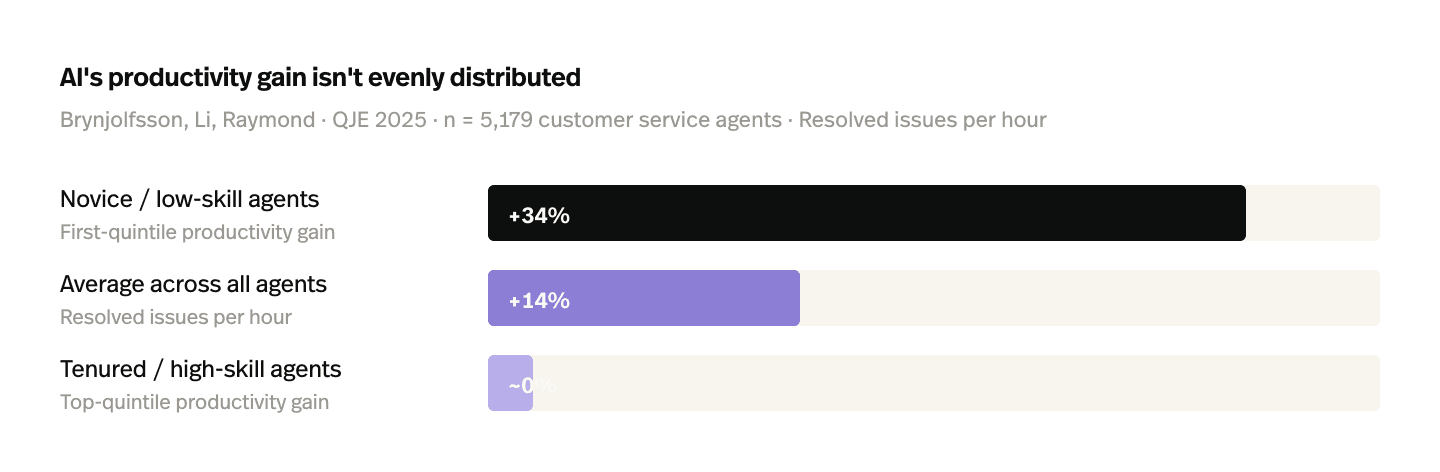
The most rigorous study to date on AI in customer support is Brynjolfsson, Li, and Raymond's analysis of a real-world rollout across 5,179 agents, published in The Quarterly Journal of Economics in 2025. Access to a generative-AI assistant raised resolved-issues-per-hour by 14% on average, but the headline finding is the distribution. Novice and low-skilled agents saw a 34% productivity gain. Tenured agents saw almost none. Customer sentiment improved. Employee retention improved (Brynjolfsson, Li, Raymond, Generative AI at Work).
The reframe: what AI actually removes
A modern AI agent in a B2B support stack handles a specific layer: the repetitive, proceduralized intent traffic that has a deterministic right answer and a clear resolution path. Password resets. Plan changes. Billing lookups. Refunds within policy. Seat additions. Status checks. The work that doesn't require judgment, doesn't require empathy, doesn't require account context.
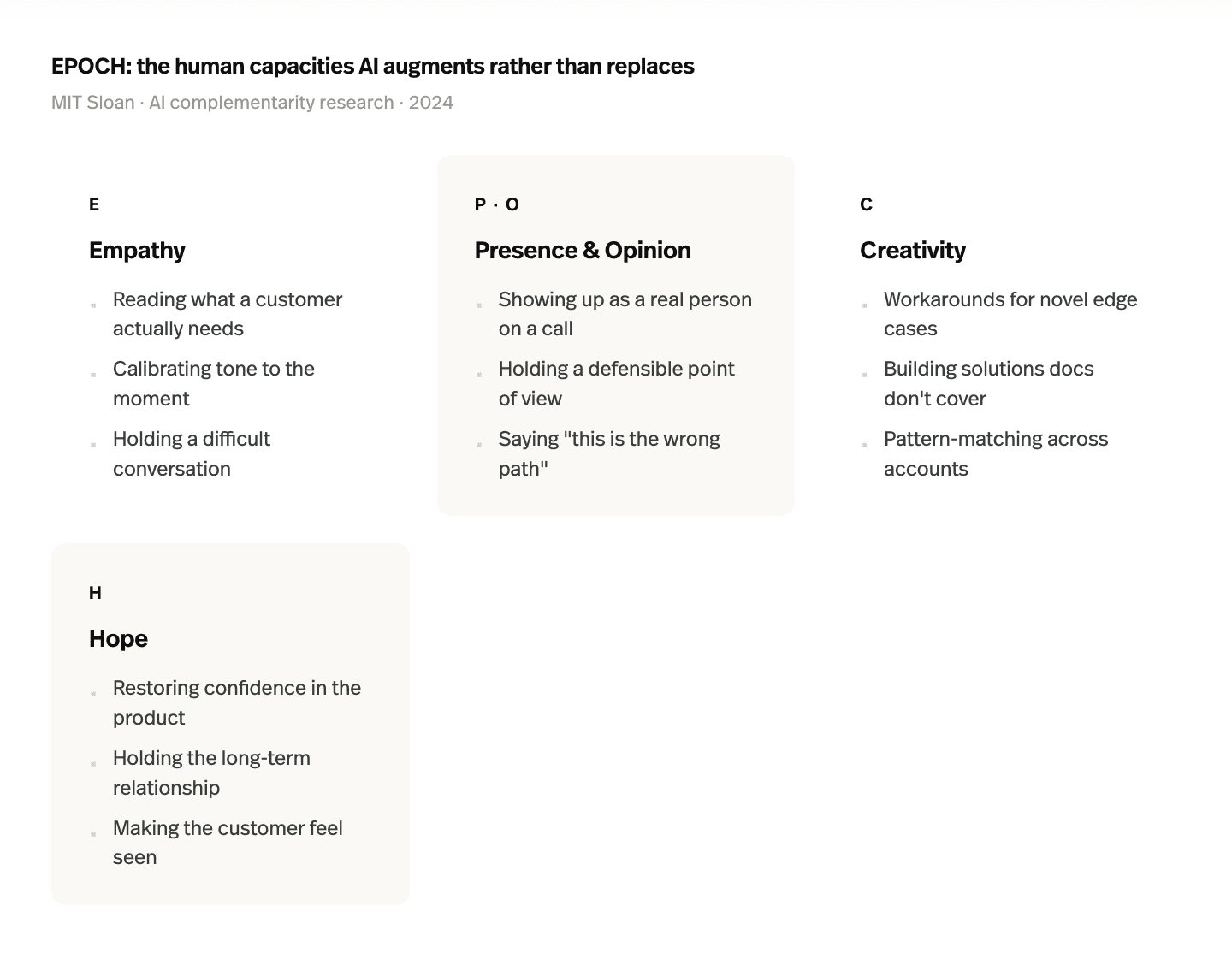
What it can't do, and what the academic consensus is increasingly explicit about, is the work that depends on human capabilities AI doesn't substitute for. MIT Sloan's research on AI complementarity formalizes this with the EPOCH framework: Empathy, Presence, Opinion, Creativity, Hope. These are the capacities AI augments rather than replaces, and they correspond directly to the customer interactions where the cost of getting it wrong is highest (MIT Sloan, AI is more likely to complement, not replace, human workers).
What humans should actually be doing
This is the question most B2B leaders haven't sat with long enough. If a meaningful slice of tier-1 volume comes off the queue, what does the freed-up team actually do? "More of what they're doing now, but better" is the lazy answer, and it's the one that produces no second-order ROI.
The right answer, in B2B specifically, is four kinds of work.
1. High-touch support on accounts that matter
Not "respond when a ticket comes in", that's reactive support, and AI handles the reactive layer better than humans do for the easy half of it. High-touch means proactively reaching into accounts the team has identified as strategic, anticipating the questions, and resolving issues before they become tickets. It's the work executive sponsors of major contracts assume is happening and almost never is.
2. Churn intervention
Every B2B product produces signals that predict churn, usage drops, login frequency declines, integration pulls, NPS dips, support escalations. Most CX teams see those signals and cannot act on them because they're underwater on tier-1 volume. A team operating with AI handling the repetitive layer can run a structured churn-intervention motion: a flagged-account list refreshed weekly, a defined outreach playbook, a measurable save rate. This is one of the highest-ROI activities in B2B, and almost no support team currently runs it.
3. Structured onboarding
The first 60 to 90 days of a new B2B customer disproportionately determines whether they renew. Software-only onboarding works for self-serve plans. For mid-market and up, human-led onboarding, guided setup, success milestones, named touchpoints, is the difference between a renewable account and a deferred churn risk. Most CX teams know this. Most can't staff it.
4. Expansion
Customers approaching template limits, hitting integration ceilings, exporting unusual amounts of data, or showing patterns that historically precede a seat-add, those are conversations sales should be having, but the trigger usually shows up in support before it shows up in sales. A CX team with capacity becomes the upstream signal for the expansion pipeline.
The underutilization problem
There's a quiet structural problem in most B2B support orgs: the most skilled reps are doing the least skilled work. They have product depth, customer relationships, instincts about what's about to break, and a working memory of every edge case the documentation never captured. And they're using all of that to answer "where do I find the export button?"
The skills the market is increasingly paying a premium for are the skills your senior support reps already have. They are currently being deployed against the wrong work.
The World Economic Forum's Future of Jobs Report 2025, drawing on responses from employers covering 14 million workers globally, flags empathy, active listening, and customer-service skills as rising-importance interpersonal capabilities through 2030 (World Economic Forum, Future of Jobs Report 2025). The mismatch is obvious.
Why CSAT and revenue move together
The conventional wisdom is that you trade one for the other, push too hard on cost-to-serve, customer experience drops; over-invest in CX, margins suffer. The data on AI deployment doesn't support that trade-off. It shows both moving in the same direction.
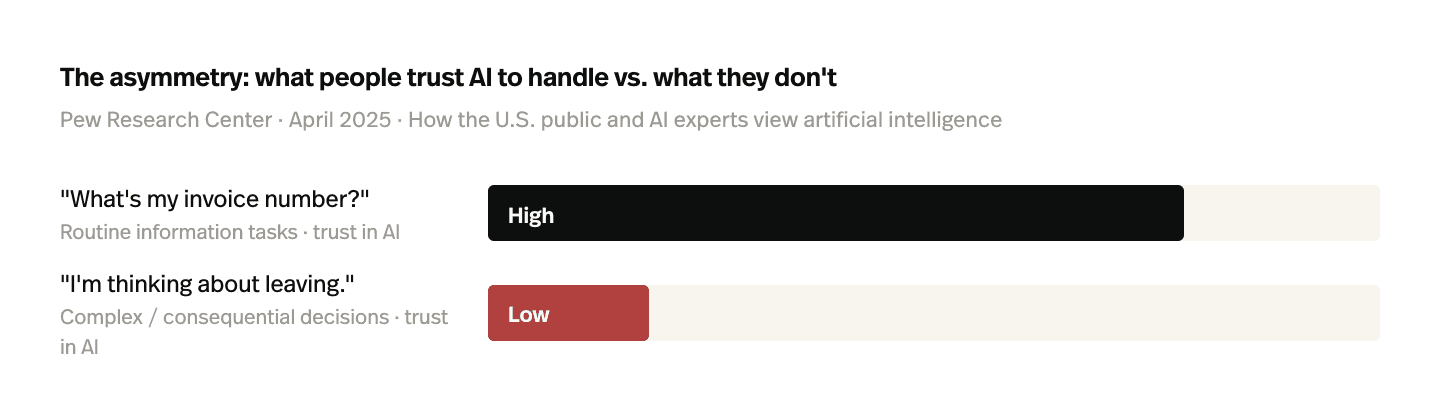
Customers do not actually want a human for everything. Pew Research's 2025 study on public views of AI capability shows large segments of the public seeing AI as competent for routine information tasks but consistently distrusting it for complex or consequential decisions (Pew Research Center, How the U.S. Public and AI Experts View Artificial Intelligence). The asymmetry is the opportunity.
The Brynjolfsson study captured the same dynamic from the team-experience side: AI assistance improved customer sentiment scores and increased employee retention, simultaneously. That's not a coincidence. Reps who spend their day on judgment work instead of macro work are happier, stay longer, and get better at the work that compounds.
The actual shift
The fear isn't entirely wrong. Something is being replaced. It's the part of the job nobody on the team wanted to be doing in the first place. What's left, and what will keep growing in value as the AI layer scales, is the work that requires a human being who knows the product, knows the customer, and has the bandwidth to act on both.
That's not a smaller support function. It's a more valuable one.
Sources
- Brynjolfsson, Li, Raymond · NBER Working Paper / Quarterly Journal of Economics, 2025
- MIT Sloan · New MIT Sloan research suggests that AI is more likely to complement, not replace, human workers
- World Economic Forum · Future of Jobs Report 2025
- Pew Research Center · How the U.S. Public and AI Experts View Artificial Intelligence · April 2025
About the author

Alex Turnbull
CEO & Founder, Helply
Alex is the CEO & Founder of Groove. He loves to help other entrepreneurs build startups by sharing his own experiences from the trenches.


