Automated service is transforming customer support by using technology to handle routine tasks, improve efficiency, and enhance customer satisfaction.
This article explores how automated services streamline workflows, reduce costs, and free up human agents to tackle complex issues.
Read on to discover the key benefits of adopting automated service in your business and practical strategies for implementation.
Key Takeaways
- Automated customer service enhances efficiency and satisfaction by streamlining workflows and reducing the workload on support staff.
- AI-powered tools, including chatbots and virtual assistants, facilitate real-time support and allow for the handling of complex queries, significantly improving productivity.
- Implementing automated systems leads to cost reductions, enhanced service consistency, and improved customer experience through faster responses and self-service options.
- Automation technology can help support teams by providing contextual article recommendations based on customer feedback, ensuring that customers receive relevant and helpful information.
TL;DR: Automated customer service
Automated customer service is transforming the landscape of customer support, offering numerous benefits such as cost reduction, improved efficiency, and enhanced customer satisfaction.
By integrating technologies like AI-powered chatbots, virtual assistants, automated email responses, and IVR systems, businesses can provide timely, consistent, and high-quality support to their customers.
The key to successful implementation lies in balancing automation with human support, regularly evaluating tools, and tracking performance metrics to optimize processes. Implementing automated systems also involves auditing the knowledge base and updating pre-written responses regularly to ensure accuracy and relevance.
Tools like Helply exemplify the potential of automation, offering advanced capabilities that ensure efficient and personalized support.
As businesses continue to adopt automated solutions, the future of customer service looks promising, with improved satisfaction and loyalty as the ultimate goals.
Understanding Automated Customer Service
Automated customer service refers to support enhanced by automation technology and AI, which significantly improves efficiency and customer satisfaction. These systems streamline workflows, reducing the workload on support staff and allowing them to focus on more complex issues that require human intervention.
Additionally, automated customer service software can further enhance these capabilities. However, if customers can’t reach a human agent when they need one, it risks delivering unhelpful, bad customer service, highlighting the importance of maintaining a balance between automation and human support.
At various stages of the customer journey, automated customer service provides effective support that can limit the need for human involvement.
This means customers receive timely assistance, enhancing their overall customer service experience and allowing businesses to maintain high service standards without overextending their resources through automated customer service tools.
Additionally, automated customer service solutions should be integrated across multiple channels, including websites and social media, to ensure a seamless customer experience.
Key Benefits of Automated Customer Service
Implementing automated customer service can lead to significant cost reductions. Reducing manual labor for simple inquiries helps businesses cut operating expenses.
Additionally, automating customer service allows organizations to handle multiple requests simultaneously without compromising service quality. Automated payment systems can also generate and send invoices and process recurring payments automatically, further streamlining operations.
Improving customer satisfaction is another significant advantage. Automated systems offer:
- Immediate responses to routine queries, drastically cutting down customer wait times
- Enhanced performance metrics, such as quicker response times and improved resolution rates
- Ultimately, faster issue resolutions and better increased customer satisfaction, which can help improve customer satisfaction.
Automation also ensures:
- Scalability and consistency.
- Around-the-clock service, allowing customers to access support anytime, regardless of their location.
- Standardized interactions that reduce human error.
- Consistent service quality that maintains customer trust and loyalty through self service automation.
AI-Powered Chatbots for Real-Time Assistance
AI-powered chatbots are designed to:
- Handle initial inquiries
- Direct customers
- Solve simple issues
- Provide real-time assistance
These chatbots can operate 24/7, offering instant responses to customers at any time of the day or night, which is a significant advantage in today’s always-on world.
One of the critical benefits of AI chatbots is their ability to free up human agents to focus on more complex issues, thereby enhancing the efficiency of customer support teams. By reducing response times in handling customer inquiries by up to three times compared to human agents, chatbots significantly boost support team productivity.
When looking for a chatbot platform, consider key features such as natural language processing. Additionally, evaluate personalization options and integration functionality.
For chatbots to be effective, they must be well-trained to understand and answer both basic and advanced questions, ensuring they can handle a wide range of customer inquiries.
AI-Driven Virtual Assistants
AI-driven virtual assistants provide reliable assistance around the clock, catering to customer needs at any time. These systems go beyond simple interactions by generating personalized recommendations and tailored responses based on individual customer data.
Moreover, AI-powered virtual assistants can handle complex queries seamlessly.
When a situation requires human intervention, these assistants can transition conversations to live agents without disrupting the customer experience.
This blend of automation and human support ensures that customers receive the help they need efficiently and effectively.
Streamlining Support with Automated Email Responses
Automated email responses are a valuable tool in customer support, quickly addressing common inquiries and keeping customers informed without overloading support staff. By providing immediate confirmation to customers, businesses can enhance the customer experience, especially during peak times.
These systems also allow for sending targeted messages based on specific customer actions, improving the relevance of responses. Automated email systems can facilitate self-service by sending relevant resources to customers right after contact, empowering them to resolve issues independently.
Additionally, automated notifications about account activities help loyal customers manage their services and assist customers in avoiding potential problems. Keeping customers updated on order status and new releases reduces the need for them to reach out for updates, thereby enhancing overall satisfaction.
Enhancing Service with Interactive Voice Response (IVR) Systems
Interactive Voice Response (IVR) systems provide self-service options and efficiently route calls. These systems enhance the customer experience by quickly directing calls to the appropriate departments based on user input, ensuring that customers reach the right person or resource promptly.
IVR systems also help in call handling by offering automated responses or routing calls to the appropriate agent. IVR systems enhance customer experience by greeting callers and swiftly directing them to the right department or agent.
Allowing customers to navigate phone menus and find answers quickly, IVR systems reduce the need for a live representative, thus streamlining support operations and improving efficiency.
Leveraging Knowledge Bases for Self-Service
A knowledge base is a centralized repository of information, including FAQs, troubleshooting guides, and how-to articles.
The role of a knowledge base in customer service is to serve as a self-service tool, enabling customers to search for knowledge base articles and troubleshooting tips independently.
Self-service solutions can also be customized to meet the needs of specific industries or businesses, ensuring they address unique customer requirements effectively.
Knowledge bases significantly enhance customer satisfaction by enabling customers to find solutions independently. This reduces the need for human support, increasing overall efficiency and allowing customer service teams to focus on more complex issues.
A well-maintained knowledge base improves overall efficiency by deflecting tickets and allowing customers to resolve their issues independently.
This leads to higher ticket deflection rates, reducing the burden on customer service teams and enhancing the overall customer experience.
Automating Ticket Routing and Prioritization
Automated ticketing systems categorize and prioritize incoming tickets to streamline customer support operations. These systems ensure that tickets are automatically routed to the correct agents, improving resolution times and workflow efficiency.
An automated ticketing system can greatly enhance these processes, particularly through automated ticket routing.
AI ticket prioritization uses:
- Customer profiles
- Sentiment analysis to flag negative customer emotions, prompting immediate attention from specialized agents
- Issue complexity to assign urgency and direct tickets accordingly
These systems use sentiment analysis to ensure timely and appropriate responses.
Workflow Automation for Efficient Support Operations
Workflow automation uses technology to streamline repetitive customer service tasks, improving response times and overall service efficiency. Implementing customer support automation can lead to reduced operational costs while enhancing overall satisfaction.
Companies must also have robust measures to protect sensitive customer information when implementing automated systems, ensuring data security and customer trust.
These systems are scalable and can adapt to changing needs without requiring additional physical infrastructure. Advanced automation solutions help support teams manage high volumes of tickets while maintaining quality service.
Automating mundane tasks allows support agents and customer service agents to focus on complex problem-solving, high-touch customer support, and innovative projects, enhancing overall service quality while addressing customer support automation challenges.
Implementing Proactive Support Through Automation
Proactive support enhances customer loyalty by addressing issues before they arise, leading to fewer support tickets. AI can improve customer support by monitoring user behavior and predicting customer needs, allowing businesses to anticipate and address concerns before they escalate.
AI detects customer frustration through sentiment analysis, allowing for timely intervention and better handling strategies. Automation can also drive revenue by offering personalized solutions and addressing customer needs proactively, enhancing overall satisfaction.
Identifying tasks suitable for automation involves analyzing interactions and feedback to prioritize efficiency, ensuring that automated responses are relevant and timely.
Best Practices for Successful Customer Service Automation
Balancing automation with human support is crucial to avoid losing the personal touch in customer service interactions and human interaction. Regular evaluations of automation tools ensure proper functionality and identify opportunities for enhancement.
However, the biggest potential disadvantage of automated customer service is the lack of human interaction and touch, which can negatively impact customer satisfaction if not managed carefully.
Automated responses should be concise and relevant, ensuring clarity and simplicity to enhance the customer experience. Tracking key metrics like resolution time and customer feedback is essential for evaluating and optimizing automation effectiveness.
Automated systems follow predefined rules, reducing the risk of human error in tasks like accounting and order fulfillment, which further enhances operational reliability.
How to Measure the Success of Your Automated Service
Automation tools allow for better tracking of key performance indicators, enabling data-driven optimizations in support workflows. First response time is crucial as it reflects how promptly a company addresses customer inquiries.
Key metrics such as overall resolution rate, first contact resolution rate, and average ticket handling time measure the efficiency of agents in managing common customer inquiries. Regular user feedback collection through surveys can track key metrics, guide improvements in customer service, and address recurring issues.
Customer satisfaction metrics like CSAT, CES, and NPS provide insights into how happy customers are with services and products, helping businesses improve their support operations and ensure higher customer loyalty.
Automate Customer Service with Helply Today
Helply is an AI-powered customer experience (CX) agent that automates tier-1 customer support with guaranteed accuracy.
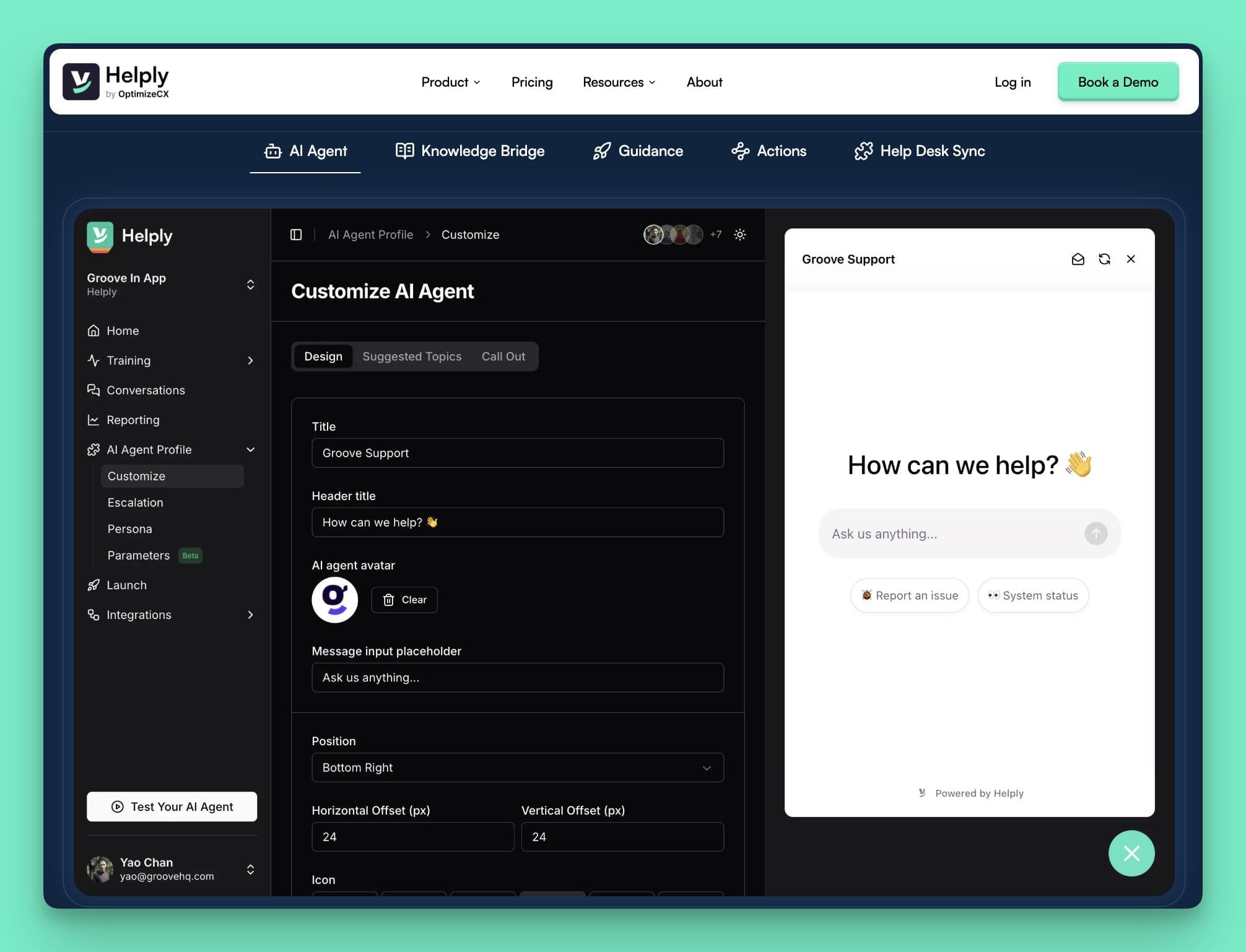
This tool offers a range of features designed to enhance customer service operations, including automated responses and 24/7 availability.
By automating routine tasks and providing personalized support, Helply ensures that customer service teams can focus on more complex issues, improving overall efficiency and customer satisfaction.
AI CX Agent
The AI CX agent resolves over 50% of common support tickets automatically, operating 24/7 to answer customer questions without human intervention.
This significantly reduces the workload on support agents and ensures timely responses to customer inquiries.
As the AI CX agent handles repetitive support tasks, it gets smarter with every ticket interaction, continuously updating itself and improving over time. This self-improving capability ensures that the system remains effective and efficient.
Knowledge Bridge Technology
Helply’s Knowledge Bridge technology transforms knowledge bases into living systems by:
- Analyzing historical support data to identify gaps between customer questions and documented answers
- Suggesting updates and new articles to address unmet customer needs
- Ensuring that the knowledge base remains relevant and accurate through AI-powered recommendations
The Knowledge Bridge technology automatically optimizes existing content for accuracy and relevance, creating a self-improving, self-correcting support system that enhances service quality.
Advanced Capabilities
Helply offers advanced capabilities such as:
- Personalization through Guidance features that allow on-brand responses without coding.
- Actions functionality that syncs with existing tools, pulls account data, sends updates, and triggers workflows.
- Seamless integration with popular help desk platforms like Zendesk, Groove, Freshdesk, Help Scout, and Stripe.
Additionally, Helply provides multi-language support, responding in over 40 languages without any setup, making it a versatile tool for global customer service operations.
Performance Metrics
Helply’s performance metrics and benefits include:
- An average ticket resolution rate of 66.3% without human intervention.
- A threefold improvement in response times compared to traditional support teams.
- A 32.5% reduction in support costs for organizations using Helply, making it a cost-effective solution for managing customer service operations.
These metrics demonstrate the system’s consistent delivery of high-quality service. Improved ticket resolution rates and faster response times enhance customer satisfaction and allow support teams to manage a larger volume of inquiries without compromising service quality.
This consistent performance is crucial for resolving issues and maintaining customer trust and loyalty.
Helply's Key Benefits
One of the key benefits of using Helply is its ability to scale support operations without the need to scale headcount.
This means that as your business grows, your customer service can keep pace without requiring proportional increases in staff. Helply also significantly reduces ticket volume, allowing support teams to focus on more complex and high-value customer interactions.
Helply provides full visibility into AI agent decisions and actions, offering real-time analytics to measure resolution rates, response quality, and identify knowledge gaps.
These valuable insights are invaluable for continuously improving customer service processes and ensuring that the support provided aligns with customer expectations and needs.
Frequently Asked Questions
What is automated customer service?
Automated customer service leverages automation technology and AI to enhance support efficiency and customer satisfaction, minimizing the reliance on human involvement. This approach streamlines workflows and optimizes the overall service experience.
How do AI-powered chatbots improve customer support?
AI-powered chatbots enhance customer support by delivering instant responses around the clock, allowing human agents to concentrate on more complex issues. This results in increased efficiency and improved overall service.
What are the benefits of using IVR systems in customer service?
IVR systems enhance customer service by offering self-service options and efficiently routing calls, ensuring that customers are quickly directed to the appropriate departments or agents. This leads to improved customer satisfaction and reduced wait times.
How can businesses measure the success of their automated customer service?
To effectively measure the success of automated customer service, businesses should focus on key performance indicators such as first response time, resolution rate, and customer satisfaction metrics like CSAT, CES, and NPS. Regularly collecting feedback through surveys will also provide valuable insights into customer experiences.
What makes Helply an effective solution for customer service automation?
Helply is an effective solution for customer service automation due to its AI-driven features that automate tier-1 support, ensure accurate ticket resolution, and provide 24/7 availability. Additionally, its Knowledge Bridge technology enhances support systems, offering multi-language support and seamless integration with help desk platforms.
About the author

Bildad Oyugi
Head of Content
Bildad is a digital marketing expert with over 5 years of experience in copywriting, content marketing, and editing. Outside of work, he enjoys videography and spending time with his family.


