Key Takeaways
- Every customer apology letter should follow the 5 R's: Recognition, Responsibility, Remorse, Restitution, and Repetition Prevention. Skip any one, and the apology feels hollow.
- Use a severity matrix (low, medium, high, critical) to decide the right tone, signatory, compensation, and response time for each apology.
- Send the first reply within 1 hour for a critical incident and within 24 hours for a minor slip.
- A careless apology can cost you the next order or the renewal, and earn you a bad public review.
- Helply's AI agents can flag a frustrated customer early and draft the apology for your team to review. With unlimited users on every plan, the VP or CEO who signs gets a login of their own.
A customer emailed a minute ago, and they're furious. A bug wiped four hours of their team's work, six weeks before their renewal. You open a blank reply and don't know where to start.
With this one reply, you can keep that customer or push them toward a competitor.
Skip the copy-paste apology. Your customer may have a contract, a repeat order or a team that relies on your product. Anyone they forward your reply to will judge you by it.
Treat that furious email as a chance to keep the customer. In a 2015 deck, thinkJar's Esteban Kolsky reported that 1 in 26 unhappy customers complains, and most of the rest leave.
Use the 5 R's to structure your customer apology letter and the severity matrix to calibrate it. Then adapt one of the 15 templates, from a cosmetic bug to a security breach, and study how GitLab and Southwest apologized.
Helply's Churn Agent watches conversations for frustration and churn risk, so your team can act while that renewal is six weeks out.
How to Write a Customer Apology Letter (The 5 R's Framework)
To write a customer apology letter, follow the 5 R's. Recognize the issue and its impact, and take Responsibility without deflecting. Express Remorse, offer Restitution and explain how you'll prevent Repetition.
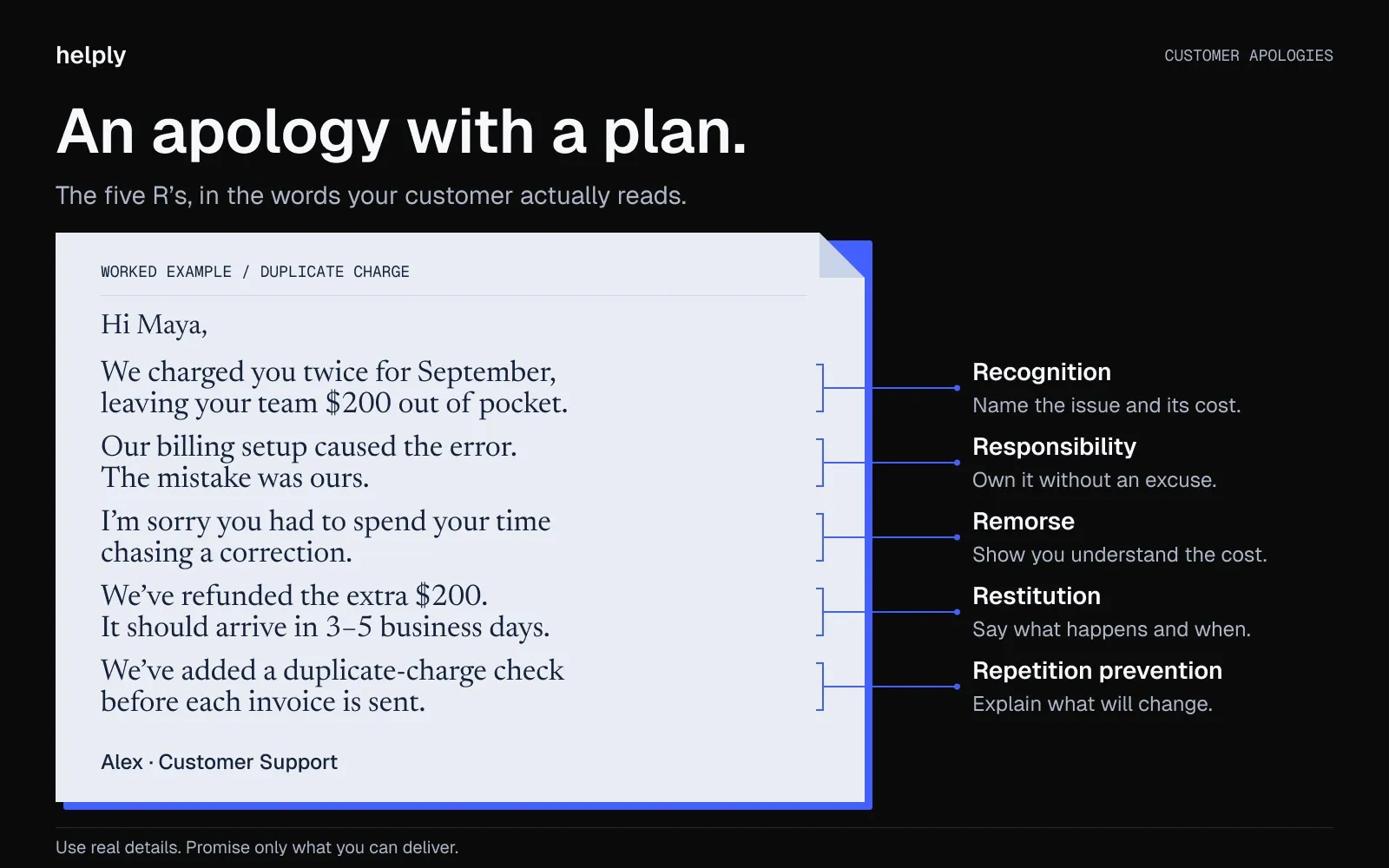
Take Responsibility without deflecting. Express genuine Remorse. Offer Restitution with a concrete fix or compensation.
Tailor the tone and the escalation path to the severity of the issue and what the customer stands to lose.
In a 2016 Ohio State study of 755 people, acknowledging responsibility mattered most in an apology. An offer of repair came second, and a request for forgiveness mattered least. Those top two match Responsibility and Restitution in the 5 R's.
Recognition: Name the Specific Issue and Its Impact
Vague apologies are worse than no apology at all. "Sorry for the inconvenience" tells the customer you didn't bother to understand what happened.
Name the exact issue. Name the exact impact. Be specific enough that the customer knows you read their ticket.
Bad: "We apologize for the recent issue with your account."
Good: "We recognize that the API outage on Tuesday between 2 PM and 6 PM ET prevented your team from processing customer orders for four hours."
The specific version shows the customer you understand what they lost. The vague version sounds like a template. Because it is one.
Responsibility: Own It Without Deflecting
Take ownership. Skip the "but," and blame neither the customer nor a vendor. Avoid passive phrasing such as "mistakes were made."
Your customer wants someone at your company to stand behind the fix, whoever caused the problem.
The person who signs the apology matters as much as what it says. A support lead can sign for a billing error, a VP for a multi-hour outage and the CEO for a data breach. Check the severity matrix for the right signer at each incident level.
Remorse: Show You Understand What It Cost Them
Show remorse by describing the business impact in the customer's terms.
Compare "we're sorry for any inconvenience" with "this disrupted your team's workflow in your busiest quarter." The second shows you know the cost.
Use the customer's own words, and refer to their goals.
You hold the context: their plan, order history, renewal date and past tickets. Use it to make the apology personal.
Restitution: Offer a Concrete Fix
Match the compensation to the severity with this rule:
- Low severity (minor bug, slow reply): The fix itself is enough. No monetary compensation needed.
- Medium severity (service disruption, billing error): Add a credit, extended trial, or priority support window.
- High severity (extended outage, data loss): Refund, a dedicated escalation contact, and an executive check-in call.
- Critical severity (security breach, regulatory violation): All of the above, plus public disclosure if warranted.
Never promise what you can't deliver. "This will never happen again" is a promise most companies can't keep. "We've added monitoring that will alert our team within 60 seconds if this recurs" is specific and credible.
Repetition Prevention: Tell Them What Changes
To rebuild trust, tell the customer what you changed to prevent a repeat, and be specific.
Bad: "We're taking steps to prevent this."
Good: "We've added automated monitoring on this API endpoint. If response times exceed 500ms, our engineering team gets an alert within 60 seconds. We've also added a redundant failover that wasn't in place before."
For high-severity incidents, consider sharing a mini post-mortem. Link to a status page. Give them something concrete to point to when their boss asks, "Is this vendor reliable?"
The Severity Matrix: Match Your Apology to the Impact
Before you write a single word, classify the incident. A common mistake in customer apology letters is treating every issue the same way.
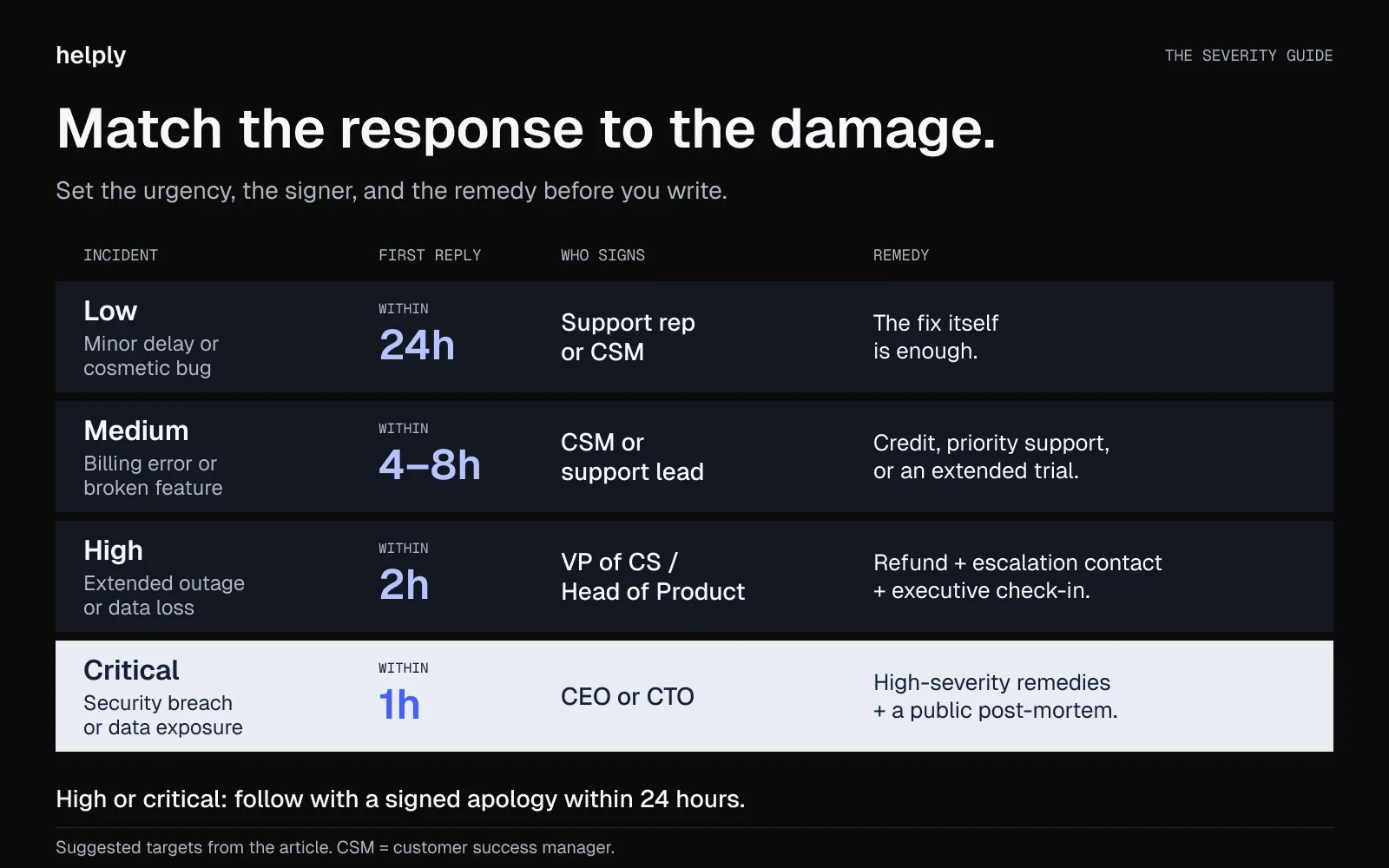
Sort each incident into one of four levels: low, medium, high or critical. Each level comes with its own tone, signer, remedy, reply time and follow-up. A cosmetic bug needs a rep's reply within 24 hours, and a security breach needs a first reply within 1 hour.
| Low | Medium | High | Critical | |
|---|---|---|---|---|
| Example incidents | Minor delay, cosmetic bug, slow response | Service disruption, billing error, feature malfunction | Extended outage, data loss, repeated issue | Security breach, data exposure, complete service failure |
| Tone | Friendly, brief | Professional, empathetic | Formal, detailed, executive-level | Urgent, transparent, C-suite gravity |
| Who signs | Support rep or CSM | CSM or support lead | VP of CS or Head of Product | CEO or CTO |
| Compensation | The fix is enough | Credit, priority support, or extended trial | Refund + dedicated escalation + executive check-in | All of the above + public post-mortem |
| Response time | Within 24 hours | Within 4 to 8 hours | Within 2 hours | Within 1 hour |
| Follow-up | Optional check-in | Required within 48 hours | Multiple follow-ups + post-mortem | Ongoing updates until fully resolved |
Once a customer reports an issue, classify it first, then pick the right template below.
Helply's AI can triage each conversation before anyone on your team opens it. It can categorize the request, fill a custom severity field, set the priority and route it by your rules.
A cosmetic bug can go to a rep, a double charge to the support lead and a breach to leadership. Your team stops sorting the queue by hand.
15 Customer and Business Apology Letter Templates by Severity
Every template below includes a subject line, the full email, and a "when to use" note tied to the severity matrix above. Customize the bracketed fields for your situation.
For shorter versions to send by email, use these 12 business apology email examples.
Low Severity Templates
Template 1: Minor Bug or Cosmetic Issue
When to use: A visual glitch, UI inconsistency, or minor defect that doesn't block workflows.
Subject: Quick fix on [issue]. Sorted.
Hi [First Name],
We spotted the [describe bug] you reported. We fixed it on [time/date].
The cause was [one-sentence explanation]. It didn't affect your data or workflows, but we understand it's not the experience you expect from us.
Thanks for flagging it. Reports like yours help us catch things faster.
[Your Name], [Role]
Template 2: Slow Response Time
When to use: Missed SLA, ticket sat too long, or the customer had to follow up.
Subject: We were too slow. Here's what we're doing about it.
Hi [First Name],
You reached out on [date] and didn't hear back from us until [date]. That's not acceptable, and I'm sorry.
[Brief explanation, e.g., "We had a spike in ticket volume that overwhelmed our queue."] We should have planned for it.
We've [specific action, e.g., "added a staffing buffer for peak periods" or "set up automated alerts for tickets approaching SLA"]. Your next interaction will be faster.
[Your Name], [Role]
Template 3: Incorrect Information Provided
When to use: An agent gave wrong guidance or documentation was outdated.
Subject: Correction on [topic]. The right answer is here.
Hi [First Name],
In our conversation on [date], we told you [incorrect information]. That was wrong. The correct answer is [correct information].
I've updated our internal documentation so this doesn't happen to anyone else. If the incorrect guidance caused you to take any actions you'd like to reverse, let me know, and I'll help.
Sorry for the confusion.
[Your Name], [Role]
Medium Severity Templates
Template 4: Poor Customer Service Experience
When to use: The customer felt dismissed, went through too many transfers or had a negative interaction.
Subject: Your experience wasn't acceptable. Here's how we're fixing it.
Hi [First Name],
I reviewed your recent interaction with our support team, and I owe you an apology. You reached out for help with [issue] and got [what went wrong: three transfers, conflicting answers or a dismissive tone].
You deserved better from us.
I've taken this up with the team directly. We're [specific action: retraining, process change, assigning a dedicated point of contact]. As a make-good, I'd like to offer [credit, priority support window, etc.].
If you'd prefer a different primary contact going forward, I'm happy to arrange that.
[Your Name], [Role]
Template 5: Billing or Pricing Error
When to use: Overcharge, double charge, incorrect invoice, or pricing discrepancy.
Subject: Billing error on your account. Corrected.
Hi [First Name],
We made a billing error on your [month] invoice. We charged you [incorrect amount] instead of [correct amount]. We've credited the difference of [amount] to your account, and it will appear within [timeframe].
This happened because [brief explanation]. We've [specific fix] to prevent it from recurring.
I know billing accuracy is non-negotiable. If you'd like a full breakdown of the correction or have questions about your account, I'm here.
[Your Name], [Role]
Template 6: Feature Malfunction
When to use: A feature broke, didn't behave as documented, or produced incorrect results.
Subject: [Feature name] didn't work right. Here's the fix and timeline.
Hi [First Name],
I'm writing about the issue you reported with [feature name] on [date]. You expected [expected behavior], but instead saw [actual behavior]. That's a bug on our end.
Our engineering team identified the root cause: [one-sentence technical explanation, no jargon]. We deployed a fix on [date/time], and the feature now works as expected.
We've added automated tests for this scenario, so we catch it before it reaches production again. If you notice anything off, reply to this email, and it comes straight to me.
[Your Name], [Role]
Template 7: Missed Deadline or Late Delivery
When to use: An order arrived late, an implementation timeline slipped or a promised deliverable was overdue.
Subject: We missed our deadline. New timeline and next steps.
Hi [First Name],
We committed to delivering [deliverable] by [original date]. We missed that deadline, and I'm sorry.
The delay came from [brief, honest explanation]. I should have flagged the risk earlier instead of letting you find out at the deadline. That's a communication failure on my part.
Here's the updated timeline: [new date]. I've blocked time on [date] for a check-in so you have visibility into progress. If this revised timeline creates problems on your end, let me know, and we'll find a workable path forward.
[Your Name], [Role]
For medium-severity slips like these, Helply's Assist Agent can search the customer's past tickets and draft the apology. If you connect Stripe, it can check the invoice and take the supported billing Actions you've enabled. Your CSM or support lead checks the facts and the remedy, then sends it.
High Severity Templates
Template 8: Extended Service Outage
When to use: Multi-hour outage or degraded service affecting customer operations.
Subject: Service outage on [date]. Full incident report and next steps.
Dear [First Name],
On [date], our platform experienced an outage lasting [duration], from [start time] to [end time] [timezone]. During this window, [specific impact: "your team was unable to access the dashboard, process tickets, or pull reports"].
I want to be direct about what happened. [Root cause, no jargon, e.g., "A database migration failed during a scheduled maintenance window, and our failover system didn't activate as designed."] This is on us.
Here's what we've done since:
- Deployed a fix at [time] that restored full service
- Added redundant failover monitoring that would have caught this in under 60 seconds
- Scheduled a review of all maintenance procedures to prevent a repeat
To account for the disruption, we're applying a [credit/refund] to your next invoice. I'd also like a 15-minute call this week to walk your team through our incident timeline and answer questions.
We'll share a detailed post-mortem by [date].
[Your Name], [Title] [Company Name]
Template 9: Data Loss or Corruption
When to use: You lost or corrupted customer data, or customers couldn't reach it for a time.
Subject: Data incident affecting your account. Full details and our response.
Dear [First Name],
I'm writing to inform you of a data incident that affected your account on [date].
What happened: [Specific description, e.g., "After a storage failure, we lost your team's project changes from 5:00 PM to 11:00 PM UTC."]
What it affected: [Scope, e.g., "Approximately 12 hours of ticket updates, comments, and new entries."]
What we've recovered: [Details of recovery efforts and current status.]
What we're doing to prevent this: [Specific technical measures, e.g., "We've implemented continuous replication with point-in-time recovery, reducing our recovery window from hours to minutes."]
I take full responsibility for this. You trusted us with your data, and we failed to protect it.
We're issuing a [refund/credit] for [amount/period]. I'd also like a call with you and our CTO to walk through the technical details and our prevention plan.
[Your Name], [Title] [Company Name]
Template 10: Recurring Issue
When to use: The customer has reported the same or similar problem more than once.
Subject: We know this keeps happening. Here's the structural fix.
Dear [First Name],
I'm not going to pretend this is the first time. You've reported [issue] on [previous dates], and each time we told you we'd fixed it. Our fixes didn't hold, and I'm sorry.
Each time, we patched the symptoms and left the root cause in place. This time, our engineering team has [describe the structural fix]. These are the changes:
- [Specific change 1]
- [Specific change 2]
- [Monitoring or alerting added]
I've assigned [Name], our [Title], as your dedicated escalation contact for this issue. If it recurs, email them directly and it bypasses the queue.
We're also crediting your account [amount] for the repeated disruption.
[Your Name], [Title]
Template 11: Negative Employee Interaction
When to use: A team member was rude, dismissive or unprofessional with a customer.
Subject: Your recent experience with our team was unacceptable.
Dear [First Name],
I reviewed the [call transcript/ticket thread/chat log] from your interaction on [date], and I want to apologize. The way our team treated you does not reflect our standards
I've addressed this directly with the team member involved and our broader team. We're implementing [specific action: additional training, revised escalation protocols, etc.] to make sure it doesn't happen again.
If you'd prefer to work with a different point of contact going forward, I'll set that up today. And to acknowledge the poor experience, we'd like to [offer compensation].
[Your Name], [Title]
Critical Severity Templates
Template 12: Security Incident
When to use: Unauthorized access, data breach, or vulnerability exploitation.
Subject: Security incident affecting your account. Immediate action required.
Dear [First Name],
I'm writing to notify you of a security incident that we identified on [date].
What happened: [Clear, factual description. E.g., "An unauthorized party gained access to our authentication system through a compromised third-party integration between [times]."]
What data the attacker may have seen: [Specific scope. E.g., "Email addresses and hashed passwords for accounts created before March 2026. The attacker didn't reach payment data, API keys or customer records."]
What you should do: [Clear action items. E.g., "Reset your password at [link]. Enable two-factor authentication if you haven't already. Review your account activity log for any unfamiliar actions."]
What we've done: [Specific technical remediation. E.g., "Revoked the compromised integration, rotated all authentication tokens, engaged a third-party security firm for a full audit, and notified the relevant regulatory authorities."]
I take personal responsibility for the security of your data. We will publish a full incident report by [date] and are available for a call with your security team at your earliest convenience.
[CEO/CTO Name], [Title] [Company Name]
Template 13: Service Failure During a Critical Customer Moment
When to use: Total service failure during the customer's peak season, product launch, or critical business event.
Subject: Service failure during [critical period]. Our accountability and next steps.
Dear [First Name],
On [date], our platform went down for [duration]. I know this happened during [their critical moment: product launch week, annual enrollment, board reporting period]. The timing made a serious failure worse for your team.
[Honest explanation of what happened and what made it critical.]
Here's what we owe you:
- A full refund for [period]
- A dedicated escalation line to [Name, Title] for the next [timeframe]
- A detailed post-mortem delivered to your team by [date]
- [Any additional remediation specific to their situation]
I'd like a call with you and [relevant stakeholders] this week to hear how this affected your team.
[CEO Name], [Title]
Template 14: Mass Apology (CEO-Level)
When to use: Widespread incident affecting most or all customers.
Subject: From [CEO Name]: What happened and what we're doing about it.
Dear [Customer Name / "Team"],
On [date], [what happened in one sentence]. It affected [scope: all customers / customers on a specific plan / customers in the US region].
I want to be direct: this was our failure. [One to two sentences on root cause without making excuses.]
Here's what we've done since:
- [Action 1]
- [Action 2]
- [Action 3]
And here's what we're changing so it doesn't happen again:
- [Structural change 1]
- [Structural change 2]
We're crediting [compensation details] to every affected account. A full post-mortem is available at [link].
If you have questions, reply to this email. It comes to me directly.
[CEO Name] [Company Name]
Template 15: Follow-Up Email (Any Severity)
When to use: 48 to 72 hours after any medium, high, or critical apology. Essential for closing the loop.
Subject: Checking in. Is everything resolved on your end?
Hi [First Name],
I wanted to follow up on the [issue] from [date].
On our end, [confirm what you fixed or resolved]. I want to make sure that's matching your experience too.
A few things I'd like to confirm:
- Is the issue fully resolved from your team's perspective?
- Did the [credit/refund/compensation] come through correctly?
- Is there anything else we can do?
If everything looks good, no need to reply. But if anything is still off, hit reply and I'll handle it personally.
[Your Name], [Role]
How to Write an Apology Letter to a Client
To apologize to a client in writing, name the mistake, own it, and give the corrected date for the work. The client has a contract, a renewal date, and an account owner on your side. Several people there may read your apology, and it may come up at the next business review.
Have the account owner, such as the CSM or account manager, sign and send it. A generic support@ address reads as a brush-off. Refer to the client's project, deadline, and business impact in their own words.
Size the remedy to the contract and the severity. For a medium- or high-severity slip, offer an account credit, an SLA upgrade, a dedicated escalation line, or an executive check-in.
Adapt this sample after a mistake on a deliverable, or use Template 7 for a missed deadline:
Subject: Correction to [deliverable], with a new delivery date
Hi [First Name],
We sent [deliverable] on [date] with [the mistake]. That error is ours, and I'm sorry it cost your team [impact].
The cause was [one-sentence reason]. [Name], our [role], will check the corrected version before you get it on [date].
We're crediting [amount] to your account for the lost time. I'll call you on [date] to confirm the fix works for you.
[Your Name], [Account Manager], [Company Name]
How Should a Company Apologize for a Major Outage?
Acknowledge a major outage within 1 hour, and post updates every 30 to 60 minutes until service returns. Send a signed apology within 24 hours and a post-mortem within 5 business days. GitLab's public updates during its 2017 data loss are a useful model.
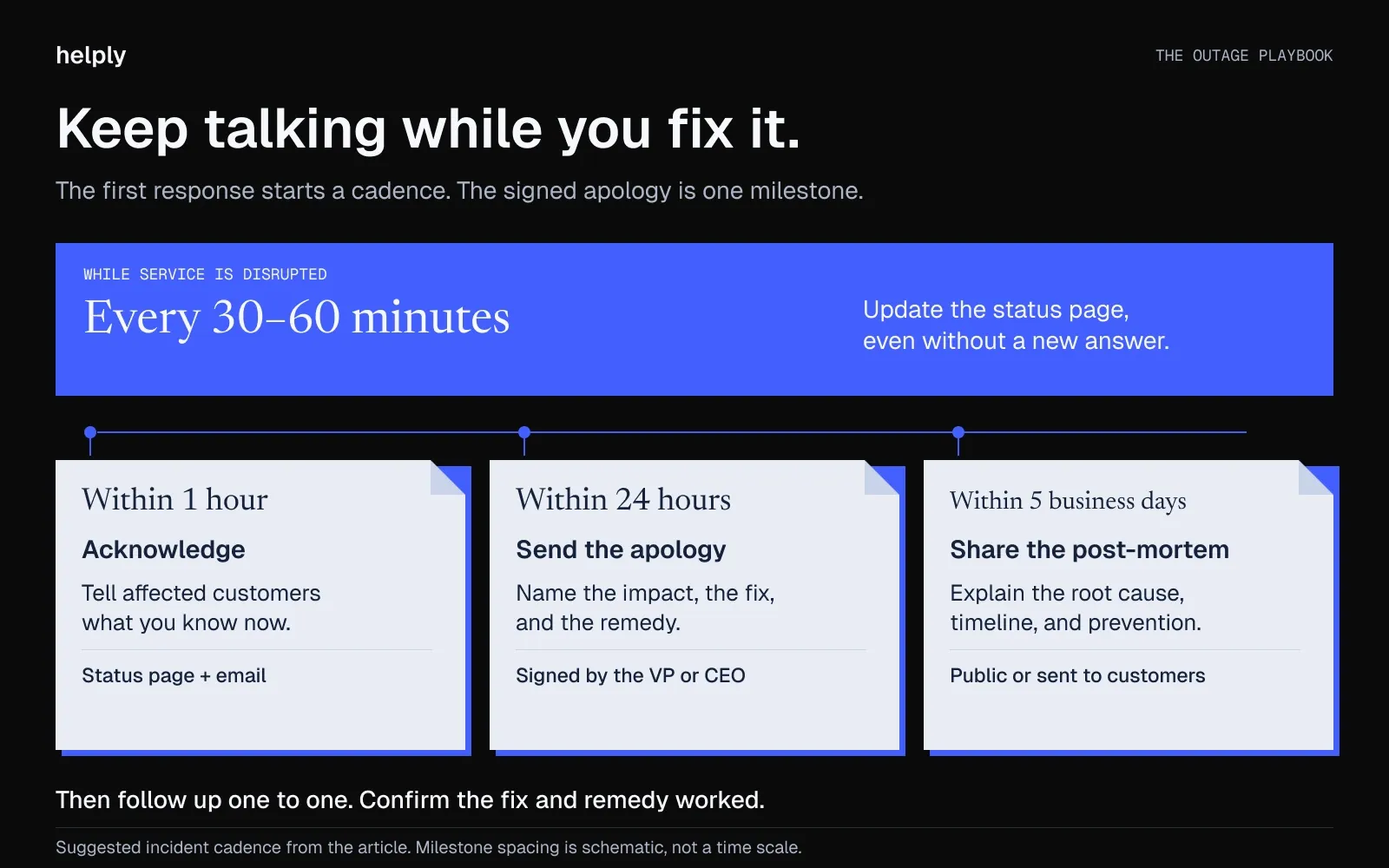
GitLab streamed its recovery on YouTube, then published a full post-mortem.
Use this playbook for your next outage:
- Acknowledge within 1 hour. Post to your status page, and email affected customers before you have a full diagnosis.
- Provide updates every 30 to 60 minutes. Post one if your only news is "still working on it."
- Send the formal apology within 24 hours. Use Template 8 or 14 above, and have the VP or CEO sign it, depending on severity.
- Publish a post-mortem within 5 business days. Cover the technical root cause, the timeline and what changed. Make it public, or send it to affected customers.
- Follow up one to one. Use Template 15, so every affected customer hears from a person on top of the mass email.
Subject Lines That Get Apology Emails Opened
Your customer reads the subject line, then decides whether to open your apology or archive it. Be direct, and name the issue.
Low severity:
- Quick fix on [issue]. Sorted.
- Correction on [topic]. The right answer is here.
Medium severity:
- Billing error on your account. Corrected.
- Your experience wasn't acceptable. Here's how we're fixing it.
- [Feature name] didn't work right. Here's the fix and timeline.
High severity:
- Service outage on [date]. Full incident report and next steps.
- We know this keeps happening. Here's the structural fix.
- Data incident affecting your account. Full details and our response.
Critical severity:
- Security incident affecting your account. Immediate action required.
- From [CEO Name]: What happened and what we're doing about it.
Name what went wrong, and signal that you're acting on it. Skip clickbait and vague lines like "A quick update from [Company]" after a six-hour outage.
How to Automate Your Apology Workflow
Build a five-step system, so your team stops scrambling each time something breaks:
Step 1: Detect. Your help desk watches for apology-worthy signals: missed SLAs, negative sentiment, sudden spikes in complaints and repeated contacts from the same customer. The trigger fires on its own, so your team doesn't have to spot the problem first.
Step 2: Draft. AI writes the first version from the customer's context: plan, order or contract value, past tickets and severity. The draft follows the 5 R's and maps to the right template.
Step 3: Route. The draft goes to the right person for its severity. Low goes to the rep, medium to the CSM or support lead, and high or critical to leadership.
Step 4: Review and send. A person reads the draft, adds the empathy and sends it.
Step 5: Log the signal. Add the incident to the customer's profile, with any earlier churn flags and the renewal date. The account owner then knows to watch the relationship.
Helply is an AI-native customer support platform. In one help desk, it can run all five steps, and AI triage can prioritize and route each ticket before anyone opens it. Once a customer shows frustration or churn risk, the Churn Agent can alert the right teammate and update the customer's record.
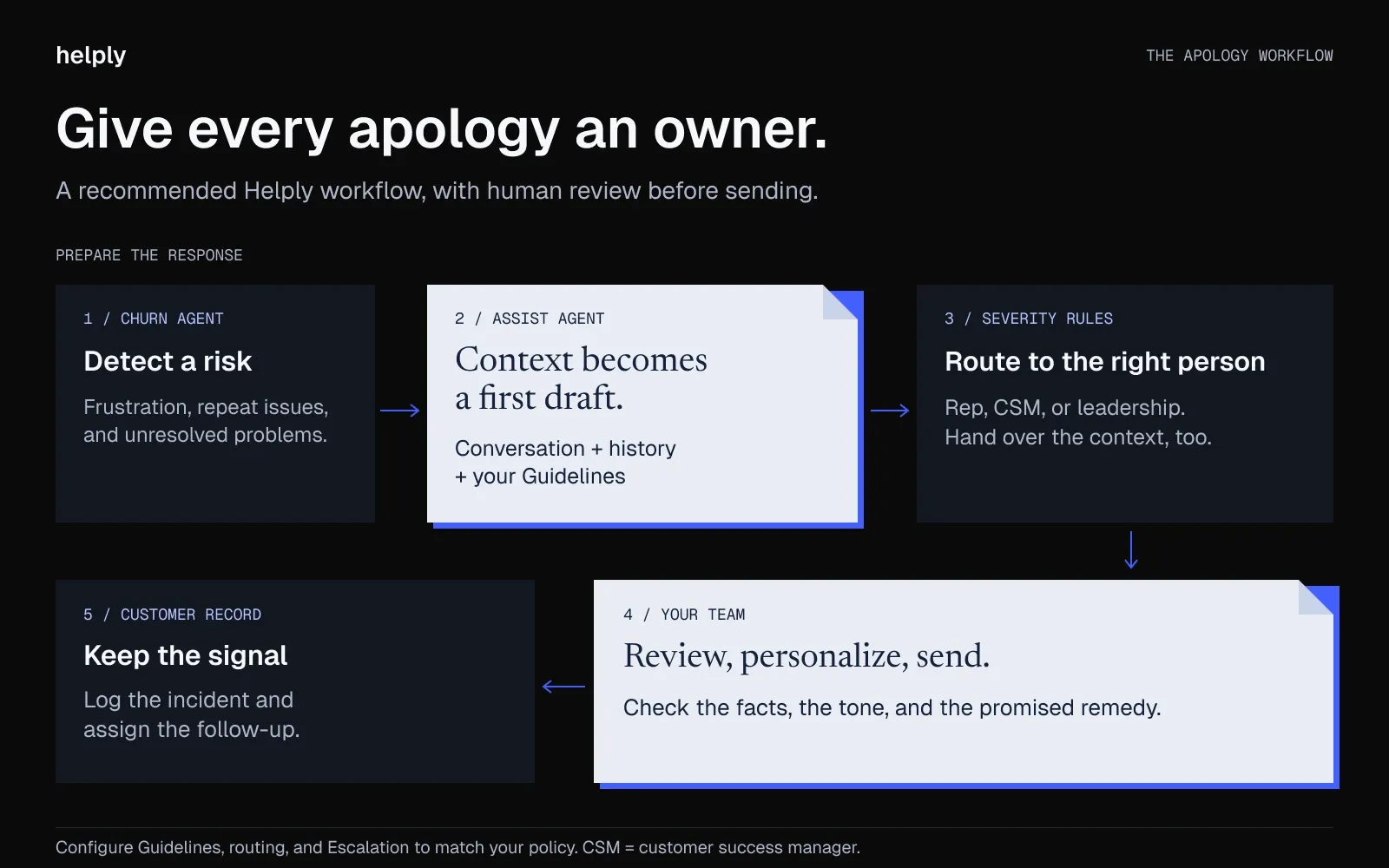
The Assist Agent can draft the apology from the conversation, the customer's past tickets and your Guidelines. Connect Salesforce, HubSpot or Stripe, and it can search them for account and billing details. Add your severity matrix to Guidelines, and the agent can match each draft's remedy and signer to the incident level.
In Escalation settings, you define when AI can proceed on its own and when a person takes over. Mark every high-severity apology for human sign-off. The VP who signs gets the investigation and customer context with the handoff.
During an incident, the Support Agent can answer routine questions while your people handle the customers who need a person to reply. The Insights Agent can surface an unusual rise in complaints and group related conversations across customers. If an agent gets an apology wrong, your team can give feedback through Training and improve how it handles similar cases.
Every plan has unlimited users, so your CSM, VP and CEO can all sign apologies without a per-user fee.
Five support reps on Zendesk Suite Professional cost $575 a month on annual billing, and Copilot adds $250. On Helply, you pick the credit block your AI work needs, from $49 a month.
Company Apology Letter Examples: GitLab, Atlassian, Southwest, Cloudflare
GitLab (2017), Atlassian (2022), Southwest Airlines (2023) and Cloudflare (2025) each apologized in public after a major failure.
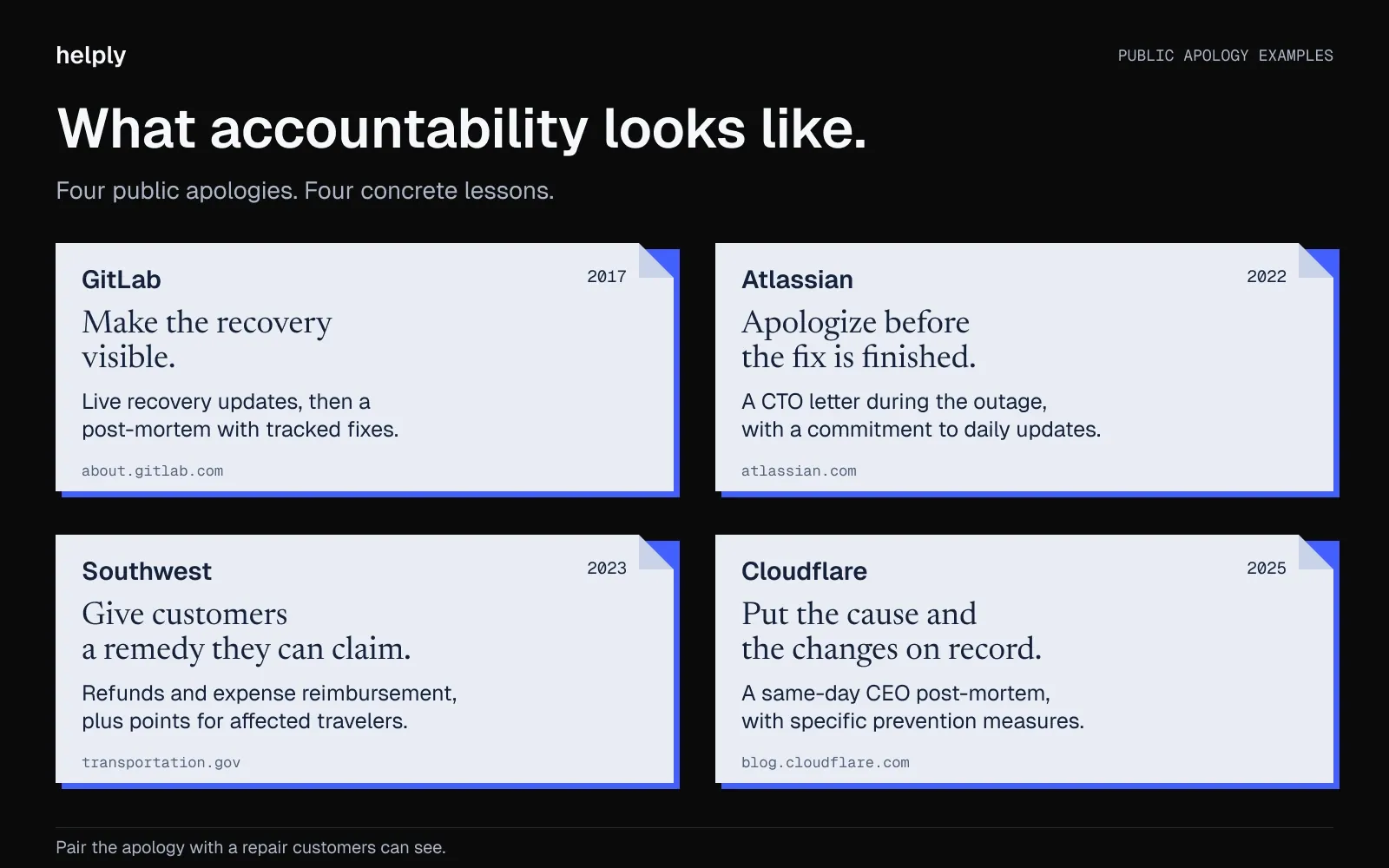
All four named the damage, took ownership and listed their fixes.
GitLab, 2017: A Public Recovery After Data Loss
On 31 January 2017, a GitLab engineer wiped about 300 GB from GitLab.com's primary database by mistake. GitLab lost about six hours of database changes.
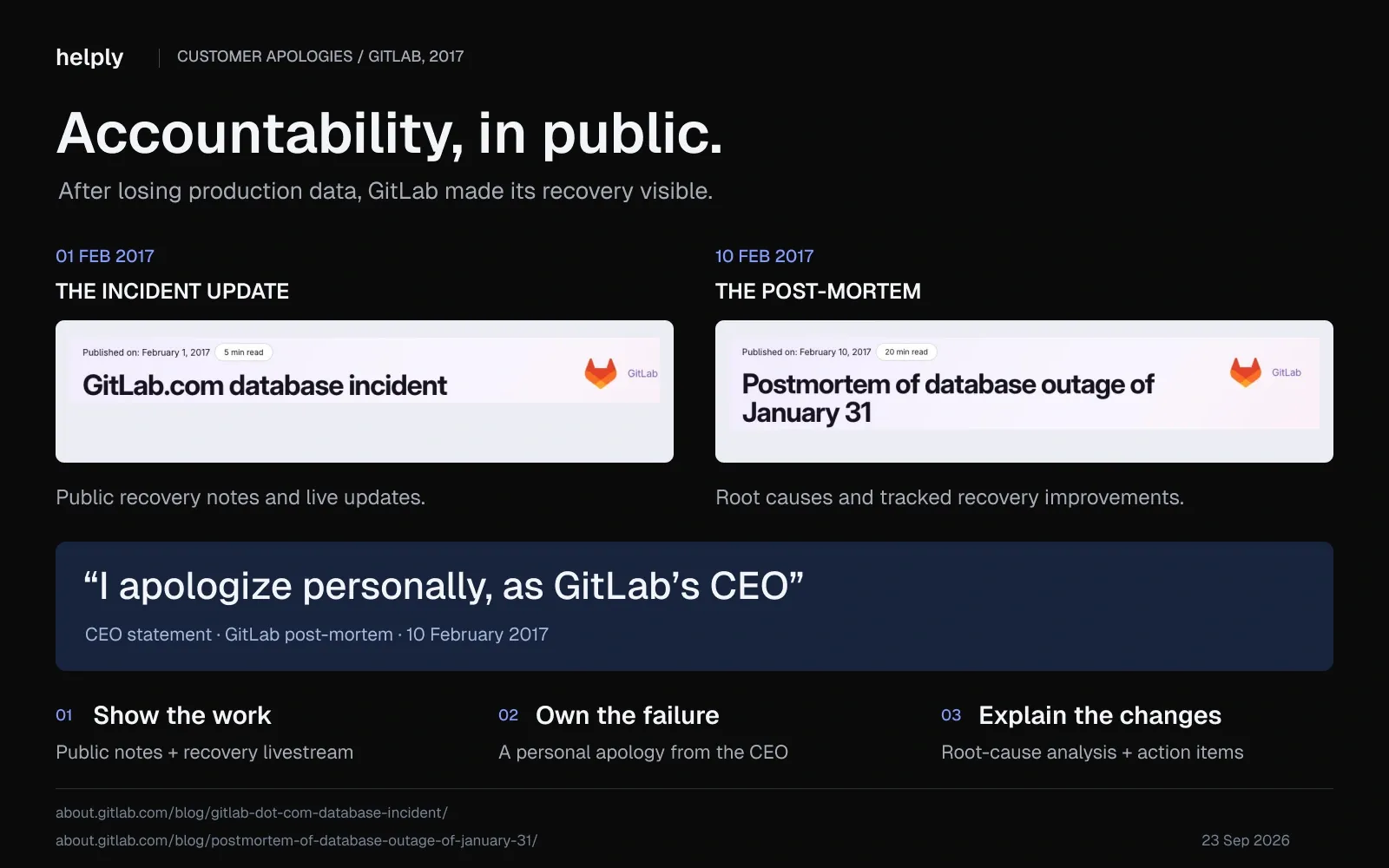
GitLab's team kept recovery notes in a public Google Doc and streamed the restore on YouTube. On 1 February, GitLab listed the lost data types and the six-hour window.
On 10 February 2017, GitLab traced the root cause in a post-mortem and linked a public issue for each fix. The CEO apologized in the same post: "I apologize personally, as GitLab's CEO, and on behalf of everyone at GitLab."
Run GitLab's response through the 5 R's. Recognition came within a day, when GitLab listed what it had lost. The CEO took responsibility in a first-person apology.
GitLab showed remorse through its tone and openness, and made restitution with live updates and full disclosure. Its post-mortem covered repetition prevention with a list of technical fixes.
The lesson: publish the facts while you fix the problem, then put the apology and the fixes in one public document.
Atlassian, 2022: A CTO Letter in the Middle of a Two-Week Outage
In April 2022, an Atlassian maintenance script deleted 883 cloud sites belonging to 775 customers. Some customers waited up to 14 days to get their sites back.
A week into the outage, CTO Sri Viswanath published a letter on the cause, the scope and the restore process. He said the incident and the response time fell short of Atlassian's standard, and he apologized. He committed to daily updates and a public post-incident review.
In the post-incident review, the company promised soft deletes across its systems, faster multi-site restores and a playbook for incident communications. Its co-founders and co-CEOs wrote: "The buck stops with us."
The lesson: apologize before you finish the fix, and tell customers when the next update arrives.
Southwest Airlines, 2023: A CEO Letter With a Remedy Customers Could Claim
Southwest Airlines disrupted holiday travel for millions of customers in late December 2022. In a December 2023 release, the US Department of Transportation counted 16,900 cancelled flights.
CEO Bob Jordan's letter to Rapid Rewards members on 17 January 2023 said the airline was "deeply sorry" for falling short of expectations. It listed refunds, expense reimbursements, returned bags and 25,000 Rapid Rewards points for the customers hit hardest.
It named fixes, such as more staff and an upgraded system for crew recovery. The department credited Southwest $33 million of a $140 million civil penalty for issuing those points.
The lesson: pair the apology with a remedy customers can claim and a fix they can hold you to.
Cloudflare, 2025: A Same-Day Post-Mortem From the CEO
On 18 November 2025, an oversized configuration file broke Cloudflare's core traffic routing for about three hours. Co-founder and CEO Matthew Prince published the post-mortem the same day.
Prince apologized "on behalf of the entire team at Cloudflare," and called it Cloudflare's worst outage since 2019. The post explained the cause and listed four fixes, including more global kill switches.
The lesson: publish the post-mortem the same day, under the CEO's name.
What Are the Biggest Mistakes Companies Make in Customer Apology Letters?
- "Sorry you feel that way." Saying this shifts the blame onto the customer's feelings. Replace it with "I'm sorry we [specific thing we did wrong]."
- Burying the apology behind excuses. Put three paragraphs of explanation before the apology, and you lose the reader early. Apologize first, and explain second.
- Using passive voice. "Mistakes were made" doesn't tell the customer who is accountable. "We made a mistake" does.
- Over-promising. "This will never happen again" is a promise you probably can't keep. "We've added [specific safeguard]" is credible.
- Sending a template without personalizing. Your customer will spot a mass email. Spend 60 seconds on their account, issue and timeline, so they can tell you wrote it for them.
- Forgetting to follow up. Put a check-in on your calendar when you send the apology. If you don't follow up within 48 to 72 hours, the customer assumes you forgot about them.
- Having the wrong person sign it. A support rep signing for a critical security incident tells the customer leadership doesn't care. Match the signer to the severity.
Keep Writing Apologies by Hand, or Start Each One From an AI Draft
A team that apologizes a few times a month can work from a shared doc of these 15 templates. Teams on Zendesk Suite Professional or higher can add Copilot drafting for $50 per agent a month on annual billing. Helply fits teams that want churn flags, routing, drafting and opt-in billing Actions in one help desk.
Next time a bug wipes four hours of a customer's work, you start from a draft. The Assist Agent can write it from the incident, earlier tickets and your severity rules. The Churn Agent can alert the account owner before the renewal call.
Your worst case is an AI that misreads a furious customer and apologizes in the wrong tone. You can set every apology to wait for a person's approval before the customer reads it. Helply's Support Agent escalates anything it can't resolve with confidence.
Razia Aliani, Senior Systematic Reviewer at Covidence, says:
"What convinced us was watching it decline to answer, it hit a genuinely ambiguous question and escalated instead of bluffing."
Covidence saw no measurable rise in inaccurate answers over its human-only baseline.
Helply charges for AI work, with no per-user fees. Plans start at $49 a month, and drafting an apology from the thread alone uses 1 credit.
Start with one mailbox and this week's apologies. Compare Helply's drafts with the replies your team would have written.
Frequently asked questions
The 5 R's of apology stand for Recognition, Responsibility, Remorse, Restitution and Repetition prevention. In a customer apology letter, you name the issue, own it, show regret, offer a fix and explain the safeguard against a repeat. Ohio State researchers found in a 2016 study of 755 people that acknowledging responsibility mattered most.
To write a letter of apology to a customer, name the issue in the subject line and open with a direct apology. Take responsibility, give the cause in one or two sentences, and state the fix and any compensation. Close with the safeguard you added and a named contact.
Say "I'm sorry" or "We apologize" once, near the top, and tie it to the specific mistake. Skip "sorry for any inconvenience" and "sorry you feel that way," which shift the focus off your error.
For example: "I'm sorry we charged you twice in March. That was our error, and we've refunded the second charge."
Use one line to name the mistake and own it. "I'm sorry we sent the wrong item" and "That error was ours" both work. Follow either with the fix, so the customer knows what happens next.
Send a customer apology letter within 24 hours for a low-severity issue and within 4 to 8 hours for medium. Reply within 2 hours to a high-severity issue and within 1 hour to a critical one. For high and critical incidents, follow up with the signed letter within 24 hours.
No. The fix alone is enough for a low-severity issue such as a cosmetic bug. Offer a credit for a billing error, and a refund plus an executive call for data loss.
Match the signer to the severity. A support rep signs for low, a CSM or support lead for medium and a VP for high. The CEO or CTO signs for a critical incident.
In a good apology letter, you say sorry, own the mistake, date the fix and name a safeguard, as in this short example:
"I'm sorry your order went to the wrong address, and the mistake was ours. We've sent a replacement by express, and it arrives Thursday. We've also added a second address check before every shipment."
GitLab's CEO apologized for a 2017 database loss in a public post-mortem that linked every fix. Atlassian CTO Sri Viswanath published a letter during a two-week outage in April 2022.
In January 2023, Southwest CEO Bob Jordan wrote to Rapid Rewards members about refunds, reimbursements and 25,000 points for those hit hardest. Cloudflare CEO Matthew Prince posted a same-day post-mortem in November 2025.
Name the mistake and its effect on the client's work in the first lines. Explain the cause in one sentence, state the corrected timeline or deliverable, and say who checks the fix. Send it from the account owner, and offer a credit if the mistake cost them time or money.
Name the poor service you gave, such as three transfers or a dismissive reply, and apologize without excuses. Say what you changed, like retraining or a new contact, and start from Template 4. If the customer remains upset, use these steps for angry customers before you write.
The apology letter addresses the customer's experience and emotions within 24 hours. The post-mortem addresses the technical root cause and prevention plan within 3 to 5 business days. High-severity incidents need both.
Yes, AI can draft an apology that fits the severity and the customer's history, and a person should check its facts and tone. Helply's Assist Agent, part of an AI-native customer support platform, can draft from the conversation, the customer's record and your Guidelines. Your team can approve each draft before it reaches the customer.
On Helply, a draft from the thread alone, with no tools or search, costs 1 credit. If the agent searches one or two connected systems, such as Stripe, the draft costs 4 credits.
Plans start at $49 a month for a 500-credit block, with no per-user fees. Drafts your team rejects before they reach a customer cost nothing.
Yes. Helply's free trial runs for 14 days and includes 1,000 credits, and you sign up without a card. Draft apologies on real tickets before you pay.
About the author

Bildad Oyugi
Head of Content
Bildad is a digital marketing expert with over 5 years of experience in copywriting, content marketing, and editing. Outside of work, he enjoys videography and spending time with his family.


