Key Takeaways
- Customer service orientation puts customer needs ahead of internal convenience in every team, from support to finance.
- Seven traits carry the habit, from empathy and active listening to empowerment and follow-through.
- Every customer conversation carries a signal: frustration, a repeat problem, a request or a reason to buy more.
- Customer-oriented and customer-centric overlap. Orientation is the daily posture, and centricity is the company-wide operating model.
- Per-user pricing on support software works against the habit, because each person who joins the inbox raises the bill.
- Helply has unlimited users on every plan, and its AI agents route what customers say to sales, success and product.
A customer service oriented business is one that organizes its decisions, processes, and teams around solving customer problems before its own. It treats each interaction as more important than a single transaction.
Customer orientation is a business philosophy: you weigh choices by their impact on the customer first, and the business benefit follows.
Customer-oriented, client service oriented, customer service driven and consumer-oriented are synonyms for a business that puts customer needs ahead of its own convenience.
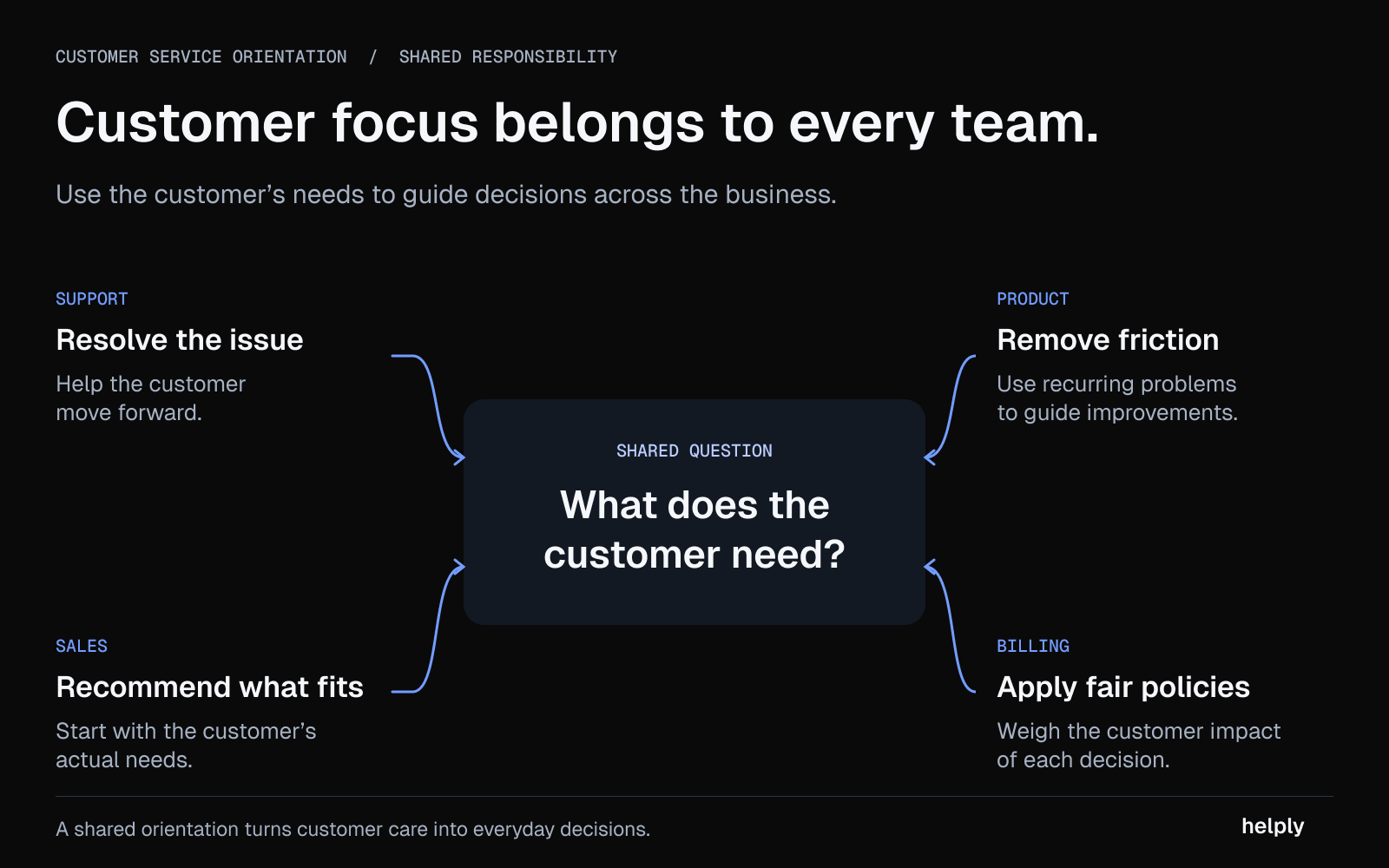
The word "oriented" describes a direction the whole company faces. Product, sales and finance all make calls that shape the customer experience, so all of them share the orientation.
A customer service-oriented company tends to share four traits:
- Customer problem first. The default question is "what does the customer need here?" Internal convenience comes second.
- Whole-company buy-in. Everyone from engineering to billing considers customer impact, along with the customer service team.
- Proactive, not reactive. The team anticipates customer needs and heads off issues instead of only putting out fires.
- Decisions weighed by customer impact. Teams judge policies, pricing and roadmap trade-offs in part by how they land with customers.
Customer-Oriented vs. Customer-Centric
Customer-oriented means putting customer needs ahead of internal convenience in daily decisions. Customer-centric goes further and builds the whole business model around the customer.
| Customer-oriented | Customer-centric | |
|---|---|---|
| Scope | Behavior and mindset, often led by support | Company-wide operating model |
| Question it asks | How do we serve this customer well right now? | How do we build the entire business around customer lifetime value? |
| Owned by | Every team, with support leading day to day | Leadership, every department |
| Signal it's working | Higher customer satisfaction and loyalty | Retention and expansion drive strategy and budget |
You can be customer-oriented before you are customer-centric. The practical path runs in that order: build the orientation first, prove it moves retention, then earn the company-wide mandate.
Customer orientation has limits. You can refuse a request and keep the customer's problem first, by explaining why and offering what you can.
Customer Service Orientation vs. a Service-Oriented Company
In another sense, a "service-oriented company" is a business that sells services, such as plumbing or bookkeeping, rather than goods. Customer service orientation is a different idea, and any business can have it.
Why Customer Service Orientation Matters
Customer service orientation matters because it moves the numbers that decide whether a business grows: retention, repeat purchases and referrals. Customers who feel looked after tend to stay longer and spend more.
Frederick Reichheld and W. Earl Sasser measured what retention is worth in a 1990 Harvard Business Review study. Cutting customer defections by 5% raised profits 25% to 85% in the service industries they studied. Depending on the study and industry, winning one new customer can cost five to 25 times what it takes to keep one.
Three benefits compound over time:
- Retention and revenue. Customers who get help fast are more likely to come back, buy again and expand.
- Word of mouth. Well-served customers leave better reviews and refer peers, so you spend less to win new ones.
- Engaged teams. A 2012 Journal of Marketing meta-analysis linked customer orientation to better front-line well-being and job outcomes.
In Zendesk's CX Trends 2025 survey of about 5,100 consumers, 63% were willing to move to a competitor after one bad experience. In Salesforce's 2024 State of the AI Connected Customer, 43% of consumers named poor service as a reason they left a brand.
In Qualtrics XM Institute's 2024 study of nearly 24,000 people, spending fell after 38% of very poor experiences and stopped after another 15%. Weak orientation shows up in conversations before it reaches a churn report, so teams that read them can act early.
Everyday Examples of Customer-Oriented Service
Customer orientation shows in small moves that customers notice. In each of these five everyday cases, the rep or team puts the customer's problem ahead of the easiest path.
- A return without a receipt. The rep looks up the order history and offers an exchange instead of a flat no.
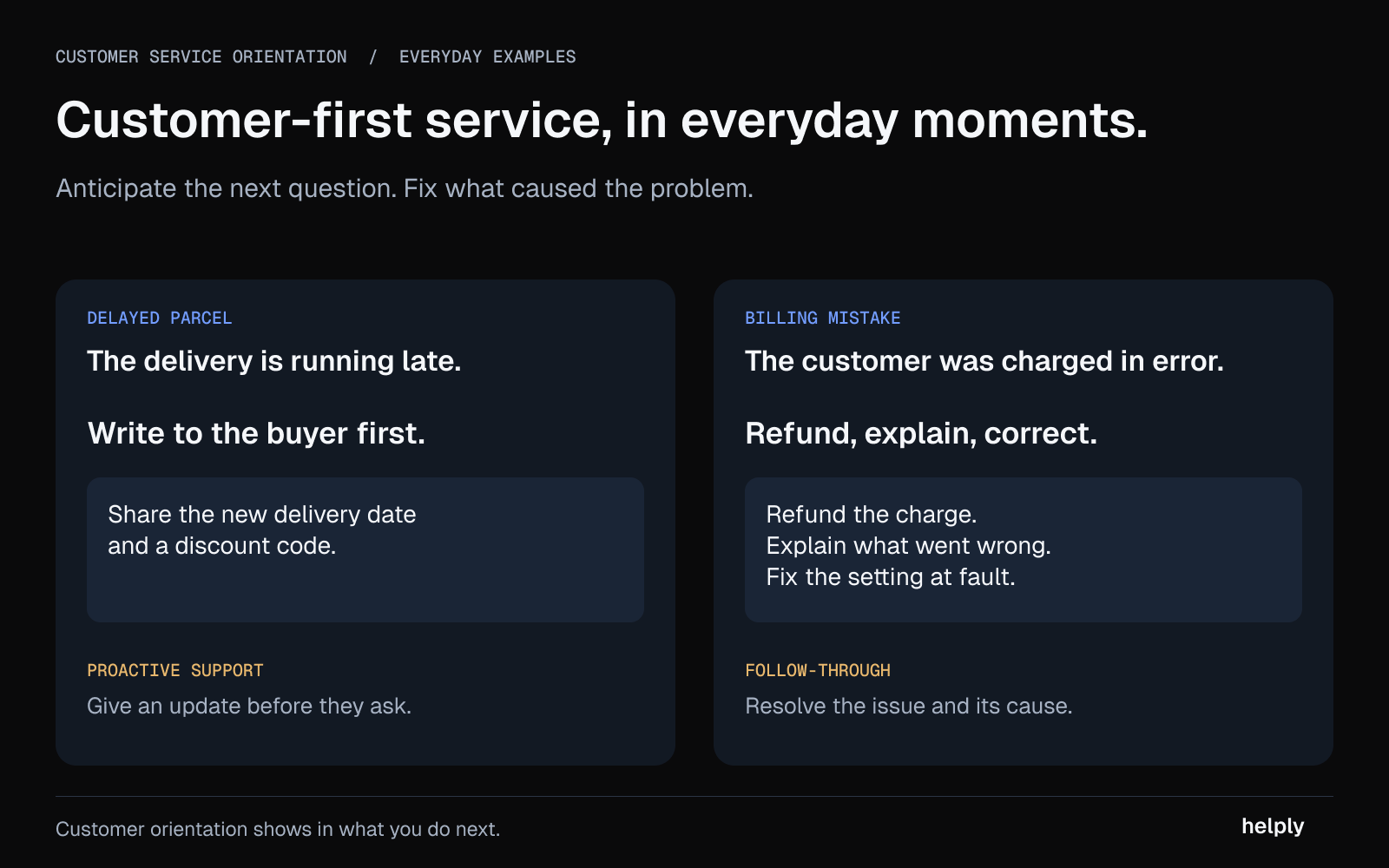
- A delayed parcel. The team writes to the customer before they ask, with a new date and a discount code.
- A billing mistake. The rep refunds the charge, explains what went wrong and fixes the setting at fault.
- A confused new user. Support sends a two-minute walkthrough and checks in a week later.
- A recurring bug. Support tells engineering the same day and updates every affected customer once the fix ships.
Every Conversation Carries a Signal
Read each support conversation in context. The same question, "How do I export this report?", means one thing from a customer weighing a competitor and another from a new user.
A customer-oriented team looks at who is asking, what they bought and what the pattern predicts. Frustration, repeat problems and feature requests often surface in conversations before a customer leaves.
The Answer Often Lives Outside the Conversation
The information that solves a problem often sits in another system: the order history, the billing tool, the CRM or product usage data.
Customer orientation here means giving every rep that context by default. Then they answer with the full picture instead of asking the customer to repeat themselves. In Zendesk's CX Trends 2026 research, 74% of consumers said retelling their story to different agents frustrates them.
Examples of Customer Service Oriented Companies
The best-known examples show the operating habits behind the reputation.
Zappos built its reputation on service, and its agents have logged calls of more than 10 hours. In a 2016 Refinery29 article, then-CEO Tony Hsieh said Zappos encouraged employees to stay on a call as long as the customer wanted. The lesson is empowerment: front-line staff can act without escalating every decision.
Nordstrom told Business Insider in 2014 that its employee handbook was a single card with one rule: use good judgment. Today, its careers site says it trusts its people to use good judgment in every situation. The lesson is trust: people get room to solve customer problems their own way.
Amazon's Leadership Principles describe its mission of being "Earth's most customer-centric company." Its Customer Obsession principle says leaders "start with the customer and work backwards." The lesson is direction: customer needs set the roadmap.
Software companies show the same orientation in a different habit: the whole company takes a turn in support.
Whole-Company Support at 37signals and Zapier
At 37signals, the maker of Basecamp, everyone in the company joins Everyone on Support every few months. The company's handbook says talking with customers shows staff what is wrong and right with its products.
In a 2015 blog post, Zapier CEO Wade Foster wrote that every person on the team, whatever their title, spent time on support. He named the catch: "You need to pay for extra users in your help desk software."
One Conversation, Two Signals
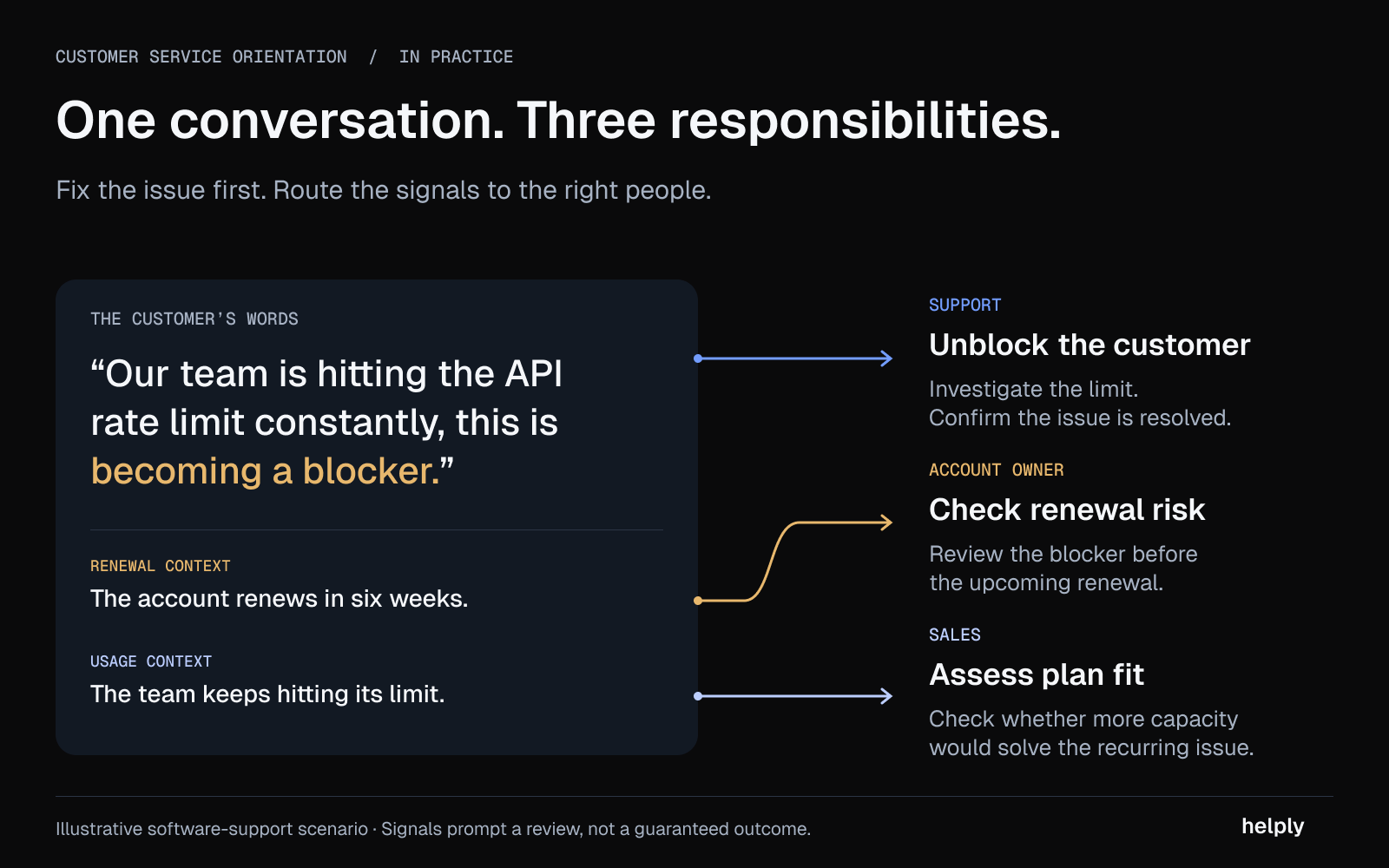
Picture a data platform with 900 customers. A message arrives: "Our team is hitting the API rate limit constantly, this is becoming a blocker."
A customer-oriented team fixes the rate-limit problem first. It reads "becoming a blocker" as risk language. The team sees that the contract renews in six weeks and tells the account owner the same day.
Hitting rate limits often means the customer has outgrown their plan, so the team flags a possible upgrade to sales. The customer gets a fix, the account owner gets a warning and sales gets a lead.
The 7 Skills and Traits of Customer-Oriented Teams
Customer orientation runs on a specific set of skills. Your team turns the philosophy into daily behavior when you hire and train for these traits.
- Empathy. Reading the customer's mood and tailoring the reply to the person and their history, so upset customers calm down.
- Active listening. Catching what the customer means, including the concern behind the question.
- Clear communication. Plain words, a clear next step and no jargon the customer has to decode.
- Proactive support. Spotting an issue and addressing it before the customer has to chase you.
- Empowerment. The authority to refund, replace or make an exception without a chain of approvals.
- Follow-through. Owning a problem until it is resolved, then closing the loop with the customer.
- Product knowledge. Knowing the product well enough to give a real answer, which matters more when customers are technical.
Product knowledge and clear communication get easier when the tools carry the context.
Helply's Assist Agent searches the customer's history and your connected tools, then drafts a reply that follows your Guidelines. Your rep reviews the draft and decides what to send.
What It Means to Be a Service-Oriented Person
A service-oriented person puts the needs of the people they serve ahead of their own convenience. In a customer-facing role, the primary goal is to solve the customer's problem. Closing the request comes second.
Tom J. Brown and three colleagues measured where the trait comes from. In their 2002 Journal of Marketing Research study, three personality traits explained 39% of the variance in employees' customer orientation. The traits were emotional stability, agreeability and the need for activity.
Internal Customers Count Too
Internal customers are the colleagues who depend on your work. Your service orientation covers them, because the customers they serve wait on your reply.
An engineer who answers a support question the same day is customer-oriented without talking to a customer.
Interview Questions That Reveal Service Orientation
Ask for real stories over opinions. These five questions show how a candidate behaves when a customer needs something:
- Proactive support. Tell me about a time you solved a problem before the customer noticed it.
- Saying no well. Describe a customer request you had to refuse, and the alternative you offered.
- Follow-through. Tell me about a problem you owned from start to finish.
- Acting on feedback. Describe a time you changed how your team worked because of customer feedback.
- Internal customers. Tell me about a time a colleague needed your help to serve a customer.
The Hidden Barrier: Tools That Charge for Every Person Who Helps
If your support software charges per user, every teammate you invite into the inbox adds cost. The success managers, engineers and salespeople who could help stay outside the tool. Per-user pricing works against the culture you are trying to build.
Helply removes that cost. Every plan has unlimited users, so you can invite support, product, engineering, operations and founders into the same inbox. From $49 a month, the plan price stays the same as you add teammates.
At Proposify, every CS manager, account owner and product lead gained full visibility into support. "Now my whole team can see support conversations without me buying a license for each of them," says Jacqueline Antworth, Director of Customer Experience.
StaffTraveler runs support with a handful of people. It replaced its old help desk with Helply and never had to grow the team.
"We went from 'help arrives when someone's awake' to genuine 24/7, and tickets dropped in half."
Send What Customers Say to the Team That Can Act
Customer orientation pays off when you put each customer comment in front of the person who can act on it. Helply's Background Agents watch every conversation and route what they find:
- Reach at-risk customers sooner. The Churn Agent flags frustration, sentiment changes and repeat problems, and can alert the right teammate.
- Catch buying signals reps might miss. The Revenue Agent spots upgrade intent and can alert sales or success, or update your CRM.
- Know who wants each feature. The Feature Request Agent groups matching requests, connects each to the customers behind it and alerts the right team.
- Spot emerging problems early. The Insights Agent surfaces recurring problems for support, product, success and leadership.
How to Become a Customer Service Oriented Business
You can build customer orientation in seven steps, from a written service standard to a self-service help center.
Write Down Your Customer-First Standard
Put your service standard into plain words, then make sure every team knows it and hires to it. Keep it short enough for a new hire to repeat from memory.
Get buy-in from product and billing, because their decisions shape the customer experience. In Helply, Guidelines hold that standard for the AI agents: your tone, your policies and when to involve a person.
Hire and Train for Empathy and Follow-Through
Screen for the traits above, then train them. Our list of customer service training videos covers empathy, listening and difficult conversations.
Give Every Teammate the Full Customer Context
Connect the systems where the answers live, such as your CRM, billing and order history. A rep who opens a conversation with the history loaded can solve the problem without asking the customer to start over.
Helply brings customer information, conversation history and knowledge into every conversation, for your reps and the AI agents alike.
Put Every Team on a Support Rotation
Schedule short support shifts for engineers, product managers and founders, as 37signals does. Give them inbox access between shifts, so they can follow the problems they found. Check that your help desk lets them in without a new license each time.
Set Response Standards Customers Can Count On
Promise response and resolution times you can keep, and track them. Our guide to service level agreements shows how to set them. As you scale, you can set SLAs in Helply and hold your team to those times.
Close the Loop: Listen, Measure, and Act on Feedback
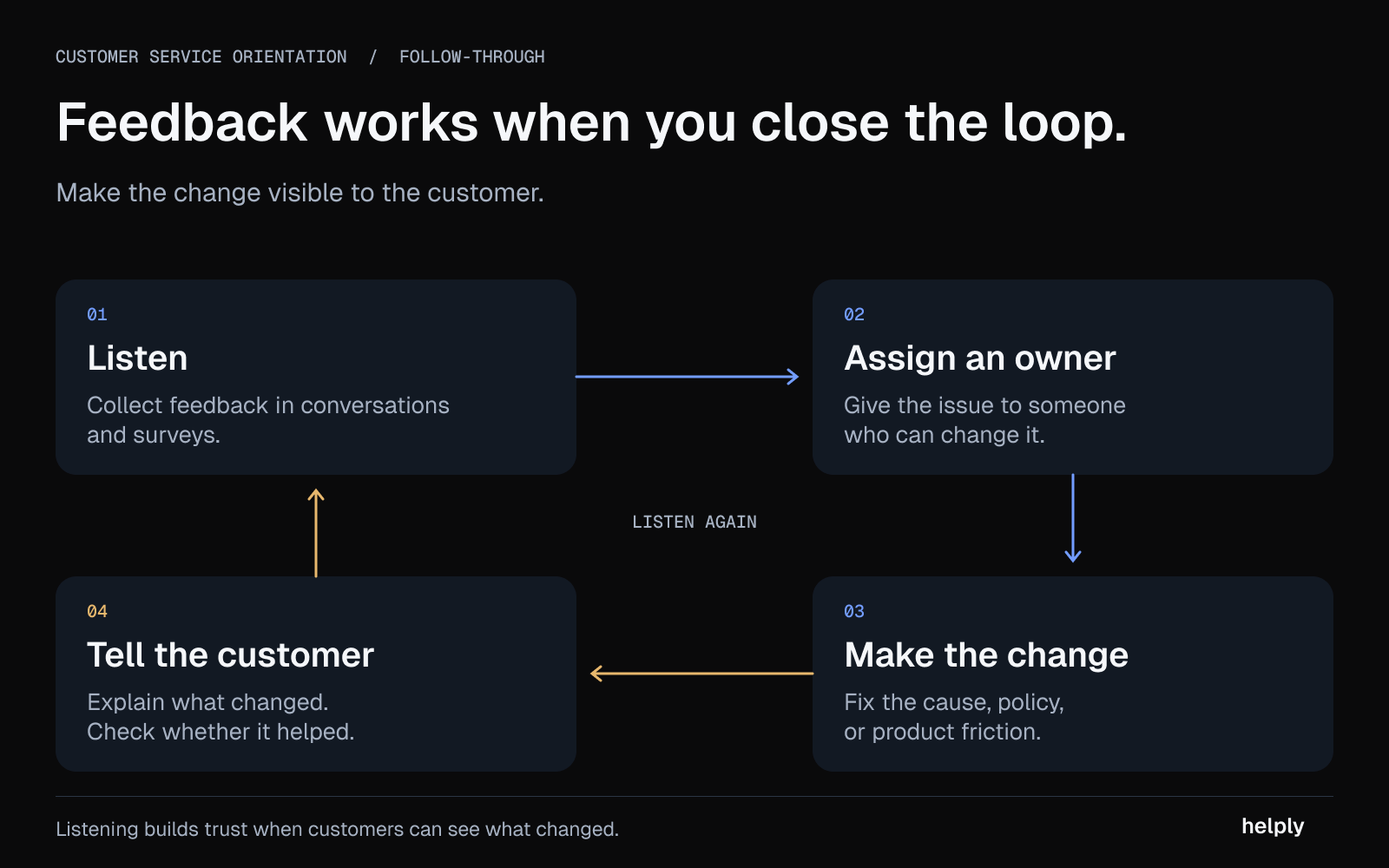
Gather feedback through surveys and everyday conversations, then fix the problems customers raise. Listening to customer feedback builds loyalty once customers see the result. These customer satisfaction survey tools help you collect it.
Make Self-Service Part of the Service
Many customers want to solve simple problems themselves. A help center that answers common questions frees your team for the hard ones. These knowledge base examples show what good looks like.
How to Measure Customer Service Orientation
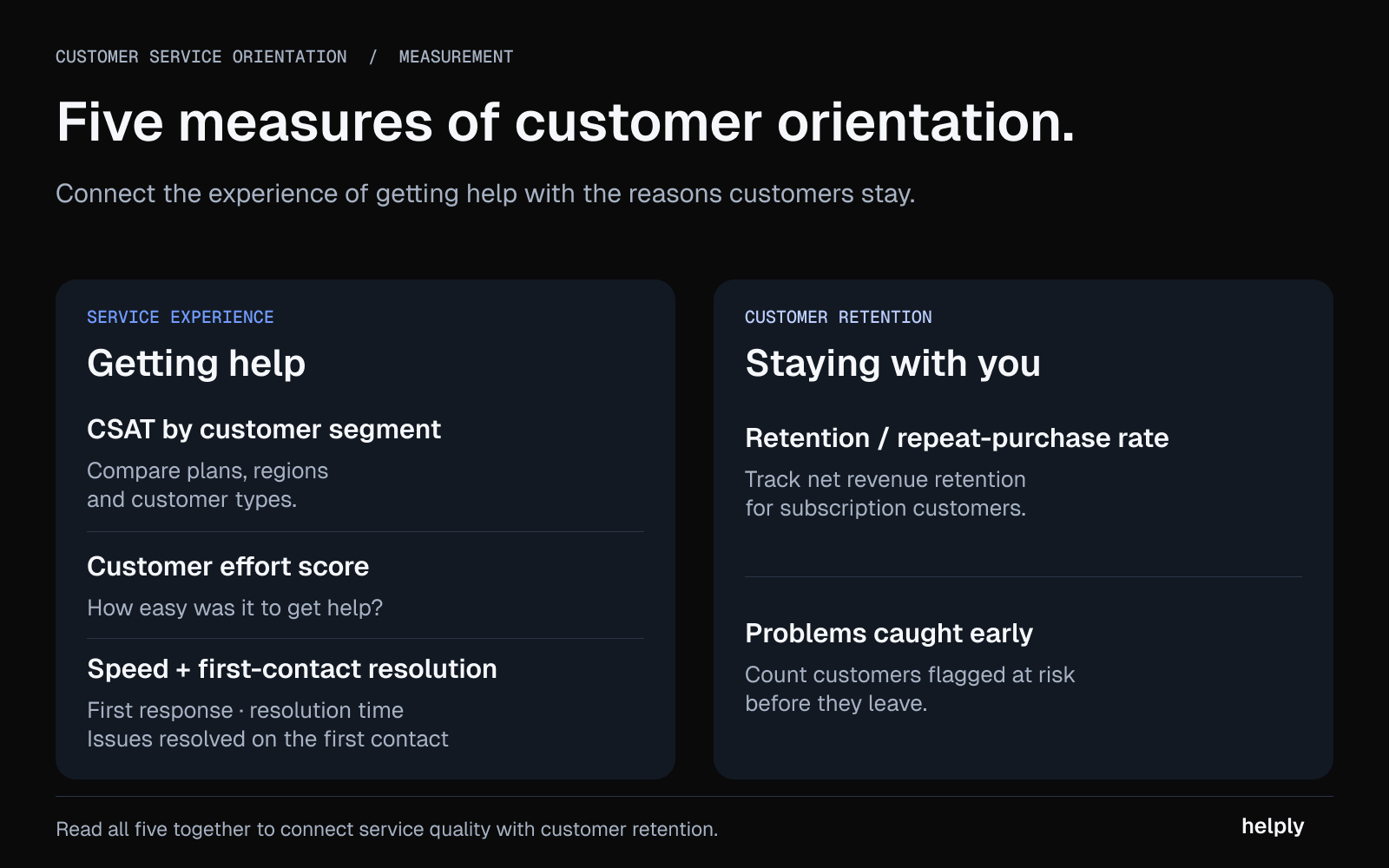
Measure customer service orientation with five numbers that connect service quality to retention:
- Retention or repeat-purchase rate. The clearest proof that orientation works. For subscriptions, track net revenue retention.
- CSAT by customer segment. An overall score hides risk, so split it by plan, region or customer type.
- Customer effort score. Customers rate how easy it was to get help. A 2010 Harvard Business Review study found it predicts loyalty better than satisfaction scores or NPS.
- First response, resolution time and first contact resolution. Speed matters most to customers who are blocked.
- Problems caught early. The number of at-risk customers your team flagged before they could leave.
Compare the five numbers, and you'll see whether your team keeps customers or closes tickets and moves on.
Customer Orientation Is a Habit Every Team Shares
A customer service oriented business faces its customers on purpose, across every team. It shows up in problems solved before customers ask, product fixes based on feedback and customers who stay. Start this week: invite an engineer or product lead to read support conversations for an hour.
Your engineers and product leads may want to help, but per-user pricing keeps them out of the inbox.
Helply is an AI-native customer support platform, trusted by 1,400+ companies. Every plan has unlimited users, and you pay for the AI's work in credits. Its AI agents investigate, resolve and act, so your whole team can focus on the customers who need a person.
Frequently asked questions
Customer-oriented service puts the customer's needs ahead of internal convenience. It means careful listening, spotting problems before customers report them, seeing each one through and giving staff the authority to fix things.
Customer service orientation is a mindset and a way of running a business that puts solving customer problems first. It applies to product, engineering and billing as much as to support.
A service-oriented person focuses on the needs of the people they serve. They listen, anticipate problems and follow through, whether they serve customers or colleagues. For a company, the term can mean it sells services rather than goods.
Customer-oriented describes a person or business that starts each decision from what the customer needs. In a company, that covers product, pricing and policy as well as service.
In everyday use, yes. "Customer service oriented" stresses the service interaction, while "customer-oriented" describes the whole company's posture toward customer needs.
No. Customer-facing, client-facing and front-line all describe roles where you talk to customers. Customer-oriented describes a mindset, so an engineer can be customer-oriented without facing a single customer.
A rep who finds a billing mistake refunds it, explains the cause and fixes the setting before the customer asks. Among brands, Zappos agents have stayed on a single call for more than 10 hours.
Customer-oriented skills include empathy, active listening, clear communication, proactive support, empowerment, follow-through and product knowledge.
Yes, and small teams often do it best, because everyone sees the customer. Tools with unlimited users let the whole company help without a fee for each new person. Our small-business help desk guide compares plans and pricing.
A help desk that shows customer context and lets the whole company join comes first, then a knowledge base, survey tool and CRM. Helply includes the help desk and knowledge base, and it connects to Salesforce and HubSpot. Our comparison of AI tools for customer support teams covers the options.
About the author

Bildad Oyugi
Head of Content
Bildad is a digital marketing expert with over 5 years of experience in copywriting, content marketing, and editing. Outside of work, he enjoys videography and spending time with his family.


