What a typical B2B support org actually costs
Start with labor. The U.S. Bureau of Labor Statistics' Occupational Employment and Wage Statistics report puts the median hourly wage for customer service representatives at $20.59 in May 2024, with the top decile above $30.16. B2B technical support roles sit above the BLS median because the work requires product fluency and account-context judgment, call it $30–$35/hour fully loaded once benefits, taxes, software, and overhead are layered on. That maps to roughly $70,000–$85,000 fully loaded per agent annually, depending on geography and tenure.
Take a representative mid-market team: five support agents, fully loaded at $75,000 each. Annual labor: $375,000. Add tooling and infrastructure overhead, help-desk software, knowledge-base infrastructure, QA, training, at roughly 18% of labor cost, or $67,500 annually. Total fully loaded: ~$442,500 per year, or about $37,000 per month.
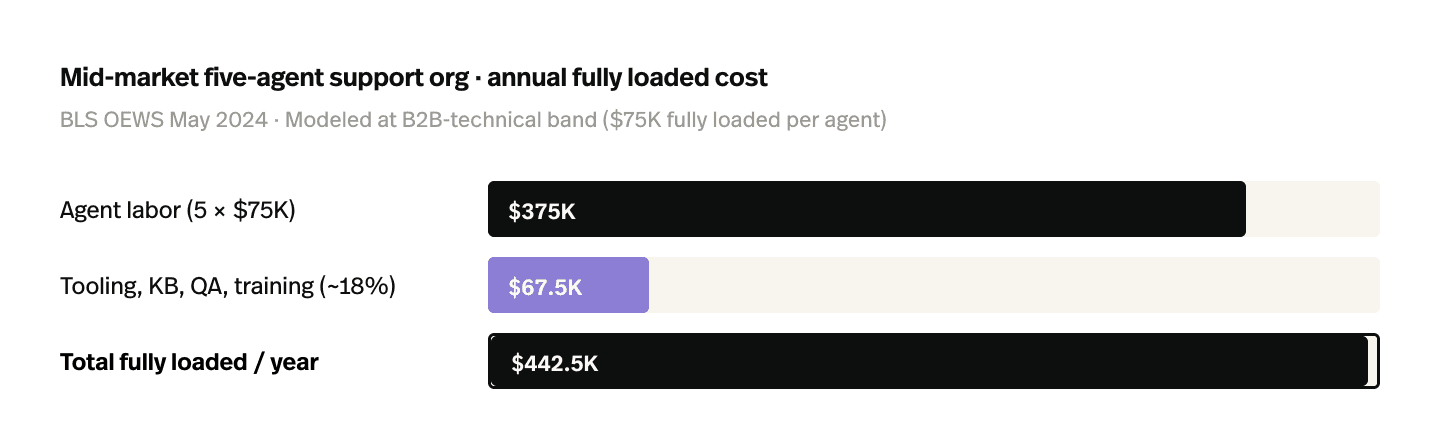
For comparison, ContactBabel's 2025 U.S. Contact Center Decision-Makers' Guide puts the average inbound contact cost across all industries at $7.16, with finance and fintech in the $15–$30 range and telecom around $20–$30. B2B sits in the middle band, higher than retail call-center work, lower than finance, and $11–$15 per ticket is a reasonable working number for a mid-market team. A larger B2B support org with multiple tiers, dedicated QA, and management layers will land closer to $20–$25.
Where the volume actually goes
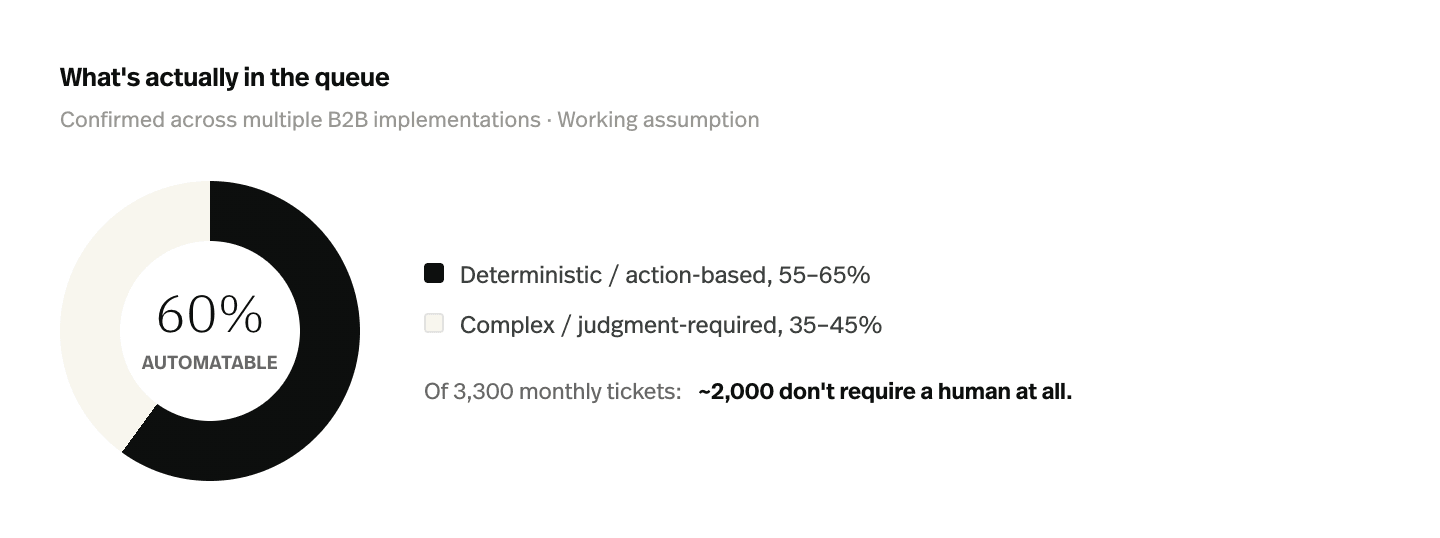
Of those 3,300 monthly tickets, the breakdown matters more than the total. The categories that absorb the majority of volume in B2B are well-documented and well-known: password resets and account access, billing and invoice questions, plan and seat changes, refund requests within policy, integration-setup walkthroughs, status and usage lookups.
None of these require judgment. None require empathy. None require the senior product knowledge a $75,000 agent brings to the role.
Side-by-side: cost per outcome
The unit-cost comparison is where the financial picture changes shape.
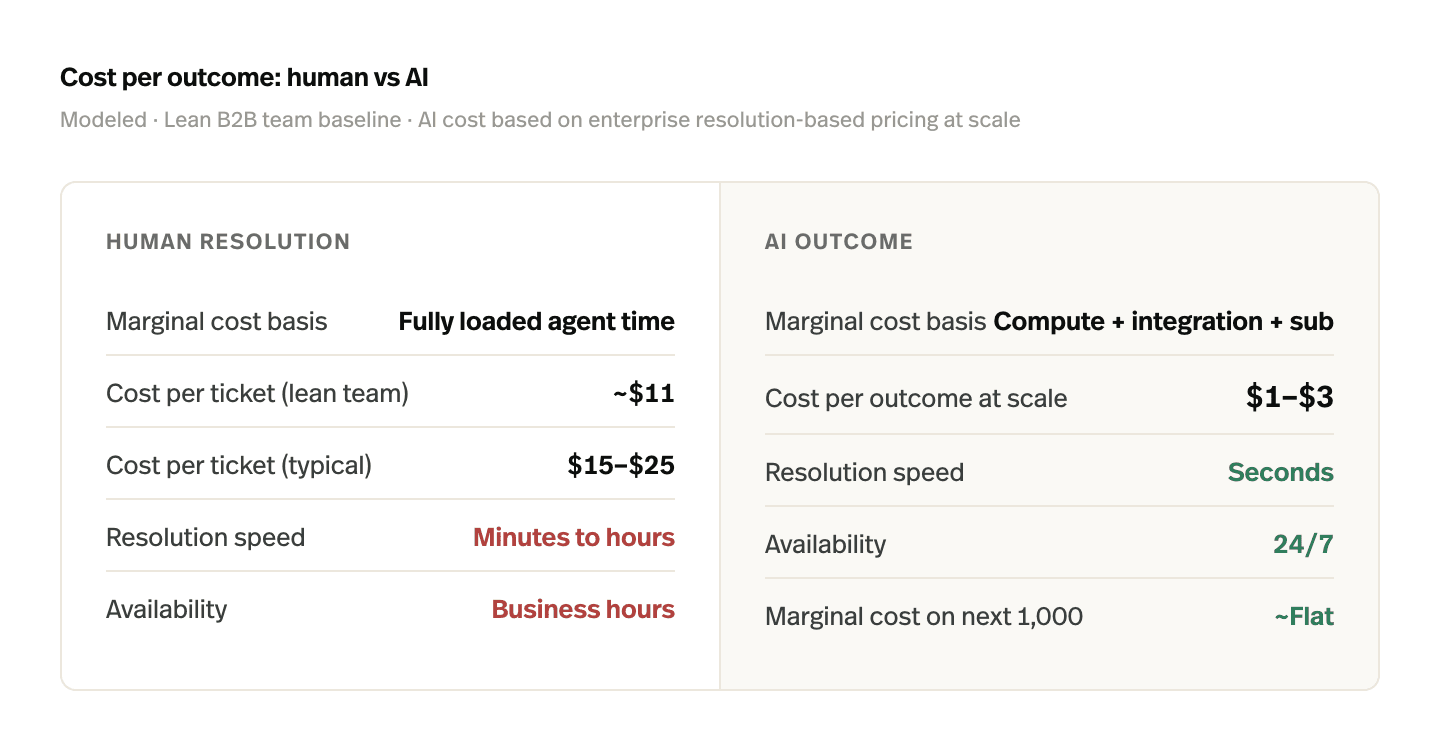
Plug those numbers into the example team:
- Old state: 3,300 tickets × $11 = $36,300 per month in resolution cost.
- New state, 60% AI outcome at $2/resolution: (1,320 human × $11) + (1,980 AI × $2) = $14,520 + $3,960 = $18,480 per month.
- Monthly savings: ~$17,800. Annualized: ~$214,000.
$214K
Annualized savings on a five-agent team. Double the team, a 10-agent, 6,600-ticket-per-month organization, and the annualized savings clear $400,000. Triple it and you're north of $640,000.
These are conservative numbers. They assume no expansion in coverage as AI maturity improves, no compounding savings from reduced agent attrition or QA overhead, and no second-order effects on response time and customer experience.
Concrete examples: what the AI actually does
Each of the categories below represents an end-to-end workflow the AI handles without a human ticket-touched.
Billing automation
Customer asks about an invoice, requests a copy, or questions a charge. The AI authenticates the customer, pulls the invoice from the billing system, sends it, and answers any line-item questions from the same dataset. If the question becomes a refund request within policy, it executes the refund. Resolution time: under a minute. Cost: a fraction of one human-touched ticket.
Account changes
Customer wants to add three seats to their plan. The AI verifies the customer's role on the account, confirms the change won't violate the contract, processes the seat addition in the billing and provisioning systems, sends confirmation, and updates the audit log. The same workflow handles seat removals, role changes, and SSO configuration adjustments.
Plan upgrades
Customer is approaching a usage ceiling and asks about the next tier. The AI explains the differences, models the cost impact for that customer's actual usage, processes the upgrade if it's a self-service tier, and routes to sales if it's enterprise. Either way, the customer gets a same-session answer instead of waiting for a sales rep to respond tomorrow.
Refunds within policy
Customer requests a partial refund within the policy window. The AI verifies eligibility against the policy logic, executes the refund through the payment processor, updates the account record, and confirms in the same conversation.
These aren't questions being answered. They are workflows being completed.
The second-order: revenue, not just savings
The $214,000 in annual savings on the example team is the small half of the math. The larger half is the redirected human capacity.
Five agents at 60% of their time freed up is the equivalent of three full-time human FTE redeployed, onto retention conversations, structured onboarding, expansion outreach, QBRs on key accounts. The economic comparison shifts.
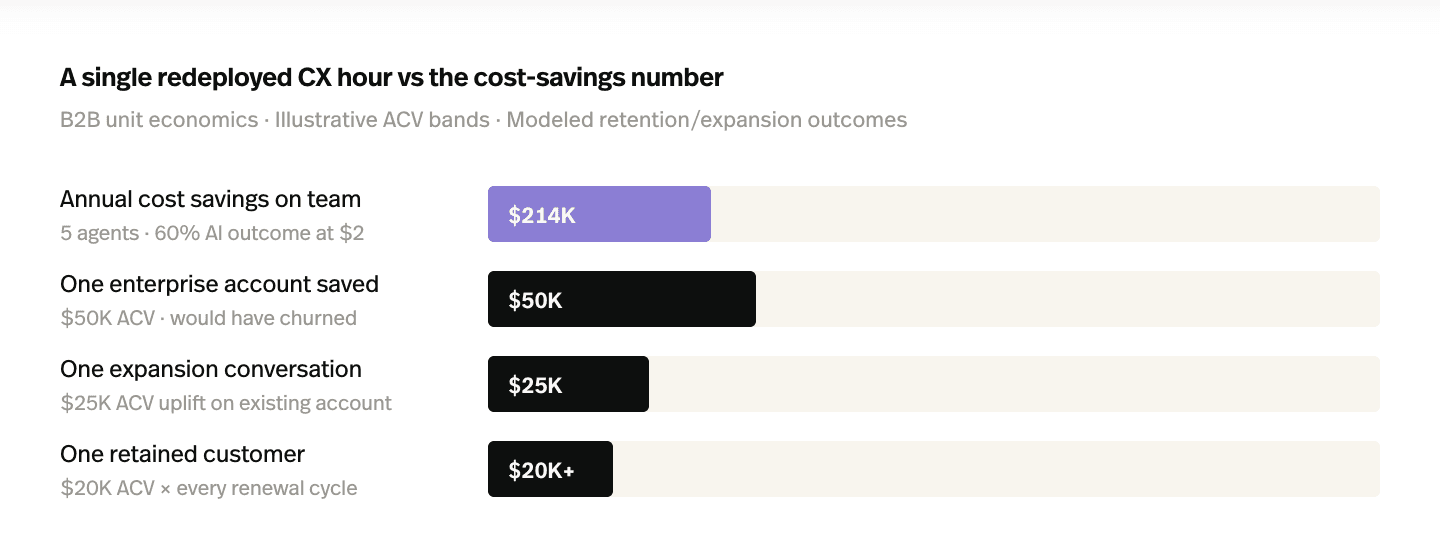
The math on the revenue side is harder to pin to a single number because it depends on the team's existing motion, account mix, and execution discipline. But the directional logic is unambiguous: the same $375,000 labor budget now produces measurable revenue contribution alongside reduced cost-to-serve.
That's not a cost line being optimized. That's a function being repositioned.
The summary number
Five-agent team. $214,000 annual cost savings on a conservative model. Three FTEs of redirected human capacity producing retention and expansion revenue. Same headcount. Different P&L.
The numbers don't require interpretation. They require acting on them.
Sources
About the author

Alex Turnbull
CEO & Founder, Helply
Alex is the CEO & Founder of Groove. He loves to help other entrepreneurs build startups by sharing his own experiences from the trenches.


