So, you've invested in a brand new AI chatbot or virtual assistant. It’s handling queries and working 24/7. But is it actually doing a good job?
Without the right data, you're flying blind. You might be saving time, but you could also be frustrating customers without even knowing it. That's where Key Performance Indicators (KPIs) come in. Establishing and tracking KPIs allows companies to objectively evaluate the efficiency, effectiveness, and user satisfaction generated by artificial intelligence in customer service.
This guide will break down the essential KPIs for measuring your AI customer support. We'll show you what to track, why it matters, and how to use that information to build an AI assistant your customers will love.
Why AI Needs Its Own Set of KPIs
Before we dive into a long list of metrics, let’s get one thing clear: you can't measure a bot the same way you measure a human agent.
Simply put, AI support uses smart tools to handle customer questions automatically. You see it everywhere:
- Website chatbots that pop up to help you.
- Voice assistants on customer service phone lines.
- Automated help desks that sort and answer support tickets.
The reason these tools need their own rulebook is twofold. First, they operate at a massive scale. A single AI can have thousands of conversations at once, meaning a small error can frustrate thousands of customers instantly.
Second, unlike a human, an AI must be measured on two levels:
- Its technical skill: Is it fast and accurate?
- Its customer impact: Is it actually helpful and easy to use?
Because of this unique nature, just looking at old metrics won't give you the full picture. It demands a specific set of KPIs.
Why Measure KPIs for AI Customer Support
Effective measurement of KPIs in AI customer support is crucial for several reasons:
- Performance evaluation. KPIs provide objective data to assess the speed, accuracy, and effectiveness of AI-driven responses.
- Return on Investment (ROI). Quantifying AI’s impact on support outcomes and cost savings helps justify ongoing investments.
- Continuous improvement. Monitoring KPIs helps you spot exactly where your AI is struggling, so you can make targeted improvements to its programming and knowledge base.
- Customer experience. KPI tracking ensures that AI-powered interactions meet or exceed customer expectations, directly feeding into customer satisfaction and loyalty.
- Benchmarking. By comparing AI and human agent KPIs, you can create a smarter system where bots handle routine queries and humans tackle the high-value issues.
- Scalability and consistency. As your company scales, KPIs ensure your automated support remains consistent and high-quality for every single customer.
Without a clear strategy for how to measure KPIs for AI customer support, organizations risk missing out on valuable insights, stagnating their automation initiatives, or potentially damaging the customer experience due to unmonitored system weaknesses.
The Essential AI Support KPIs And How to Measure Them
The key to successfully measuring your AI customer support isn't to track everything, but to track the right things. Below is a breakdown of the most impactful KPIs, what they mean, and the simple formulas for calculating them.
1. First Response Time (FRT)
What it Is: How fast your AI replies to a customer's first message.
Why it matters: An instant response meets modern customer expectations and makes your brand look incredibly efficient. With 90% of consumers rating an immediate response as important or very important for customer service queries, speed is no longer a bonus but a requirement. This is often the first metric teams look at when learning how to measure their AI support's performance.
How to measure FRT:
- Record the exact timestamp when a customer submits an inquiry.
- Capture the time when the AI issues its first response.
- Calculate the difference and average across all interactions within a reporting period.
2. Resolution Rate
What it is: The percentage of conversations your AI handles successfully from start to finish, with no human help needed.
Why it matters: A high resolution rate proves your AI is capable and is directly reducing the workload for your human agents. Measuring this AI support KPI shows you the direct impact on team efficiency.
How to measure resolution rate: (AI-resolved inquiries ÷ total inquiries) x 100
To ensure this number is accurate, it's a great practice to spot-check a few resolved conversations each week to confirm the AI's solution was genuinely helpful and the customer didn't just give up.
3. Customer Satisfaction Score (CSAT)
What it Is: The classic "How did we do?" score typically collected via a post-interaction survey.
Why it matters: While other metrics measure efficiency, CSAT measures happiness. It’s a direct indicator of how customers feel about your AI, which is crucial for loyalty. To get the most out of this metric, always include an optional comment box. The score tells you what customers think, but the comments tell you why.
How to measure CSAT:
- Deploy a simple survey immediately after the AI interaction, asking customers to rate their experience (commonly on a 1–5 or 1–10 scale).
- CSAT (%) = (Number of positive responses ÷ total survey responses) x 100
- Monitor aggregate and segmented results to uncover pain points or improvement opportunities.
4. Net Promoter Score (NPS)
What it is: A measure of loyalty, asking customers how likely they are to recommend your AI support to a friend on a 0-10 scale.
Why it matters: NPS is your barometer for long-term brand health and customer advocacy. It helps you understand if your AI is creating brand promoters or detractors.
How to measure NPS:
- Ask, “How likely are you to recommend our AI support to a friend or colleague?” on a 0–10 scale.
- Promoters (score 9–10), passives (7–8), and detractors (0–6).
- NPS = % promoters – % detractors.
5. First Contact Resolution (FCR)
What it is: The percentage of issues resolved by the AI in the very first interaction, with no follow-ups needed.
Why it matters: A high FCR means your AI is highly effective and creates an effortless experience for customers, which is a huge driver of loyalty. Measuring this KPI is key to understanding AI effectiveness.
How to measure FCR: (Cases resolved on first contact ÷ total cases) x 100
Be sure to evaluate whether the original customer concern is completely addressed within the first session.
6. Abandonment Rate
What it is: The percentage of chats that customers end before getting a resolution.
Why it matters: This is a major red flag . A high abandonment rate signals customer frustration or a confusing bot interface. This metric becomes even more powerful when you connect it with session analytics to pinpoint exactly where in the conversation users are dropping off, which is the first step to fixing a broken dialogue flow.
How to measure abandonment rate:
- Monitor the total number of AI conversations started.
- Track those ended by the customer without resolution.
- Abandonment rate (%) = (Abandoned interactions ÷ total interactions) x 100
7. Escalation Rate
What it is: The percentage of chats the AI has to pass over to a human agent.
Why it matters: Some escalations are good (for complex issues!), but a high rate can mean your AI's knowledge base has gaps. The real value of this KPI comes from digging into why conversations are escalated. Segmenting this data by query type is the fastest way to find the exact topics your AI needs more training on.
How to measure escalation/fallback rate:
- Track the total number of AI-handled conversations.
- Count cases where the AI escalates to a human (either through explicit handoff or customer request).
- Escalation rate (%) = (Escalated interactions ÷ total AI interactions) x 100
8. Engagement Rate
What it is: The percentage of visitors or customers who choose to interact with your AI within a defined time frame.
Why it matters: A high engagement rate means customers see value in using the AI, while a low rate might suggest your chatbot isn't visible enough or customers are hesitant to use it.
How to measure engagement rate: (Number of AI interactions started ÷ total number of visitors) x 100
9. Knowledge Base Utilization
What it is: A measure of how often your AI successfully uses your internal help articles, FAQs, and documentation to answer questions.
Why it matters: High knowledge base utilization means your AI is delivering consistent and approved answers. Low utilization, however, can signal a disconnect between your AI and your content library. This is a systems problem that a simple chatbot can't solve, but a true AI agent can.
The Helply AI agent, for example, is built around a core feature called a knowledge bridge.
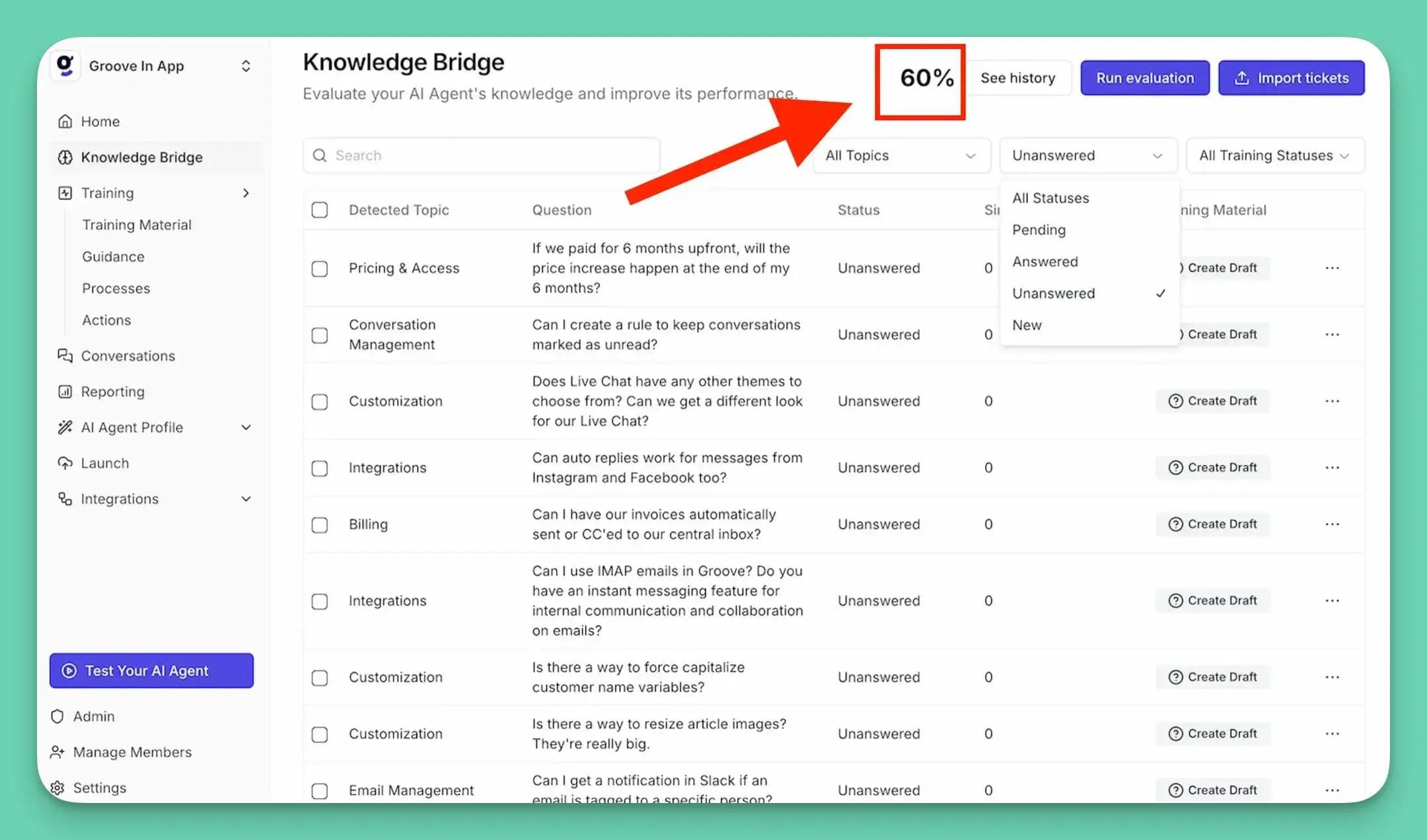
It doesn’t just link to articles; it actively syncs and validates information between the agent's intelligence and your help center. So when an answer in an FAQ is updated, the agent knows instantly.
This ensures your AI agent isn't just referencing your knowledge base but is a living, up-to-date extension of it. This active synchronization is what turns a static KPI into a driver for automatic improvement.
How to measure knowledge base utilization:
- Monitor the frequency of AI references to knowledge base articles during interactions.
- Assess which articles are most/least used and update content accordingly.
- Track the correlation between utilization and successful resolutions.
10. Self-Service Rate
What it is: The percentage of customers who resolve their issues entirely via AI tools without needing to engage with a live agent.
Why it matters: A rising self-service rate directly translates to lower operational costs and frees up your human agents to focus on complex, high-value problems. This aligns perfectly with modern customer preferences, as studies show 81% of customers attempt to solve issues on their own before reaching out to a live representative.
How to measure self-service rate: (Issues resolved by AI ÷ total number of support issues) x 100
11. AI Accuracy Rate
What it is: The percentage of time the AI provides correct and contextually appropriate answers.
Why it matters: If your AI is frequently wrong, customers will lose confidence in it and your brand. Improving accuracy is one of the most important goals when you measure your AI support's success.
How to measure AI accuracy rate:
- Analyze a representative sample of conversations for error rates, misinterpretations, and incorrect or incomplete answers.
- Use manual review, customer feedback, and automated validation tests.
- Accuracy Rate (%) = (Correct AI answers ÷ total analyzed answers) x 100
12. Customer Effort Score (CES)
What it is: A metric that asks customers how easy it was to get their issue resolved with the AI.
Why it matters: Modern customer service is all about reducing effort. As first identified in the Harvard Business Review article "Stop Trying to Delight Your Customers," a low-effort experience is a stronger predictor of customer loyalty than a high satisfaction score. Measuring CES reveals how seamless your AI support truly is.
How to measure CES: Ask a simple question like, "How easy was it to resolve your issue?" on a 1-5 or 1-7 scale after an interaction.
13. Interaction Volume
What it is: The total number of conversations your AI handles over a specific period
Why it matters: Tracking volume helps you understand demand, spot trends (like a spike after a new product launch), and ensure your system can handle the load as your company grows.
How to measure interaction volume:
- Aggregate all AI-initiated conversations within daily, weekly, or monthly periods.
- Segment volume by channel, product, or customer segment to pinpoint adoption trends or usage surges.
14. Conversion & Cost Savings
What they are: Two powerful business metrics. Conversion rate is the percentage of AI chats that lead to a desired outcome (like a sale or sign-up). Cost savings is the money saved by having AI handle issues instead of a human agent.
Why they matter: These KPIs tie your AI support directly to the bottom line. They are essential for proving the financial ROI of your automation efforts to leadership.
How to measure conversion and cost savings:
- Conversion: Set up goal completions within the AI interface and calculate conversion rate as (AI-driven conversions ÷ Total AI interactions) x 100.
- Cost Savings: Compare support center expenses before and after AI deployment, factoring in agent headcount, call durations, and other OPEX categories.
15. Training Data Quality
What it is: Not a traditional KPI, but a critical health metric. It’s an audit of how accurate, relevant, and unbiased the data used to train your AI model is.
Why it matters: The quality of your AI's "brain" determines the quality of its answers. High-quality training data is the root cause of high accuracy and resolution rates. Regularly reviewing your data for issues like algorithmic bias is the most proactive way to improve all other KPIs and ensure a fair customer experience.
How to measure training data quality: This is measured through regular audits of your training data sets, looking for outdated information, biases, and gaps in knowledge.
Best Practices for Measuring AI KPIs
Having the right KPIs is the first step, but a successful strategy depends on how you use them. Here are five best practices to turn your data into meaningful improvements.
- Set clear KPI targets and benchmarks. Define specific success thresholds for each KPI based on industry standards, business goals, and historic performance data.
- Leverage analytics platforms. Use advanced dashboards for real-time monitoring, trend analysis, and granular reporting across KPI segments.
- Integrate feedback loops. Your KPI data shouldn't live in a silo. Create a process to regularly share insights with your product and engineering teams. This feedback loop ensures that what you're learning from customers is used to build a better, smarter bot in the next update.
- Schedule regular reviews. Conduct monthly or quarterly reviews to assess progress, calibrate expectations, and reprioritize enhancements.
- Ensure data privacy and ethics. Always handle customer data responsibly. As you measure and analyze automated interactions, ensure you are fully compliant with all data protection regulations like GDPR. Building an ethical AI that respects user privacy isn't just a legal requirement; it's fundamental to earning and keeping customer trust.
Challenges and Limitations of AI KPIs
- Ambiguity in KPI definitions. Not all organizations define and interpret KPIs identically, which can lead to inconsistencies in reporting and benchmarking. Therefore, build consensus on precise definitions for meaningful measurement.
- Complexity of customer intent. AI can struggle with sarcasm, slang, or complex questions, which impacts accuracy and resolution scores. This can be improved with regular AI model retraining and advanced language processing.
- Data quality and availability. Your KPIs are only as good as your data. Incomplete or inaccurate data will lead to misleading insights. Robust data governance and regular audits are essential to ensure you're acting on reliable information.
- Balancing automation with human touch. Over-reliance on automation may degrade the customer experience in complex or emotionally charged scenarios. Use your escalation rate KPI to find the optimal balance and know when to hand off a conversation to a human agent.
- Maintaining ethical standards. There are risks related to privacy, fairness, and transparency in automated interactions. Ensure AI systems are transparent, bias-mitigated, and compliant with prevailing regulations.
Turn Your AI KPIs into Your Biggest Advantage
So, you’ve got your list of KPIs. You know your CSAT from your FCR, and you have a dashboard full of numbers. But here’s the hard truth: data is useless if you don’t act on it. The biggest challenge isn't tracking your AI's performance, but building a system that automatically improves it.
That’s where Helply comes in. We designed our AI agent around a simple idea: it should get smarter with every single ticket.
Our reporting suite doesn't just show you an escalation rate; it helps you dig into why those escalations happen. Our knowledge bridge then uses that insight to find and fix gaps in your content, boosting your AI accuracy rate automatically. It’s a closed-loop system designed for one thing: turning insights into resolutions.
It's how our partners achieve a 66.3% AI resolution rate. They aren’t just measuring KPIs; they’re using an AI agent that is built to improve them.
Ready to put your tier-1 support and its improvement on autopilot?
Book a demo today and see the power of Helply in play!
About the author

Bildad Oyugi
Head of Content
Bildad is a digital marketing expert with over 5 years of experience in copywriting, content marketing, and editing. Outside of work, he enjoys videography and spending time with his family.


