Key Takeaways
- The earliest known use of “the customer is always right” dates to 1905, in Boston newspaper accounts of retailer Marshall Field. Snopes found no evidence that the original motto included “in matters of taste,” so the full quote has no qualifier.
- If you run the motto as a policy, you can lose good staff. Pew found that 57% of US workers who quit a job in 2021 cited feeling disrespected as a reason.
- A customer can be wrong about the facts and still deserve a fair hearing. Check the order or account before you agree or push back.
- Write down your refund, exception, and abuse rules, so no agent has to decide alone under pressure.
- With your order and billing tools connected, Helply's agents can look up the account before replying. Background Agents can flag churn risk and feature requests to the right team. Every plan has unlimited users, so those teammates can see the conversation.
Businesses keep the motto because good service pays off. For its 2024 ROI of Customer Experience study, Qualtrics XM Institute analyzed ratings from 28,400 consumers in 26 countries. After a five-star experience, consumers were 3.0 times more likely to recommend an organization than after a one- or two-star experience.
In Zendesk's CX Trends 2025 report, 63% of consumers were willing to switch to a competitor over one bad experience.
The trouble starts when a company makes the motto its policy. Agents lose room for judgment and can't tell a fair complaint from an unreasonable demand.
Who Said “The Customer Is Always Right”? The Origin and Full Quote
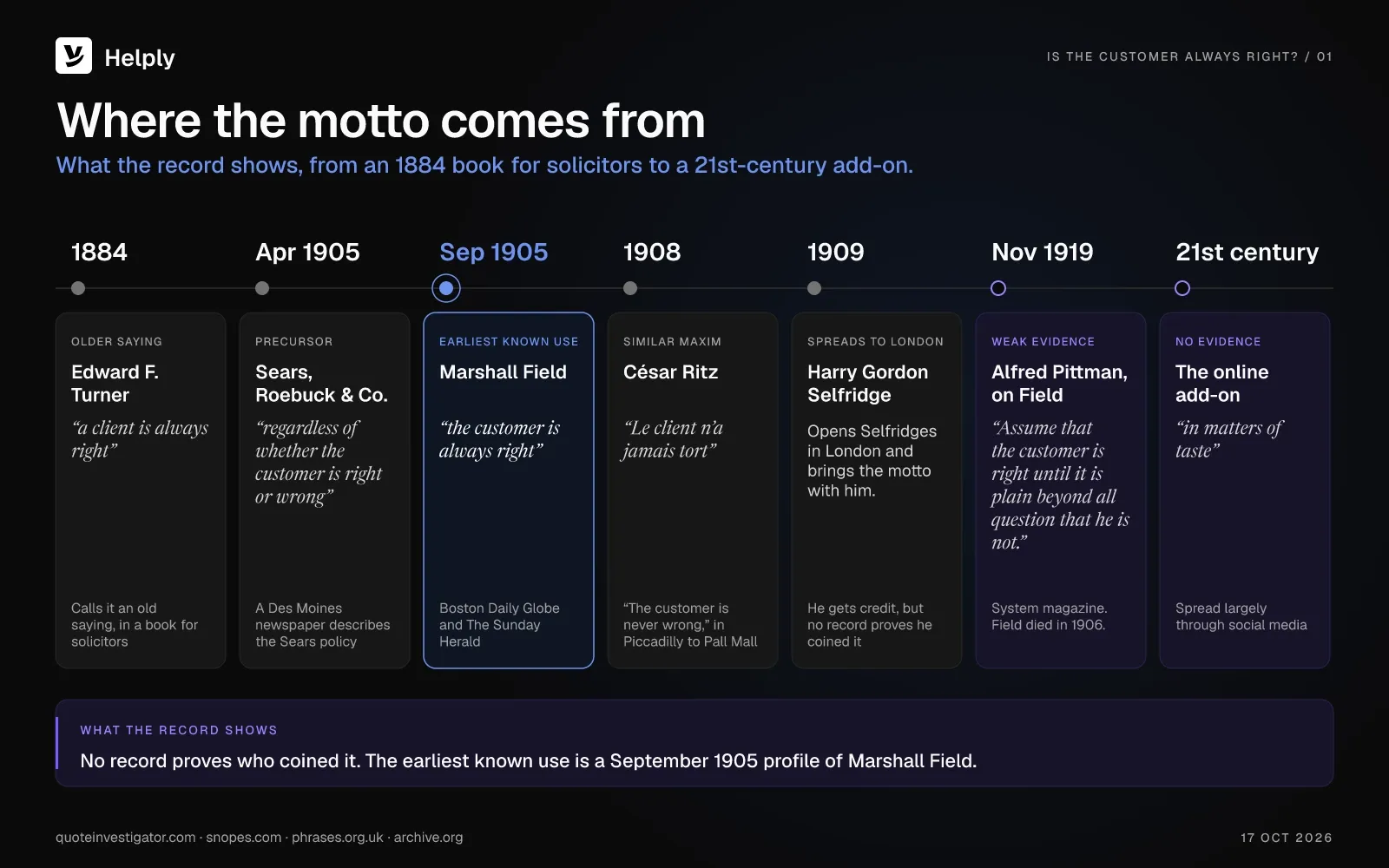
No record proves who first said, “The customer is always right.” Marshall Field, Harry Gordon Selfridge, and John Wanamaker get the credit. These early-1900s retailers used the motto to instruct staff to handle complaints with respect.
The earliest known use of the wording ran in two Boston newspapers in September 1905, in a profile of Chicago retailer Marshall Field. “Broadly speaking, Mr. Field adheres to the theory that ‘the customer is always right,’” the Boston Daily Globe wrote on 24 September. Quote Investigator found the same text in The Sunday Herald three weeks earlier, on 3 September.
The idea is older than that wording. In an 1884 book for solicitors, Edward F. Turner called “a client is always right” an old saying, useful “only up to the point at which self-respect makes its appearance.” In April 1905, a Des Moines newspaper credited Sears, Roebuck & Co. with a policy to satisfy the customer “regardless of whether the customer is right or wrong.”
Field, Selfridge, and Wanamaker sold in an era of caveat emptor, or “let the buyer beware.” With the motto, they promised to hear shoppers' complaints. Selfridge took it to London, where he opened Selfridges in 1909.
Hotelier César Ritz ran his hotels on a similar French maxim: “Le client n'a jamais tort,” or “the customer is never wrong.” In Piccadilly to Pall Mall (1908), Ralph Nevill and Charles Edward Jerningham wrote that his staff met every complaint, “however frivolous, ill-grounded, or absurd,” with civility.
Writing in System: The Magazine of Business in November 1919, Alfred Pittman credited Field with a longer version: “Assume that the customer is right until it is plain beyond all question that he is not.” Field died in 1906, and Quote Investigator calls the evidence for this version weak.
Is “The Customer Is Always Right in Matters of Taste” the Full Quote?
No. The 1905 Field profile and the 1908 record of Ritz's maxim carry no mention of taste. Snopes found no evidence that Harry Gordon Selfridge used the “matters of taste” wording, including in his 1918 book The Romance of Commerce.
Phrase Finder calls the add-on “a 21st-century invention spread largely through social media.” The full quote ends at “the customer is always right.”
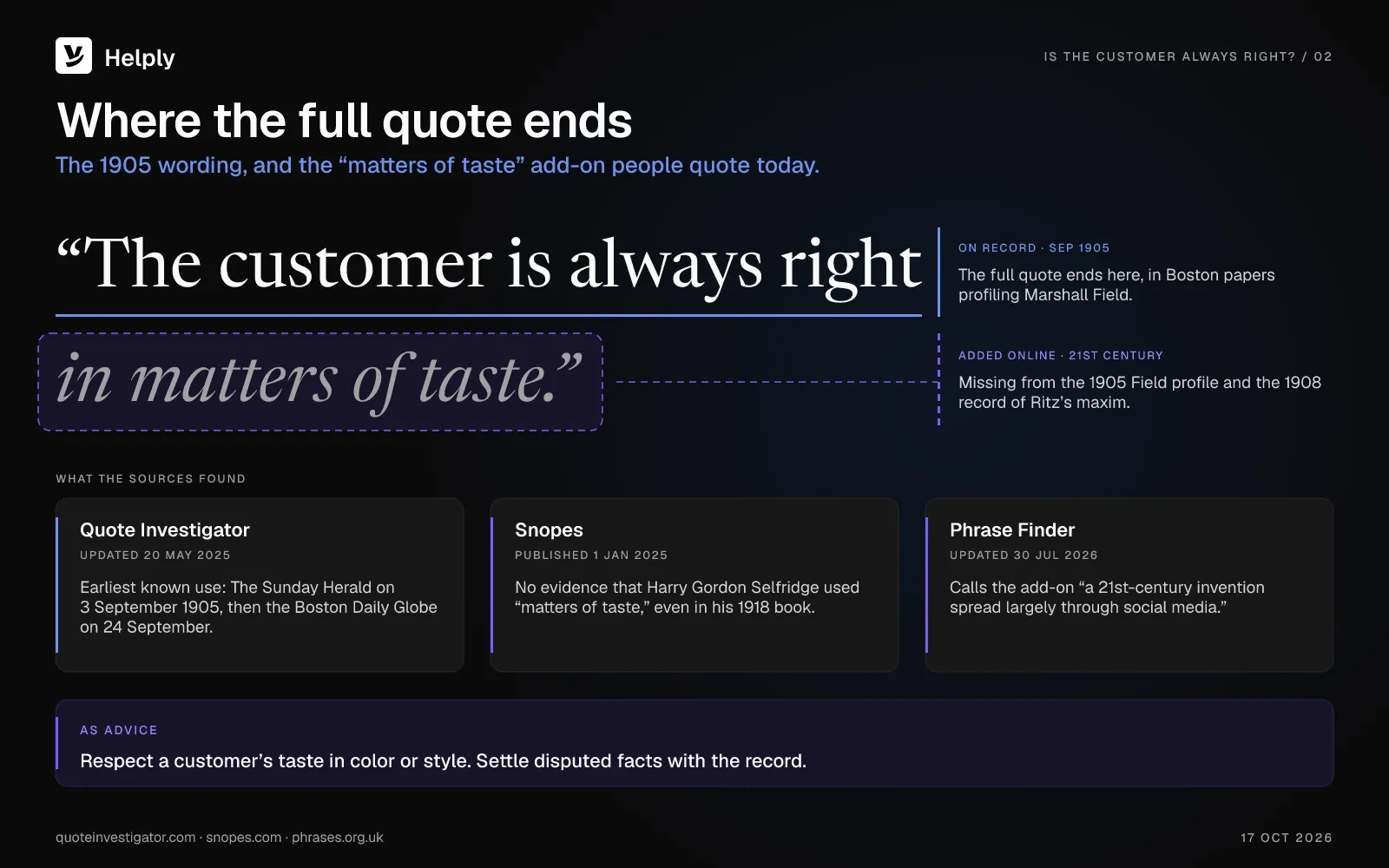
As advice, the add-on holds up for preferences: customers pick the color or style they like, and staff should respect that choice.
5 Reasons the Customer Is Not Always Right
1. Agents Burn Out Under the Motto
Researchers at Deakin University titled a 2023 study “The customer is often wrong.” They found that customer-caused failures harm frontline employees' well-being. An apology from the customer helps, but its benefit fades when staff lack a supervisor's support.
Tell agents to side with the customer every time, and they learn that their judgment doesn't count.
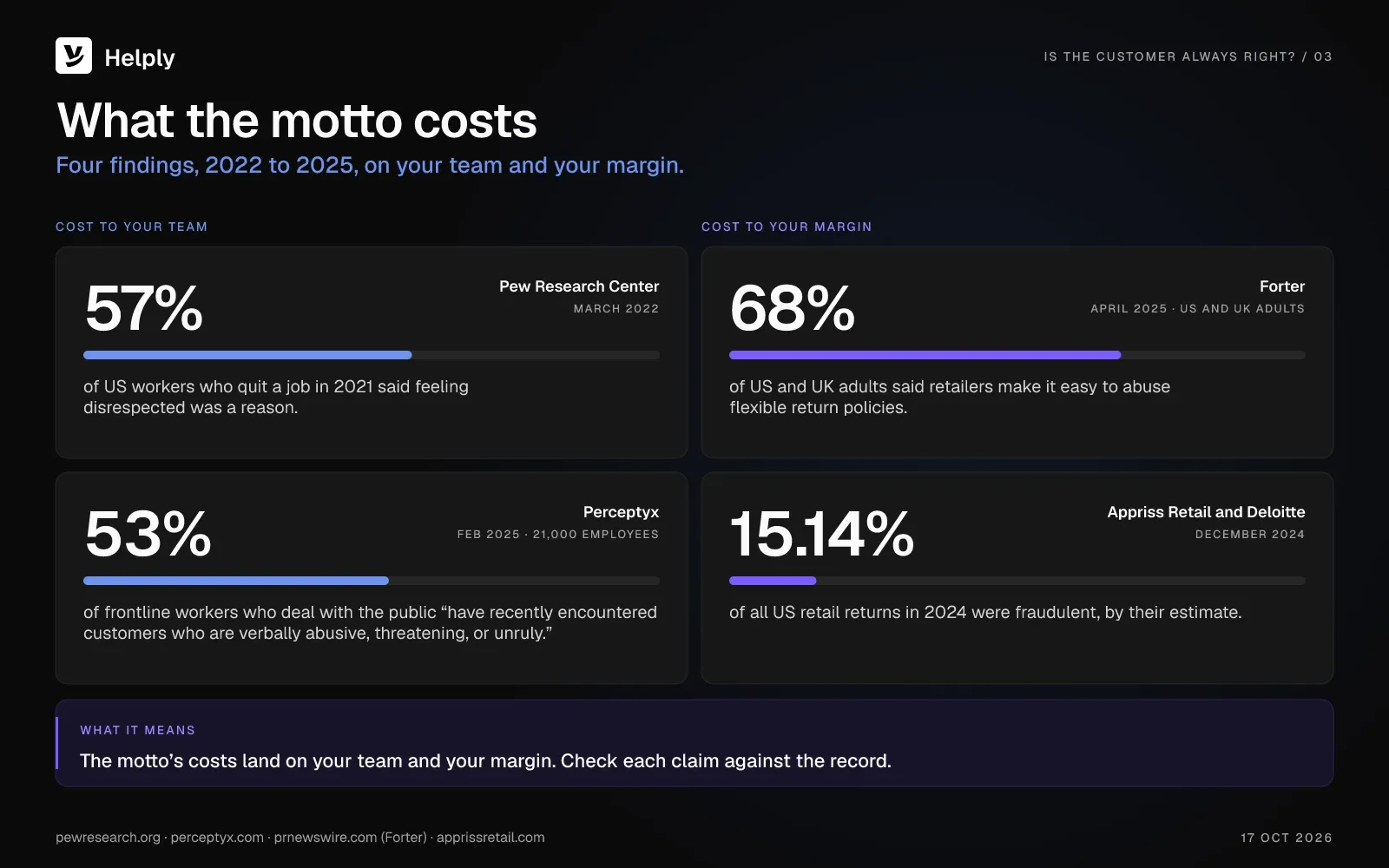
In a 2022 Pew Research Center survey, 57% of US workers who quit a job in 2021 said feeling disrespected was a reason. Managers who always side with the customer build disrespect into the daily work.
Each time a manager overrules an agent to calm a difficult customer, the agent concludes that the customer's feelings outrank theirs.
2. Some Customers Use the Motto to Justify Abuse
In a 2021 analysis, Business Insider linked the phrase to shopper entitlement that led to aggression and even violence toward retail workers. Perceptyx published a survey of 21,000 frontline employees in February 2025, and 53% of those who deal with the public “have recently encountered customers who are verbally abusive, threatening, or unruly.”
Some customers who believe they're always right act on it. They make demands and threats, and some insult the staff serving them.
In a 2025 Forter survey of US and UK adults, 68% said retailers make it easy to abuse flexible return policies. Appriss Retail and Deloitte estimated that fraudulent returns accounted for 15.14% of all US retail returns in 2024.
You may see the same habit in scope creep and in refund requests after heavy use. Some customers call free custom work a “partnership” and cite the motto to justify the ask.
3. Early Retailers Meant It as a Promise to Listen
Field and Selfridge used the motto to win shoppers' trust. They wanted staff to listen and give every complaint a hearing. In the longer version, a 1919 writer attributed to Field, staff treat the customer as right until they can prove otherwise.
A manager who approves every demand or refunds every complaint on request treats an advertising line like a contract.
4. Customers Sometimes Lack the Full Picture
Customers know their own goals, but they can't see your systems. A customer who says “this feature is broken” may be looking at a setting they changed last week.
A customer who says “your competitor does this better” may be comparing a different plan. Agreeing won't help either of you, so show them what the record says.
Give the customer an honest explanation of the facts behind the issue, and work out the fix with them.
If you agree without checking, you teach customers to blame you for their own misconfigurations.
5. Customers Learn to Expect Exceptions
In the Nordstrom tire story, a Fairbanks, Alaska, customer returned tires for a refund at a Nordstrom store, though Nordstrom never sold tires. Nordstrom says the story is true. The building had belonged to Northern Commercial Company, which sold tires, until Nordstrom bought it in the 1970s.
You could take the story as proof that every rule should bend. One goodwill refund costs little, but a standing rule to refund anything, for anyone, adds up.
You set a precedent each time you accept a return outside your policy or build a custom feature for one account. Your most demanding customers will hold you to it, and you pass the cost to the rest.
Richard Branson's first business fundamental is about staff: “Look after your people and your people will look after your business.”
Who Is Right When a Customer Disputes the Facts?
You can check your records to see who is right. Many customer disputes turn on a fact, such as whether the order shipped or who changed a setting. Your rep owes every customer a fair hearing, including one who has the facts wrong, and gives it by checking the record.
Your customers may know your product well, and some know a feature better than the new hire answering them. To hold their own, your rep needs to see enough of the account to know what happened.
That takes the order or account, billing history, product usage and past conversations in one view. With all four in front of them, your rep can answer from the record.
Without that view, reps hunt for facts across tools. At AirGigs, a marketplace for hiring remote studio musicians, a person once checked the account and order for each routine question. “We were paying skilled people to answer ‘how do I log in?’ a hundred times a week, and every answer meant digging through three screens first,” says David Blacker, co-founder and CEO.
In Helply's customer records, your team and AI agents see the customer's details, past conversations, account information and support activity in one place. Connected tools can add order, billing and usage data.
Let AI Gather the Facts Before Anyone Replies
Under the old rule, a manager had to choose. They could side with the customer and wear down the agent, or back the agent and risk the account.
An AI agent can look up the account in your connected order and billing tools before your rep starts. Your rep replies with the facts in hand, and the manager can back whichever side those facts support.
Assist Drafts From the Record, and Your Rep Decides
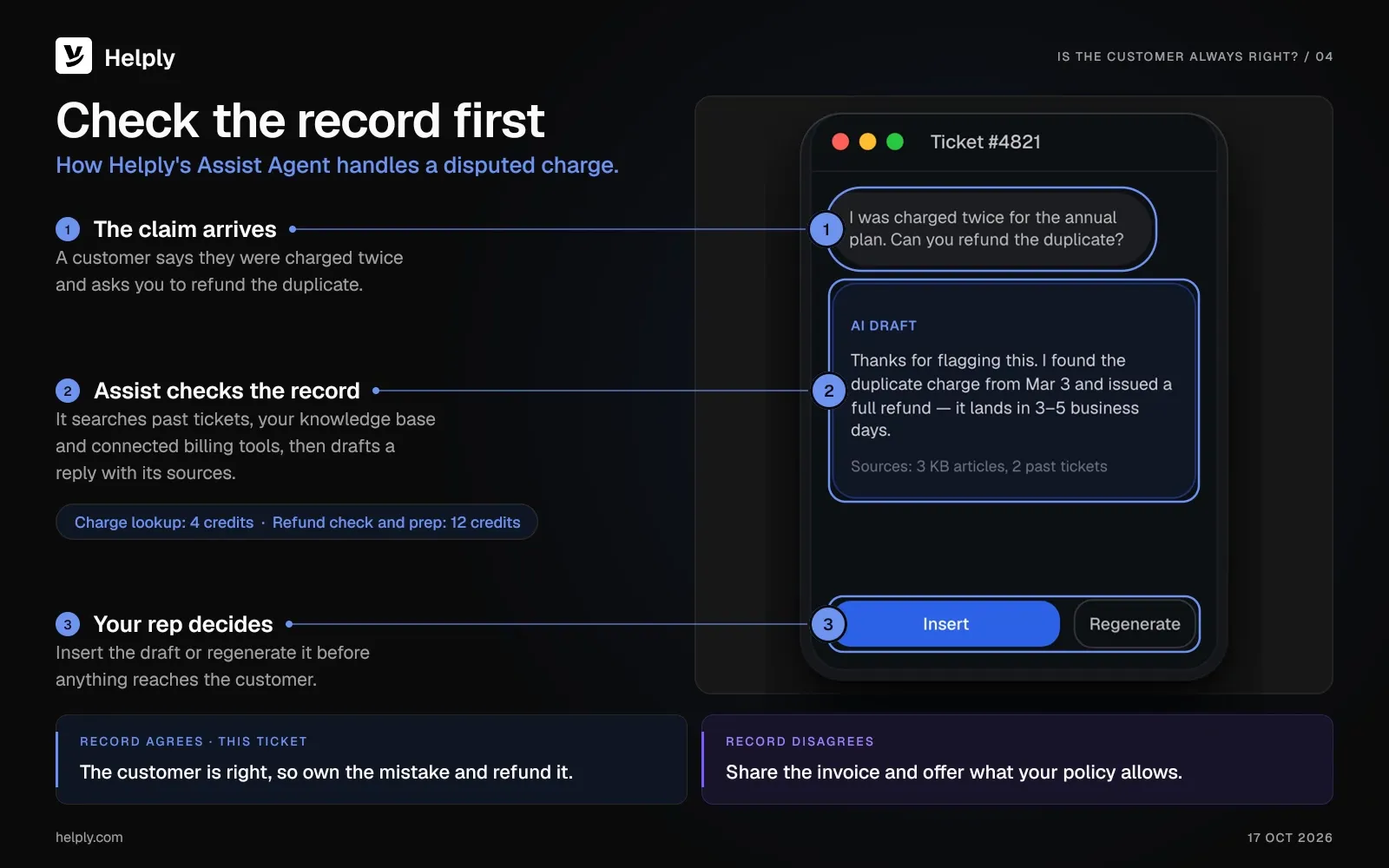
Helply's Assist Agent works beside your rep inside the conversation. It searches customer history, your knowledge base and connected tools, then drafts a reply grounded in your Guidelines. Your rep gets the facts without leaving Helply.
Your rep can edit the draft or discard it. A draft that uses no tools costs 1 credit, while a lookup in one or two connected systems costs 4. Drafts your team throws out before a customer sees them cost nothing.
Let the Support Agent Resolve Routine Requests
Helply's Support Agent answers customers on every channel. It can investigate with connected tools, take supported actions and resolve routine requests, such as an order status check, from start to finish.
With escalation rules, you can send refund disputes, threats or high-value cases to a person and let AI handle what it can. If the Support Agent isn't confident, it hands your team the conversation along with everything it checked.
Ask Assist About the Customer Without Leaving the Ticket
Before a rep answers a disputed claim, they can ask Assist about the customer.
“Is this our bug or their config?” and “Why were they charged $412 this month?” use 4 credits each. “Do they qualify for a refund, and prepare it” uses 12, since Assist checks several systems and ends with a judgment call.
Your rep reviews what Assist found, approves any refund and answers the claim on the facts.
Any teammate who handles disputes can use Assist, since every plan has unlimited users. The AI's work runs on credit blocks, starting at 500 credits for $49 a month ($42 on annual billing).
How to Handle a Customer Who Is Wrong
If a customer gets the facts wrong, hear them out and check the record before anyone replies.
Six Common Disputes and a Better Reply to Each
| Situation | Wrong Response | Better Response | Why |
|---|---|---|---|
| Customer wants custom work outside their plan or contract | Build it to keep them happy | Acknowledge the need, explain the scope and offer a workaround or paid service | Protects margins and sets honest expectations |
| Customer insults or threatens an agent | Tolerate it because the account is large | Set a boundary, warn once, then hand off or end the conversation | Your team's safety outweighs any one account |
| Customer blames the product for a setting they changed | Apologize and accept fault | Show the settings history and walk them through the fix | Keeps the conversation on the cause instead of on blame |
| Customer says an order never arrived, but tracking shows delivery | Refund at once without checking | Share the tracking record, open a carrier claim and agree on a next step | Guards against abuse without calling anyone a liar |
| Customer threatens to cancel over a missing feature | Promise it's on the roadmap | Log the request against the account and alert the account owner | Gives the right person time to act |
| Customer wants a refund after using the service | Refund with no questions | Review what they used, then offer a credit, a partial refund or more onboarding | Ties the outcome to usage instead of a blanket rule |
If the record shows your company made the mistake, the customer is right, so own it. Apologize and fix it, and use these customer apology letter templates for serious failures.
If a customer turns abusive, follow these steps for dealing with angry customers, including how to end the conversation.
Three Steps When a Customer Escalates
Step 1: Listen, then open the record. Before you respond to any escalation, check the order or plan, billing, product usage and past conversations.
Step 2: Answer with what the record shows. Share the order status, settings history or invoice, and adapt one of these customer service email templates to explain what happened. Swap “I think” for “Our records show.”
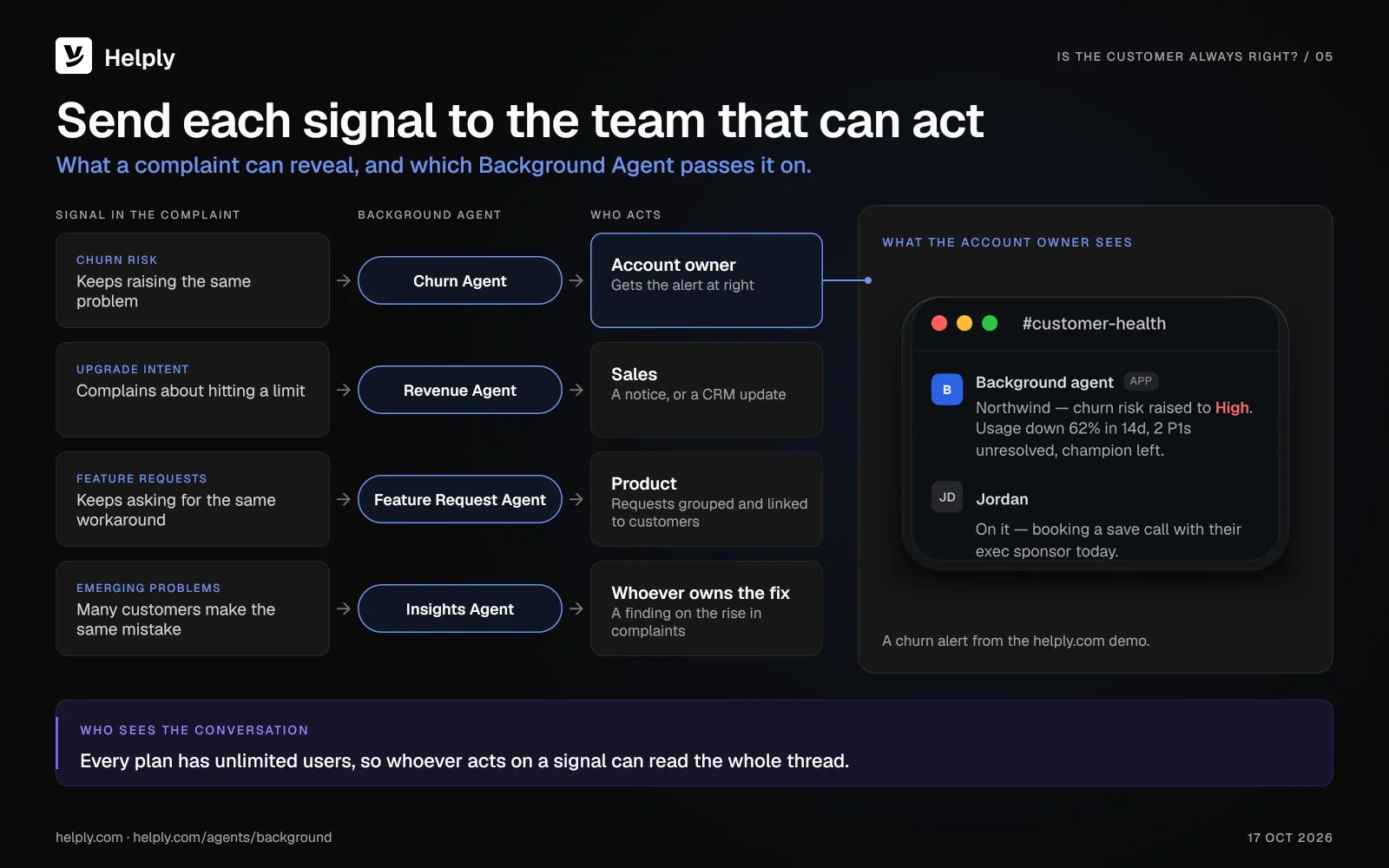
Step 3: Pass on what you learned from the complaint. Send churn risk to the account owner, upgrade questions to sales and feature requests to product.
Send Each Complaint's Signal to the Team That Can Act
Read each complaint for more than its request. A customer who demands a refund may be at risk of churning, and an angry thread about a missing feature is product feedback.
Helply's Background Agents monitor every conversation for these signals. They can alert teammates, update systems or trigger workflows:
- Churn risk. A customer who keeps complaining about the same problem may be close to leaving. The Churn Agent tracks frustration, repeat problems and shifts in sentiment, and it can alert the right teammate.
- Upgrade intent. A complaint about hitting a limit can mean the customer is ready to buy more. The Revenue Agent spots that intent and can notify sales or update your CRM.
- Feature requests. Customers who keep asking for the same workaround have found a gap your product team can fill. The Feature Request Agent groups requests across conversations and connects each one to the customers asking.
- Emerging problems. A run of customers making the same mistake can mean a screen or policy is unclear. The Insights Agent surfaces unusual increases in complaints or topics and delivers the finding to the right people.
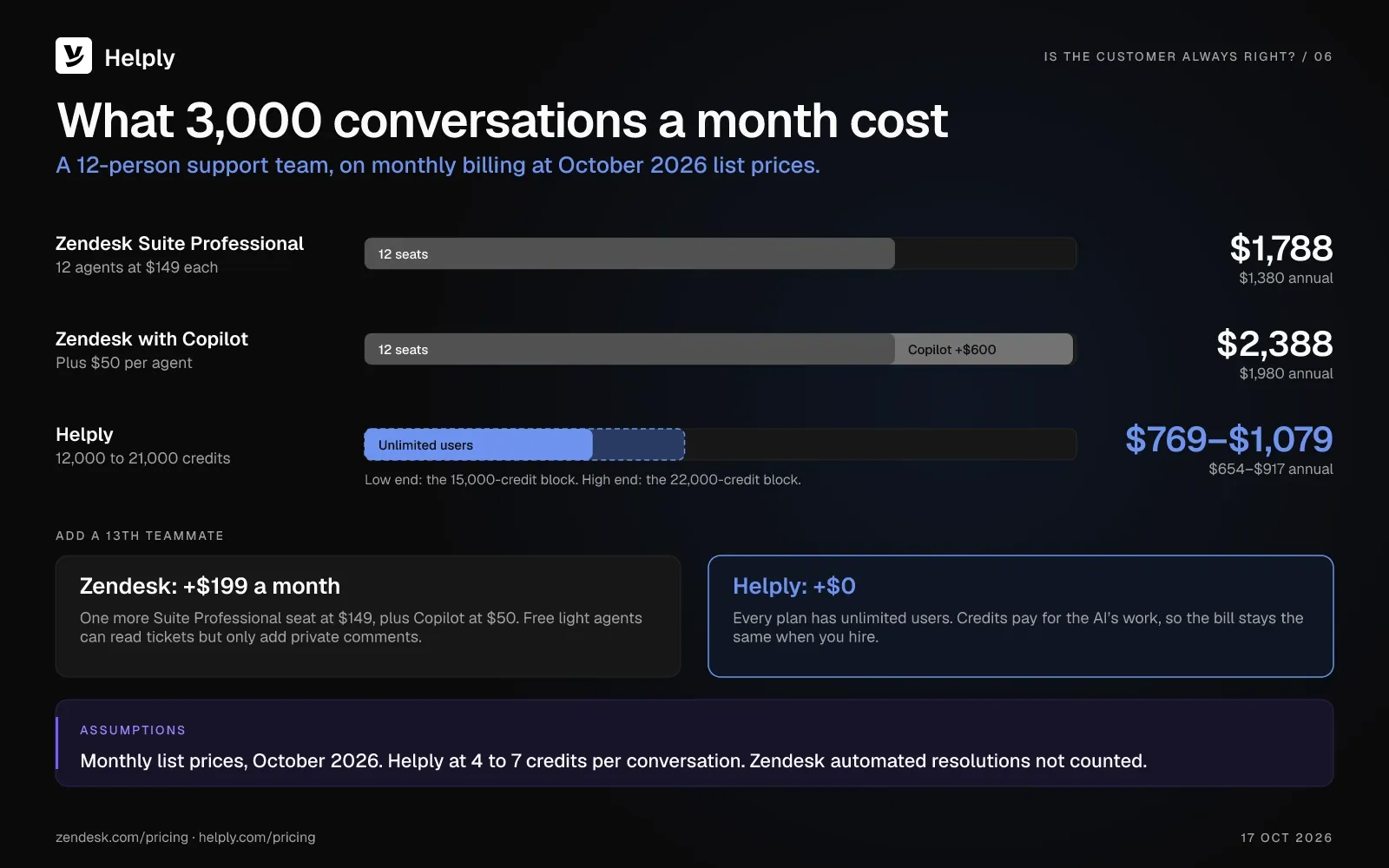
The people who act on a signal need to see the conversation. In October 2026, 12 agents on Zendesk Suite Professional cost $1,788 a month ($1,380 on annual billing). Adding Copilot at $50 per agent a month brings the total to $2,388 ($1,980 on annual billing).
Zendesk light agents, up to 100 on that plan, can read tickets, but every comment they add stays private.
Helply is a full help desk with AI agents built in, and every plan has unlimited users. Product, operations, engineering and founders can join the same thread with no per-user fee. Say the same 12-person team handles 3,000 conversations a month, at about 4 to 7 credits each.
That comes to 12,000 to 21,000 credits a month. The 15,000-credit block costs $769 a month and the 22,000-credit block $1,079 ($654 or $917 on annual billing). You buy credits for the AI's work and nothing else, so the bill stays the same when you hire.
You do right by the customer when you check each complaint against the record and pass its signal to whoever can act.
Check Each Disputed Claim by Hand, or Let Helply Pull the Record?
A small team with a few disputes a week can check each claim by hand, using a written policy and its help desk. Helply fits once your reps spend more time gathering facts than answering, or once hard tickets wait behind routine ones.
The Support Agent can handle routine requests and pass the rest to your team, attaching its findings. Your reps then spend their judgment on the disputes that need it.
Assist can pull the account record into a draft, and your rep edits it before it goes out. Once you write your refund and exception rules into Guidelines, Helply's AI agents follow the same policy as your reps.
You may worry that AI will side with whoever pushes hardest. In Guidelines, you define what the AI can grant on its own, such as a refund or an exception. Escalation rules you write can send sensitive or high-value cases to a person.
At AirGigs, the Assist Agent freed one full-time rep for marketplace operations. “It gave us a whole person back, and my whole team can finally see what's going on for less than the old per-seat tool cost,” says David Blacker.
Your whole company can see disputes and the signals inside them at no per-user cost. Credit blocks start at 500 credits for $49 a month ($42 on annual billing).
Start by turning your refund policy into Guidelines. Writing Guidelines and connecting tools use no credits.
Frequently asked questions
No. The motto asks staff to respect every complaint, yet customers can be wrong about facts such as an order or a bill. Hear them out, check the record and fix what your company got wrong.
“The customer is always right” means staff should treat every complaint with respect and give the customer a fair hearing. Retailers used it in the early 1900s to win trust when “let the buyer beware” was common practice.
Boston newspapers linked it to Chicago retailer Marshall Field in September 1905, the earliest known use. Harry Gordon Selfridge and John Wanamaker share the credit, and César Ritz used the French “Le client n'a jamais tort.” No record proves who coined it.
The full and original quote is “the customer is always right,” with nothing after it. Phrase Finder calls the “in matters of taste” ending a 21st-century add-on.
In 1919, writer Alfred Pittman credited Marshall Field with a longer version: “Assume that the customer is right until it is plain beyond all question that he is not.” Field died in 1906, and Quote Investigator rates that evidence as weak.
The add-on means customers decide what they like, such as a color or a style. Snopes found no evidence that the original phrase included “in matters of taste,” or that Selfridge said it. Phrase Finder dates the add-on to the 21st century.
Early 1900s retailers used it to promise shoppers a fair hearing in an age of “let the buyer beware.” Businesses keep repeating it because unhappy customers can take their money elsewhere. Announcing CX Trends 2026, Zendesk CEO Tom Eggemeier said 85% of CX leaders see one unresolved issue as enough to lose a customer.
Customers can misread a bill, change a setting by mistake or ask for something your policy doesn't allow. Some abuse the rules: Appriss Retail and Deloitte estimated that 15.14% of US retail returns in 2024 were fraudulent. Deakin University researchers found in 2023 that customer-caused failures harm frontline employees' well-being.
No, not on the facts. Customers decide what they want to buy and how an experience felt to them. Your team checks the facts about orders, bills and settings and applies the same policy to every customer.
Listen to the full complaint, then look up the order or account, the bill and past conversations. Explain what you found, correct any mistake on your side and offer what your policy allows. Set a boundary if the customer turns abusive, and route churn risk or product feedback to whoever can act on it.
Say no, then show your judgment. A sample answer: “No, but every customer deserves a fair hearing, so I listen, check the facts and fix anything we got wrong. If the facts back our policy, I explain it with courtesy and offer the best option it allows.”
“Every customer deserves a fair hearing.” That motto keeps the respect behind the old one and leaves staff room to check the facts and apply a fair policy.
AI can pull the account record into view before anyone answers. Inside Helply, an AI-native customer support platform, your rep edits whatever the Assist Agent drafts from that record. Guidelines hold your refund and exception rules, and escalation rules can send sensitive cases to a person.
About the author

Bildad Oyugi
Head of Content
Bildad is a digital marketing expert with over 5 years of experience in copywriting, content marketing, and editing. Outside of work, he enjoys videography and spending time with his family.


