Key Takeaways
- Per-agent pricing scales with headcount: five people on Zendesk Suite Team cost $275 a month on annual billing, before AI.
- Shared Gmail and Outlook inboxes break down past about 10 support people or a few hundred weekly tickets.
- Most tools charge per agent, then bill AI on top: per resolution, per session, or per seat.
- Free plans exist, but each caps users, contacts, or AI usage, and self-hosted tools require engineering time.
- Helply is a complete help desk with unlimited users on every plan. Plans start at $49 a month, and the AI runs on included credits.
Three reps share one Gmail inbox, and a customer email sits unanswered for four days because no one knows who owns it.
In a shared inbox, everyone sees a message, and no one owns it, so two people send different answers.
A billing question slides to page two, where nobody answers it. In HubSpot's 2024 survey of 1,537 customer experience leaders, 67 percent said customers expect tickets to be resolved within three hours. A shared inbox has no clock to track that target.
The 10 helpdesk ticketing systems for small businesses below differ most in their per-user pricing and AI costs.
What Is a Helpdesk Ticketing System?
A helpdesk ticketing system is software that collects customer or employee requests from email, chat, messaging, and web forms. It turns each one into a ticket with a unique ID and an owner, and tracks it from the first message to resolution.
Each ticket gives you four things a plain inbox can't:
- A unique ticket ID and timestamp. Every request becomes a numbered ticket, so none goes missing.
- Clear ownership. One person owns each ticket, so two people never reply to the same customer.
- Threaded history. The whole exchange lives in one place, so the next rep never has to start from scratch.
- Response-time tracking. SLA timers show what is on time and what is slipping.
What is an email ticketing system?
An email ticketing system is the email side of a help desk.
It converts messages sent to an address like support@yourcompany.com into tickets with an owner, threaded history, and response tracking.
The Best Helpdesk Ticketing Systems for Small Business at a Glance
| Tool | Best For | AI | Starting Price | Free Plan or Trial |
|---|---|---|---|---|
| Helply (formerly Groove) | Small teams whose volume is growing faster than headcount | Agents triage, draft, resolve and take approved actions; hand off with context | $49/month, unlimited users, AI credits included | 14 days free, 1,000 credits, no card |
| Zendesk | Large teams with complex routing | Copilot ($50 per agent, Suite Professional and up); 5 to 10 resolutions per agent included, then $1.50 to $2.00 each | $19 per agent (Support Team), $55 (Suite Team), annual | 14-day trial |
| Freshdesk | Teams that want a free six-month start and a cheaper Copilot | Freddy AI Agent (500 sessions once, then $49 per 100); Copilot $29 per agent on Pro | $19 per agent, annual | 14-day trial; a two-agent Free Program for six months |
| Help Scout | Email-first teams that want a clean inbox | AI Drafts on Plus and Pro; AI Answers $0.75 per resolution | $25 per user, annual | Free plan: 5 users, 100 contacts a month |
| Hiver | Teams that work in Gmail | AI Agents on every plan | $25 per user, annual | 7-day trial |
| Zoho Desk | Teams on Zoho CRM or other Zoho apps | Zia Agents free on all plans; prebuilt Desk agents on Enterprise | $7 per user (Express), annual | Free plan: 3 users |
| Front | Shared-inbox collaboration | Autopilot billed per conversation, $0.05 to $0.89 | $25 per seat (Starter), annual | 14-day trial, no card |
| HelpDesk | Simple queues with some AI included | 10 to 200 AI resolutions a month; extra packs of 50 for $49.50 | $19 per user, annual | 14-day trial |
| JitBit | Small technical teams and self-hosting | AI triage and first replies | $24.92/month for 1 agent, annual ($29 monthly) | Trial |
| osTicket | Zero-budget self-hosting | None | Free self-hosted; cloud from $12 per agent | Free |
Helply: Best for Handling More Tickets Without Growing the Team
Helply (formerly Groove) is a complete AI-native customer support platform. Shared inbox, views, assignment, custom fields, collision detection, internal notes, help center and reporting all come in its help desk.
Every plan has unlimited users, and credits cover the work the AI does.
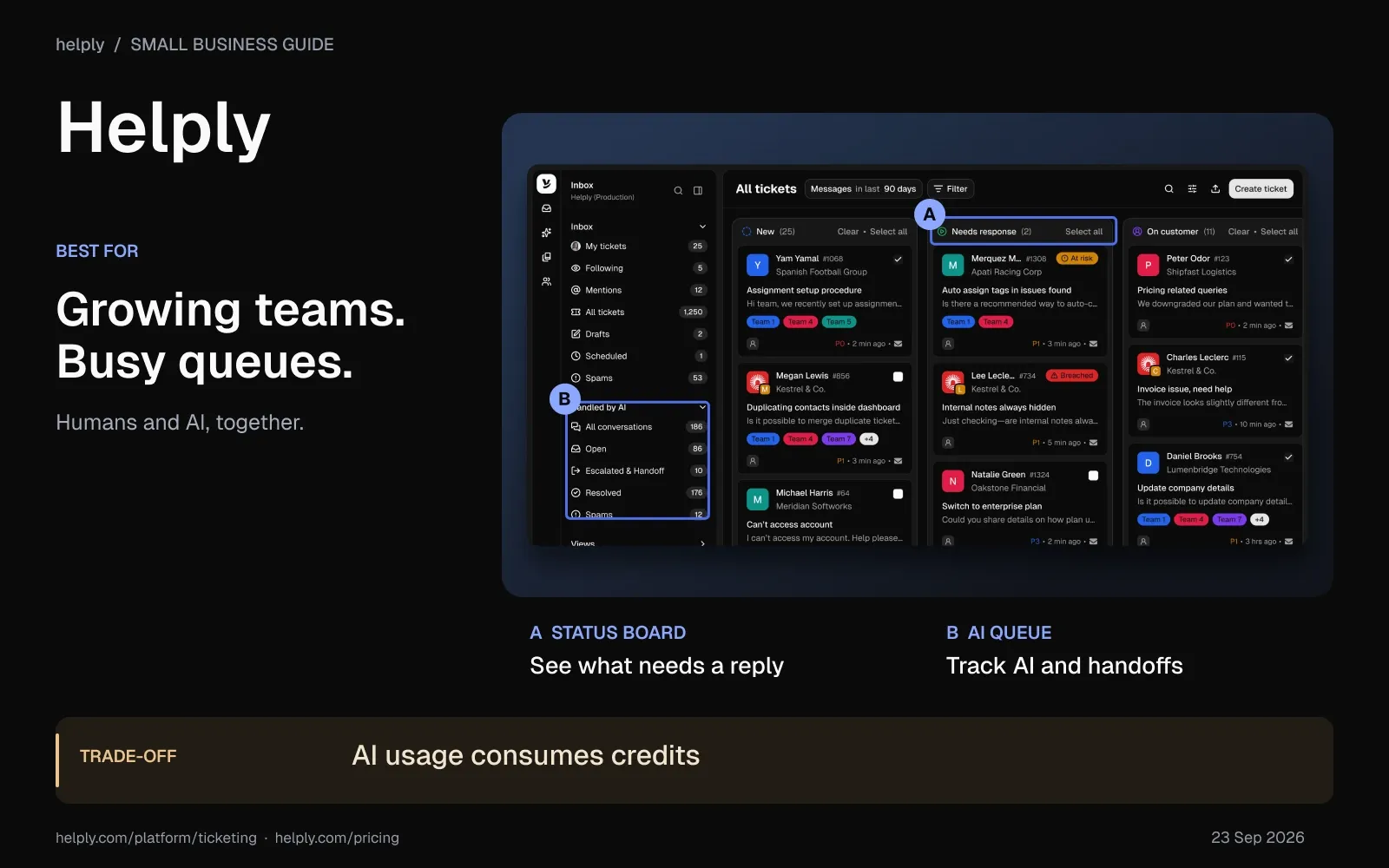
Three kinds of AI agents work inside that help desk, and you set how much each one can do.
The Support Agent talks with customers over email, chat, SMS, WhatsApp, Slack, Teams, Discord and Telegram.
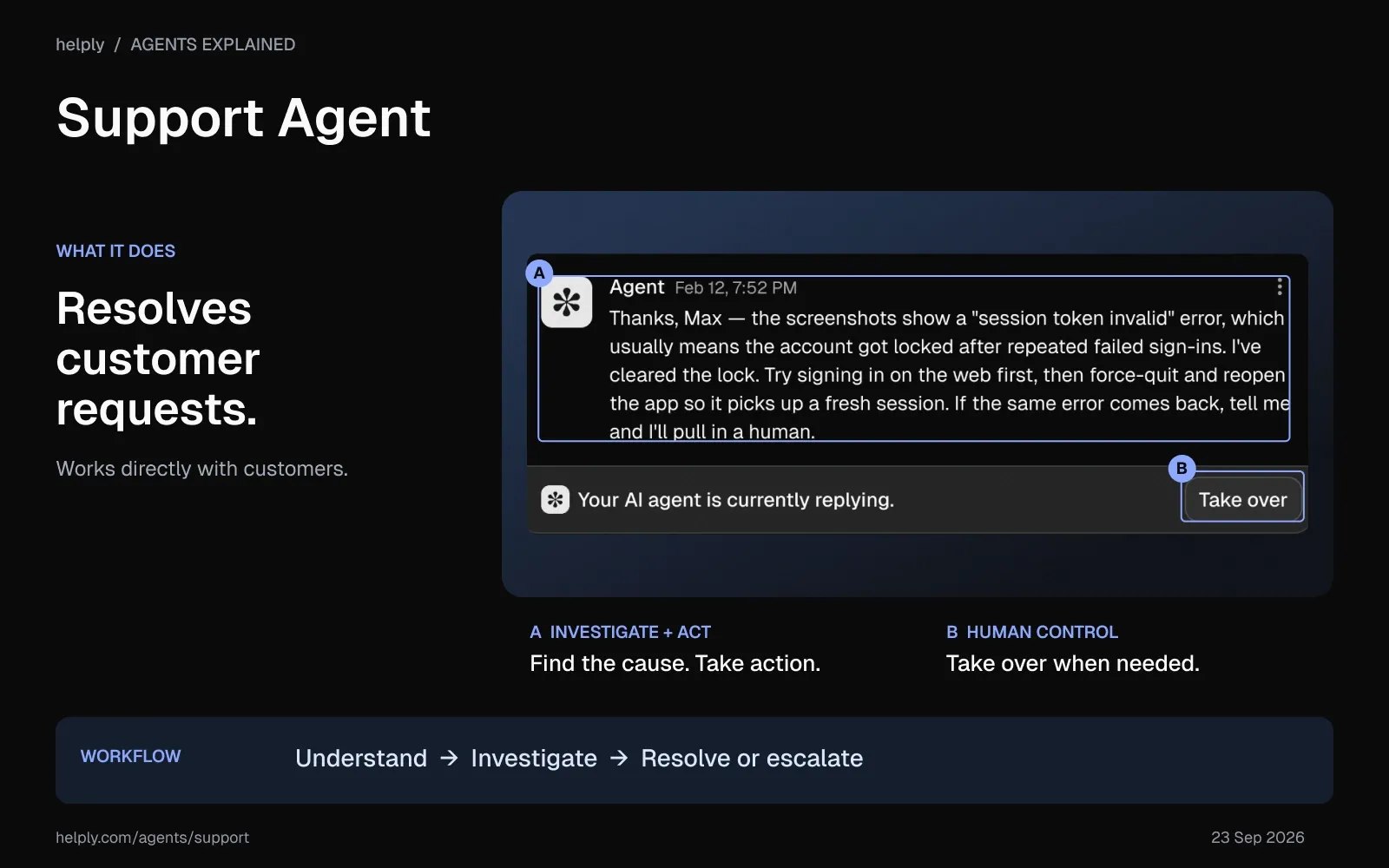
It reads the customer's history and checks Stripe, Salesforce or HubSpot, then takes the actions you have approved, such as issuing a refund. If it isn't confident, it hands the ticket to your rep with the investigation done.
The Assist Agent sits inside the conversation with your rep.
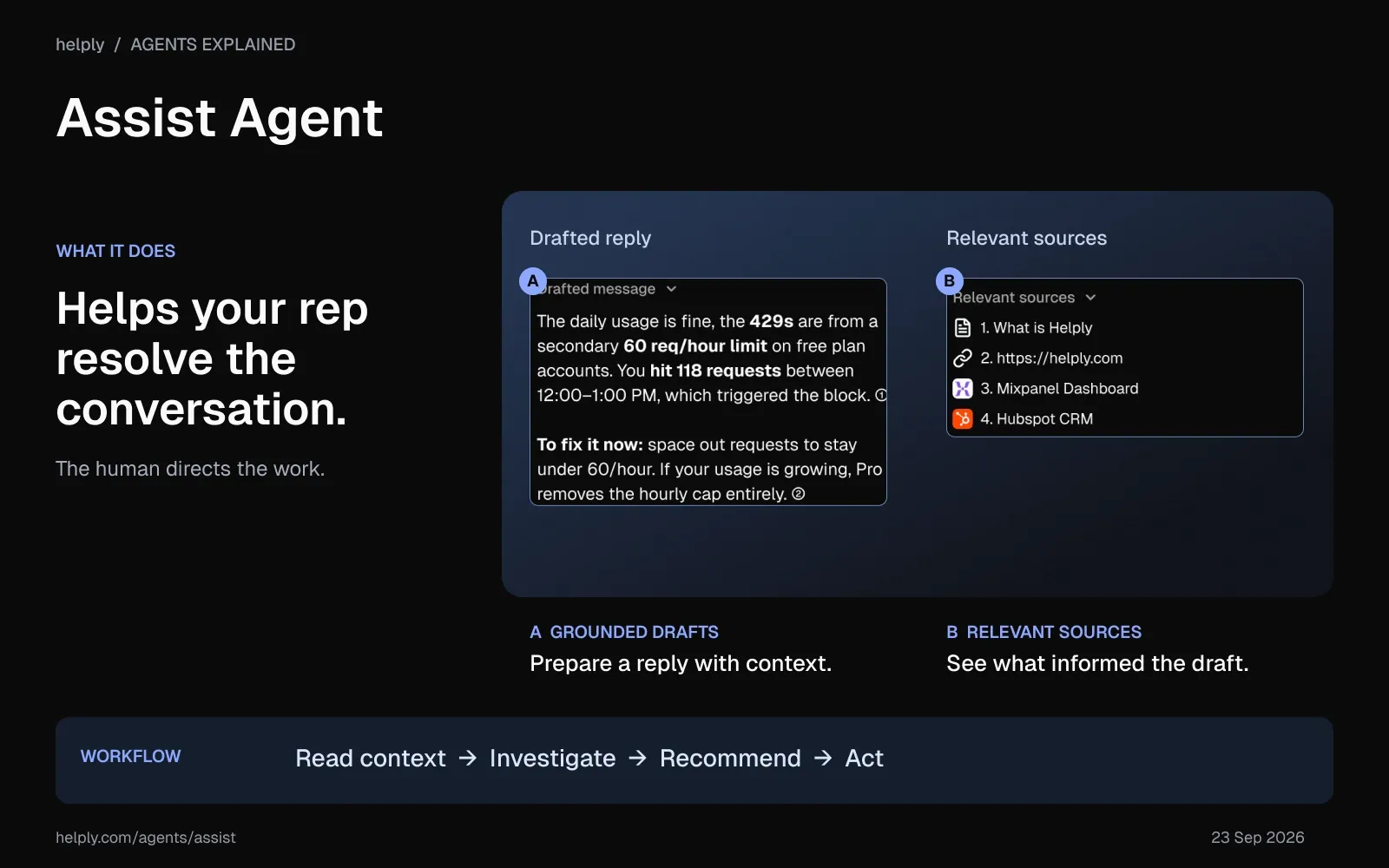
It summarizes the thread, finds the answer and drafts a reply in your voice. At the rep's request, it updates the CRM or opens a Linear issue.
Background Agents watch every conversation on their own.
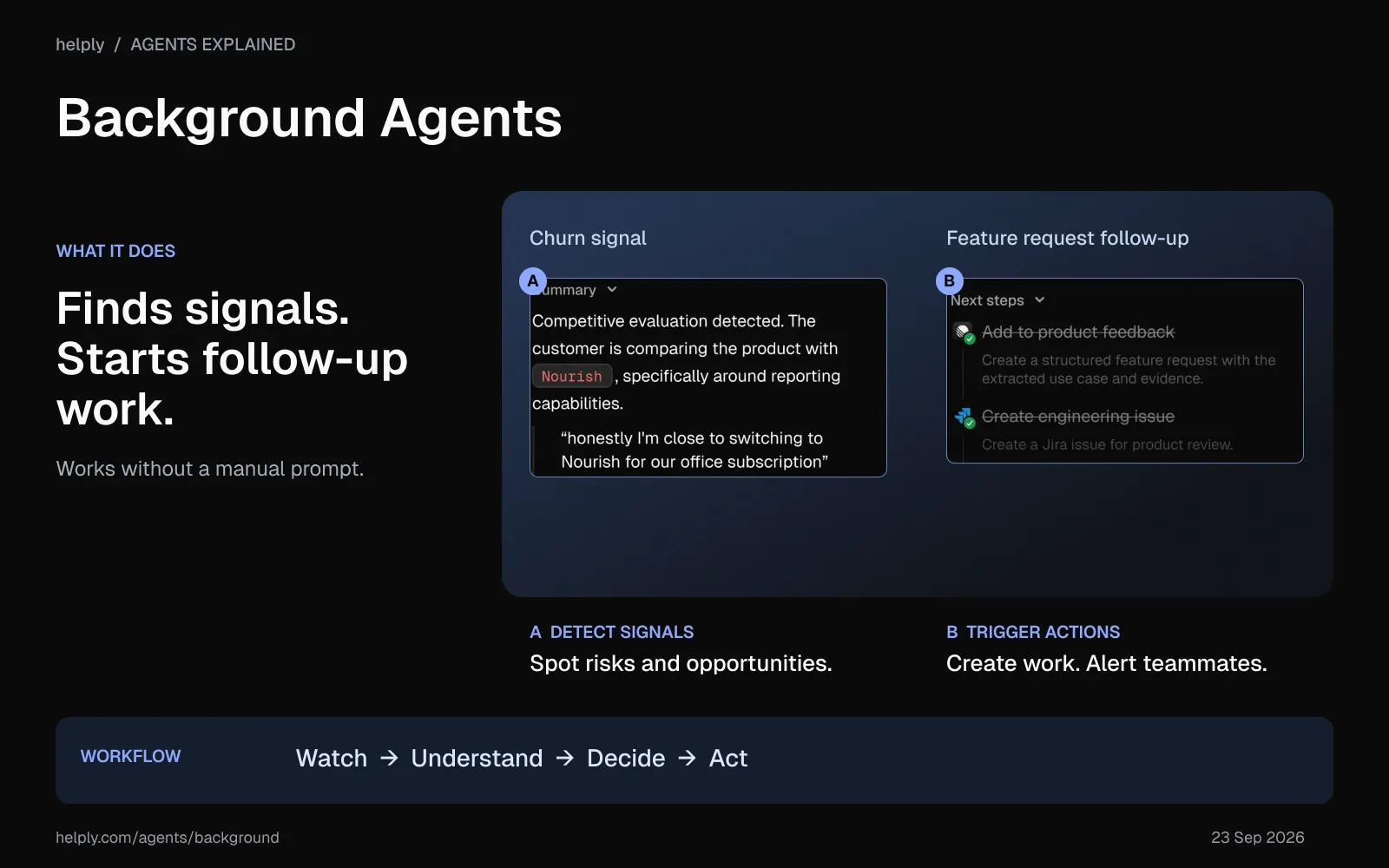
Five come ready. The Churn Agent flags frustration and cancellation risk, the Knowledge Agent drafts articles from resolved tickets, and the Revenue Agent spots upgrade signals.
The Feature Request Agent clusters requests, and the Insights Agent groups thousands of conversations into themes. You can build your own for QA review, bug clusters, or SLA watching.
You teach all of them how your company works. Guidelines hold your refund policy, your tone and the situations that need a person, and Skills hold your processes. Training lets you correct mistakes from real conversations, and escalation rules let you choose when an agent stops for a person.
StaffTraveler runs 24/7 coverage for 1M+ users on Helply, with tickets down by half and an 88% resolution rate. At Proposify, about 220 fewer tickets a month reach a person, with 52% resolved end to end.
More than 1,400 companies trust Helply.
A shopper asks where a refund is, and the agent checks the payment, confirms the date, and replies. A user reports a broken sync; the agent reviews the account, checks recent API errors, and provides the fix.
Key features
- Everything you expect from a help desk. One inbox for every channel, views by status or customer, smart routing, custom fields, collision detection, internal notes, a help center and reporting. You can also set SLA targets and escalation rules.
- AI triage before anyone opens the ticket. The AI categorizes each new conversation, sets fields, prioritizes it and routes it to the right person, team or agent. Investigation can start the moment a ticket arrives.
- Actions as well as answers. Agents look up the order and issue the refund, where you have allowed it. They can update the CRM or open the engineering issue, then reply with the result.
- Context from the systems your team runs. Stripe, Chargebee, Salesforce, HubSpot, Linear, Jira, Notion, Gong, Snowflake and your own APIs feed one customer record. Your team and the agents read the same one.
- Your rules on every conversation. Guidelines set tone, policy and when a person steps in, and Skills capture how your best rep works. With escalation rules, you set confidence levels and decide when the AI can act on its own.
- A knowledge base that maintains itself. The Knowledge Agent finds questions your articles don't answer, drafts new ones from finished investigations, and flags articles that have gone stale. Your team reviews and publishes.
- Background Agents you can build. Watch for any signal and give the agent your Tools and Guidelines. Then choose what it does when it finds something: alert a teammate, update a system, trigger a workflow.
- Security your buyer will ask about. SOC 2 Type II, GDPR, encryption in transit and at rest, and customer data never used to train AI models.
Pricing
Plans start at $49 a month for 500 credits, and every plan has unlimited users. The price rises with the monthly credit block: 7,000 credits cost $399 and 32,000 cost $1,549. You save 15% on annual billing.
The AI is the same on every plan. A drafted reply costs 1 credit, a lookup across your systems costs 4, and a full investigation costs 12. Retries, failed actions and drafts your team rejects cost nothing.
Credit blocks run from 500 to 32,000 a month, and the spend cap defaults to your plan price. Trials run 14 days with 1,000 credits and no card, enough to put the agents on your real queue.
See Helply pricing.
Pros
- More volume, same team. The Support Agent clears the repeat requests end to end, so your people spend their time on the conversations that need judgment.
- All three agent types on every plan. Support, Assist and Background Agents follow your Guidelines and learn from corrections on your own tickets.
- Unlimited users on every plan. Invite engineering, product, sales and the founder. The bill does not move.
- One meter for all AI work. Drafting, resolving and background findings draw on the same credit block. No plan adds a per-agent AI license.
- Humans stay in control. Guidelines set what the agents handle alone and when they stop for a person. Escalations arrive with the investigation done.
Cons
- The payoff scales with repeat volume. A team with very few tickets and little repeat work gets less from AI resolution than a busy queue does.
- Credits take a little forecasting. A consumer conversation uses about 4 credits and a business one about 7. The estimator on the pricing page does the sum.
- Heavy AI use costs more. Prices run from $49 a month for 500 credits to $1,549 for 32,000.
- The setup work is real. Guidelines, Skills and connected Tools are what make the agents good, and someone has to write them.
Who is Helply Best for?
Helply is best for small businesses whose ticket volume is growing faster than they want to hire.
Software companies, online stores, marketplaces, and consumer apps all fit the bill, whether they are leaving a shared Gmail inbox or replacing Zendesk.
Zendesk: Best for Large Teams That Can Absorb the Total Cost
Zendesk is built for large teams with complex workflows, and its pricing assumes you are one.
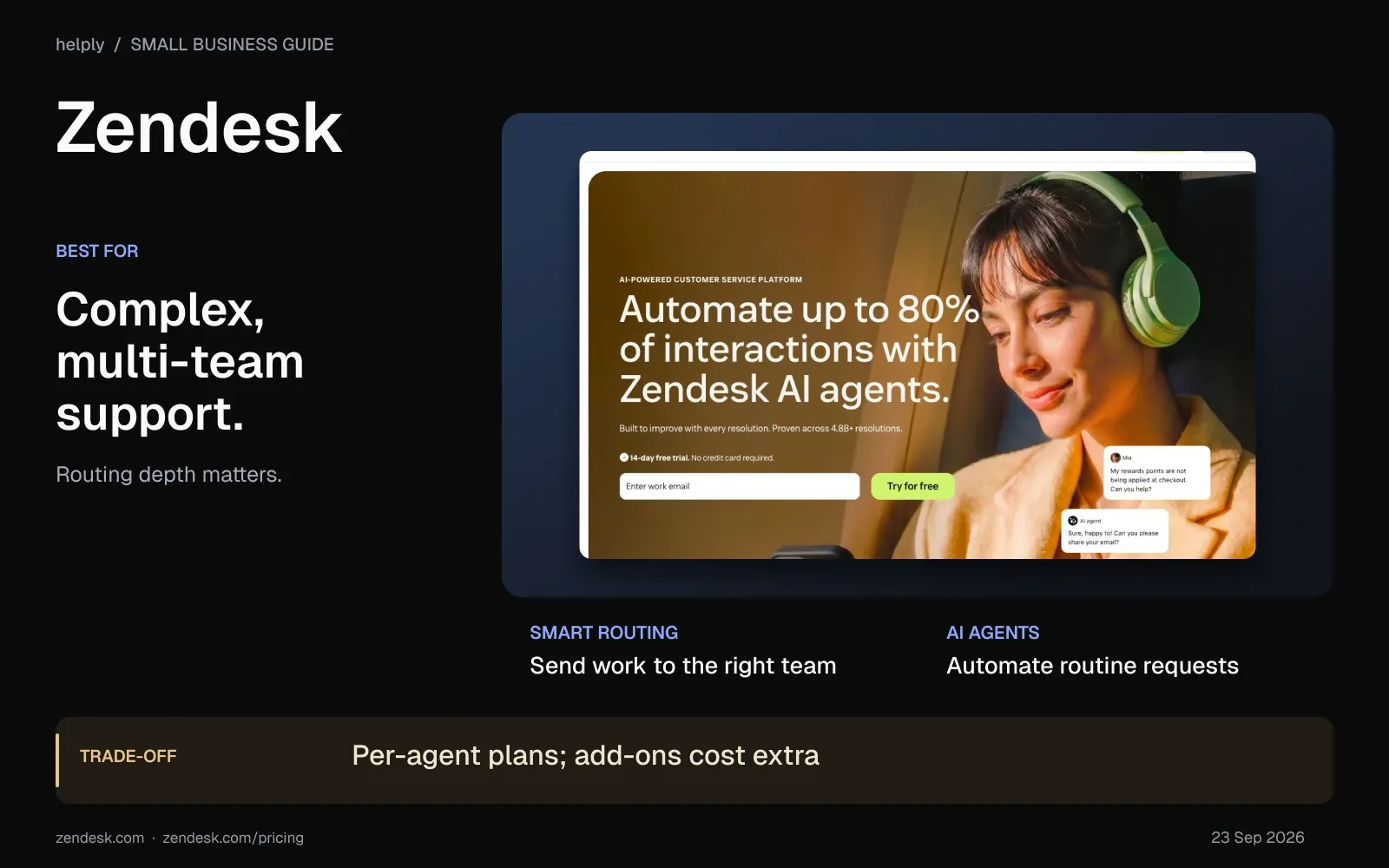
It sells two kinds of AI: Copilot, which assists your reps, and AI Agents, which resolve requests on their own across systems.
Key features
- Configuration depth. Routing, macros, SLAs, and a large app marketplace, aimed at complex multi-team workflows.
- AI Agents. They act across systems and finish multi-step requests. Every Support and Suite plan includes a monthly allowance of automated resolutions.
Pricing
Support Team is $19, Suite Team is $55 and Suite Professional is $115 per agent per month, billed yearly. The Copilot add-on costs another $50 per agent per month on Suite Professional and above.
Plans include 5 to 10 automated resolutions per agent each month. Extra resolutions cost $1.50 to $2.00 each, and Zendesk offers a 14-day trial in place of a free plan.
Pros
- Handles complex, multi-team operations, with routing, macros and SLAs.
- Autonomous AI Agents that resolve tickets end to end on every plan.
Cons
- Seat costs scale with headcount. Suite Professional plus Copilot costs $165 per agent a month, billed yearly.
- AI adds two meters to the seat price: Copilot per agent from Suite Professional, and automated resolutions past the allowance.
Best for
Larger teams with the budget for per-seat plans plus AI add-ons.
Read more: Helply vs. Zendesk
Freshdesk: Best for a Free Start and a Cheaper Copilot
Freshdesk uses the same per-agent-plus-AI model as Zendesk, with Copilot at $29 per agent, compared to Zendesk's $50.
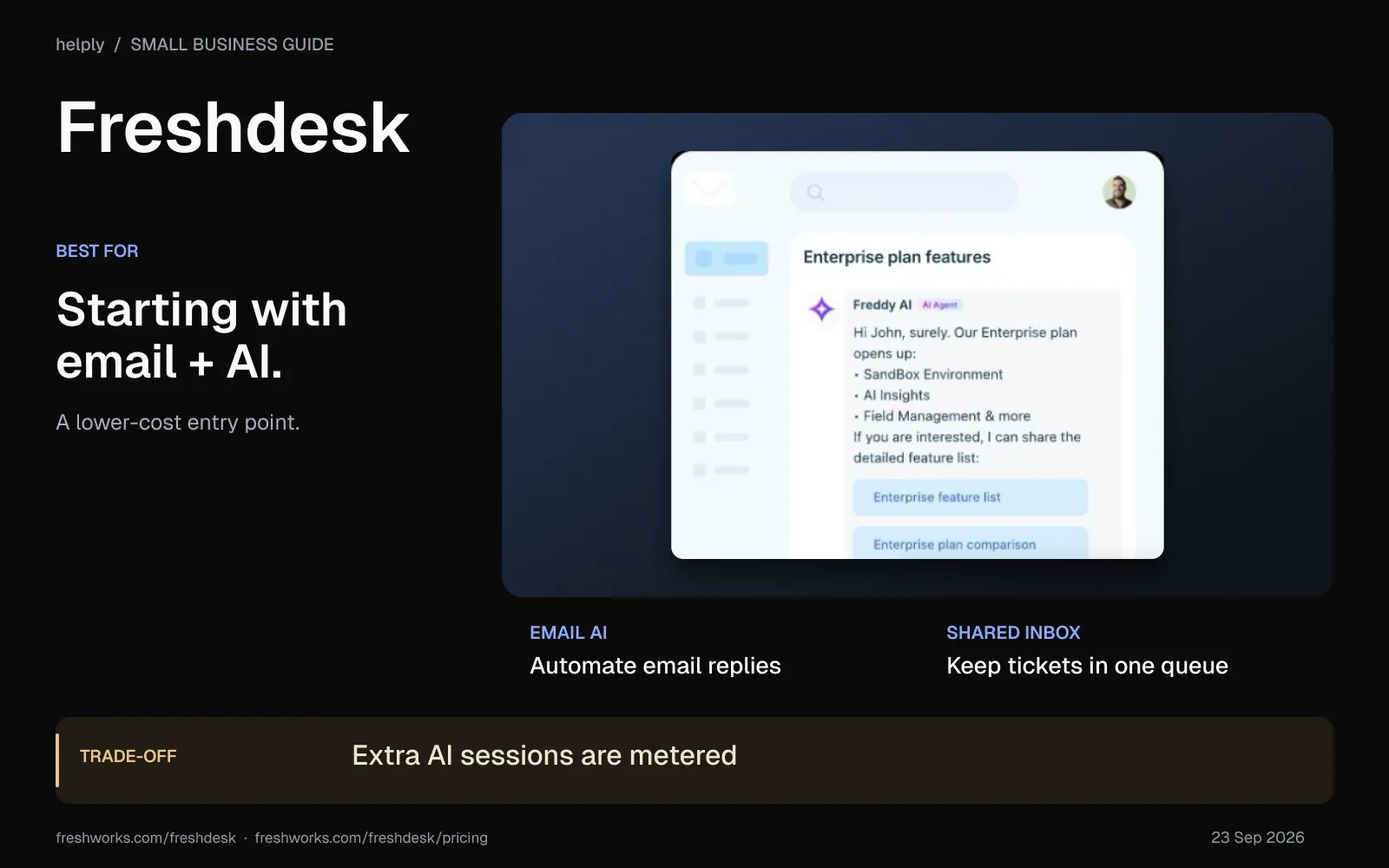
Its Freddy AI includes an AI Agent that resolves queries on its own, plus a Copilot for your reps.
Key features
- Freddy AI Agent. It answers customers across chat, messaging, and email, and Freshdesk meters it by the session.
- Automations on paid tiers for routing and SLAs.
Pricing
Growth is $19, Pro is $55, and Enterprise is $89 per agent per month, billed annually. Freddy AI Copilot adds $29 per agent for Pro and Enterprise plans.
Each account gets 500 Freddy AI Agent sessions once, and additional sessions cost $49 per 100 sessions. Freshdesk offers a 14-day trial, and its Free Program includes two agents for six months.
Pros
- Copilot costs $29 per agent, compared to $50 at Zendesk.
- Autonomous Freddy AI Agent, with 500 starter sessions per account.
Cons
- No free-forever plan. New teams start on a trial or the six-month Free Program, then pay per agent.
- AI copilot and agent sessions are separate line items on top of the seat price.
Best for
Budget-conscious teams that want autonomous AI and can model the add-on costs.
Read more: Helply vs. Freshdesk
Help Scout: Best for a Clean, Email-First Experience
Help Scout does fewer things, and the things it does feel tidy and personal.
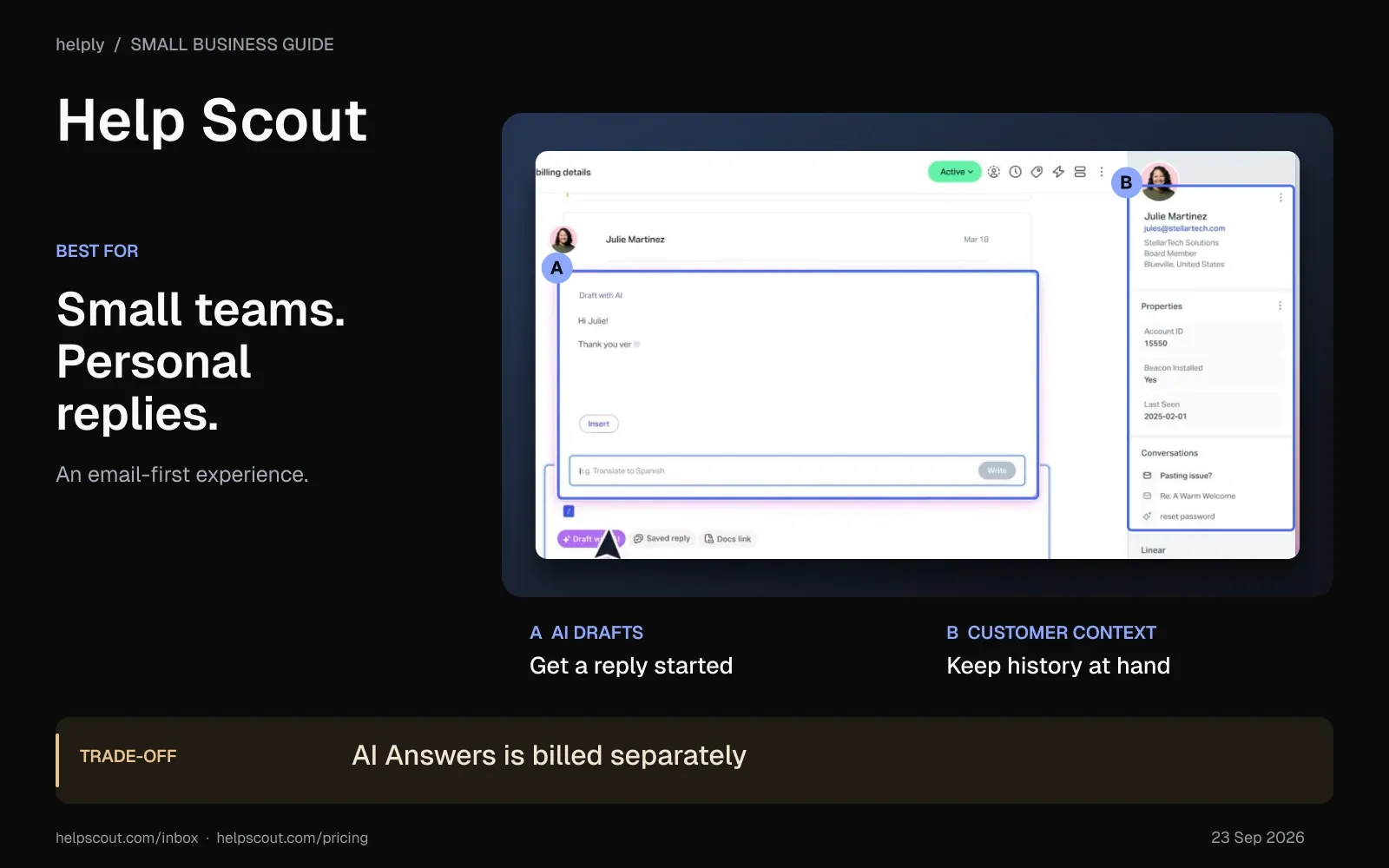
Its AI leans toward drafting replies and answering common questions rather than taking account actions.
Key features
- Email-first shared inbox with a personal, non-tickety feel.
- AI Drafts and AI Answers. Drafts come with Plus and Pro, and AI Answers costs $0.75 per resolution on any paid plan.
Pricing
The Free plan allows 5 users and 100 contacts a month. Paid plans start at $25 per user per month, billed annually, and Plus is $45.
Pros
- A real free plan and a gentle learning curve.
- AI Answers that resolve common, repeatable questions.
Cons
- The AI assists more than it acts. It does not run account actions the way the agent-first tools do.
- AI Answers does not answer email, and each resolution costs $0.75.
Best for
Small teams that want a clean shared inbox with light AI.
Read more: Helply vs. Help Scout
Hiver: Best for Gmail Teams That Want an Omnichannel Option
Hiver started inside Gmail and sells Hiver Omni as a standalone omnichannel platform.
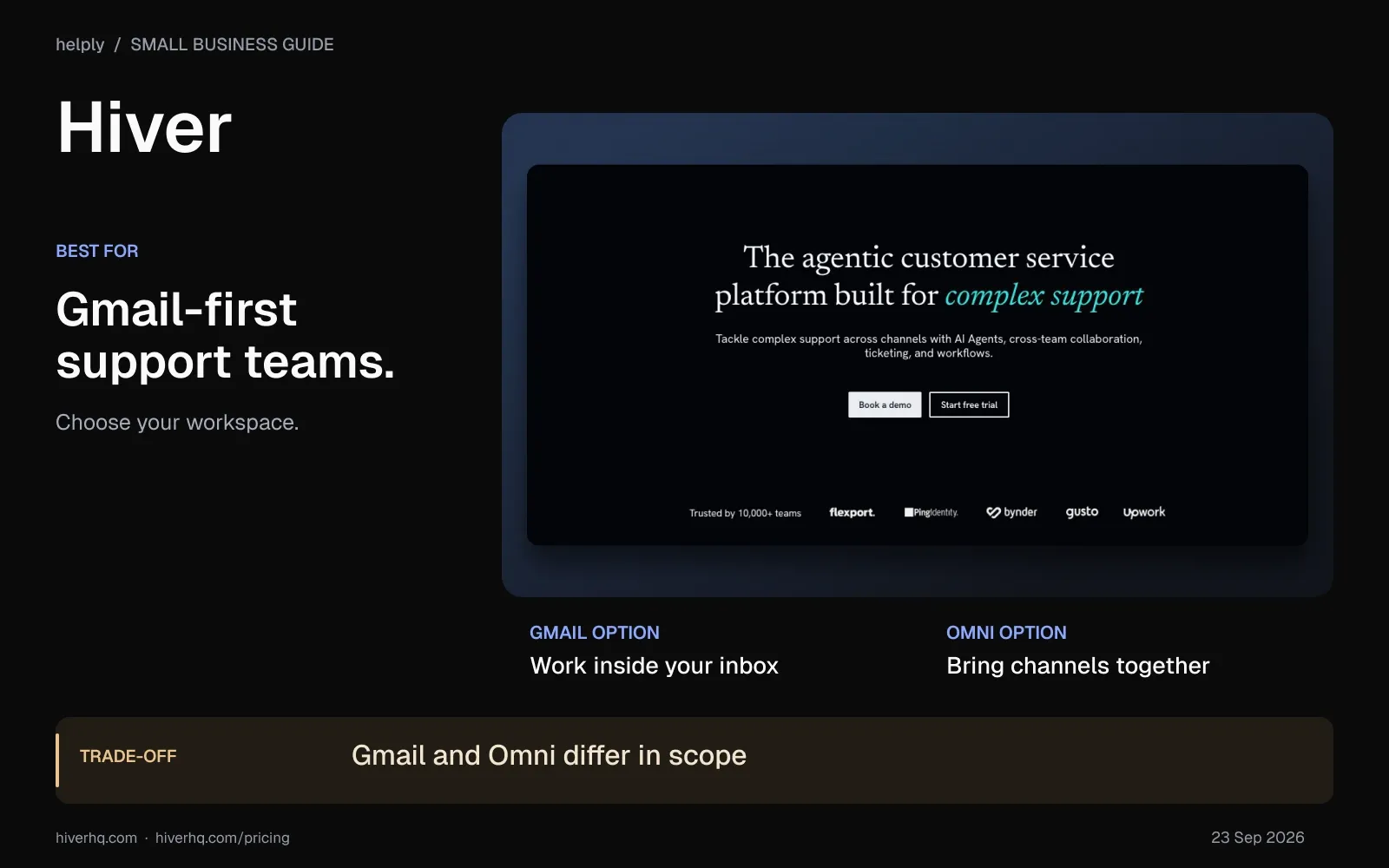
Its AI Agents resolve tickets and take actions across your systems.
Key features
- Runs in Gmail or standalone. Keep ticketing inside Gmail, or move to Hiver Omni for other channels.
- Hiver AI Agents. They triage, resolve, and act across your systems, and pause for approval on sensitive actions.
Pricing
Hiver in Gmail and Hiver Omni both offer Growth at $25, Pro at $55, and Elite at $85 per user per month, billed annually.
The 7-day trial opens on Elite.
Pros
- Familiar for Google Workspace teams that do not want to leave Gmail.
- AI Agents that act, with a human-approval gate on sensitive steps.
Cons
- Per-user pricing. Plans start at two seats, move to five, then add seats in blocks of five.
- Hiver in Gmail costs the same as Omni, which adds chat, WhatsApp, social, Slack, and voice channels.
Best for
Gmail-native teams that want ticketing without leaving the inbox.
Zoho Desk: Best for Zoho-Ecosystem Teams
Zoho Desk starts at $7 per user on Express, billed yearly, and its free edition covers three users.
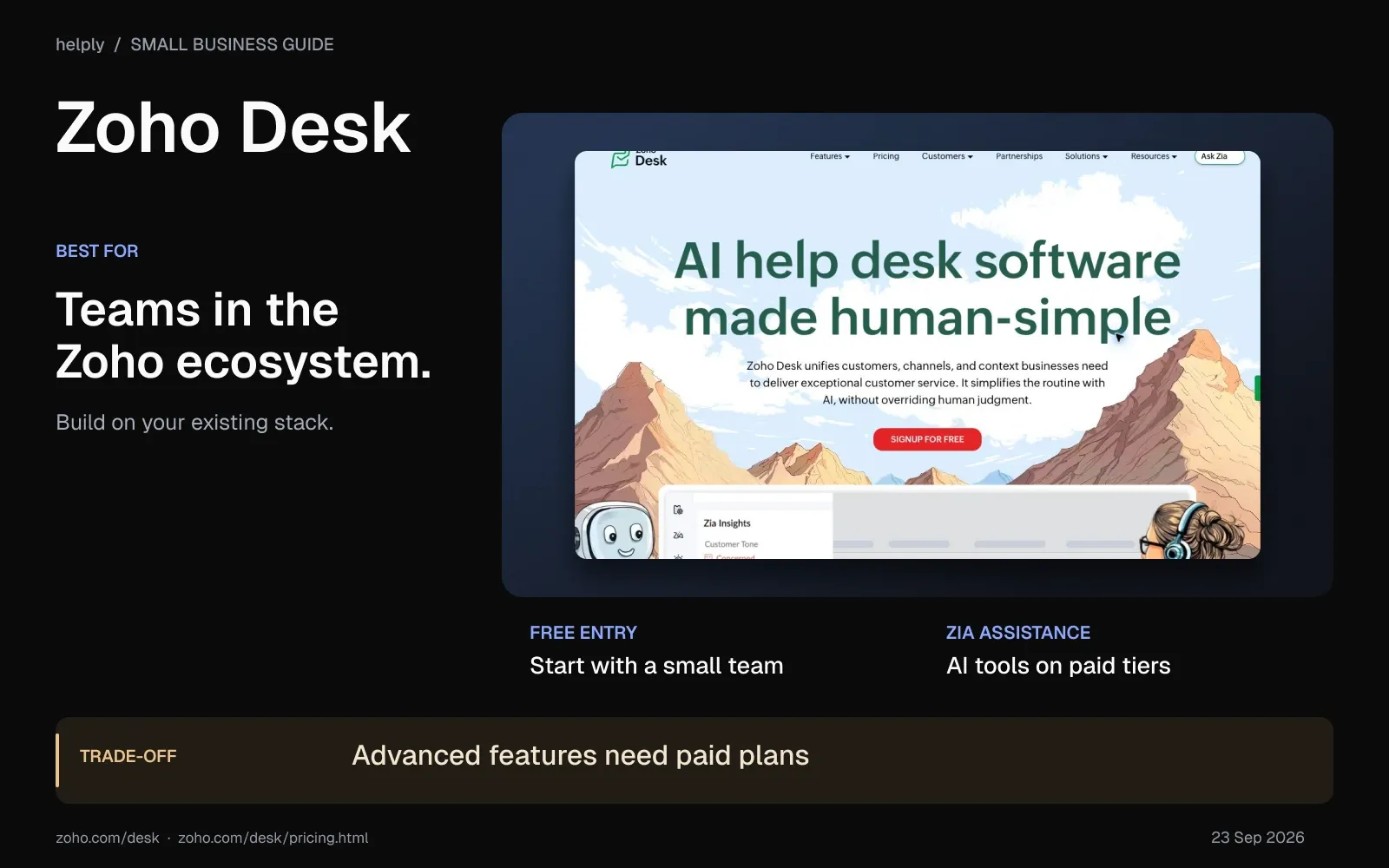
It fits best when your business runs Zoho CRM, Books or Projects.
Key features
- A Free Forever edition for a small team.
- Zia Agents on every plan. Prebuilt Desk agents and Zia Actions need the Enterprise plan.
Pricing
The Free edition covers three users. Paid plans run $7, $14, $23 and $40 per user per month billed yearly, or $9 to $50 monthly.
Pros
- A genuine free plan for getting started.
- Fits teams on Zoho CRM, Books or Projects.
Cons
- Most useful inside the Zoho stack.
- The deepest AI sits on Enterprise, and generative features on Express and Standard need your own OpenAI key.
Best for
Teams standardized on Zoho.
Front: Best for Collaborative Operations
Front keeps an email feel and adds internal comments and shared drafts for the team.
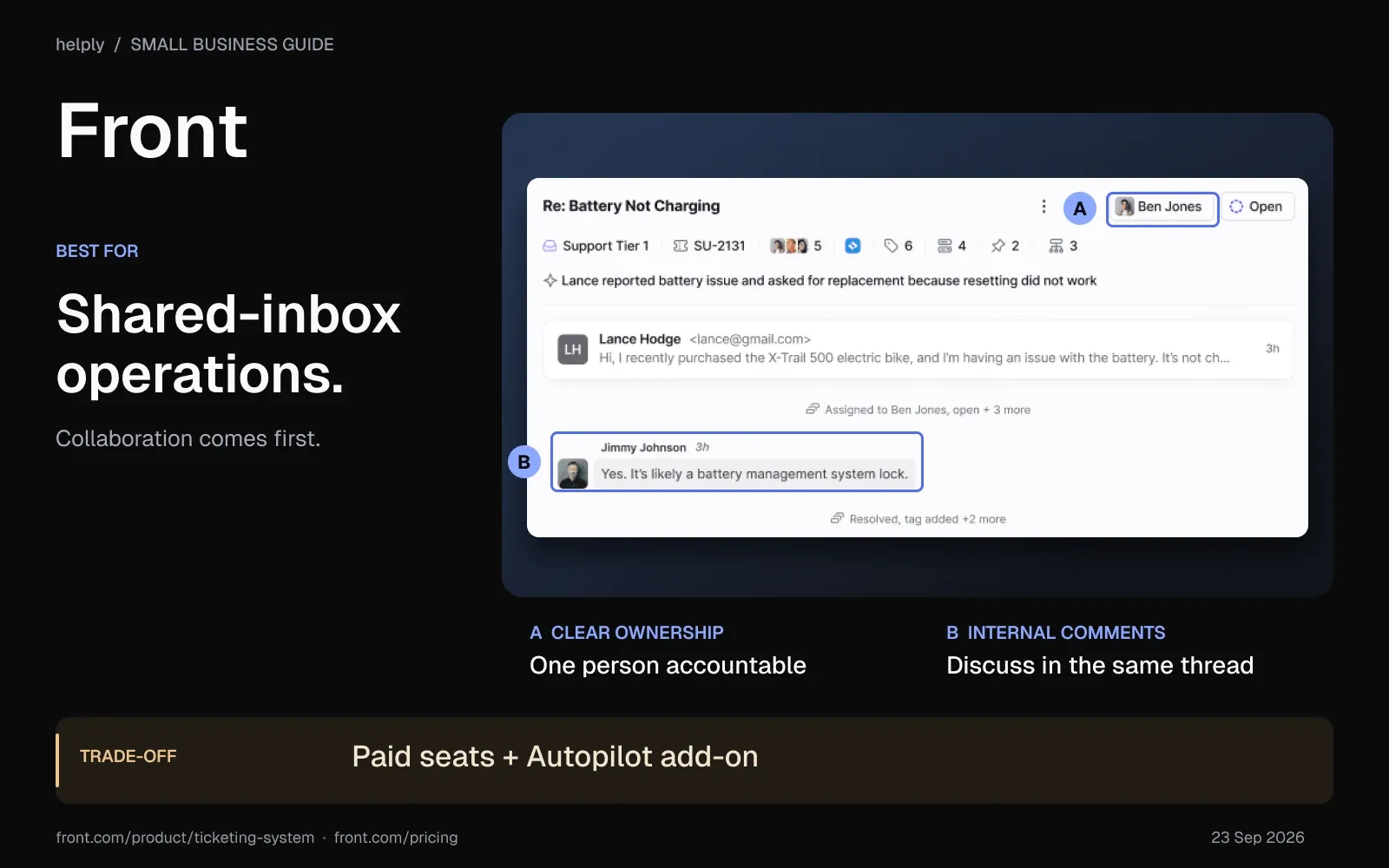
Its Autopilot is an AI agent that triages, hands off or resolves conversations, billed by outcome.
Key features
- Shared-inbox collaboration with comments, assignments, and drafts.
- Front Autopilot. An AI agent built for complex work beyond happy-path automation.
Pricing
Starter is $25, Professional is $65 and Enterprise is $105 per seat per month, billed yearly. Monthly billing is $35 for Starter and $85 for Professional.
Autopilot is an add-on on every plan, billed by outcome: $0.05 for triage, $0.39 for a handoff and $0.89 for a resolution.
Pros
- Comments, assignments, and shared drafts for teams working one inbox together.
- Autopilot resolves conversations, and you pay per outcome.
Cons
- Per-seat pricing plus a per-conversation AI charge. Costs climb with both headcount and volume.
- Omnichannel and SSO start on the Professional tier.
Best for
Operations teams that live in a shared inbox and want collaboration first.
Read more: Helply vs. Front
HelpDesk: Best for Simple Queues With AI Included
HelpDesk keeps the queue simple and puts a monthly allowance of AI resolutions in the per-user price.
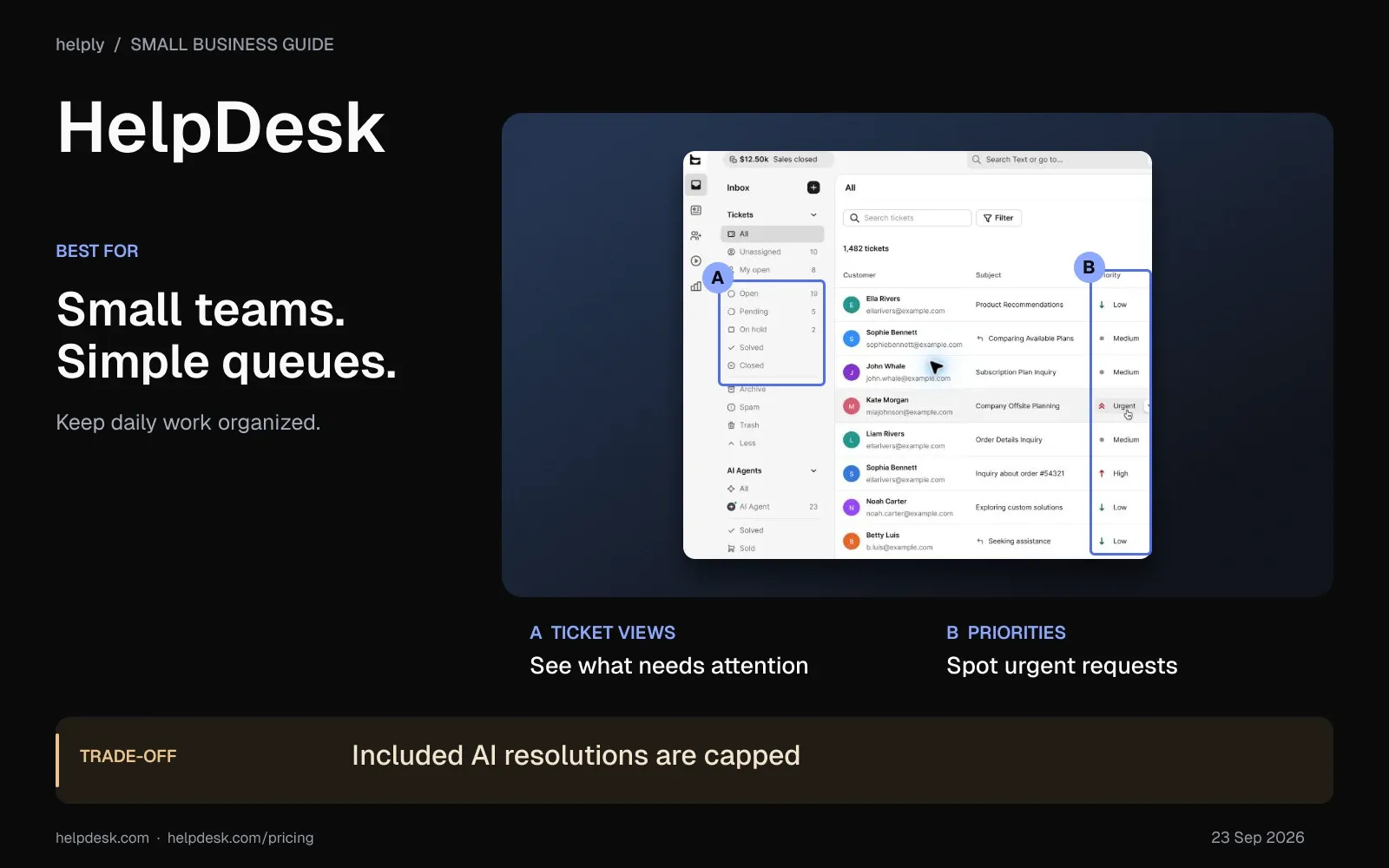
The AI comes with monthly caps.
Key features
- Clean ticket queues without heavy configuration.
- AI Agents and AI resolutions included, capped by plan.
Pricing
Plans run $19 to $79 per user per month billed yearly, or $25 to $99 monthly, with a 14-day trial. Essential includes 10 AI resolutions a month, and Growth includes 200.
Pros
- AI resolutions come in the plan: 10 a month on Essential and 200 on Growth.
- A simple setup for small teams.
Cons
- Each plan caps AI resolutions, and packs of 50 cost $49.50 past the cap.
- Workflow runs top out at 300 on Essential and 1,000 on Growth.
Best for
Small teams that want some AI included in the per-user price.
JitBit: Best for Small Technical Teams and Self-Hosting
JitBit prices by agent count and sells a perpetual self-hosted license.
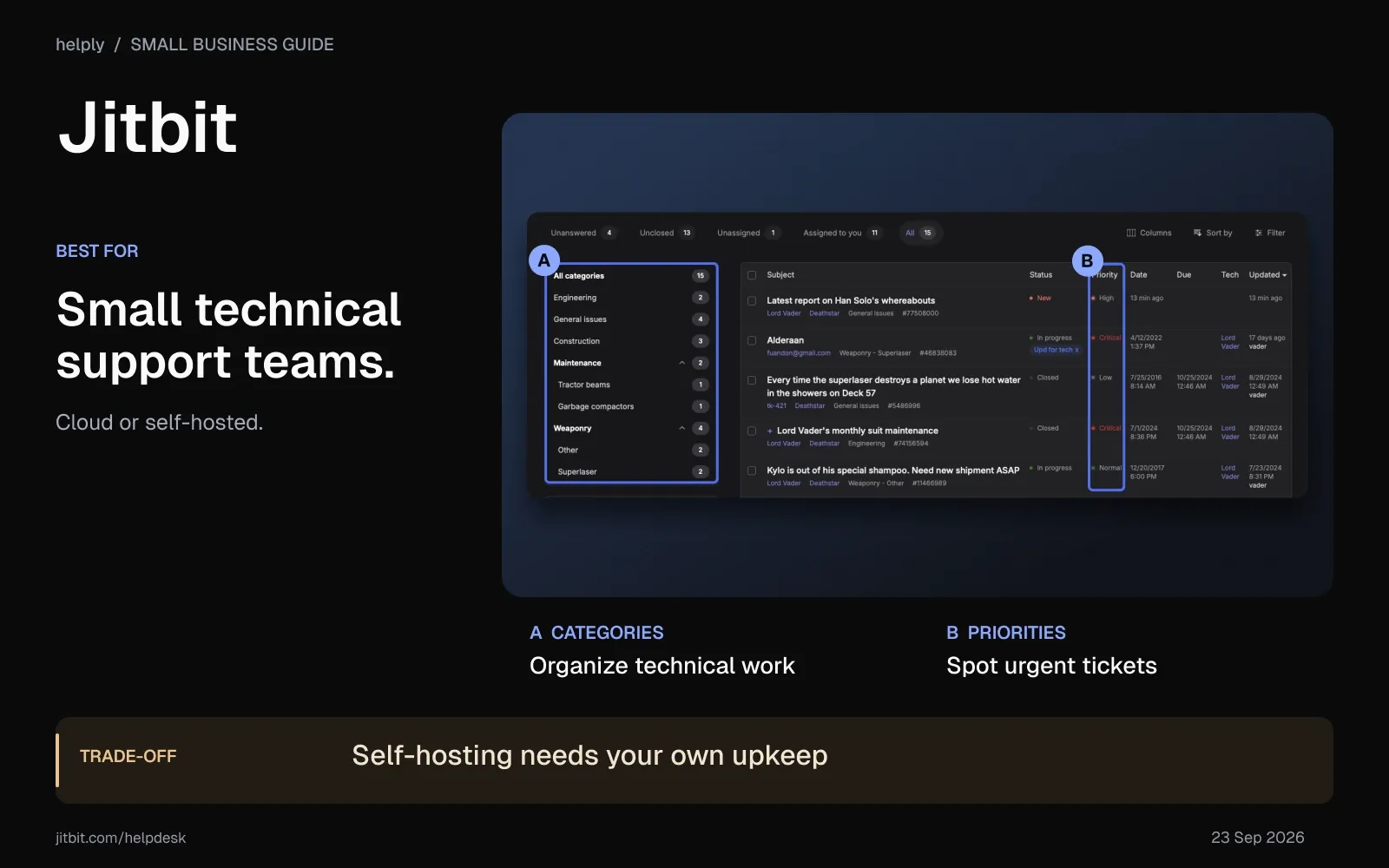
Its AI can triage tickets and send first replies, and it calls your own APIs as tools.
Key features
- Flat tiers by agent count, plus a self-hosted perpetual license.
- Email-first ticketing that technical teams find easy to run.
Pricing
SaaS plans run $29 to $249 a month by agent count, or $24.92 to $208.25 a month billed yearly. A self-hosted perpetual license starts at $2,199 for 10 agents, with one year of upgrades.
Pros
- Tier pricing by agent count, so the bill moves in steps.
- A self-hosted option you control.
Cons
- Each tier caps agents, so a growing team moves up a plan, and self-hosted AI is a $999 add-on.
- On-prem AI runs on your own LLM API key.
Best for
Small technical teams that want a self-hosted or flat-priced option.
osTicket: Best for Zero-Budget Self-Hosting
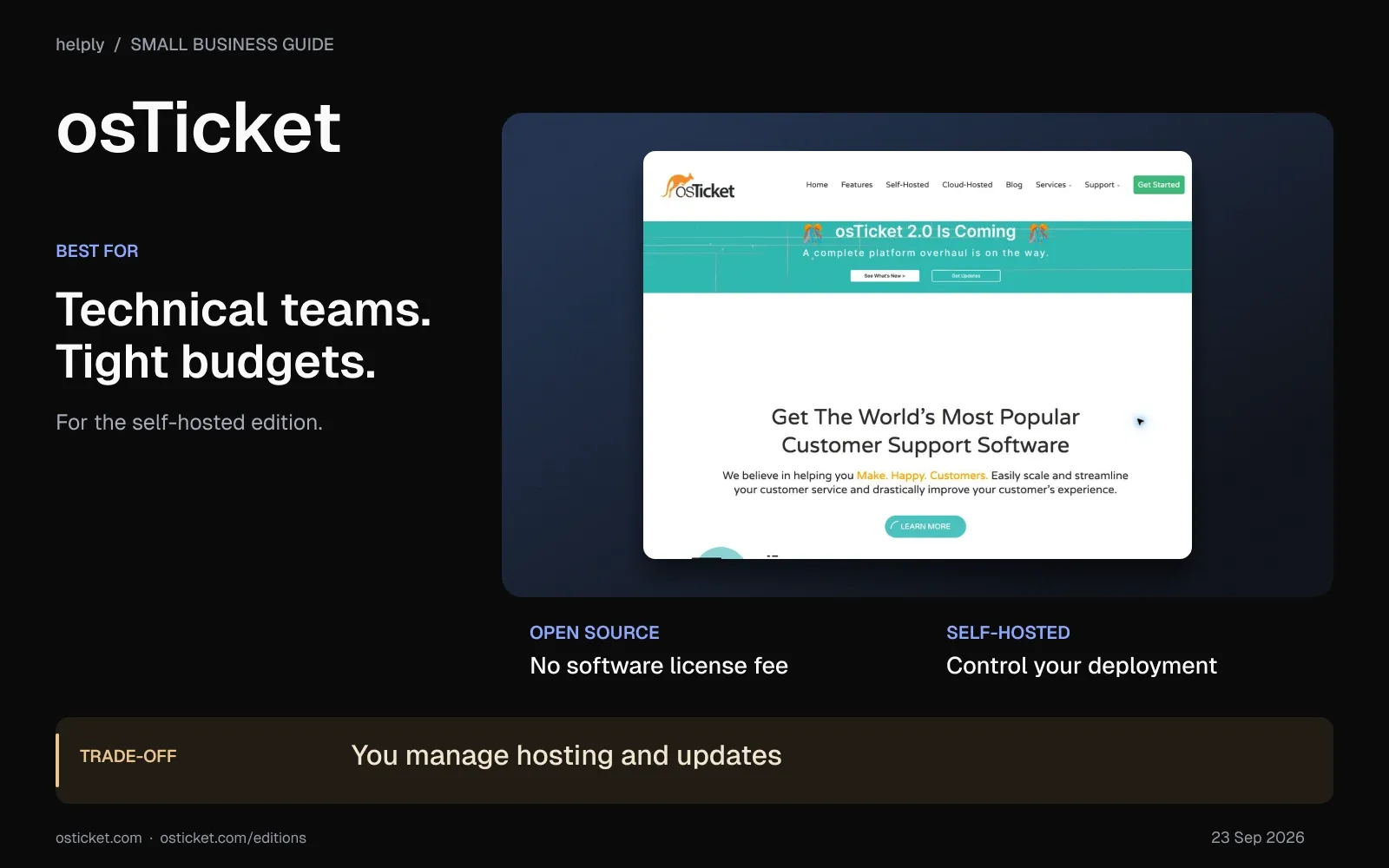
osTicket is free and open source if you self-host, which suits a technical team with no budget.
Key features
- Email-to-ticket with the core queue, assignment, and SLA basics.
- Full control on your own server.
Pricing
Free and open source when self-hosted. The managed cloud version, SupportSystem, starts at $12 per agent per month.
Pros
- No license cost.
- You own and control the deployment.
Cons
- You host, maintain, and secure it yourself.
- No AI.
Best for
Technical teams with time to run it but no budget.
Free Helpdesk Ticketing Systems for Small Business
Zoho Desk and Help Scout offer free plans, Freshdesk offers a six-month free plan, and three open-source tools are free to self-host. Each one has a limit:
- Zoho Desk Free: three users, email tickets, and a help center, without workflows or assignment rules.
- Help Scout Free: five users, one inbox, and 100 contacts a month.
- Freshdesk Free Program: two agents for six months, enabled within the product.
- osTicket, FreeScout and Zammad: free when self-hosted, so your team patches, backs up and secures the server.
FreeScout sells add-on modules for a one-time fee, such as Workflows for $14.99. Zammad's hosted Starter plan costs €7 per agent a month, billed annually.
Ticketing Systems for Internal IT Help Desks
Internal IT help desks handle employee requests such as laptop requests, access requests, and outage reports. Two IT-focused tools have free plans for small IT teams:
- Jira Service Management: part of Atlassian's Service Collection, free for up to three agents. Standard costs $25 per agent per month on monthly billing for a small team.
- Spiceworks Cloud Help Desk: a free Core plan for up to five technician seats. Premium costs $6 per seat per month, billed annually, from October 1, 2026. Once an account has six or more active employees, Spiceworks bills Premium for all of them.
A technical team can self-host osTicket for employee requests.
How a Support Ticketing System Works
The system sits behind your support address and chat widget, and it turns each message into a tracked ticket.
- Point your support address at the system. Forward support@yourcompany.com, add an alias or connect the mailbox. Nothing changes for the customer.
- Each email becomes a ticket. The system creates a numbered ticket with a timestamp, so every request is visible and countable.
- The ticket gets an owner. Rules or round-robin assign it, which kills duplicate replies and orphaned mail.
- An SLA timer starts. The clock tracks first response and resolution against your targets, in real time.
- A rep or the AI replies in one thread. The full history stays attached, so the customer never repeats themselves.
- It resolves and feeds reporting. Closed tickets roll up into response times, volume by topic, and workload.
Tools differ in how much of steps three through six they automate, and in what that automation costs.
Can You Use Gmail, Outlook or Microsoft 365 Instead?
For a small, low-volume team, a shared inbox is fine. Past a point, the tickets your team drops cost more than a real system.
The do-it-yourself paths give you some structure, and each one breaks in a predictable place.
- Outlook or Microsoft 365 shared mailbox. Everyone sees the same mail and can reply from the shared address. The mailbox lacks ticket ownership, collision control, SLA timers, and reporting.
- Gmail or Google Groups collaborative inbox. You can assign and label messages by convention. It works until two people grab the same thread or someone misses a label.
- Labels, filters, and rules. They sort mail, but they do not track a response clock, prevent duplicate replies, or report your first response time.
In Microsoft Lists, the Issue tracker template adds Priority, Status, and Assigned to columns, with email rules for the assigned person.
If you build your own, Make can label support emails in Gmail, and Zapier can log each message as a row in Google Sheets. Neither the Make nor the Zapier template records an owner, a status, or a response deadline.
On every one of these paths, two reps can answer the same customer while a buried thread gets no reply. The customer follows up asking why nobody replied, and no report shows the miss.
| Situation | Shared inbox | Dedicated system |
|---|---|---|
| 1 to 3 people, light volume | Fine | Overkill |
| Roughly 10+ on support, or a few hundred tickets a week | Breaks down | Needed |
| You need SLAs, ownership, and reporting | Missing | Built in |
| You want AI to resolve repetitive tickets | Not possible | Core capability |
A useful rule of thumb: a shared inbox can support about 10 people on support or a few hundred tickets a week. Above that, the missed and duplicated work costs more than the software would. At that size, move to a help desk with ownership and SLAs.
Leaving a shared inbox used to mean buying a per-seat help desk, then adding AI later. You can skip that step and start on a help desk built for AI.
You get ticket ownership on day one. The Slack, WhatsApp, and Teams threads that leaked around the inbox land in the same queue. The agents clear the repeat tickets that buried it.
How Ticketing Systems Bill for AI
Zendesk, Freshdesk, Help Scout, and Front bill AI on top of the seat price, per resolution, session, or conversation.
HelpDesk and Zoho Desk include some AI with caps, and Hiver lists AI Agents on every plan.
Helply bills all AI work in credits from one block and charges nothing per user.
| Tool | AI billing |
|---|---|
| Helply | Credits in the plan (500 at $49); a draft 1, a lookup 4, an investigation 12; rejected drafts free |
| Zendesk | Copilot $50 per agent from Suite Professional; a monthly allowance of 5 to 10 resolutions per agent, then $1.50 to $2.00 each |
| Freshdesk | Copilot $29 per agent on Pro and Enterprise; 500 AI Agent sessions once, then $49 per 100 |
| Help Scout | AI Answers $0.75 per resolution; AI Drafts from the Plus plan |
| Hiver | AI Agents on every plan |
| Zoho Desk | Zia Agents free up to 30 million tokens a month; bring your own OpenAI key on Express and Standard |
| Front | Autopilot $0.05 to $0.89 per conversation; Copilot $20 per seat |
| HelpDesk | 10 to 200 resolutions included monthly; 50 more for $49.50 |
| JitBit | Unlimited AI credits from the Startup plan, $69 a month on monthly billing; self-hosted AI $999 |
| osTicket | No AI |
The answer to most tickets lies outside the ticket itself, in the order system, the billing tool, or the account record. Helply loads that before the AI or your rep replies, and its agents can act in those systems.
In Salesforce's 2025 survey of 6,500 service professionals, respondents expect AI to resolve half of cases by 2027, up from 30 percent. A Gartner survey of 321 service leaders, published in February 2026, found that 91 percent face pressure from executives to implement AI.
To see how much context the AI reads before it replies, look at how Helply's Support Agent works. For a wider comparison, read the best AI tools for customer support teams.
What to Look for in a Small Business Ticketing System
Use this checklist to match a tool to how your team works:
- Email parsing and aliasing. It should accept mail from
support@, forwards, and aliases without dropping formatting or attachments. - Automatic routing and assignment. Every ticket gets an owner by rule or round-robin, with no manual triage.
- Collision detection. The system warns when two reps open the same ticket, so the second rep can hold back a duplicate reply.
- SLA enforcement. Timers track first response and resolution against your targets and flag what is slipping. Read more in What Is an SLA? Meaning, Types & Examples.
- Conversation history and context. The full thread and account data sit with the ticket, so no one starts from scratch.
- Reporting. First response time, resolution time and volume by topic, beyond a raw ticket count.
- AI cost and context. Most tools resolve tickets with AI. Check whether the plan includes the AI or the vendor bills it on top, and how much account data the AI reads.
- Self-service and channels. A help center for common questions, plus chat and messaging in the same queue as email.
The Pricing Model Decides Your Real Cost
Help desks price in four ways: per seat, per seat plus an AI add-on, a flat plan plus AI credits, or free. The vendor's pricing model sets how your bill changes as you add people and tickets.
Per-seat billing charges you for every person with access, busy or not. A teammate who joins for a rush raises next month's bill, whether or not tickets rise. On most seat-based tools, you then pay again for the AI.
On a flat plan with unlimited users, a teammate who helps during a busy week leaves the bill where it was.
On Helply, the AI draws on credits: a draft takes 1, a lookup 4, and a full investigation 12. Helply bills nothing for drafts your team rejects.
On annual billing, 10 people on Zendesk Suite Team cost $550 a month in seats, before any AI usage. Helply's prices below are monthly rates, and annual billing takes 15% off.
| Plan | 3 people | 5 people | 10 people | AI on top |
|---|---|---|---|---|
| Helply Starter (billed monthly) | $49 | $49 | $49 | 500 credits included; larger blocks cost more |
| Helply, 7,000 credits (billed monthly) | $399 | $399 | $399 | Covers about 1,000 B2B conversations a month |
| Zendesk Support Team (annual) | $57 | $95 | $190 | 5 automated resolutions per agent included; extras $1.50 to $2.00 |
| Zendesk Suite Team (annual) | $165 | $275 | $550 | 5 automated resolutions per agent included; no Copilot option |
| Zendesk Suite Professional (annual) | $345 | $575 | $1,150 | Copilot $50 per agent; 10 automated resolutions each, extras $1.50 to $2.00 |
| Freshdesk Growth (annual) | $57 | $95 | $190 | AI Agent sessions after the first 500 |
| Freshdesk Pro (annual) | $165 | $275 | $550 | Copilot $29 per agent; AI Agent sessions |
| Help Scout Standard (annual) | $75 | $125 | $250 | AI Answers $0.75 per resolution |
| Help Scout Plus (annual) | $135 | $225 | $450 | AI Drafts included; AI Answers $0.75 per resolution |
| Zoho Desk Standard (annual) | $42 | $70 | $140 | Your own OpenAI key for generative features |
| Front Starter (annual) | $75 | $125 | $250 | Autopilot billed by outcome, up to $0.89 a resolution |
| HelpDesk Essential (annual) | $57 | $95 | $190 | 10 AI resolutions included; $49.50 per extra 50 |
With heavier AI use, you move to a larger credit block, such as 7,000 credits for $399 a month.
Which Ticketing System Is Right for Your Small Business?
Match the choice to your inbox, your volume, and the way each vendor prices its AI.
- Gmail-native and staying there. Hiver runs in Gmail starting at $25 per user per month, billed annually, and Hiver Omni adds more channels at the same price.
- Outlook-native and staying there. Helpdesk 365 runs as an Outlook add-in and keeps ticket data in Microsoft 365.
- Leaving a shared inbox as volume climbs. Helply starts at $49 per month for unlimited users and includes AI credits. Its agents handle the repeat tickets and pass judgment calls to your reps.
- Free start. Zoho Desk's free edition supports 3 users, and Help Scout's Free plan supports 5 users and 100 contacts per month.
- Internal IT desk. Jira Service Management is free for up to three agents, and Spiceworks Cloud Help Desk is free for up to five technician seats.
- Large team with complex routing. Zendesk Suite Professional costs $115 per agent per month on an annual plan, plus $50 per agent for Copilot and fees for additional resolutions.
- Zero budget, technical team. With osTicket or another self-hosted tool, you pay no license fee and spend your own time running it.
If support volume is climbing, you want it handled without adding headcount or stacking AI add-ons. Look hard at a help desk with unlimited users that prices AI by the work it does.
Frequently asked questions
A helpdesk ticketing system is software that turns each customer or employee request from email, chat or a web form into a ticket. Every ticket gets a unique ID, an owner, threaded history and a response clock.
Helply suits a small team whose volume grows faster than headcount: $49 a month, unlimited users, AI credits included. Help Scout fits email-first teams, and its paid plans start at $25 per user a month, billed yearly. Zoho Desk Free covers three users, and osTicket is free to self-host.
Our top five for a small business are Helply, Zendesk, Freshdesk, Help Scout and Zoho Desk. Helply costs $49 a month with unlimited users. The other four charge per person, from $7 (Zoho Desk Express) to $25 (Help Scout) a month on annual billing.
Yes. Zoho Desk's free edition has three user licenses, and Help Scout's Free plan allows five users and 100 contacts a month. osTicket, FreeScout and Zammad are free to self-host, and Jira Service Management costs nothing for up to three agents.
Freshdesk's Free Program covers two agents for six months. To test Helply first, run the 14-day trial on 1,000 credits without entering a card.
Paid per-user plans for customer support run from $7 (Zoho Desk Express) to $115 (Zendesk Suite Professional) a month, billed annually. Most tools charge extra for AI, per agent for a copilot or per resolution. Helply (formerly Groove) starts at $49 a month, with unlimited users and 500 AI credits.
Yes, until about 10 people or a few hundred tickets a week. Past that, the missing ownership, collision control, SLAs and reporting cost more than a real system.
Yes. Microsoft sells Dynamics 365 Customer Service for case management, starting at $50 per user a month, paid yearly. In Microsoft 365, the Lists Issue tracker template tracks requests with Priority, Status and Assigned to columns.
Zendesk is a ticketing system. It covers email, messaging, phone and social, and Zendesk markets it as a customer service platform. Its sales CRM, Zendesk Sell, retires on August 31, 2027, and Zendesk points Sell customers to Pipedrive.
Freshdesk, Zoho Desk, Help Scout, Front and Hiver all sell help desks priced per agent or per user, as Zendesk does. Helply competes with a flat plan price and unlimited users, from $49 a month.
Make can file support email under Gmail labels, and Zapier can log each labeled email as a Google Sheets row. Google Groups Collaborative Inbox adds assignment and a resolved status. None of these setups includes SLA timers or support reports, so you would build those yourself.
The ticketing system is the mechanism that tracks each request. A help desk is the wider platform around it, with a help center, reporting and automation, and in everyday use the terms overlap.
Yes, on most paid tools. Zendesk, Freshdesk, Hiver, Front, HelpDesk and Helply all run AI that resolves or acts, but each prices that AI its own way.
You forward your support address or connect the mailbox. Each incoming email then becomes a ticket with an ID, an owner and an SLA timer.
Yes. Groove was the original product of the team that built Helply. Groove customers can move to Helply and bring their existing support history with them.
Yes. The trial runs for 14 days with 1,000 credits, and you enter no card details. It includes unlimited users, so your whole team can test the agents on your real queue.
About the author

Bildad Oyugi
Head of Content
Bildad is a digital marketing expert with over 5 years of experience in copywriting, content marketing, and editing. Outside of work, he enjoys videography and spending time with his family.


