When it comes to customer support automation, the chatbot containment rate stands as a pivotal metric.
It reflects the effectiveness of AI-powered bots in resolving customer issues without human agent intervention.
A high containment rate signals efficiency and cost-effectiveness, while a low containment rate indicates areas needing improvement.
Ultimately, understanding and optimizing this metric is key to maximizing ROI and enhancing customer satisfaction.
Key Takeaways
- Chatbot containment rate measures how many customer interactions a chatbot resolves without human escalation.
- A high containment rate reduces costs, speeds up resolutions, and boosts customer satisfaction.
- The formula is: (Total Interactions – Escalated Interactions) ÷ Total Interactions × 100.
- Key factors include chatbot design, training and knowledge base, contextual understanding, and system integrations.
- Strategies to improve containment: enhance intent recognition, expand the knowledge base, streamline escalation, integrate with backend systems, and monitor performance.
- The right customer support chatbot, like Helply, can maximize containment while improving ROI and customer experience.
What is Chatbot Containment Rate?
The chatbot containment rate measures the percentage of customer interactions that an AI chatbot successfully resolves from start to finish, without needing to escalate the issue to a human agent.
In essence, a higher containment rate signifies that the customer support chatbot is effectively handling a larger proportion of inquiries. This directly impacts operational efficiency and customer satisfaction, making it a critical metric to track.
Why Chatbot Containment Rate Matters
A high chatbot containment rate often translates to a faster resolution rate and reduced wait times, leading to customer satisfaction.
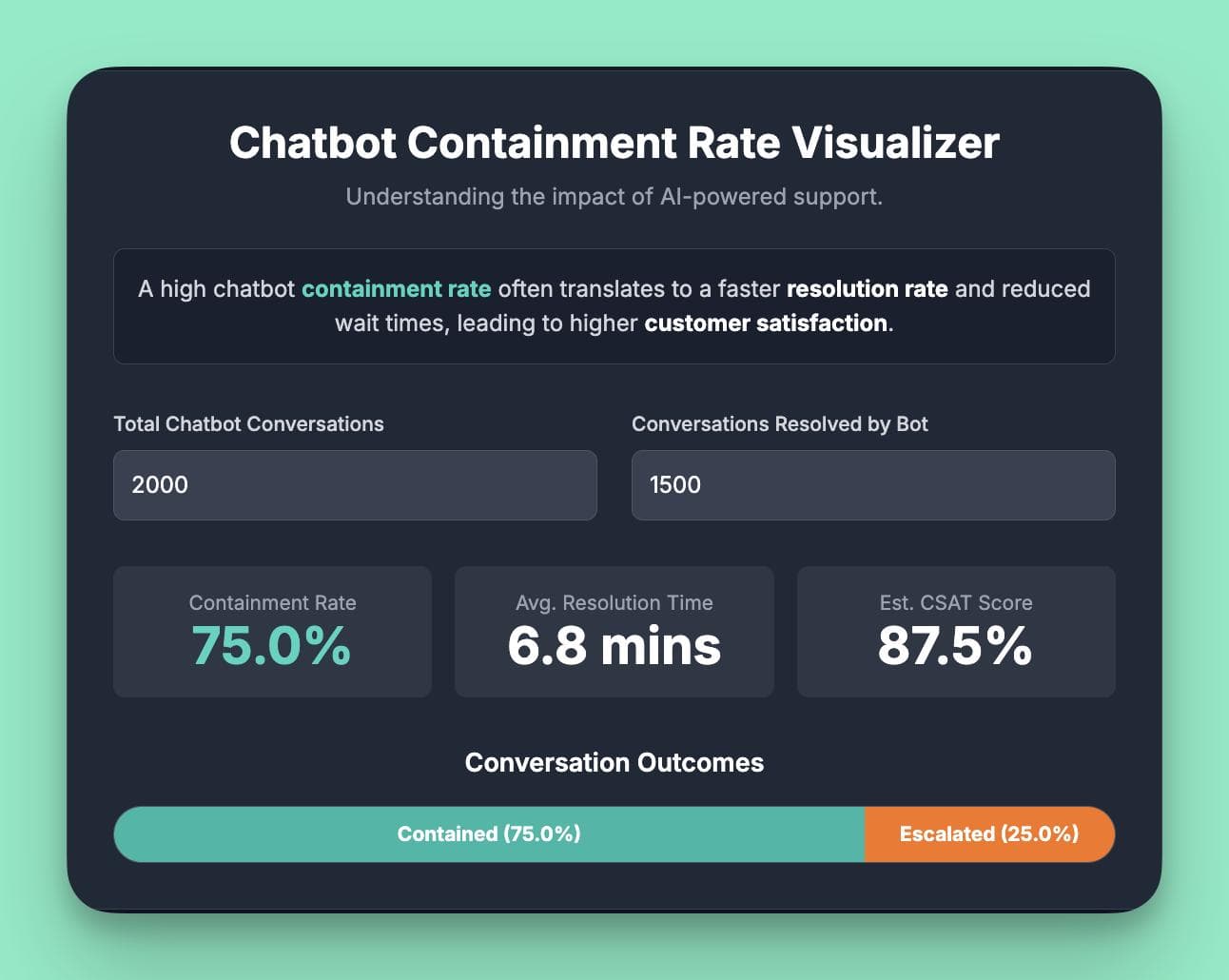
Conversely, a low chatbot containment rate can frustrate users forced to repeat their issues to a human agent.
Each interaction handled successfully by the bot eliminates the need for expensive human agent intervention.
Moreover, chatbot interactions can improve customer experience through a faster resolution rate and 24/7 availability, leading to a better customer satisfaction score.
Therefore, striving for a higher containment rate is paramount for businesses leveraging conversational AI.
Key Metrics Influencing Chatbot Containment Rate
Several key metrics influence the chatbot containment rate. Besides the raw containment rate itself, important aspects to monitor are:
- The number of escalations to a human agent
- The average interaction time for both contained and escalated conversations
- The customer satisfaction score (CSAT) for chatbot interactions
Analyzing these chatbot metrics provides a holistic view of chatbot performance. This also allows you to identify bottlenecks hindering a higher containment rate.
Importance of High Containment Rate
Benefits for Businesses
A high containment rate offers numerous benefits for businesses.
Primarily, it significantly reduces operational costs by minimizing the need for human agent intervention.
When AI-powered bots successfully handle a large proportion of customer interactions, the workload on human agents decreases. Thus, they can focus on more complex issues that require human touch.
This efficiency translates directly into cost savings, increased productivity, and a better allocation of resources, thus resulting in a higher containment rate and improved chatbot performance.
Impact on Customer Satisfaction
The impact of the chatbot containment rate on customer satisfaction is substantial.
As mentioned earlier, a high containment rate allows for faster resolution rates and reduced wait times.
This improves the customer experience and boosts loyalty because customers hate waiting.
Cost Reduction through Automation
Every interaction successfully managed by your AI chatbot for customer support eliminates the need for expensive human agent involvement.
This reduces labor costs, lowers training expenses, and streamlines operations.
So your businesses can reinvest these savings into other areas like product development or marketing.
This further enhances your competitive edge, improves your overall profitability, and, thanks to conversational AI, improves the chatbot containment rate.
How to Measure Chatbot Containment Rate
1. Track Total and Escalated Interactions
To accurately measure the chatbot containment rate, it's essential to track both total and escalated customer interactions.
Begin by logging the total number of inquiries received by your AI agent for customer support within a specific timeframe.
Then, monitor the number of these interactions escalated to human agents.
This data is crucial for calculating the containment rate and understanding chatbot performance.
For accurate tracking, you'll need robust chatbot analytics tools and processes.
2. Calculate the Containment Rate
Once you have data on total and escalated interactions, calculating the containment rate is pretty much straightforward.
The formula is:
Containment Rate = (Total Interactions - Escalated Interactions) / Total Interactions * 100.
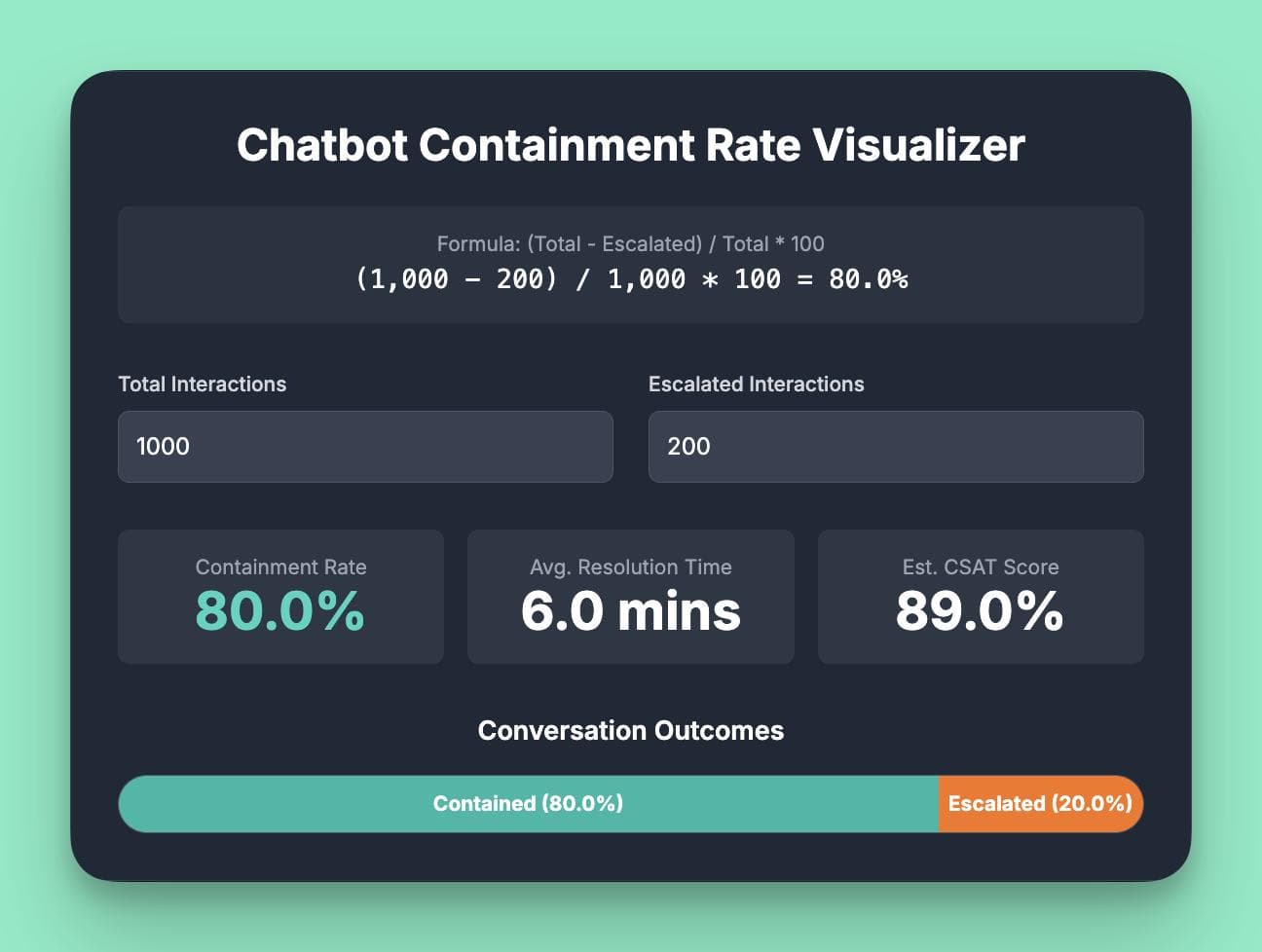
For example, if your AI agent for customer support handled 1,000 interactions and escalated 200, the containment rate would be (1000 - 200) / 1000 * 100 = 80%.
Regularly computing this metric allows you to measure chatbot performance and identify trends to improve containment.
Using AI Customer Support Chatbot Analytics Tools
Leveraging chatbot analytics tools is vital for gaining deeper insights into your chatbot containment rate.
These tools provide detailed data on customer interactions, including the;
- Specific reasons for escalations
- Average interaction times
- Customer satisfaction score
By analyzing these customer support chatbot metrics, you can pinpoint areas where your AI bot is underperforming and implement targeted strategies to improve chatbot containment rate.
Helply—the #1 customer support chatbot, for instance, provides actionable reporting, content gap analysis, and built-in AI-powered recommendations to make these improvements seamless.
Furthermore, chatbot analytics platforms reveal user behavior patterns.
Factors Affecting Chatbot Containment Rate
1. Chatbot Design and User Experience
The chatbot design and overall customer experience significantly influence the chatbot containment rate.
A well-designed interface with intuitive navigation enables users to find information and complete tasks efficiently, directly contributing to a high containment rate.
However, confusing or clunky chatbot design leads to frustration, resulting in a low containment rate and increased escalations to human agents.
Therefore, prioritizing customer experience and usability is crucial for improving chatbot containment.
2. Training and Knowledge Base
The depth and quality of the customer support chatbot’s training and knowledge base directly affect its containment rate.
A comprehensive knowledge base with accurate and up-to-date information enables the chatbot to handle a broader range of inquiries without human agent assistance.
Conversely, insufficient training or an incomplete knowledge base will result in a low containment rate.
So you want to invest in thorough training and regularly updating the knowledge base. This helps to maximize your customer support chatbot performance and thus achieve a higher containment rate.
Helply even helps automate this by identifying and fixing content gaps with AI, ensuring your bot always has accurate and updated knowledge.
3. Contextual Understanding with AI
AI-powered customer support chatbots with strong natural language processing (NLP) capabilities exhibit superior contextual understanding, leading to improved chatbot containment rate.
The ability to accurately interpret user intent, even with variations in phrasing or incomplete sentences, allows the customer support chatbot to handle complex interactions without escalation.
Poor contextual understanding results in frequent misinterpretations and a low containment rate. Enhancing the bot’s NLP engine and training it on diverse conversational patterns are crucial for higher containment.
4. Integration with Backend Systems
Seamless integration with backend systems such as CRM, order management, and inventory databases enables AI-powered customer support chatbots to access and update real-time information. This significantly improves chatbot containment.
This conversational AI integration allows the AI customer support chatbot to seamlessly handle complex tasks such as;
- Order status checks
- Address changes
- Product availability inquiries
Helply integrates directly with CRMs, order systems, and help desks like Zendesk or Intercom, so agents and bots work from the same real-time data.
Strategies to Improve Chatbot Containment Rate
1. Enhance Intent Recognition
To significantly improve chatbot containment rate, prioritize enhancing intent recognition through advanced natural language processing (NLP) and machine learning models.
An AI agent for customer support that accurately understands user intent, even when there are variations in phrasing, can resolve more issues independently.
You need to regularly train your AI models on diverse datasets, incorporating user feedback to refine the accuracy of intent detection.
Better intent recognition leads to a higher containment rate and improved customer satisfaction.
2. Improve the Knowledge Base
A comprehensive and well-maintained knowledge base is crucial for improving chatbot containment.
Ensure your customer support chatbot has access to accurate and up-to-date information on a wide range of topics.
Regularly review and update the knowledge base with new information and answers to frequently asked questions.
Also, organizing the information logically and making it easily accessible to the chatbot will enable it to improve chatbot containment rate and provide a better customer experience.
3. Streamline Escalation Paths
Even with a well-designed customer support chatbot, some interactions will require human agent intervention.
And streamlining escalation paths ensures a smooth transition from the AI bot to a human agent without frustrating the user.
You want to provide clear options for escalating to a human agent and ensure the agent has access to the conversation history to avoid repetition.
An efficient escalation process minimizes disruption and maintains customer satisfaction, even when the customer support chatbot cannot fully resolve the issue.
4. Integrate with Backend Systems
Seamless integration with backend systems is a key strategy to improve chatbot containment rate.
Connecting your AI agent for customer support to CRM, order management, and inventory systems allows it to access real-time data and perform complex tasks.
This integration minimizes the need for human agent intervention and enhances customer experience.
5. Monitor Performance and Iteration
Continuous monitoring of your customer support chatbot's performance and iterative improvements are essential for maximizing the chatbot containment rate.
Regularly analyze chatbot metrics such as containment rate, escalation reasons, and customer satisfaction score to identify areas for improvement.
Use A/B testing to experiment with different conversational flows and responses.
Implement changes based on data-driven insights to optimize the customer support chatbot's effectiveness.
Helply makes this process easier with no-code tools for optimization and real-time analytics dashboards, helping teams iterate without technical bottlenecks.
See What the Right Customer Support Chatbot Can Do for You
Improving your chatbot containment rate is the key to lowering support costs, resolving issues faster, and keeping customers happy. But not every tool is built to deliver at scale.
That’s where Helply comes in. Our AI-powered customer support chatbot helps you:
- Resolve up to 66% of tier-1 support requests instantly
- Fix content gaps automatically with AI
- Integrate seamlessly with your existing help desk systems
- Provide 24/7 support without added overhead
Don’t just take our word for it—see the difference yourself.
Book your FREE demo today and experience how Helply can transform your support into a growth engine.
FAQs
1. What is containment rate in chatbot?
Containment rate in chatbots measures the percentage of customer interactions that are fully resolved by the customer support chatbot without needing escalation to a human agent.
2. What is a good containment rate?
A “good” containment rate depends on your industry and use case, but many businesses aim for 70–80%.
3. What is the formula for containment rate?
The formula for containment rate is: Containment Rate = (Total Interactions – Escalated Interactions) ÷ Total Interactions × 100
4. What is the difference between containment rate and deflection rate?
Containment rate measures how many interactions are successfully handled within the chatbot without escalation. Deflection rate measures how many potential interactions are prevented from reaching live agents in the first place.
About the author

Bildad Oyugi
Head of Content
Bildad is a digital marketing expert with over 5 years of experience in copywriting, content marketing, and editing. Outside of work, he enjoys videography and spending time with his family.


