Artificial intelligence (AI) is revolutionizing customer service.
To effectively leverage AI in this domain, it's crucial to understand and implement key performance indicators (KPIs) that measure and track its impact.
This article will delve into the world of AI customer service. We’ll explore the essential KPIs, metrics, and performance measurement techniques that drive success and enhance customer experience.
By carefully monitoring these indicators, businesses can optimize their AI-powered customer service strategies and achieve higher customer satisfaction.
Understanding KPIs in AI Customer Service
Key performance indicators, or KPIs, are quantifiable measurements used to evaluate the success of an organization, team, or specific initiative.
In the context of AI customer service, KPIs serve as crucial benchmarks to assess how effectively AI tools and systems are meeting customer needs and achieving desired outcomes.
These metrics provide a clear and concise view of performance, enabling customer service teams to identify areas for improvement and optimize their strategies.
A well-defined KPI should be specific, measurable, achievable, relevant, and time-bound, providing a roadmap for success in AI-driven customer interactions.
By tracking these key metrics, businesses can ensure that their AI implementation is aligned with their overall customer service goals and contributing to increased customer satisfaction scores.
Importance of KPIs in Customer Service
The importance of KPIs in customer service, especially within AI customer service, cannot be overstated.
These key performance indicators provide vital insights into the effectiveness of customer service KPIs and help in measuring the success of AI in enhancing the customer experience.
Customer satisfaction scores and customer effort score are key metrics that can be significantly improved by leveraging AI.
These KPIs allow customer service teams to pinpoint areas where AI is performing well and those that need optimization.
By tracking metrics like first response time and first contact resolution, businesses can ensure that customer inquiries are addressed promptly and efficiently.
Ultimately, the proper use of KPIs drives customer loyalty and customer retention, which are vital for sustainable growth.
Types of Customer Service KPIs
Here's how you might assess the effectiveness of AI customer service, paying close attention to several key performance indicators.
These KPIs offer valuable insights into different aspects of the customer experience:
- First Response Time: Measures how quickly a customer receives an initial response.
- First Contact Resolution: Measures the percentage of customer inquiries resolved during the initial interaction.
- Customer Satisfaction Score (CSAT): Gauges customer satisfaction with the service provided.
- Customer Effort Score: Evaluates the effort a customer must expend to get their issue resolved.
- Customer Retention Rates and Customer Churn Rate: Offers insights into customer loyalty.
- Call abandonment rate: Needs to be tracked to understand if customers are being left unattended.
Key Metrics for Measuring AI Performance
Critical Performance Metrics
When evaluating the success of AI in customer service, several critical performance metrics come into play.
These metrics and KPIs provide a comprehensive view of how effectively AI systems are performing and contributing to customer satisfaction.
First Response Time remains a crucial metric, indicating how quickly customers receive an initial response from AI-powered tools like chatbots or virtual assistants.
First Contact Resolution highlights the AI's ability to resolve customer inquiries during the initial interaction, reducing the need for further assistance from human agents.
Monitoring these key metrics ensures that AI customer service operates efficiently and delivers a positive customer experience.
By using analytics to track these metrics, customer service teams can pinpoint areas for improvement.
How to Measure Customer Satisfaction
Measuring customer satisfaction is paramount when assessing the impact of AI customer service.
Customer Satisfaction Scores, often gathered through surveys after AI-driven interactions, offer direct insights into customer perception of service quality.
The Customer Effort Score measures the effort customers expend to resolve their issues using AI tools.
Analyzing customer feedback and support ticket data can also reveal pain points and areas where AI tools improve the customer experience.
Monitoring customer satisfaction scores alongside other KPIs provides a holistic view of AI performance.
Using analytics tools to analyze customer data allows businesses to see if leveraging AI results in higher customer satisfaction and increased customer loyalty.
This data-driven approach is vital for optimizing AI strategies.
Success Metrics for AI Tools
To accurately gauge the success of AI tools in customer service, a range of metrics and key performance indicators should be considered.
The resolution rate of AI tools on common customer inquiries highlights their efficiency in handling routine issues.
The escalation rate, indicating when AI systems pass interactions to human agents, provides insight into their limitations.
Analyzing customer service KPIs such as call abandonment rate also informs how efficiently customer inquiries are handled.
Furthermore, monitoring customer retention rates and customer churn rate reflects the overall impact of AI on customer loyalty.
The efficiency of AI systems can also be assessed by measuring service level and comparing performance against benchmarks.
By tracking these metrics, customer service teams can determine which AI strategies are working and which require refinement, ultimately improving service quality and enhancing customer success.
Best Practices for Implementing AI Tools
1. Choose the Right AI Tools
When implementing AI tools, the selection process is crucial for maximizing success.
It begins with a clear understanding of the specific challenges the customer service team faces and the objectives it aims to achieve.
Considering different AI technologies, such as natural language processing and machine learning, is crucial.
Evaluating various AI systems based on their ability to handle customer inquiries, automate tasks, and integrate with existing customer service KPI infrastructure is paramount.
Examining how AI tools can enhance the customer experience and improve key performance indicators, such as first response time and first contact resolution, is essential.
Furthermore, assessing the scalability and flexibility of AI solutions ensures they can adapt to evolving customer needs and business demands.
Businesses should also consider the cost of implementation, the ease of use, and the level of support provided by the vendor.
Choosing the right AI tool improves customer satisfaction scores and aligns with overall customer support goals.
2. Integrate AI with Existing Customer Service Systems
Integrating AI with existing customer service systems requires careful planning and execution.
A phased approach, starting with pilot programs, allows customer support teams to test and refine AI implementations without disrupting existing workflows.
Ensuring seamless data flow between AI tools and legacy systems is essential for accurate customer profiles and personalized service. Implementing APIs and middleware can facilitate interoperability and data exchange.
Furthermore, training human agents on how to effectively collaborate with AI tools is crucial for providing a seamless customer experience.
Regular monitoring and performance metrics analysis help identify integration challenges and opportunities for optimization.
Successful integration enhances the efficiency of customer service KPIs, improves first contact resolution, and boosts customer satisfaction scores.
Leveraging AI requires that AI tools improve existing systems and lead to streamlined customer service.
3. Train Your Staff on AI Tools
Training staff on AI tools is a critical step in ensuring the successful implementation of AI customer service strategies. Customer service metrics and key performance indicators are often affected by the training provided to staff.
Comprehensive training programs should cover the functionality of AI systems, their role in enhancing customer interactions, and best practices for collaboration between human agents and virtual assistants.
Employees should learn how to interpret AI-generated insights and feedback to improve their performance and enhance customer satisfaction. Training should also focus on addressing potential limitations of AI tools, such as when to escalate complex issues to human agents.
Ongoing training and support are essential to keep staff updated on new AI features and functionalities, ensuring they can effectively leverage AI to deliver exceptional customer service.
By investing in thorough training, businesses can empower their teams to utilize AI tools effectively, improving service quality and driving customer success.
Top Customer Service Metrics to Track
1. First Response Time
First response time, a critical customer service KPI, measures the speed at which a customer receives an initial response to their inquiry.
In AI customer service, this metric gauges the efficiency of AI systems, like AI-powered tools, in providing timely automated replies.
A shorter first response time often correlates with higher customer satisfaction scores and a better overall customer experience. Leveraging AI to instantly acknowledge customer inquiries, even with a generic message, can significantly reduce perceived wait times.
By analyzing data on response times, customer service teams can identify bottlenecks and optimize AI workflows to ensure prompt assistance.
Customer support teams should constantly monitor and refine their AI strategies to improve this key metric. Keeping first response time low also leads to greater customer loyalty.
2. Resolution Rate
Resolution rate, also known as first contact resolution, is a key performance indicator that measures the percentage of customer issues resolved during the initial interaction.
In the context of AI customer service, this metric reflects the ability of AI tools to provide complete and accurate solutions without needing human intervention. A higher resolution rate indicates that AI systems are effectively addressing customer needs and reducing the workload on human agents.
By leveraging AI to handle routine inquiries and provide self-service options, businesses can improve their resolution rate and enhance the customer experience.
Tracking this KPI helps customer service teams identify areas where AI can be further optimized to provide more comprehensive support.
Metrics and KPIs are key when considering whether to continue investing in AI systems.
3. Customer Retention Rate
Customer retention rate is a critical customer service metric that reflects the percentage of customers a business retains over a specific period.
High customer retention indicates strong customer loyalty and satisfaction. AI customer service plays a crucial role in improving customer retention by providing personalized support, proactive assistance, and efficient issue resolution.
By analyzing customer data, AI systems can identify at-risk customers and proactively offer solutions or incentives to retain their business.
Monitoring customer churn rate, the inverse of customer retention, helps businesses understand why customers are leaving and identify areas for improvement.
High customer satisfaction scores can lead to increased customer loyalty and thus a higher customer retention rate. By providing great AI customer service, businesses can increase customer retention rates.
Using AI to Improve Customer Service Metrics
AI Tools and Their Impact on Customer Experience
AI tools are transforming customer service by automating tasks, personalizing interactions, and providing faster support.
Chatbots and virtual assistants can handle routine inquiries, freeing up human agents to focus on complex issues. AI-powered analytics tools analyze customer data to identify trends, predict needs, and personalize offers.
Natural language processing (NLP) enables AI systems to understand and respond to customer inquiries in a natural and conversational way.
By leveraging AI tools, businesses can improve customer satisfaction scores, reduce customer effort, and enhance the overall customer experience.
Metrics and KPIs such as first response time, first contact resolution, and customer satisfaction scores all improve with the implementation of AI.
It is paramount that AI tools improve customer service and increase customer loyalty.
Leveraging Data for Continuous Improvement
Leveraging data is essential for continuous improvement in AI customer service. By analyzing customer feedback, support ticket data, and performance metrics, businesses can identify areas where AI systems are performing well and those that need refinement.
The importance of metrics and KPIs can't be overstated. Customer service teams should track metrics such as first response time, resolution rate, and customer satisfaction scores to measure the impact of AI initiatives.
A customer effort score is also an important factor that needs to be taken into account. AI systems can also analyze customer interactions to identify pain points and predict future needs.
Data-driven insights enable businesses to optimize AI strategies, personalize customer interactions, and improve the overall customer experience.
By using customer service metrics, businesses can see if they are achieving the results that they intended with their AI tools. Customer feedback is key to improving AI implementation.
Case Studies of Successful AI Implementation
The following case studies highlight the success of AI implementation in customer service:
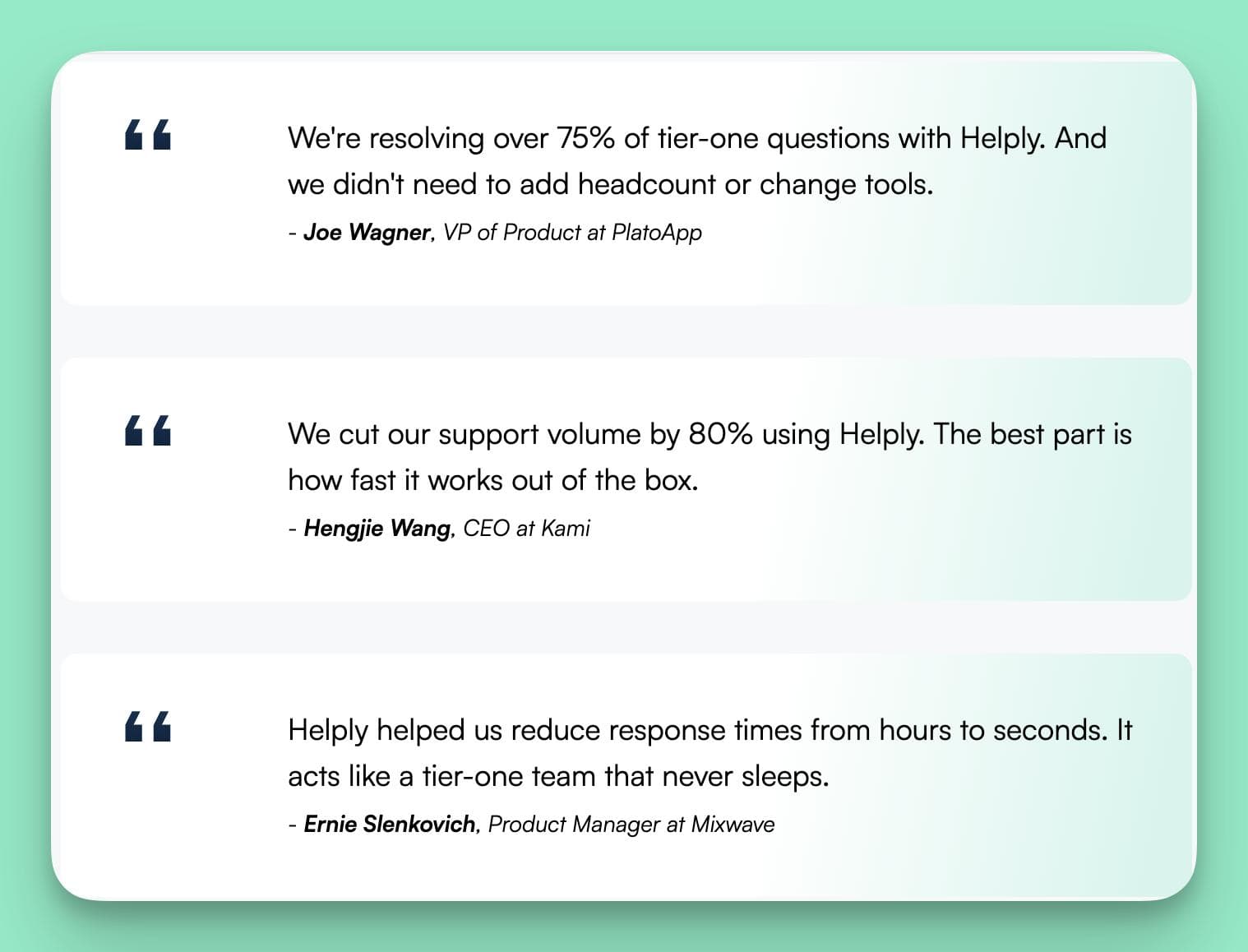
Plato integrated Helply’s AI agent for thousands of monthly support inquiries. After deployment the company saw a 20 % reduction in ticket volume and now resolves ~75.1 % of tier‑1 inquiries without human intervention.
KamiApp feeds thousands of past support conversations into Helply’s AI to convert common questions into accurate automated replies. They cut support volume by 80 %.
Mixwave used Helply to feed historical support data into the AI. The company saw a dramatic reduction in manual ticket load and reduced response times from hours to seconds.
Supabase’s support team fed three months of support tickets into InstantDocs. The AI generated over 60 polished help articles ready to publish, saving the team days of writing and significantly increasing ticket deflection.
C2Keep replaced its Notion‑based documentation and built a branded knowledge base in days using InstantDocs. It is also cited among “real teams” that built an entire knowledge base quickly.
Conzent (Conzent ApS) used InstantDocs to clean up outdated documentation and cut its documentation‑creation time by 90%.
Busable integrated InstantDocs into its development workflow, saving over 93 hours on documentation creation.
Ready to See How to Measure KPIs for AI Customer Support—And Win?
When it comes to how to measure KPIs for AI customer support, the secret is in tracking the right metrics—things like first response time, resolution rate, and customer satisfaction.
These numbers tell you if your AI is improving customer experience or just adding noise.
The best part is that you don’t have to figure it all out on your own. With Helply’s AI Agent, you can automatically measure, track, and improve these KPIs in real time.
Companies like Plato, H&M, and Supabase are already cutting tickets, reducing response times, and boosting satisfaction; all without hiring extra staff.
Ready to see how our AI Agent can transform your support team’s KPIs into real results?
About the author

Bildad Oyugi
Head of Content
Bildad is a digital marketing expert with over 5 years of experience in copywriting, content marketing, and editing. Outside of work, he enjoys videography and spending time with his family.


