Key Takeaways
- Zendesk bills three ways: seats, $50 a month per agent for Copilot and $1.50 to $2.00 per resolution past the allowance.
- Ten agents on Suite Professional with Copilot cost $1,650 a month on annual billing, before any extra AI resolutions.
- Ten of the other 11 alternatives charge per seat, agent or user, and Gorgias prices by ticket volume. Every Helply plan includes unlimited users, and you buy credits for the AI work. The spend cap defaults to your block price.
- Shortlist by use case: Slack (Helply, Pylon, Plain), email (Help Scout), ticketing (Freshdesk) or budget (Zoho Desk). Intercom fits in-app chat, and Gorgias fits e-commerce. CRM-led teams can choose HubSpot or Salesforce.
- Helply brings over Zendesk tickets, macros, help center articles and customer records. You can run both tools on one queue until you cut over.
If your Zendesk renewal quote came in higher than last year, start with the AI line items. Copilot costs $50 per agent per month, in addition to each seat. Zendesk charges for every automated resolution past the allowance, and overage is on by default.
Some of those seats belong to occasional users. Each person who replies to customers needs another seat, so you keep engineers and success managers out of the queue. On Suite Team, light agents, who read tickets and add private comments, are an add-on.
Some customers ask for help in shared Slack and Teams channels. Their messages stay outside your Zendesk queue until someone turns them into tickets.
Jacqueline Antworth, who runs customer experience at Proposify, felt the per-seat squeeze before the move to Helply. "Zendesk charged us for every person who just wanted to read a ticket. We needed leverage on routine questions and visibility for the whole team, for less than we were paying."
Zendesk is a mature help desk with a large app marketplace. It prices support by the seat and sells AI on top.
The 12 best Zendesk alternatives in 2026 cover email inboxes, Slack-first support, e-commerce queues and CRM-led teams. Price each one, including AI fees, before your renewal date.
Best Zendesk Alternatives at a Glance
A Zendesk alternative is a help desk or customer support platform that replaces Zendesk. Teams switch to cut seat and AI add-on costs, simplify setup, or answer customer questions in shared Slack channels and Microsoft Teams.
The best Zendesk alternatives in 2026 are Helply, Pylon, Plain, Front, Help Scout, and Freshdesk. Zoho Desk, Intercom (Fin), Gorgias, Salesforce Service Cloud, LiveAgent, and HubSpot Service Hub round out the 12.
Prices are per month in US dollars on annual billing. Helply's $49 credit block is its monthly-billing price, and annual billing costs 15% less.
| Tool | Best for | Entry price | Pricing model | AI pricing |
|---|---|---|---|---|
| Helply | Teams that want AI agents and unlimited users | $49 a month for 500 credits | Monthly credit block, unlimited users | 1, 4 or 12 credits per AI task, by complexity |
| Pylon | Support in shared Slack and Teams channels | Not published | Per full seat; Slack-only responders free | Separate AI bundles; prices not published |
| Plain | Small B2B teams in Slack and email | $45 per member seat | Per member seat; viewers free | Credits; Ari uses 100 per resolution |
| Front | Shared inbox collaboration | $25 per seat | Per seat | Copilot $20 per seat below Enterprise; Autopilot from $0.05 to $0.89 per conversation |
| Help Scout | Simple email support | Free for 5 users; $25 per user | Per user | AI Answers $0.75 per resolution |
| Freshdesk | Zendesk-style ticketing with a cheaper copilot | $19 per agent | Per agent | Copilot $29 per agent (Pro and Enterprise); AI Agent: 500 free sessions once, then $49 per 100 |
| Zoho Desk | Teams on the Zoho suite | Free for 3 users; $7 per user | Per user | Zia Agent Studio on every plan; bring an OpenAI key for generative AI on Express and Standard |
| Intercom (Fin) | In-app chat for product-led teams | $19 per seat | Per seat | Fin $0.99 per outcome; Copilot $29 per agent |
| Gorgias | Shopify and e-commerce stores | $10 a month for 50 tickets (monthly only); $50 for 300 on annual billing | Monthly ticket volume | $0.90 per automated interaction on annual plans ($1.00 monthly); each one counts as a ticket |
| Salesforce Agentforce | Enterprises on Salesforce | $25 per user (Starter Suite) | Per user | Agentforce: $2 per conversation, Flex Credits or a $125 per user add-on |
| LiveAgent | Phone, email and chat on a budget | $15 per agent; call center from $29 | Per agent | FlowHunt credits, with their own pricing |
| HubSpot Service Hub | Teams whose CRM is HubSpot | Free for 2 users; $20 per seat list price | Per seat | Customer Agent $0.50 per resolution, Professional and up |
| Zendesk (baseline) | Teams that depend on Zendesk marketplace apps | $19 per agent | Per agent | 5 to 15 included resolutions per agent a month; extras $1.50 on committed volume or $2.00 pay as you go; Copilot $50 per agent from Suite Professional |
Why Teams Are Leaving Zendesk in 2026
You face four problems at renewal. You pay AI fees on top of seats, and features such as skills-based routing sit in higher suites. Every teammate who answers customers needs a paid seat, and Zendesk supports shared Slack and Teams channels only in part.
The AI Tax: You Pay Per Seat and Per Resolution
Zendesk's Support Team, Suite Team and Suite Professional plans cost $19, $55 and $115 per agent each month on annual billing. Zendesk Copilot adds $50 per agent a month, and you can buy it on Suite Professional and above.
Every Zendesk plan includes AI agents and a monthly allowance of 5 to 15 automated resolutions per agent, depending on the plan. Past that allowance, each resolution costs $1.50 on committed volume or $2.00 pay as you go. Overage is on by default, and admins can turn it off to pause the AI at the limit.
Ten agents on Suite Professional cost $1,150 a month in seats on annual billing. Copilot for all ten adds $500, so you pay $1,650 before extra resolutions, about 1.4 times the seat price.
Since May 18, 2026, Zendesk has been moving accounts from these per-resolution allowances to tiers that draw on a dollar allowance per seat. Suite Professional's allowance is $5 per agent a month, and Zendesk doesn't publish the tier prices. Ask for them in writing before you renew.
Helply bills the AI work itself in credits, and every plan has unlimited users. Credit blocks begin with 500 credits at $49 a month, and a rejected draft never costs a credit.
Suite-Tier Inflation: The Features You Want Are Two Tiers Up
Skills-based routing, the App Builder and custom reporting start at Suite Professional, at $115 per agent a month.
Customizable live dashboards, custom agent roles and audit logs need Suite Enterprise, which has no published price.
On top of each seat, you can add Copilot at $50 a month, Quality Assurance at $35 or a $50 workforce engagement bundle.
Seat Math: Every Teammate Who Answers Customers Needs a Paid Seat
On Zendesk, each agent who replies to customers takes a paid seat. Suite Professional includes up to 100 light agents, who can read tickets and add private comments. Light agents can't take assignments or send public replies.
An engineer who knows the fix can leave a private note, but a paid agent has to send the answer. On Suite Professional, each extra person who replies to customers adds $115 a month on annual billing, or $165 with Copilot.
The Two Worlds Problem: Shared Slack and Teams Channels
Many software companies support customers in shared Slack Connect channels and Microsoft Teams. Zendesk's Slack Direct Messages channel handles one-to-one requests, and replies in Slack threads don't reach Zendesk.
In a shared Slack Connect channel, someone has to @mention Zendesk to turn a message into a ticket. Zendesk's Teams integration works on the agent side, for creating and updating tickets from Teams.
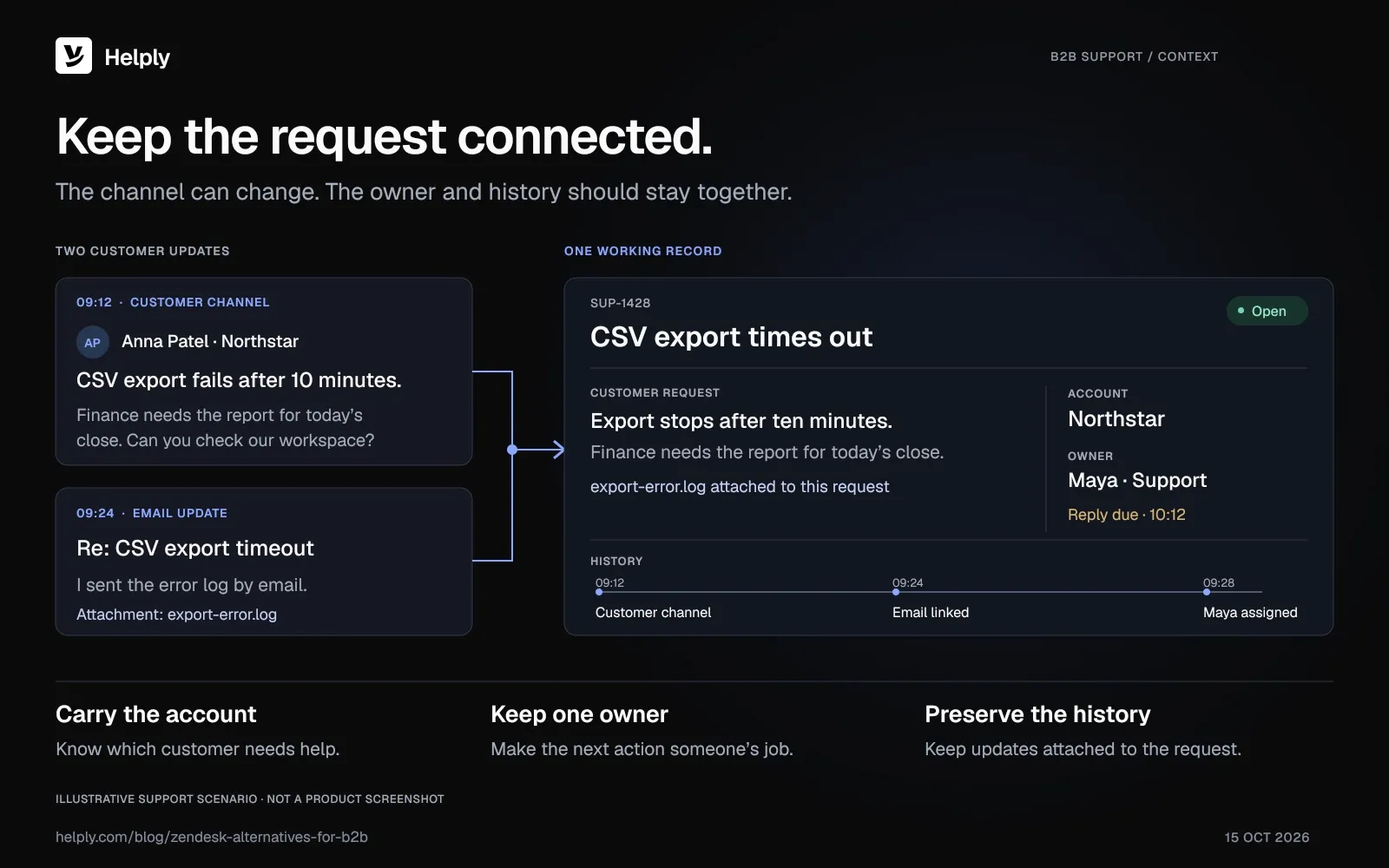
Helply, Pylon, Plain and Front bring customer Slack channels into the queue. Pylon and Plain cover Microsoft Teams on higher plans. In Helply, Teams conversations share the inbox with email and chat.
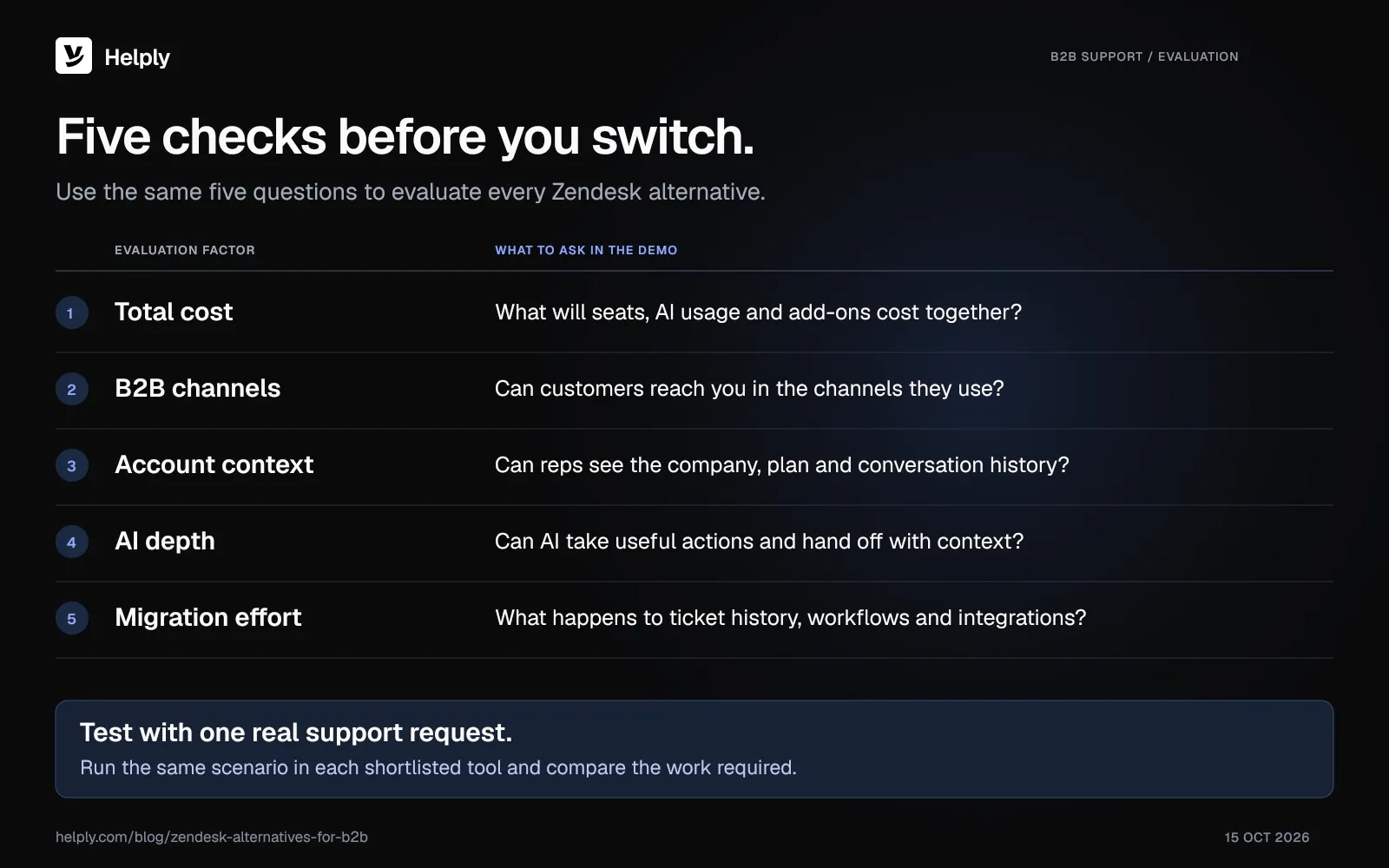
Five Factors for Comparing Zendesk Competitors
Compare each tool on five factors that move your monthly bill or change your team's workday.
- Total cost. Seat prices plus AI add-ons and per-resolution fees, on annual billing.
- AI depth. Does the AI answer from help articles only, or can it look up accounts and take actions?
- Channels. Can your team work email, chat, Slack, Microsoft Teams and WhatsApp from one queue?
- Customer context. Can your reps and the AI see account, billing and product data beside the conversation?
- Switching effort. Can you bring tickets, macros and help articles across and run both tools side by side?
1. Helply: Best for Teams That Want AI Agents and Unlimited Users
Helply is an AI-native customer support platform. Coming from Zendesk, you get the help desk you expect: shared inbox and ticketing, live chat, knowledge base, analytics, customer records and workflows. Helply's agents investigate, resolve and act inside that help desk.
The Support Agent works with customers on every channel and resolves issues end to end. If it can't resolve a case, it hands the case to a person with the investigation done. The Assist Agent works beside your reps, and Background Agents watch every conversation for churn risk, upgrade intent and knowledge gaps.
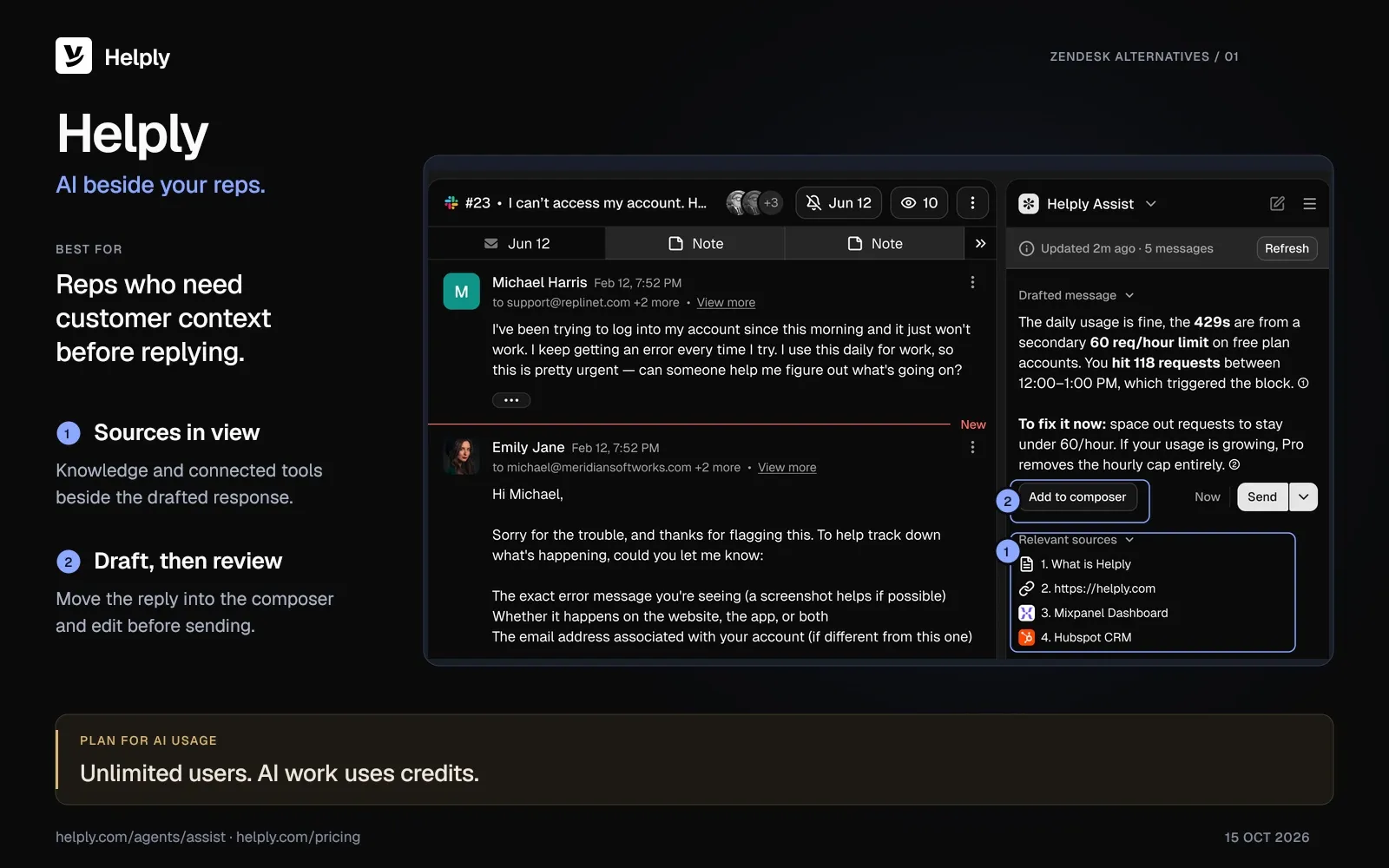
Every plan has unlimited users, so engineers, success managers and product leads can work tickets with no per-user fee. You pay for AI work from a monthly block of credits.
Proposify replaced Zendesk with Helply across two products and two knowledge bases. Its account owners, product leads and CS managers gained support visibility for less than the per-seat Zendesk plan cost. CSAT held steady through the migration.
Key Features
- The help desk you run today. Inboxes, assignment and routing, response and resolution targets, macros, collision detection and reporting all come with Helply.
- Support Agent on every channel. It investigates with your knowledge base, customer history and connected tools across email, chat, Slack, Teams, WhatsApp and more. It can resolve issues end to end and escalates with the investigation and customer context ready.
- Assist Agent for your reps. It drafts replies from the conversation and customer history, and takes actions the rep approves, such as updating records or filing issues.
- Background Agents. Churn, Revenue, Knowledge, Feature Request and Insights agents monitor conversations, and you can build your own. Churn and Revenue agents can alert a teammate, update customer records or trigger workflows.
- Customer and account context. Reps and agents see customer details, conversation history and account information together. Connect your CRM, billing and product data from 60+ integrations.
- Slack Connect and Teams as tickets. Customer channels become trackable conversations in the same inbox as email. The AI agents can reply there when you configure them to.
- Escalation rules you set. Decide which cases the AI handles alone and which go to a person.
- Zendesk migration. Bring tickets and conversation history, help center articles and macros, and customer and organization records.
Pricing
Helply bills AI work from a monthly credit block, and every plan has unlimited users. The smallest block holds 500 credits for $49 a month, and the largest holds 32,000 for $1,549. On monthly billing, unused credits carry over for one month; on annual billing, you save 15% and credits pool across the year.
Drafting a reply uses 1 credit, and a bounded lookup in one or two systems uses 4. Checking refund eligibility and preparing the refund uses 12. Retries, failed actions and rejected drafts never use credits.
Five Suite Professional agents on Zendesk cost $575 a month in seats on annual billing, or $825 with Copilot. To size a Helply block, multiply your monthly conversations by about 7 for B2B support or 4 for B2C. The free trial includes 1,000 credits over 14 days, and you don't need a card.
Pros
- Unlimited users on every plan, so a success manager or engineer can join support with no per-user fee.
- All three agents come with every plan, and each AI action costs 1, 4 or 12 credits by complexity.
- Slack Connect and Microsoft Teams conversations land in the same inbox as email and chat.
- You can keep Zendesk live while Helply works a share of your queue.
- At Kameleo, which replaced a Zendesk and GitHub setup, the Support Agent resolved 79% of inbound questions end to end.
Cons
- Your bill moves with AI usage once you raise the spend cap. The cap defaults to your block price, and Helply bills any top-up at the same rate.
- Helply lists 60+ integrations. If your workflow depends on a Zendesk marketplace app, check that Helply connects to the same tool first.
2. Pylon: Best for Support Teams Living in Slack and Teams
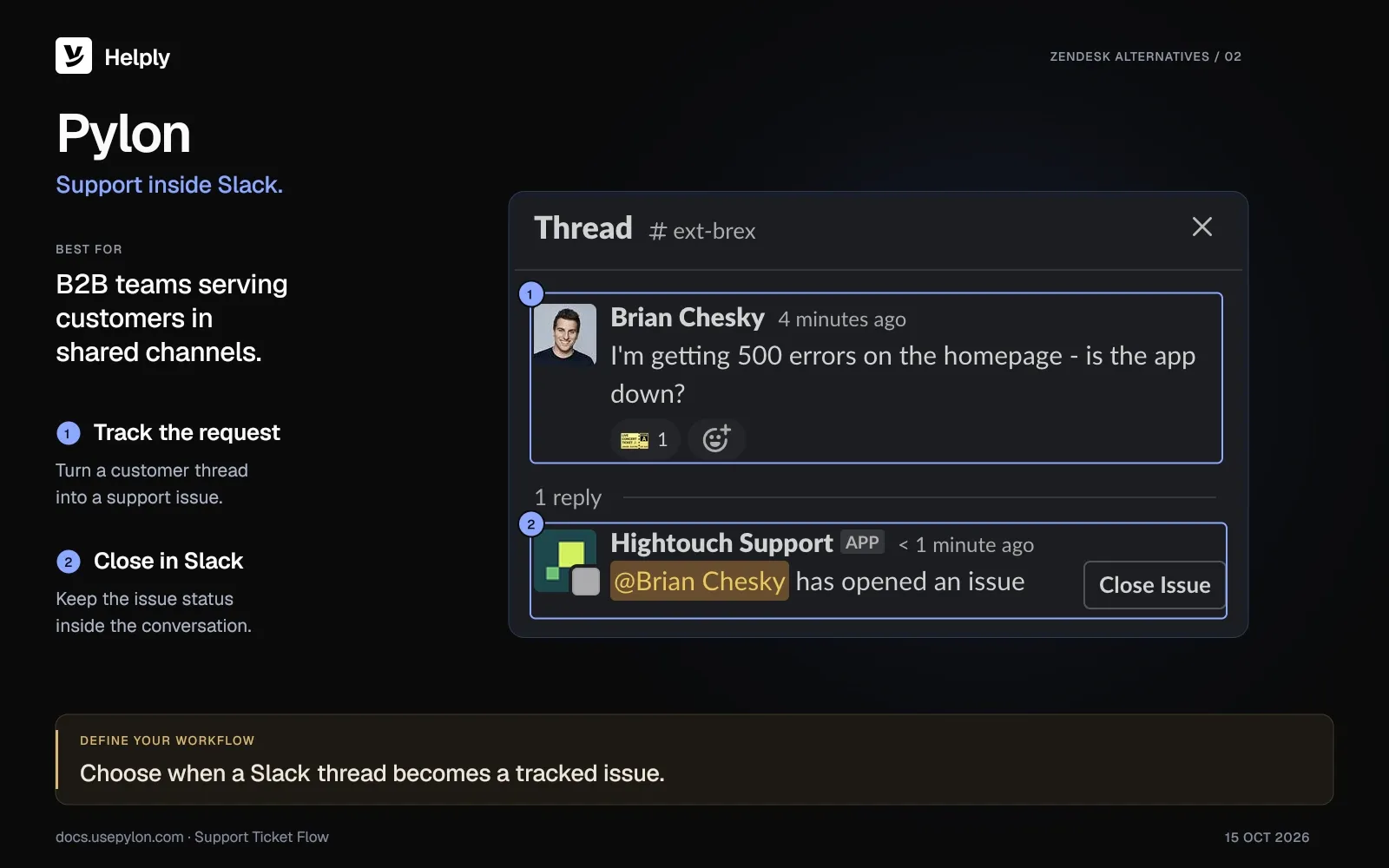
Pylon fits teams whose customers talk to them in shared Slack and Teams channels. It's a B2B support platform that turns messages from Slack, Microsoft Teams, Discord and email into tracked issues.
Pricing
Pylon doesn't publish prices, and its pricing page redirects to a demo form. It bills per full seat, gives a free seat to people who answer only in Slack, and sells AI in separate bundles.
Pros
- Supports customers across Slack, Microsoft Teams, email, chat, SMS, WhatsApp, phone and Discord.
- Teammates who reply only in Slack get a free seat.
- G2 reviewers rate Pylon 4.7/5 across 111 reviews.
Cons
- AI comes in named bundles (AI Assistants, AI Agents and Account Intelligence), and Pylon doesn't publish their prices.
- The Microsoft Teams integration sits in the Advanced / Enterprise plan.
- No free plan or self-serve trial: you start with a demo.
Best For
B2B teams that want a Slack-first help desk and are comfortable with seat-based pricing plus AI add-ons.
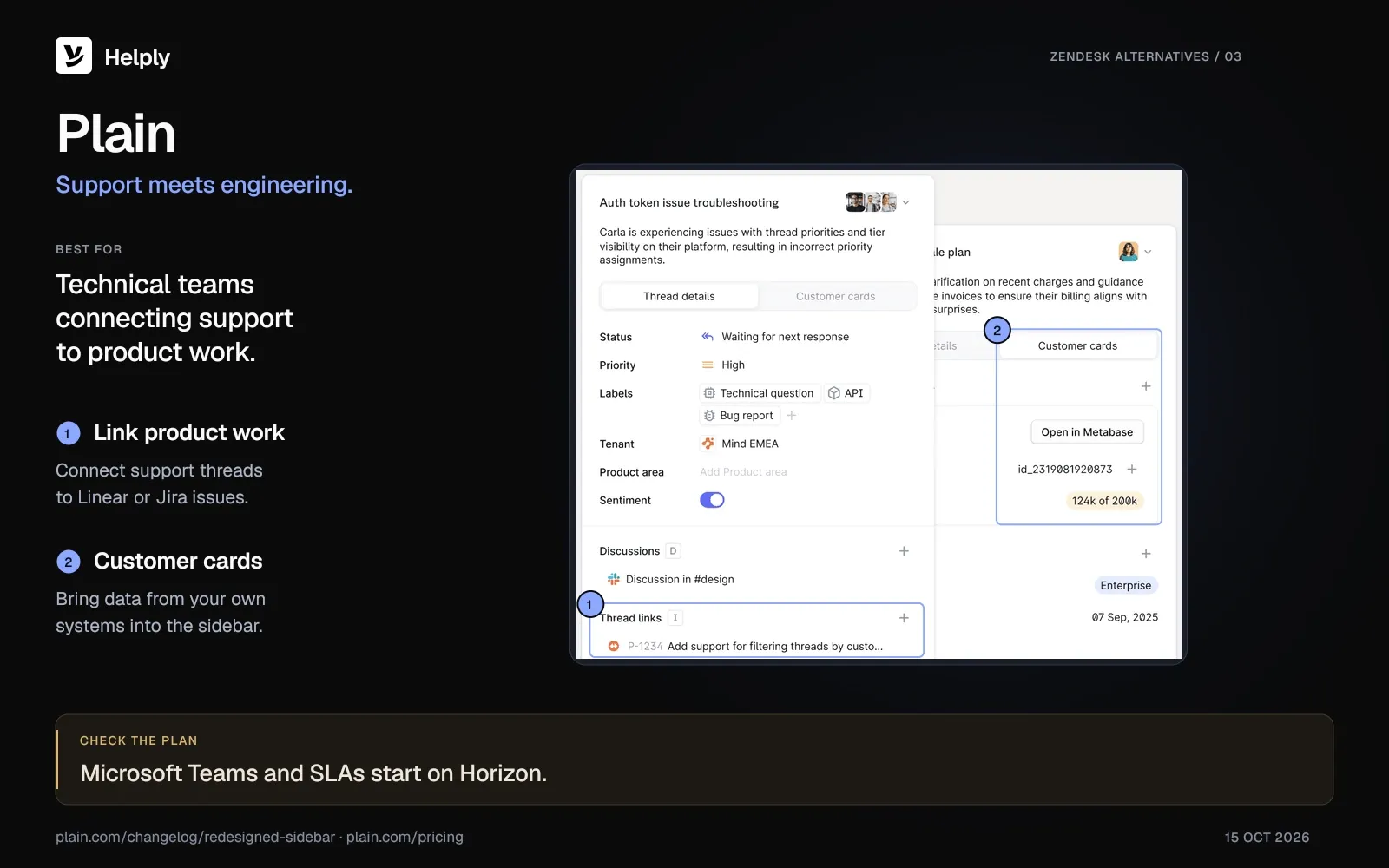
3. Plain: Best for Small B2B Teams in Slack and Email
Plain fits small B2B teams that support customers in Slack and email from a browser-based tool.
Pricing
Plain's Foundation plan costs $45 per member seat a month on annual billing, or $55 monthly, for up to 5 members. Horizon costs $99 per member seat a month on annual billing, or $139 monthly, for 3 to 10 members. Viewer seats are free, and Ari, Plain's customer-facing AI agent, uses 100 credits per resolution.
Pros
- Unlimited free viewer seats, so engineers can read every thread.
- Foundation includes 1,000 credits a month and Horizon 2,500. Extra credits cost $10 per 1,000.
- A 7-day free trial with no card, and up to 50% off for startups.
Cons
- No native mobile or desktop app: Plain runs in the browser.
- Foundation stops at 5 members, and Horizon requires at least 3.
- Microsoft Teams starts on Horizon, and Discord needs the custom-priced Frontier plan.
Best For
Small B2B teams that want free viewer seats for engineers who read support threads.
4. Front: Best for Shared Inbox Collaboration
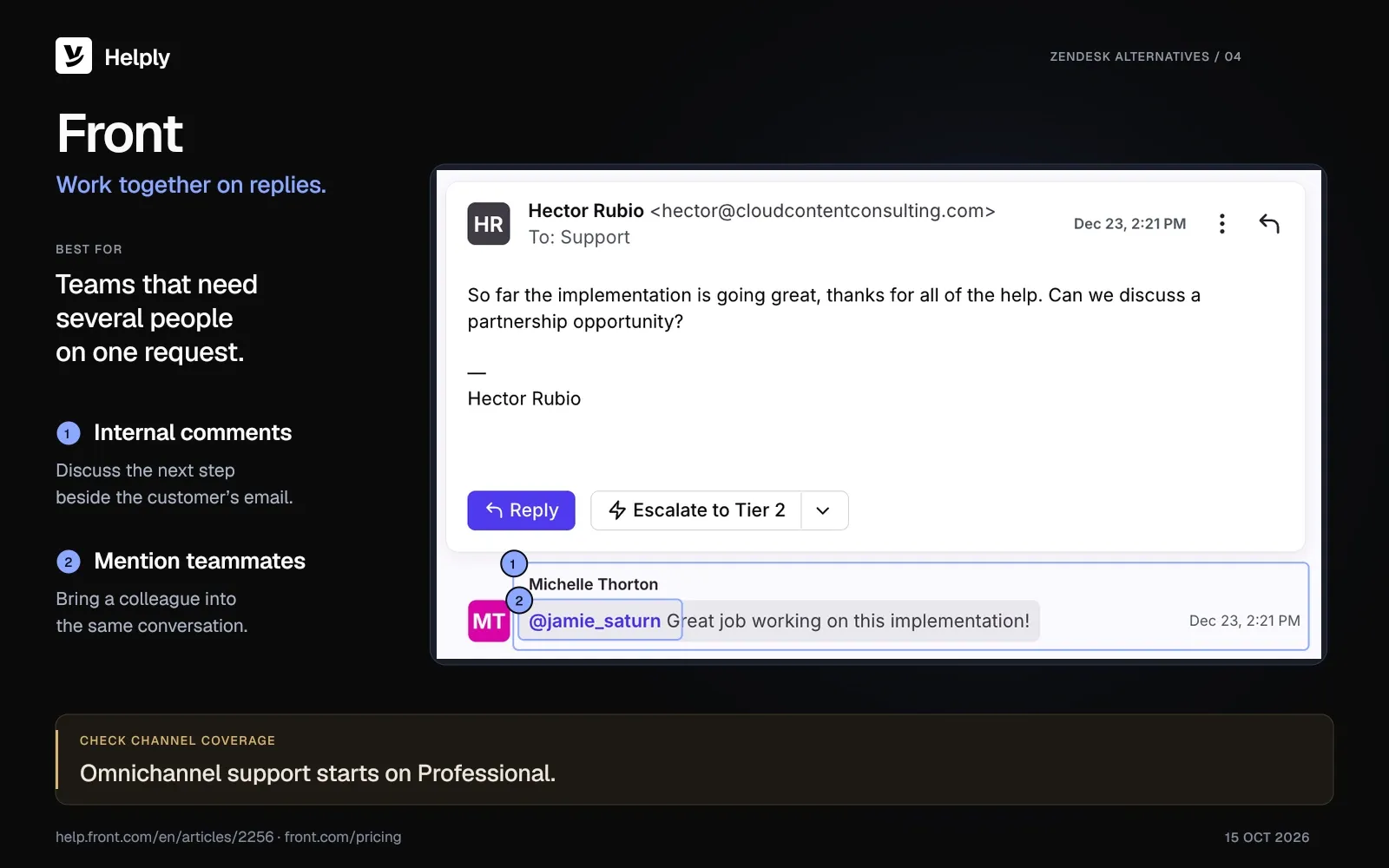
Front fits teams that handle customer conversations as shared threads more than formal tickets. It pulls email, chat, Slack and social messages into one inbox where teammates assign, comment and draft together.
Pricing
Front's Starter plan costs $25, Professional $65 and Enterprise $105 per seat a month on annual billing. Monthly billing costs $35 for Starter and $85 for Professional, and Enterprise is annual only.
Front's Copilot costs $20 per seat a month as an add-on on Starter and Professional and comes with Enterprise. Autopilot, Front's AI agent, is an add-on on every plan. Front bills each Autopilot conversation once, at the highest outcome it reaches: triage $0.05, handoff $0.39 or resolution $0.89.
Pros
- Teammates comment, assign and share drafts on the same conversation. G2 reviewers rate Front 4.6/5 across 2,500-plus reviews.
- Slack channels, including Slack Connect channels you own, connect as a Front channel.
- A 14-day trial with Professional features and no card.
Cons
- Advanced analytics and Salesforce or HubSpot sync start at Professional. Custom reports and unlimited rules need Enterprise at $105 per seat.
- Below Enterprise, AI costs extra twice: Copilot per seat and Autopilot per conversation.
- Starter caps at 10 seats and 10 rules.
Best For
Collaborative email teams of up to 50 on Professional, or larger teams on Enterprise at $105 per seat.
5. Help Scout: Best for Simple Email Support
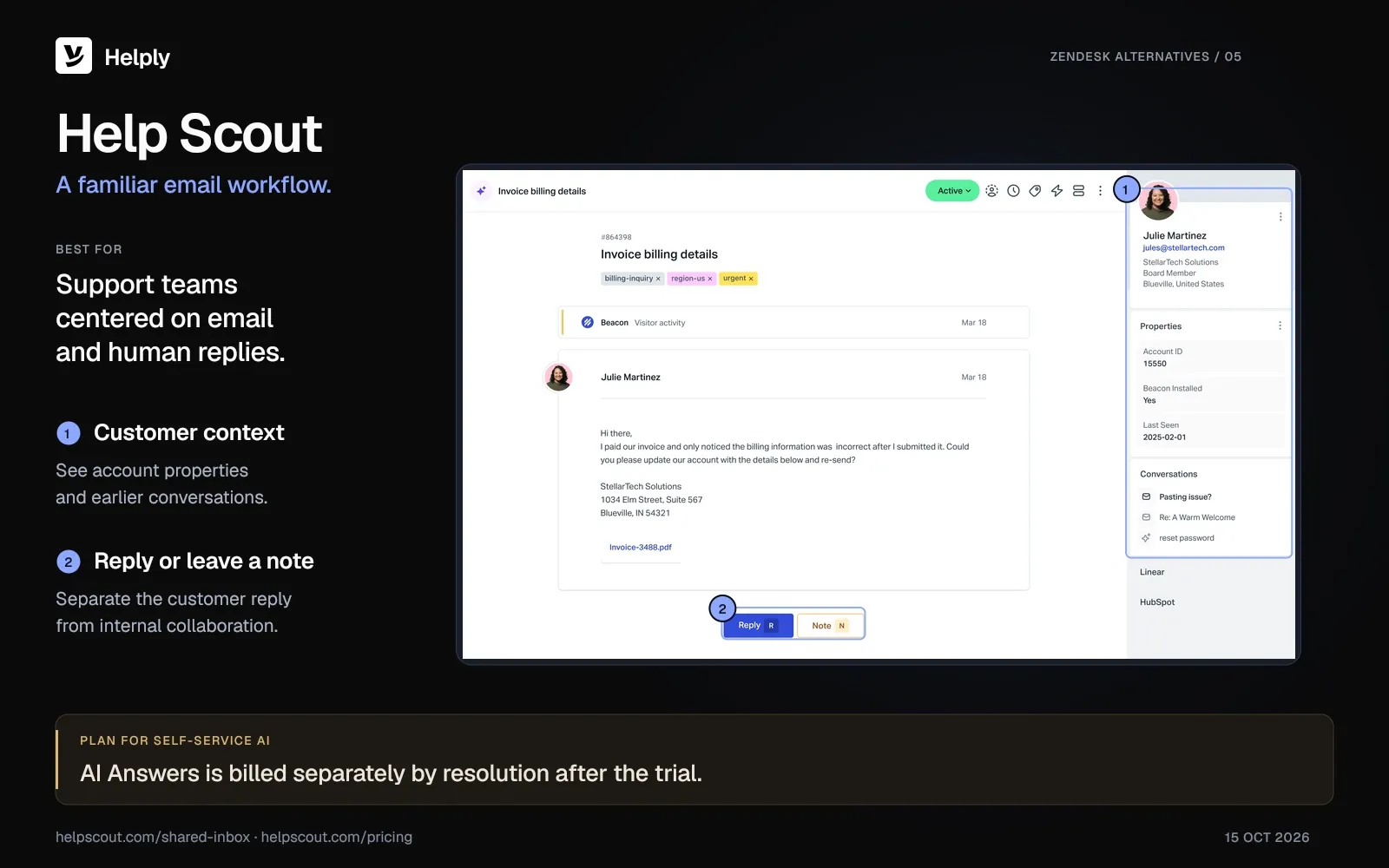
Help Scout fits small teams that want a free plan and a short setup. You answer email from a shared inbox with a built-in Docs knowledge base.
Pricing
Help Scout charges $25, $45 and $75 per user a month for Standard, Plus and Pro on annual billing. Monthly prices are $30, $54 and $90, and the free plan covers 5 users, 1 inbox and 100 contacts a month. Help Scout bills AI Answers at $0.75 per resolution on paid plans, and AI Drafts comes with Plus and Pro.
Pros
- A free plan for up to 5 users, with 1 inbox and a Docs site.
- AI Answers starts with a 3-month free trial of unlimited resolutions, and you can set a monthly spending cap.
- Standard and Plus come with a 15-day trial.
Cons
- AI Drafts and AI Summarize need Plus or Pro, and AI Answers doesn't answer email yet.
- Help Scout's Slack integration sends notifications only, and its docs say Slack is not a support channel.
- Help Scout switched to billing by contacts helped in November 2024, then moved new customers back to per-user plans in November 2025.
Best For
Small teams whose support runs on email and a help center.
6. Freshdesk: Best for Zendesk-Style Ticketing With a $29 Copilot
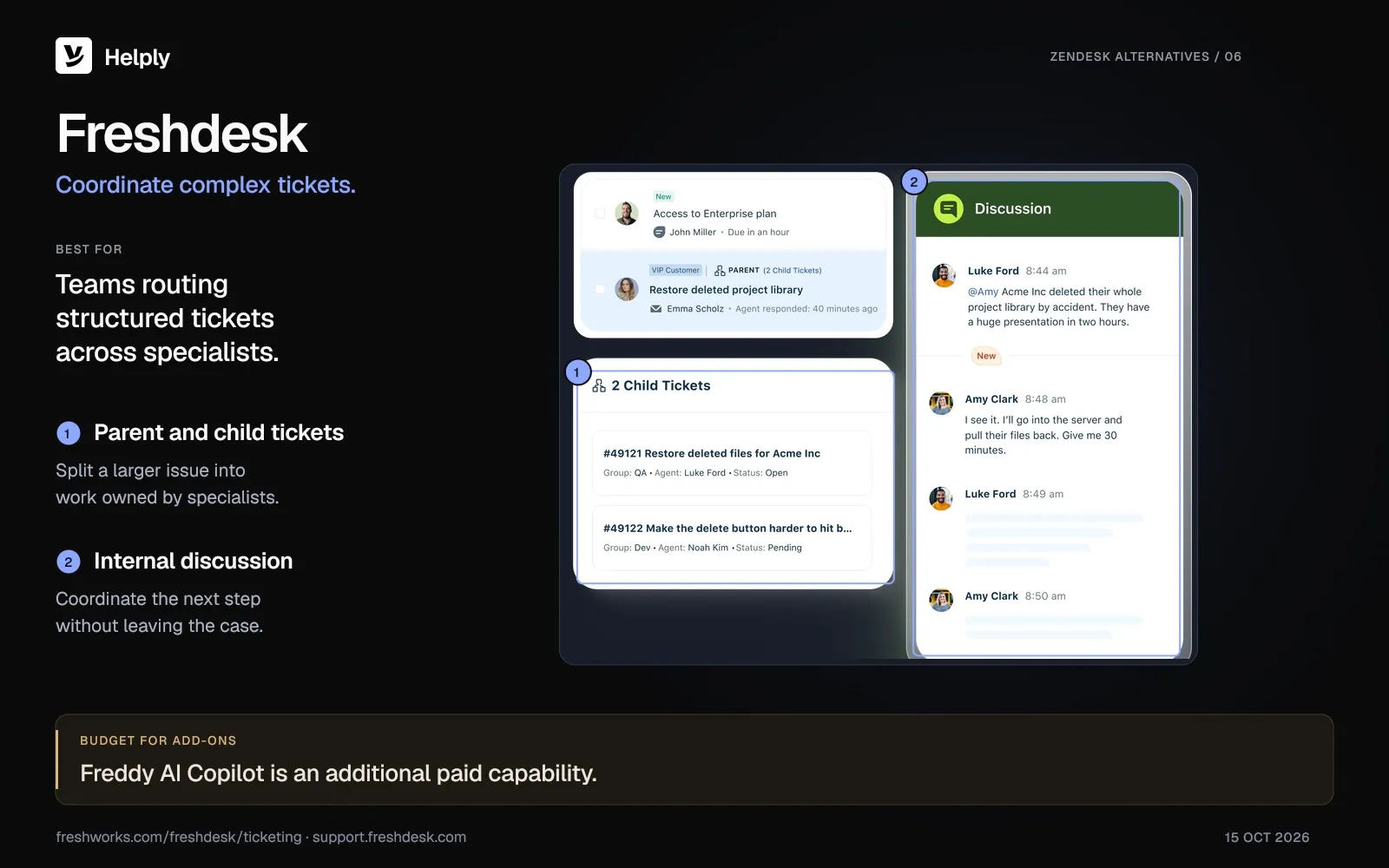
Freshdesk fits teams that like Zendesk's ticket workflow and want a cheaper AI copilot. Its three per-agent plans run from $19 to $89 a month on annual billing.
Pricing
Freshdesk charges $19, $55 and $89 per agent a month for Growth, Pro and Enterprise on annual billing. Monthly billing costs $23, $66 and $107.
Pro and Enterprise can add Freddy AI Copilot at $29 per agent a month on annual billing, or $35 monthly. Each account gets a one-time allowance of 500 Freddy AI Agent sessions, and every further 100 sessions cost $49.
Pros
- Pro with Freddy AI Copilot costs $84 per agent a month on annual billing. Zendesk's cheapest plan with Copilot costs $165.
- Freshdesk's Free Program gives 2 agents six months free, and you turn it on in the product.
- G2 reviewers rate Freshdesk 4.4/5 across 3,800-plus reviews. The 14-day trial runs on the Enterprise plan.
Cons
- Growth teams can't add Copilot, which Freshdesk sells on Pro and Enterprise only.
- The 500 free AI Agent sessions come once per account. After that, every 100 sessions cost $49.
- Freshdesk's Slack and Microsoft Teams apps work on the agent side, and neither is a customer-facing channel.
Best For
Teams that want Zendesk-style ticketing with a cheaper copilot.
7. Zoho Desk: Best for Teams Already in Zoho
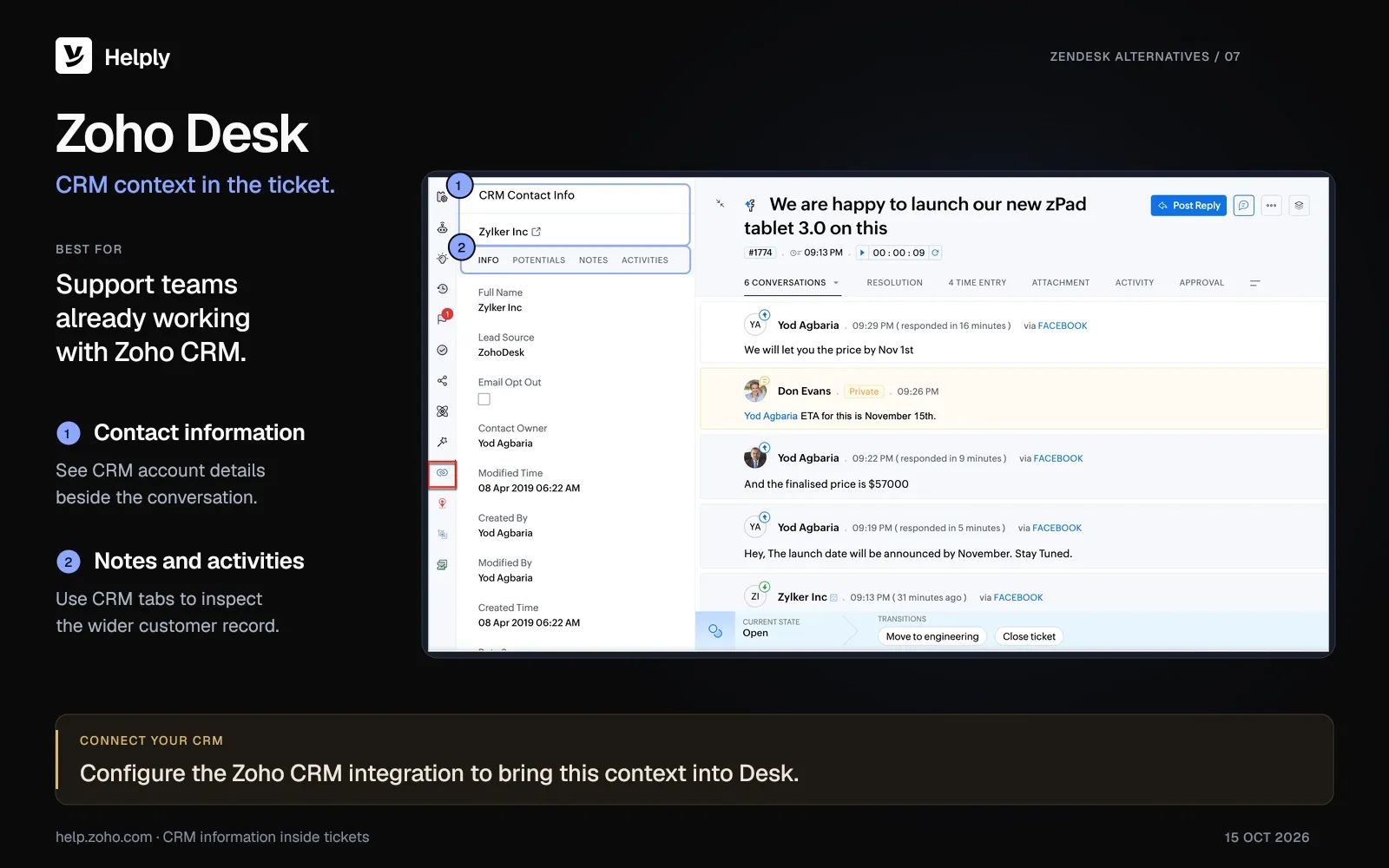
Zoho Desk fits teams that run Zoho CRM and the wider Zoho suite, with paid plans from $7 per user a month.
Pricing
Zoho Desk charges $7, $14, $23 and $40 per user a month for Express, Standard, Professional and Enterprise on annual billing. Monthly billing costs $9, $20, $35 and $50, and a free plan covers 3 users. Express caps at 5 users.
Pros
- A free plan for 3 users and a paid tier from $7 per user.
- Zia Agent Studio comes on every plan, with up to 30 million tokens a month of Zoho's in-house models.
- Standard and higher plans have no user cap.
Cons
- Blueprints, round-robin routing and SLA reporting start at Professional. Skill-based assignment and scheduled reports need Enterprise.
- Generative AI on Express and Standard needs your own OpenAI key.
- Zoho's prebuilt Desk AI agents come with Enterprise only.
Best For
Teams on Zoho CRM that want a low per-user price.
8. Intercom (Fin): Best for PLG Products Led by In-App Chat
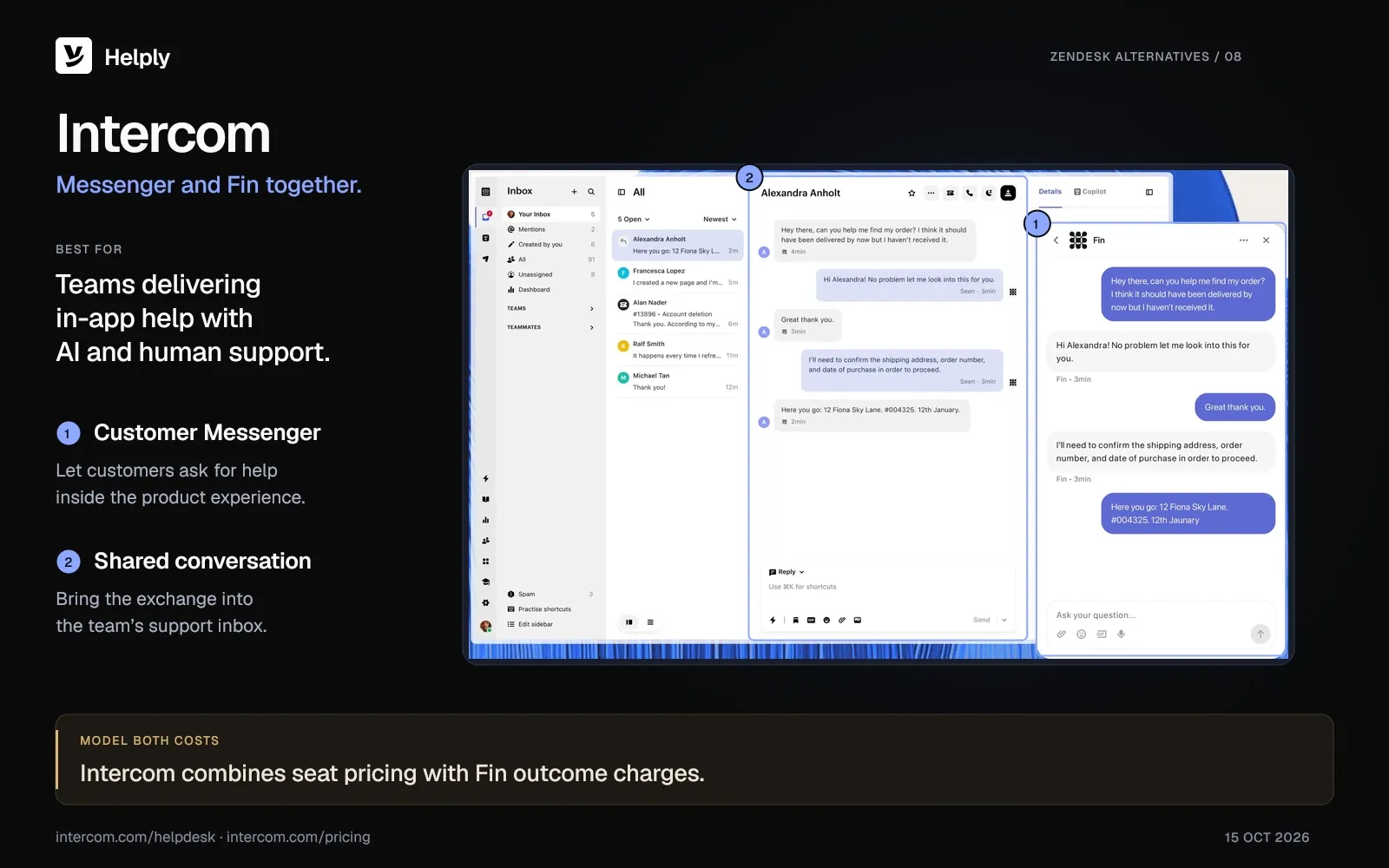
Intercom suits product-led companies whose onboarding and support happen in an in-app messenger. It's a messenger-first help desk, and Intercom bills its AI agent, Fin, per outcome.
The company renamed itself Fin on May 12, 2026, and the help desk keeps the Intercom name. Salesforce completed its acquisition of Fin on September 10, 2026.
Pricing
Intercom charges $19, $85 and $132 per seat a month for Essential, Advanced and Expert on annual billing. Month-to-month seats cost $29, $99 and $139. Fin costs $0.99 per outcome, at most once per conversation, and Copilot adds $29 per agent a month on annual billing.
Pros
- Advanced includes 20 free Lite seats, and Expert includes 50.
- You can buy Fin without the Intercom help desk, at $0.99 per outcome with a $49 monthly minimum covering 50 outcomes.
- A 14-day free trial.
Cons
- Two AI meters: Fin per outcome for customers and Copilot per agent for your reps.
- An outcome counts when the customer confirms a fix, doesn't ask for more help, or Fin completes a configured procedure, handoffs included.
- Since September 10, 2026, Fin has been part of Salesforce AI Labs, so Intercom and Agentforce share an owner.
Best For
PLG software companies that support customers mainly through in-app chat.
9. Gorgias: Best for Shopify and E-Commerce Stores
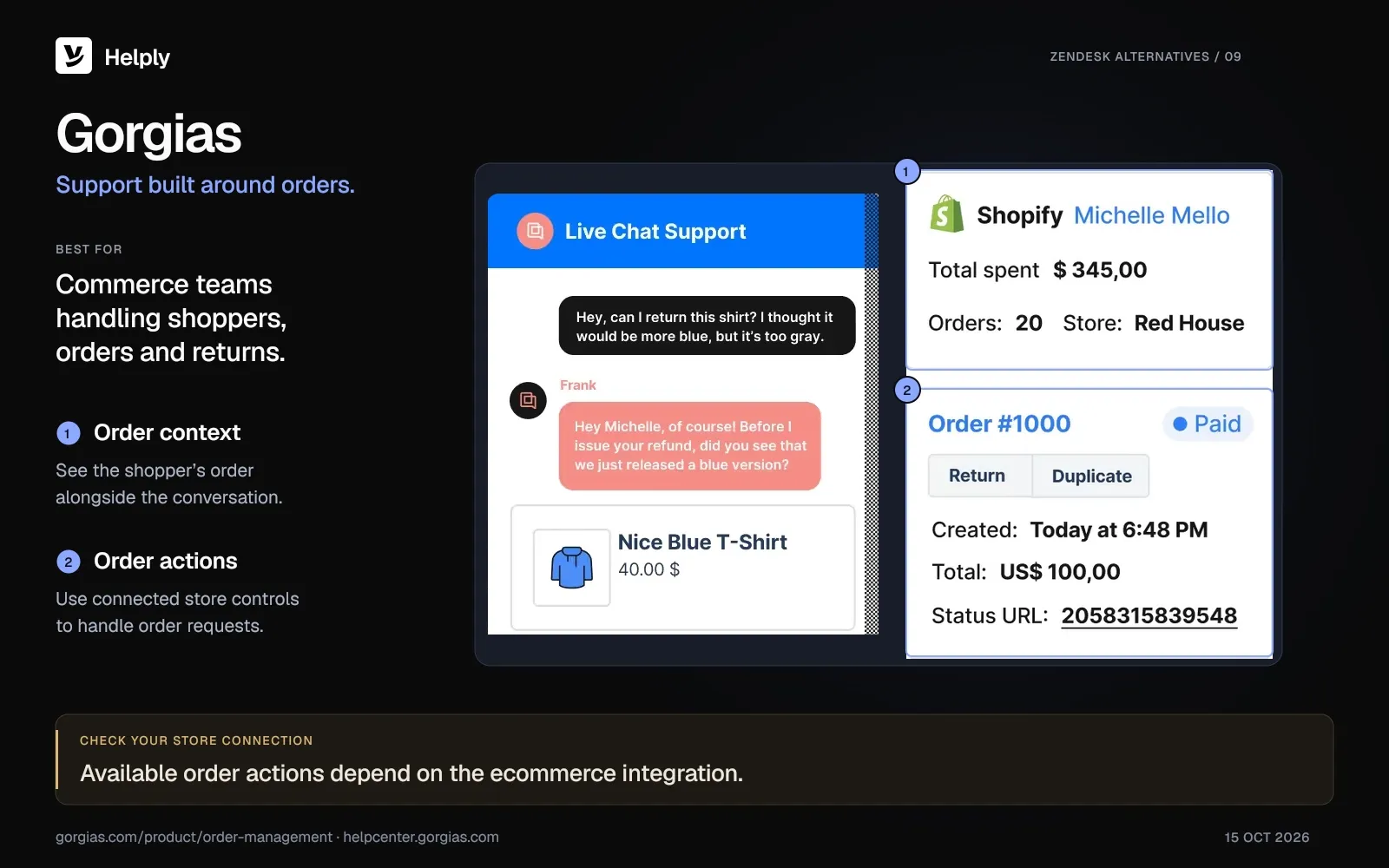
Gorgias fits Shopify and other e-commerce brands that want to pay by monthly ticket volume.
Pricing
On annual billing, Gorgias Basic costs $50 a month for 300 tickets, Pro $300 for 2,000 and Advanced $750 for 5,000. Monthly billing costs $60, $360 and $900, and a monthly-only Starter plan costs $10 for 50 tickets.
Gorgias's AI Agent costs $0.90 per automated interaction on annual plans or $1.00 on monthly plans. Gorgias counts each automated interaction as a helpdesk ticket.
Pros
- Pricing follows ticket volume, and Gorgias says it never prices per agent.
- Paid plans above Starter include up to 500 user seats. G2 reviewers rate Gorgias 4.6/5 across 580-plus reviews.
- If a person replies within 72 hours of an AI resolution, Gorgias bills only the helpdesk ticket.
Cons
- Extra tickets cost $36 to $40 per 100 on paid plans.
- Gorgias quotes its AI rate two ways: $0.90 or $1.00 in its FAQ, and $0.85 to $1.00 in its compare table.
Best For
Shopify and other e-commerce stores.
10. Salesforce Service Cloud and Agentforce: Best for Enterprises on Salesforce
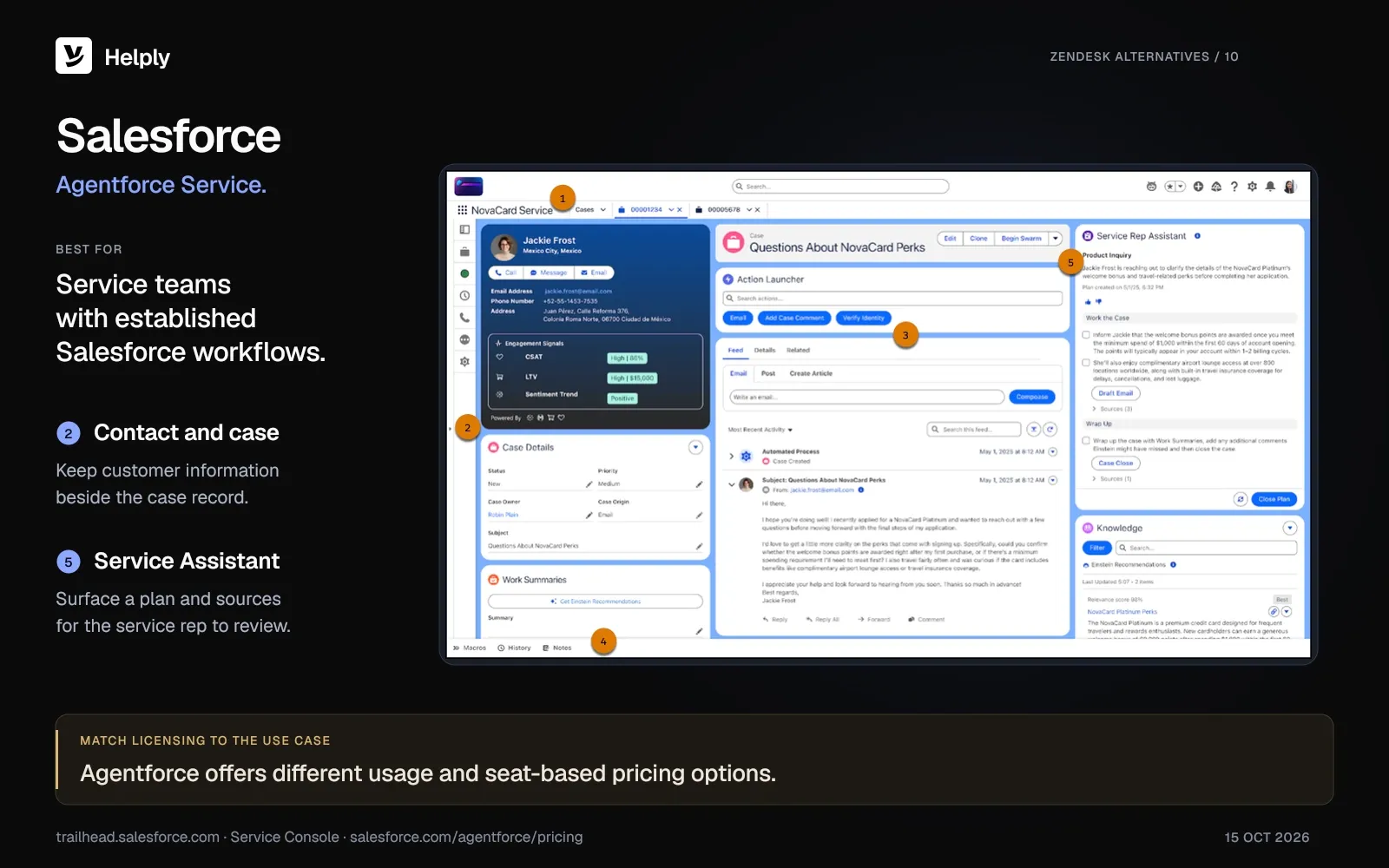
If your company runs on Salesforce, you can handle support in Service Cloud, Salesforce's help desk, inside the CRM you own. Agentforce is Salesforce's AI agent layer.
Pricing
Salesforce Service Cloud costs $25 per user a month on Starter Suite and $100 on Pro Suite. Core costs $195, Advanced $395 and Max $550 per user a month, on annual billing.
Below Max, Agentforce costs extra: $2 per customer conversation, Flex Credits at $500 per 100,000, or a $125 per user monthly add-on. A standard Agentforce action uses 20 Flex Credits, or $0.10.
Pros
- Deep integration if your company runs on Salesforce.
- Max includes Agentforce for Service and 2.75 million Flex Credits per org a year.
- Three ways to buy AI: pre-purchase, pre-commit or pay as you go.
Cons
- Pro Suite requires an annual contract, and Core, Advanced and Max use annual billing.
- Starter Suite adds transaction fees on top of the $25 seat.
- Enhanced Messaging costs $75 more per user a month on two editions.
Best For
Large enterprises standardized on Salesforce.
11. LiveAgent: Best Multichannel on a Tight Budget
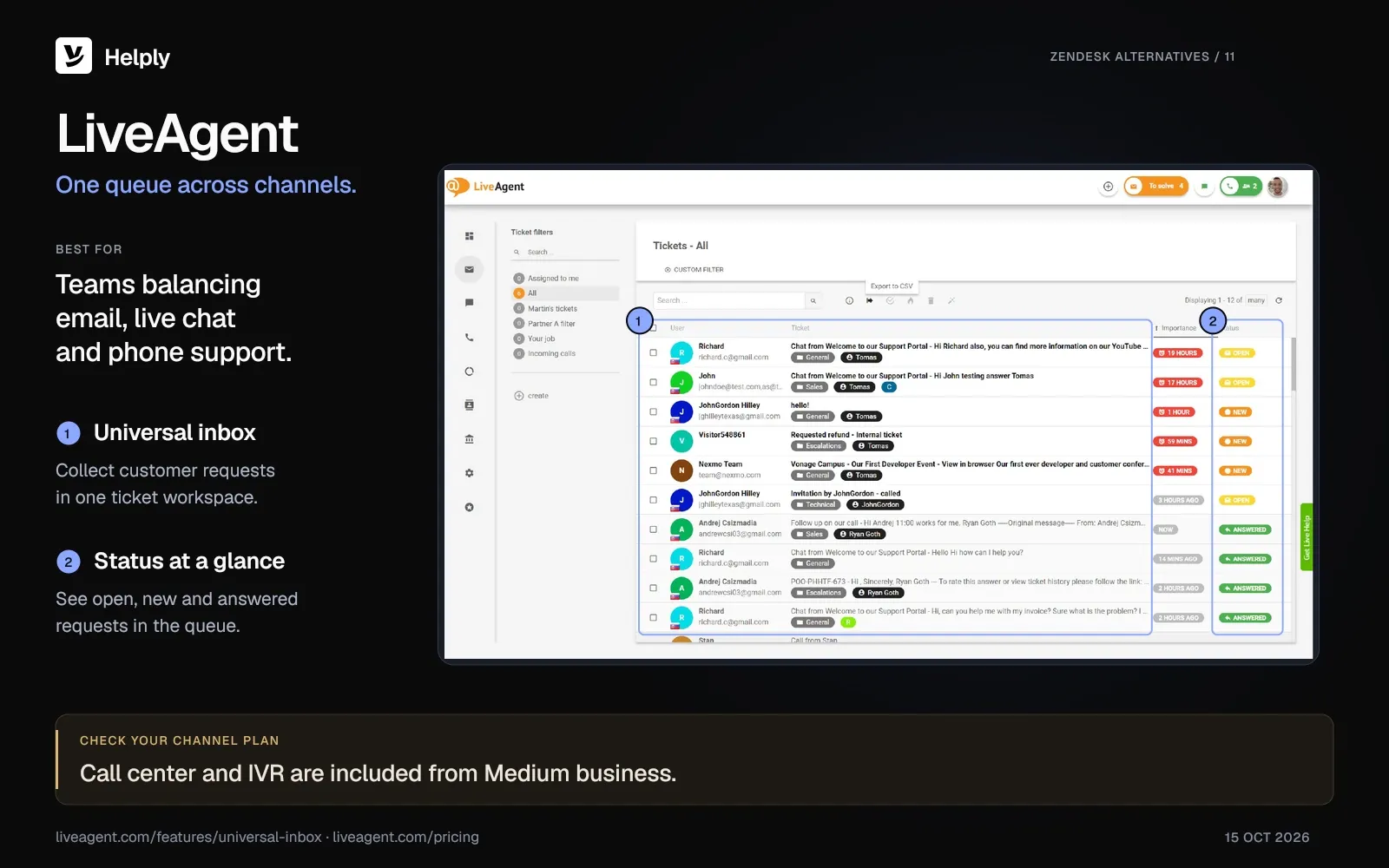
For $15 per agent a month, LiveAgent bundles email and live chat into one help desk. Its call center and IVR start on the Medium plan, at $29 per agent.
Pricing
LiveAgent charges $15, $29, $49 and $69 per agent a month for its Small, Medium, Large and Enterprise plans on annual billing. Monthly billing costs $19, $35, $59 and $85. AI features run on credits from FlowHunt, a sister product with its own pricing.
Pros
- Medium and higher plans include email, chat, call center and IVR tools. G2 reviewers rate LiveAgent 4.5/5 across 1,500-plus reviews.
- The pricing table lists an AI chatbot, an AI answer assistant and AI ticket triage on every plan.
- A 30-day free trial with no card.
Cons
- AI usage costs extra through FlowHunt credits, so the seat price doesn't cover the AI work.
- LiveAgent lists the AI Answer Assistant under different plans on different pages, so confirm your plan includes it before you buy.
- Each new agent adds $15 to $69 a month.
Best For
Budget teams that need phone, email and chat support in one tool.
12. HubSpot Service Hub: Best if Your GTM Runs on HubSpot
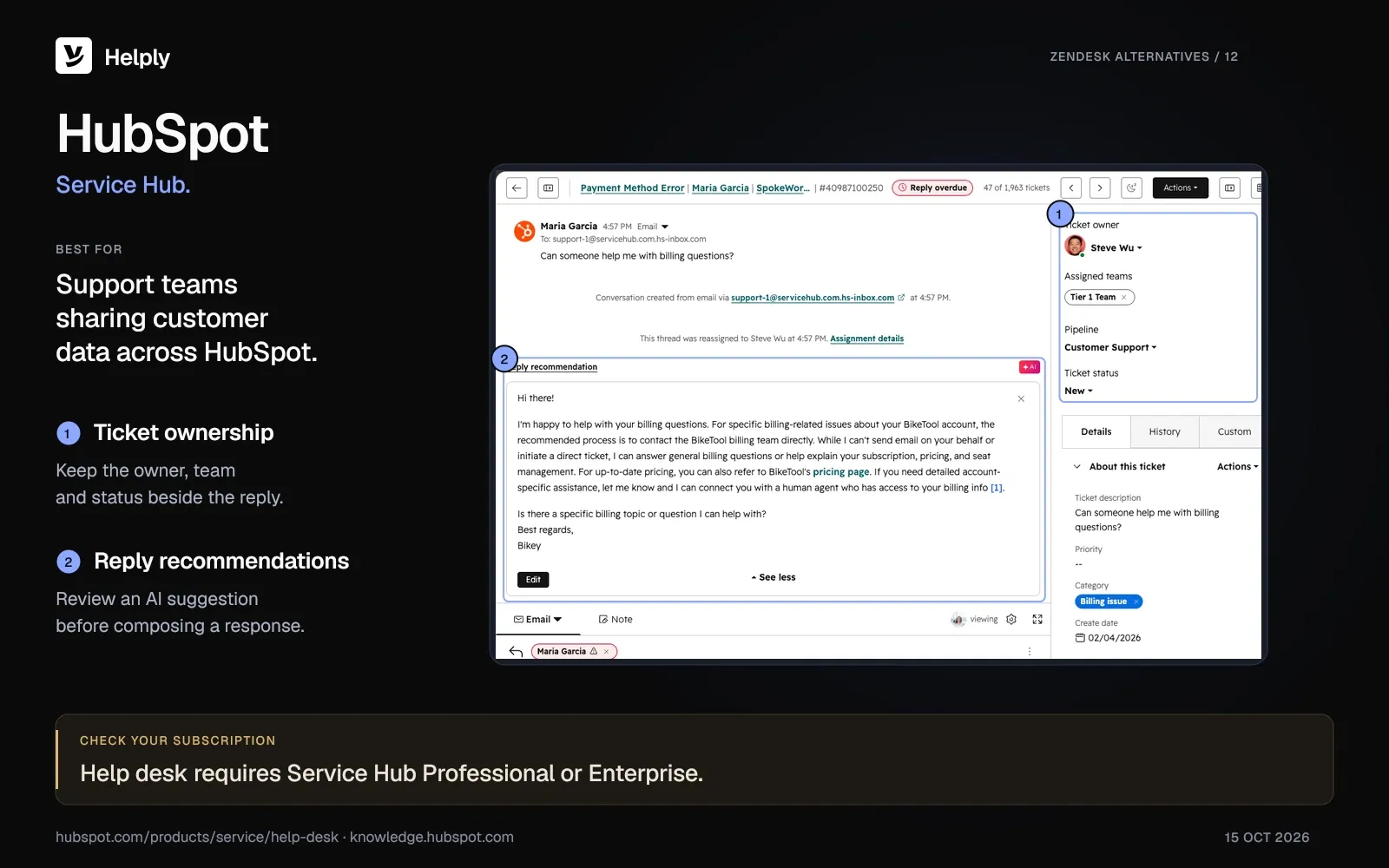
Service Hub fits teams whose CRM is HubSpot, since tickets sit beside the contact records sales and marketing use.
Pricing
Service Hub Starter lists at $20 per seat a month, with a limited-time new-customer discount to $7 on annual billing or $10 monthly. Professional costs $90 per seat a month on annual billing, and Enterprise costs $150 per seat a month, annual only. A free plan covers up to 2 users.
Professional and Enterprise carry required one-time onboarding fees of $1,500 and $3,500. Customer Agent, HubSpot's AI agent, needs one of those plans and uses HubSpot Credits worth $0.50 per resolution.
Pros
- Buying one Professional or Enterprise Service seat unlocks 14 days of unlimited Customer Agent.
- Customer Agent costs $0.50 per resolution, and Professional includes 3,000 HubSpot Credits a month.
- A free plan for up to 2 users, plus free view-only seats.
Cons
- Customer Agent and the Slack and Teams ticket apps need Professional at $90 per seat, plus the $1,500 onboarding fee.
- Seat types differ by tier: Core Seats on Starter, Service Seats on Professional and Enterprise.
- Native help desk channels cover email, chat, Messenger, forms, WhatsApp and calling. Customer Slack conversations need a marketplace app or the custom channels API.
Best For
Teams that run sales and marketing on HubSpot and want support in the same CRM.
How to Choose the Right Zendesk Alternative for Your Team
Match the tool to how your team works and how you want to pay for AI.
- If you want AI agents without per-user fees, pick Helply, which bills only AI work and has unlimited users.
- If most of your support happens in Slack or Teams, shortlist Helply, Pylon and Plain. Front can connect Slack Connect channels you own.
- If you want simple email support, look at Help Scout and Freshdesk. Help Scout's free plan covers up to 5 users.
- If onboarding and support happen inside your product, Intercom suits you, though it adds $0.99 per Fin outcome to its seat fees.
- If you need a low seat price, Zoho Desk starts at $7 per user and LiveAgent at $15 per agent.
- If you run a Shopify store, Gorgias prices by ticket volume and focuses on e-commerce.
- If your CRM is Salesforce or HubSpot, Service Cloud or Service Hub keeps tickets beside your sales records.
Before you renew, add up 12 months of seats, AI add-ons and per-resolution fees at next year's headcount. Then compare that total with a plan that has unlimited users and bills only the AI work.
Renew Zendesk or Switch to Helply?
Renew Zendesk if your team depends on marketplace apps that only run there. For Zendesk-style ticketing with a cheaper copilot, look at Freshdesk, and for a Shopify store, Gorgias. Switch to Helply if you want every teammate in the inbox and AI agents that investigate and resolve tickets.
If you renew Zendesk on annual billing, you commit to another year of per-agent seats and any Copilot fees. On Helply, every plan has unlimited users, so engineers and success managers can reply with no per-user fee.
The Support, Assist and Background agents come with every plan, so you skip per-agent AI add-ons. A draft your team rejects never costs a credit, and neither does a failed action.
Shared Slack Connect and Microsoft Teams channels land in the same inbox as email. The agents can work those conversations when you configure them to.
Kameleo joined Helply's first cohort to make a full move off Zendesk. Founder and CEO Tamas Deak says: "Helply forced us to run support properly. It resolves the deep technical tickets, keeps our docs honest, and remembers every fix, so the whole thing compounds."
At about 7 credits per B2B conversation, a five-agent team handling 1,000 conversations a month needs the 7,000-credit block. That block costs $339 a month on annual billing, whatever your headcount. On Zendesk Suite Professional, the same five agents with Copilot cost $825 a month on annual billing, before extra resolutions.
Helply brings your tickets, help center articles, macros and customer records across, and you validate the data before you switch. Run both tools on a slice of your queue, then cut over once AI resolution rates and workflows hold.
Frequently asked questions
The best Zendesk alternative depends on your main channel and AI budget. Helply fits teams that want AI agents and unlimited users, and Freshdesk offers Zendesk-style ticketing with a cheaper copilot. Pick Help Scout for email support, Intercom for in-app chat and Pylon or Plain for shared Slack channels.
Freshdesk is Zendesk's most direct competitor, with matching $19 and $55 tier prices on annual billing. Other main Zendesk competitors are Salesforce Service Cloud, HubSpot Service Hub, Intercom and Zoho Desk. Salesforce owns two of them: Service Cloud, and Intercom through its purchase of Fin.
Yes. Free Zendesk alternatives include Help Scout (5 users, 100 contacts a month), Zoho Desk (3 users) and HubSpot (2 users). FreeScout is free and open source to self-host, but workflows, reports and saved replies are paid modules.
No. Zendesk offers a 14-day free trial of Suite Professional with Copilot included. Startups can apply for a six-month trial of the Suite for up to 50 agents.
Help Scout, Zoho Desk and HubSpot have free plans for 5, 3 and 2 users. Zoho Desk Express costs $7 per user a month on annual billing, and HubSpot Starter matches it with a limited-time new-customer discount. Gorgias Starter costs $10 a month for 50 tickets, and Helply's 500-credit block costs $49 a month, with unlimited users.
On annual billing, Zendesk costs $19 per agent a month on Support Team, $55 on Suite Team and $115 on Suite Professional. Monthly billing runs $25, $69 and $149, and Suite Enterprise has no published price. Copilot adds $50 per agent a month on Suite Professional and up, and each automated resolution past the allowance costs $1.50 to $2.00.
Zendesk charges for every agent seat and sells AI on top. A 10-agent Suite Professional team pays $1,150 a month for seats on annual billing, and adding Copilot lifts that to $1,650. Skills-based routing and custom reporting start on that $115 plan.
Freshdesk costs less once you add an AI copilot: Pro with Freddy AI Copilot runs $84 per agent a month on annual billing. Zendesk sells Copilot from Suite Professional, so its cheapest plan with Copilot costs $165 per agent. Choose Zendesk if you depend on marketplace apps that only run there.
Salesforce Service Cloud fits companies that run sales on Salesforce, and Zendesk fits teams that want a standalone help desk. Service Cloud costs $25 to $550 per user a month, and Zendesk's published plans cost $19 to $115 per agent on annual billing. Below the Max edition, Agentforce AI costs extra: $2 per conversation, Flex Credits or a $125 per user add-on.
No. Zendesk's core product is a help desk for tickets and customer conversations. Zendesk Sell, its separate sales CRM, shuts down on August 31, 2027, with Pipedrive as the named migration partner.
Helply, Gorgias and standalone Fin don't price by headcount. Helply bills AI work in credits from $49 a month, Gorgias prices by ticket volume and Fin charges $0.99 per outcome. Plain and HubSpot give free view-only seats, and Pylon gives free seats to people who answer only in Slack.
Salesforce owns Intercom. Intercom renamed itself Fin on May 12, 2026, and Salesforce closed its purchase of Fin on September 10, 2026. Salesforce signed the deal in June 2026 for about $3.6 billion, and Intercom remains the name of Fin's help desk.
Price three parts before you sign: seats, any rep-facing copilot and the per-resolution or per-outcome AI fee. Then check for a spend cap: Zendesk admins can turn off overage, and Help Scout lets you cap AI Answers spending each month. Helply bills AI work in credits, and its monthly spend cap defaults to your block price.
Helply's Zendesk migration runs in three steps: connect Zendesk, choose the supported customers, conversations and knowledge to move, then validate and switch. Tickets, help center articles, macros and customer records come with you. Zendesk can stay live on the rest of your queue until you cut over.
About the author

Bildad Oyugi
Head of Content
Bildad is a digital marketing expert with over 5 years of experience in copywriting, content marketing, and editing. Outside of work, he enjoys videography and spending time with his family.


