
 Jared Scheel ·

What Is High-Touch Customer Service?
High-touch customer service is support that a person delivers with personal attention. It relies on a named contact, proactive check-ins and help shaped around the customer's goals. Low-touch service, by contrast, leans on self-service, automation and a shared queue.
Teams also call it white-glove customer service, concierge or premium support. The labels overlap: white-glove often describes onboarding and setup, while high-touch covers the whole relationship.
Common examples of high-touch service include:
- A dedicated account owner who knows the customer's history and goals.
- Guided onboarding with a live setup call and a written plan.
- Check-ins before renewals, launches and busy seasons.
- Direct lines to a person on chat, email, Slack or phone.
- Follow-ups after an outage or a bad ticket from someone who read the thread.
High-Touch vs. Low-Touch Customer Service
High-touch and low-touch service differ on who does the work and when. High-touch support puts a person on the account before problems surface. With low-touch support, customers serve themselves and a person steps in when they ask.
High-Touch vs. Low-Touch Support: Ownership, Timing, Channels and Cost
| Factor | High-touch support | Low-touch support |
|---|---|---|
| Who owns the customer | A named person or small team | A shared queue |
| When contact happens | Before problems, on a schedule or a signal | When the customer asks |
| Main channels | Calls, email, chat, Slack with a known contact | Help center, chatbot, forms, email |
| Cost per customer | High, driven by staff hours | Low, driven by tooling |
| Best fit | Complex products, high-value accounts, risky moments | Simple questions, large customer bases |
Many teams run a hybrid. Self-service and AI handle the long tail, and people spend their hours on the accounts and moments that justify them. Some customer success teams call the automated layer tech-touch.
This model costs more and gets harder to keep consistent. Every high-touch account needs hours from a person who knows it, and that person's replies get thinner after a day in the queue.
Why High-Touch Customer Service Still Matters When AI Answers First
High-touch customer service still matters because one poor experience can cost an account, and customers want a person within reach. In McKinsey's 2021 personalization research, 71% of consumers expected personalized interactions, and 76% got frustrated without them.
Zendesk surveyed nearly 5,100 consumers in June and July 2024 for its CX Trends 2025 report. In that survey, 63% said they'd move to a competitor over a single bad experience.
In December 2023, Gartner surveyed 5,728 customers for a release published in July 2024. Sixty-four percent would prefer companies not use AI in customer service. Their biggest worry was losing easy access to a person.
In a March 2025 Gartner poll of 163 customer service leaders, 95% planned to keep human agents. Gartner also expects half of the organizations that planned big service headcount cuts to abandon those plans by 2027. We make the same case in why AI won't replace your support team.
Customers also want a person to check what AI says. Salesforce surveyed 15,015 consumers and 1,570 business buyers in July and August 2024 for its State of the AI-Connected Customer. Seventy-one percent of those customers said it's important for a human to validate AI output.
Twilio Segment surveyed 500 business leaders in March 2023 for its 2023 State of Personalization report. Of those leaders, 80% said personalized experiences lift consumer spending, by 38% on average.
In a 2001 Bain brief, Fred Reichheld found that in financial services, 5% more retention produced over 25% more profit.
Which Customers and Moments Need High-Touch Support?
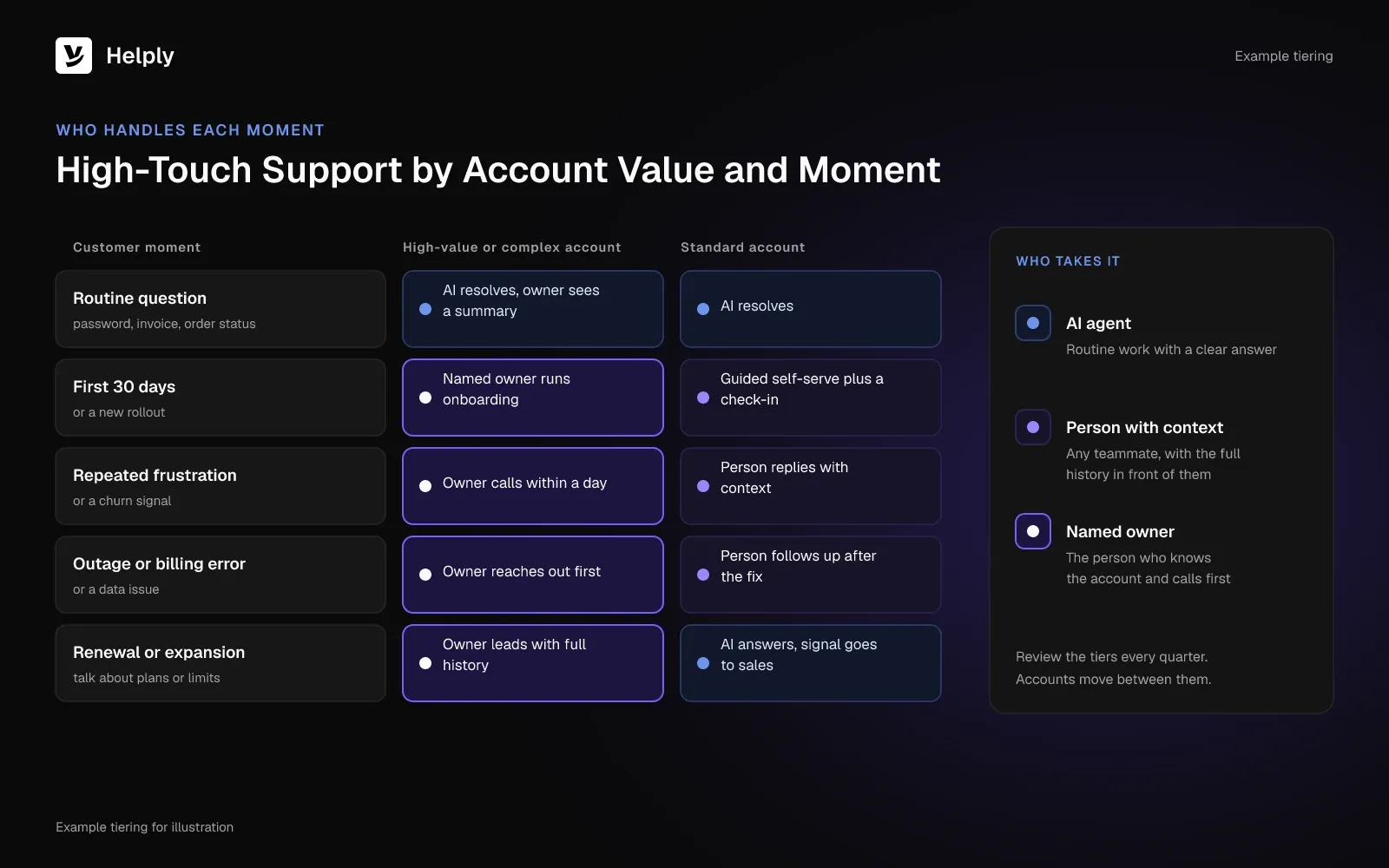
Ask two questions to set the touch level: what the account is worth to you, and how much this moment can hurt it. A small account in a crisis can need a person more than a large account asking for an invoice copy.
High-Touch Support by Account Value and Customer Moment
| Moment | High-value or complex account | Standard account |
|---|---|---|
| Routine question (password, invoice, order status) | AI resolves; owner sees a summary | AI resolves |
| First 30 days or a new rollout | Named owner, live onboarding, weekly check-in | Guided self-serve plus one check-in |
| Repeated frustration or a churn signal | Owner calls within a day with the full history | Person replies with context |
| Outage, billing error or data issue | Owner reaches out first with a plan | Person follows up after the fix |
| Renewal or expansion talk | Owner leads, with usage and ticket history | AI answers; signal goes to sales or success |
Score accounts on revenue, product complexity and strategic weight, such as a reference customer or a partner. Then map the moments in your own customer journey that decide renewals. Review the list every quarter, because accounts move between tiers.
How to Deliver High-Touch Customer Service in 7 Steps
Teams build it from seven habits: named owners, guided onboarding, outreach on signals, history first, AI on routine work, handoff triggers and feedback.
1. Give Every High-Touch Account a Named Owner
A named owner spares the customer from retelling their history. Assign an owner for each top-tier account and publish a backup for holidays and sick days. The owner reads every escalation on that account, even when someone else answers it.
2. Run Onboarding as a Guided Project
Agree on the customer's goals in a kickoff call, write a short plan with dates, and check progress each week. Our guide to shortening time to value covers the milestones worth tracking.
3. Reach Out on Signals, Before the Complaint
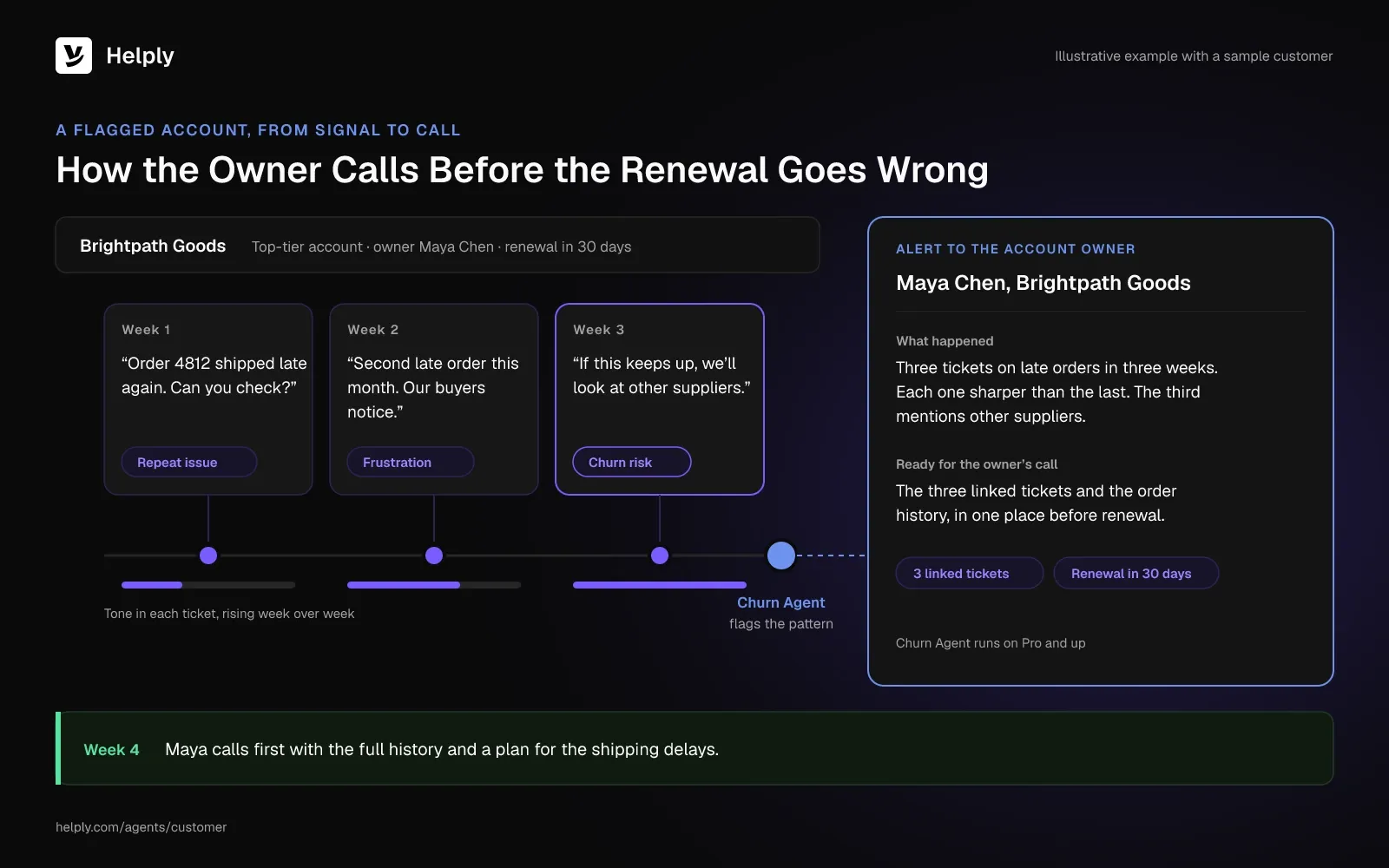
Watch for repeated tickets on one issue, sharper wording, or questions about cancelling or downgrading. Helply's Churn Agent, on Pro and up, monitors frustration, repeat issues, churn risk and sentiment shifts, then alerts the right teammate. From the Team plan, the owner can send a proactive message first.
4. Read the History Before You Reply
Pull up past tickets, orders, plan changes and open issues in one view before you write. Helply's customer view shows "previous questions, resolutions, escalations, and conversations so every new interaction starts with context."
5. Let AI Take the Routine Work
Hand password resets, invoice copies and order lookups to an AI agent that can resolve them end to end. Helply's Support Agent can do this on every plan, so owners keep their hours for the accounts. Track which questions AI resolves and which it passes on, then tune the list each month.
6. Write Down When a Person Must Step In
List the triggers that always need a person: refunds above a limit, legal threats, outages, or a frustrated top-tier account. In Helply, Guidelines set how AI agents behave, and you "can define situations where human involvement is required."
7. Close the Loop with Feedback
Owners get better at high-touch service when they hear what customers think. Ask for feedback after onboarding and after every escalation, and share recurring themes with product. Our guide to improving customer retention explains how to turn that feedback into fixes.
How AI Agents Free the Hours High-Touch Work Needs
High-touch service often fails because the people meant to deliver it spend their days in the queue. AI frees those hours when it resolves routine work and gives people the context for everything it passes on.
Worked Example: How Many Hours AI Frees for High-Touch Work
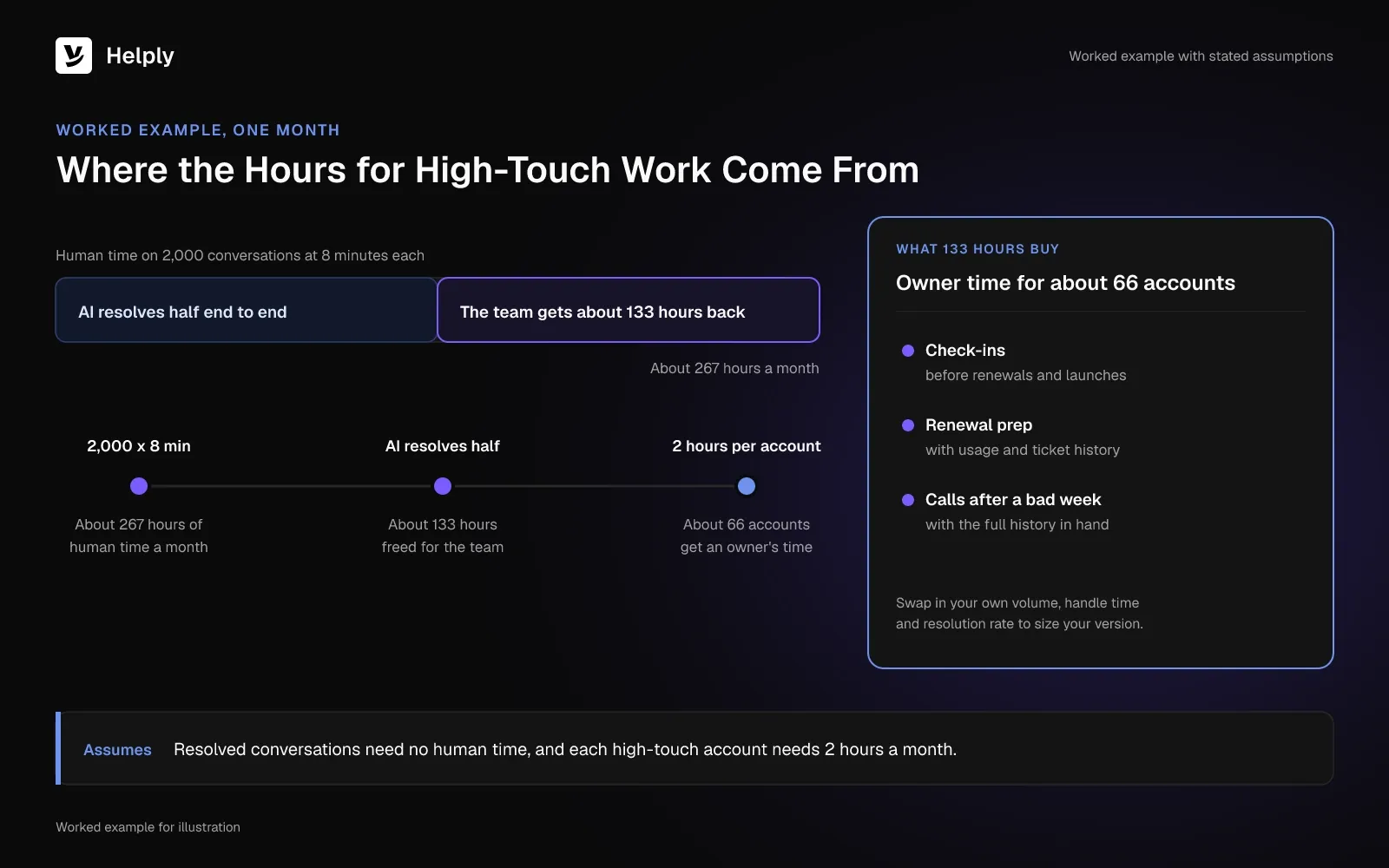
Picture a team handling 2,000 conversations a month at about 8 minutes of human time each. That adds up to about 267 hours a month. If AI resolves half of those conversations end to end and they need no human time, the team gets back about 133 hours.
At 2 hours a month for each high-touch account, those hours cover about 66 accounts. That time goes to check-ins, renewal prep and calls after a bad week. Swap in your own volume, handle time and resolution rate to size your version.
What Each Agent Takes off the Team's Plate
Helply is an AI-native customer support platform. Both of its frontline agents, Support and Assist, come with every plan. Add Background agents and Memory on higher plans, and the four cover different jobs for your team.
- Routine resolution: The Support Agent can "handle customer issues end-to-end without requiring a human to touch every conversation."
- Drafted personal replies: The Assist Agent writes draft replies from the conversation history, account details and your Guidelines. A teammate uses or edits each draft before it goes out. Assist can also summarize threads, suggest next steps and take supported Actions when your team directs it.
- Early warnings on at-risk accounts: Background agents track conversations, customers and support signals. If an account needs attention, they can alert a teammate or start a workflow. The Churn and Revenue Agents come with Pro and up, and the Insights Agent starts on the Team plan.
- Customer context: From the Team plan, Memory gives agents "context about the customer and previous interactions."
At Sender.net, the Support Agent took 71% of about 4,000 monthly conversations from first message to resolution. That beats the half our worked example assumes. The human team held steady as the customer base grew.
Guardrails That Keep a Person on the Moments That Matter
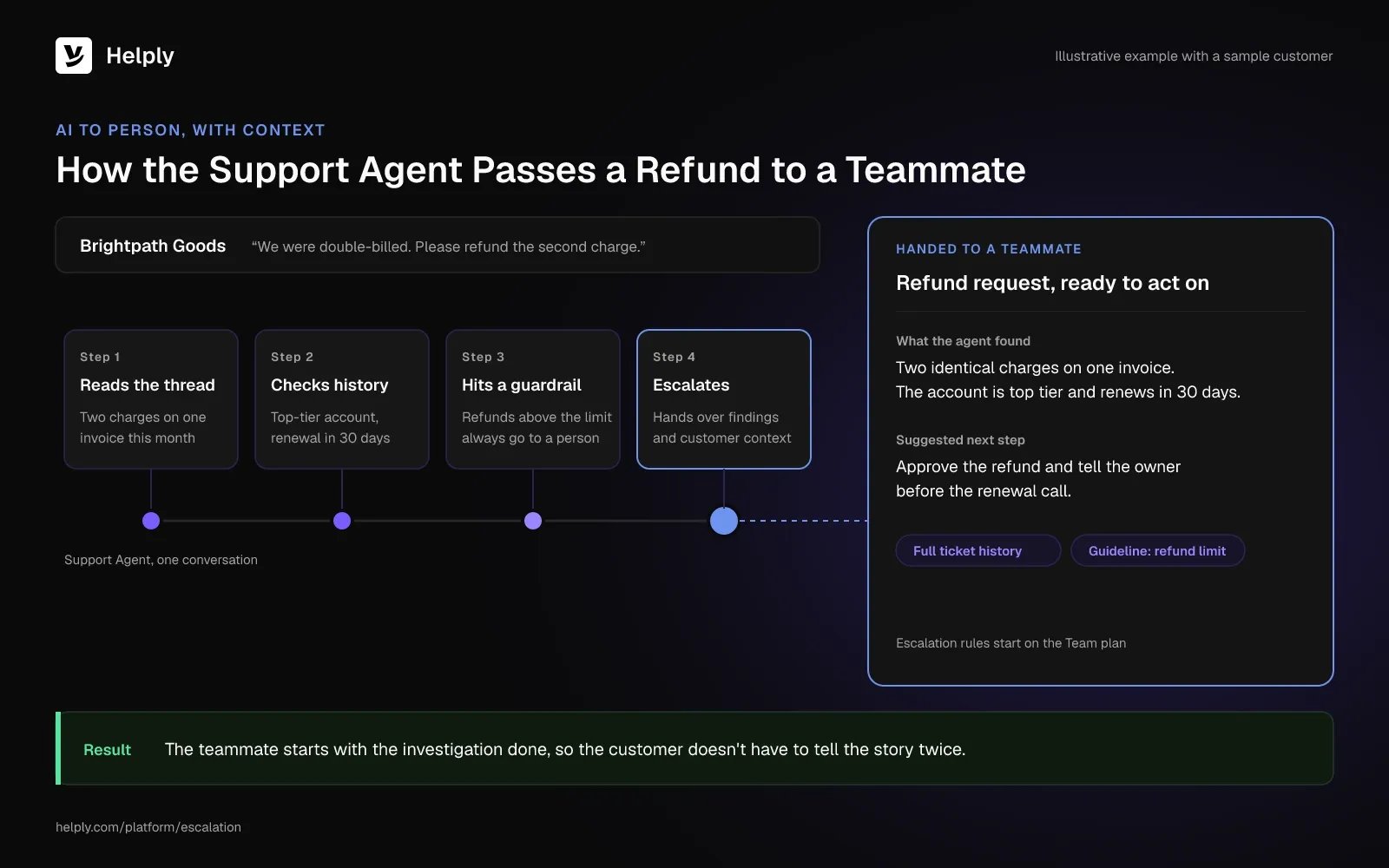
In Gartner's survey, customers worried most about losing easy access to a person. If the Support Agent isn't confident it can resolve an issue, it escalates. The teammate then receives the agent's investigation and the customer context.
Escalation rules, available from the Team plan, let you decide which situations, confidence thresholds and customer conditions send a conversation to a person. The teammate who takes over sees the conversation, the investigation and the customer history.
How to Measure High-Touch Customer Service
Measure the touch itself as well as satisfaction. Track these five numbers to see whether the model works:
- Time to a person on flagged accounts: Count the hours from a churn signal to a call or a personal reply.
- Proactive share: Track the portion of contacts with top-tier accounts that your team started.
- Retention by tier: Compare renewal and expansion rates for high-touch accounts against the rest.
- Escalation quality: Count how often the person who receives a handoff has to ask the customer to repeat themselves.
- CSAT after handoffs: Measure satisfaction on conversations that moved from AI to a person.
Review these each month next to the account list. If time to a person rises, move more routine work to AI or narrow the top tier. Our guide to scaling customer support covers capacity planning in more depth.
Should You Hire for High-Touch Service or Let AI Carry the Routine?
If you serve a few dozen large accounts and little else, a named person for each may cover the touch. Helply's customer view still puts the full history in front of each owner. If your owners also work a busy shared queue, take routine work off their desks first.
In the opening renewal call, the Support Agent could have taken the password resets and order questions, freeing those four people for check-ins.
On Pro and up, the Churn Agent can spot the angry pattern before renewal, so the owner calls first with the full history. At Sender.net, the Churn and Revenue Agents surfaced 300+ churn and expansion signals a month and routed each to the right owner.
Guidelines tell AI which conversations stay with people, and escalation rules add finer control from the Team plan. Helply pricing shows which agents each plan includes.
Start high-touch customer service with your top accounts and one inbox, then widen the scope once the handoffs work.
Frequently asked questions
High-touch customer service is human-led support with personal attention, proactive outreach and tailored help. Teams use it for complex products, high-value accounts and moments that can end a relationship. Some call it white-glove, concierge or premium support.
A software company gives each top account a named owner and a live onboarding call. The owner checks in a month before renewal. If tickets from that account turn frustrated, the owner calls with the full history.
High-touch service puts a named person on the account early. Low-touch service relies on self-service, automation and a shared queue, and a person steps in when the customer asks.
The terms overlap and many teams use them as synonyms. White-glove usually describes premium onboarding or setup, while high-touch covers the whole relationship.
AI makes room for high-touch service, and people deliver the touch. Helply's Support Agent, for example, can resolve routine questions so owners spend their hours on calls. Keep a person within reach, since 64% of customers in a December 2023 Gartner survey preferred companies not use AI in service.
Give it to accounts with high revenue, complex products or strategic weight. Any account at a risky moment, such as onboarding, a renewal, an outage or repeated frustration, also earns a person.
It depends on the hours each account needs and the hours your team has left after the queue. In one worked example, AI resolving half of 2,000 monthly conversations at 8 minutes each frees about 133 team hours. At 2 hours an account each month, that covers about 66 accounts.
Track five numbers: time to a person on flagged accounts, proactive share, retention by tier, escalation quality and CSAT after handoffs. Review them monthly next to your account list.
About the author

Jared Scheel
Co-founder & CTO


