
 Konrad Janczyk ··10 min read

Key Takeaways
- Customer service covers the whole customer journey, and customer support fixes specific product problems.
- Service requests concern orders, plans, billing and policy, while support requests concern something in the product that doesn't work.
- Service teams track CSAT, NPS and retention, while support teams track first response time, resolution time and first contact resolution.
- In Salesforce research published in August 2023, 79% of customers expected consistent interactions across departments. Yet 56% often had to repeat information to different representatives.
- One queue can carry both jobs with request types and a handoff rule, and Helply's Support Agent can resolve the routine ones.
What Is the Difference Between Customer Service and Customer Support?
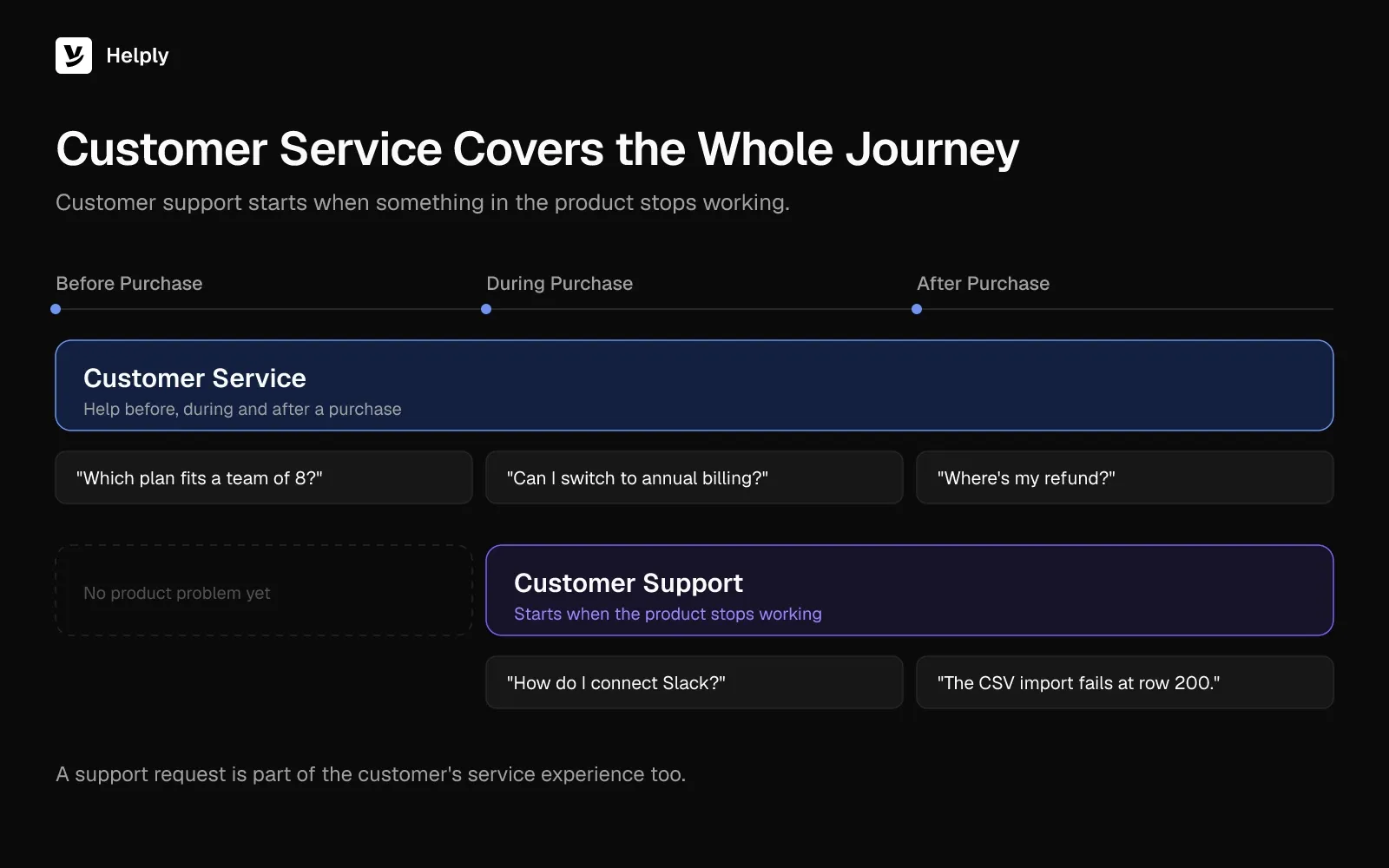
Customer service is the wider job of helping customers around a purchase. Customer support is the narrower job of fixing a problem with what they bought.
Picture one morning's queue. "Can I switch to annual billing?" sits above "Where's my refund?". Below them are "The import keeps failing" and "Which plan fits a team of 8?".
The import customer can't work until someone looks, yet that ticket waits its turn behind the billing questions. Then a manager asks whether you need a customer service team and a separate customer support team. To answer, you need a clear line between the two words.
Three of the four messages above are service requests: billing, a refund and a plan question. The failing import is a support request, because someone has to find out why the product isn't working. Many teams blur this in their job titles and say "customer service and support" for the same people.
Keeping the two apart gives each request an owner with the right access. You can then set different targets for a refund and a broken integration.
Use the split to decide whether to hire for billing or technical skills. A handoff with notes means the customer doesn't explain twice.
What Is Customer Service?
Customer service means helping customers before, during and after a purchase, from plan questions to refunds and complaints. Indeed calls it "the collection of methods designed to improve customer experience throughout the entire purchasing process."
Customer service covers requests like these:
- Pre-sales questions: pricing, plan fit, delivery times and whether the product does what the buyer needs.
- Orders and accounts: order changes, address updates, plan switches and cancellations.
- Billing: invoices, failed payments, refunds and receipts.
- Policy: returns, warranties, data requests and terms.
- Complaints: a late reply, a missing parcel or a rude interaction.
- Follow-ups: onboarding emails, satisfaction surveys and check-ins after a problem.
Every business with customers does customer service, from a coffee shop to a software company. A customer service center brings together the people, channels and tools that do this work.
What Is Customer Support?
Customer support is the part of customer service that fixes specific problems with a product, from a login loop to a failed import. Indeed defines it as "the set of processes some customers request to solve specific problems with a company's goods or services."
Customer support covers requests like these:
- Troubleshooting: a login loop, a failed sync or an error message.
- Setup and how-to questions: configuring a feature, connecting an integration or importing data.
- Bugs: something broke after a release, and engineering needs a clear report.
- Technical escalations: issues that need a developer, a specialist or access to logs.
- Documentation: help articles and troubleshooting guides that stop the same question coming back.
Many support teams work in tiers. The first line answers known issues, a technical tier investigates the harder ones, and engineering fixes the bugs.
Software, ecommerce, consumer app and hardware companies all run customer support. Their products can break in ways a policy answer won't fix.
Customer Service vs. Customer Support: Scope, Skills and Metrics
Customer service and customer support differ in scope, timing, who runs them, skills, knowledge, metrics and goal.
| Difference | Customer service | Customer support |
|---|---|---|
| Scope | The whole customer journey, before, during and after a purchase | Problems with the product or service |
| Timing | Proactive and reactive | Mostly reactive |
| Who runs it | Every business with customers | Businesses whose products can break: software, ecommerce, apps and hardware |
| Typical request | "Can I change my plan?" | "The export keeps timing out." |
| Skills | Communication, empathy, policy knowledge | Troubleshooting, product depth, technical writing |
| Knowledge used | Policies, order and billing records | Help articles, logs, product documentation |
| Main metrics | CSAT, NPS, retention | Resolution time, first response time, first contact resolution |
| Goal | Loyalty and repeat purchases | A working product and a fixed problem |
Both sides share some metrics. CSAT works for a refund and for a bug fix, and customers on both sides notice a slow first reply.
Who Owns Which Request? 10 Examples Routed
Ten common messages show where the line falls. Each row names the owner, what "done" looks like and whether an AI agent can finish it.
| Request (in the customer's words) | Service or support | Done when | Can an AI agent finish it? |
|---|---|---|---|
| "How much is the plan for 8 people?" | Service | The customer has a price and a plan that fits | Yes, from your pricing and help content |
| "Can I switch to annual billing?" | Service | The new plan is live, or the customer has the steps | Often, if it can act in your billing tool |
| "Where's my refund?" | Service | The customer knows the status and date | Often, if it can read the payment record |
| "Please change my delivery address." | Service | The order shows the new address | Often, within your order rules |
| "Nobody answered me for three days." | Service | A person apologizes and fixes the delay | Partly; a person should own the reply |
| "I can't log in. It keeps looping." | Support | The customer is back in | Often, for known causes |
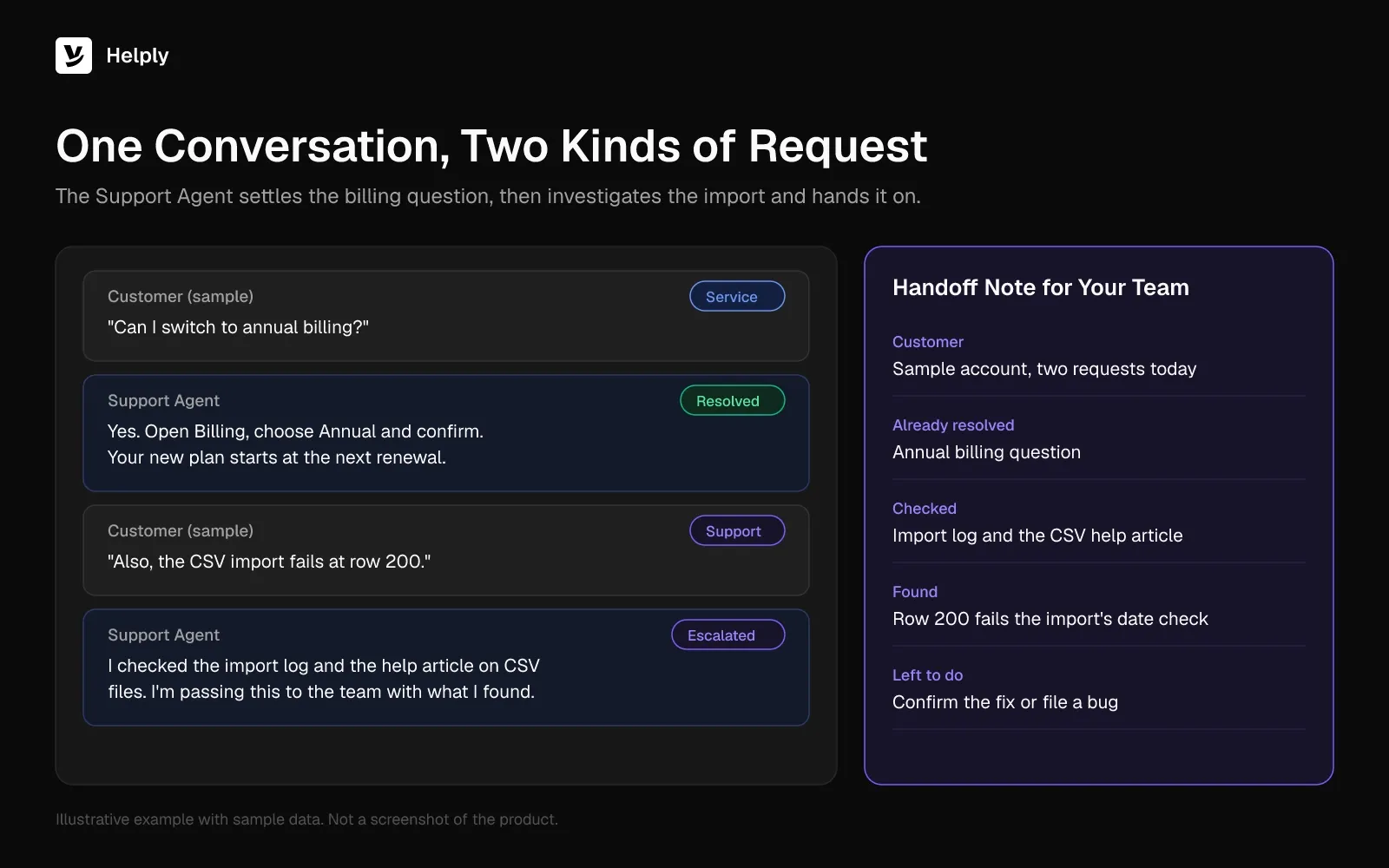
| "The CSV import fails at row 200." | Support | The import works, or engineering has a bug report | Partly; it can investigate and hand off |
| "How do I connect Slack?" | Support | The integration is working | Yes, from your help articles |
| "The dashboard shows yesterday's data." | Support | Someone finds and fixes the cause | Partly; engineering may need it |
| "Your update broke my workflow." | Both | Engineering has the bug, and a person has replied | No; a person should own it |
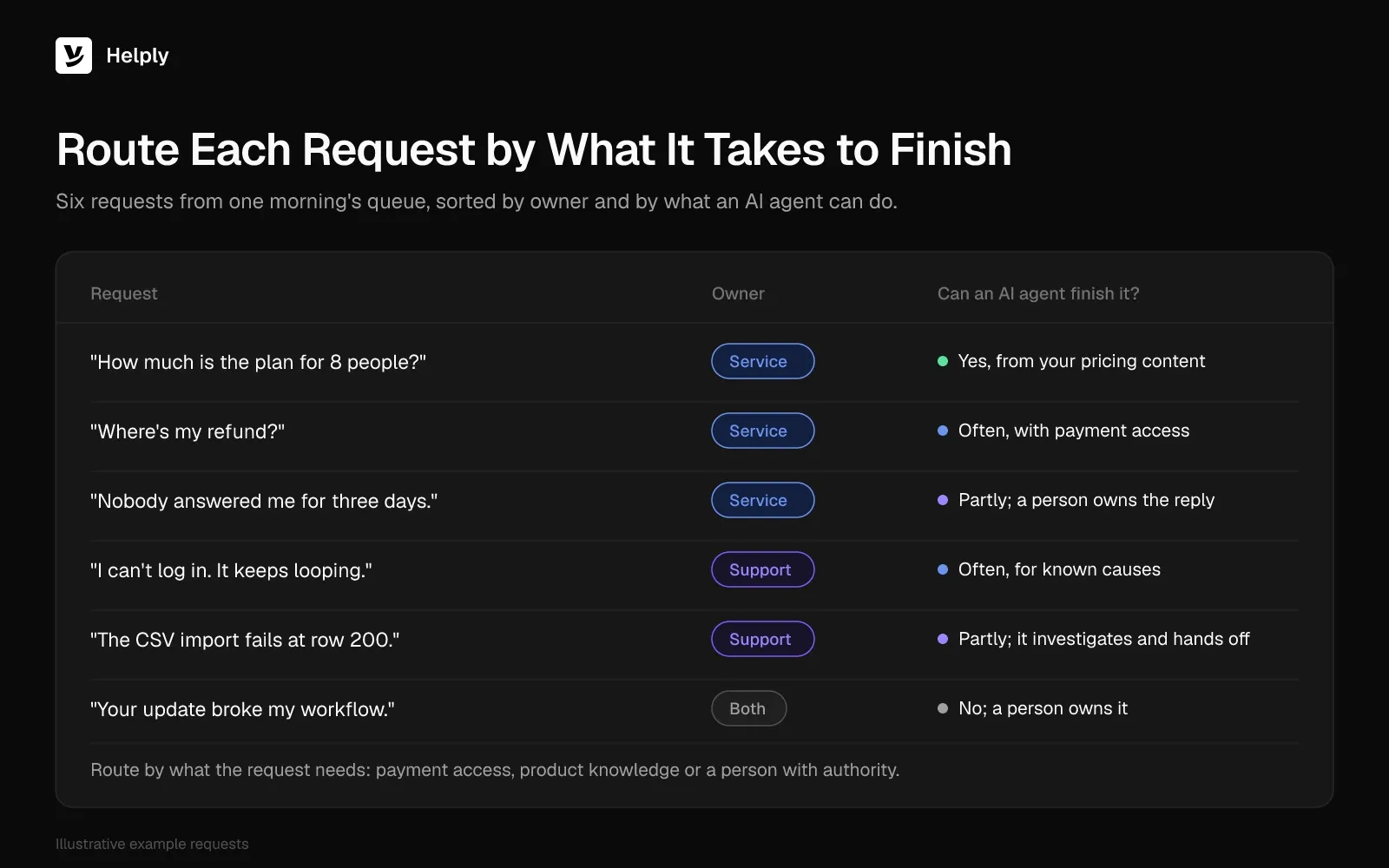
In this sample, five requests are service, four are support and one needs both. An AI agent can finish two outright, often finishes four more and can handle part of three.
Route each request by what it takes to finish it. A refund needs payment access, a failing import needs product knowledge, and a complaint needs a person with authority. Our guide to answering a customer inquiry covers the wording for each type.
Where the Line Blurs (and Why Customers Notice)
Some requests need both teams. A customer writes, "You took my money twice." That reads like a billing question for customer service.
The cause turns out to be a sync bug that created two subscriptions, which makes it a support problem.
A customer charged twice wants one answer, whichever team owns the fix. Salesforce published its sixth State of the Connected Customer report in August 2023, surveying 14,300 consumers and business buyers. In it, 79% said they expect consistent interactions across departments.
In the same report, 56% said they often re-explain information to different representatives. In Zendesk's CX Trends 2026 report (published November 2025), three in four consumers (74%) said repeating information frustrates them.
Customers can end up repeating themselves after a service-to-support handoff. Two habits cut that repetition:
- One record per customer: both sides see the same conversation history, orders and account details.
- Handoffs with context: whoever passes a request on writes what they checked, what they found and what's left.
Should a Small Team Split Customer Service and Support?
A small team can run both from one queue, with two request types and a clear path between them. Most teams use one of three models:
- One team, two request types: everyone takes both kinds of request, and each type carries its own tag and targets. This fits most small teams.
- Tiered support: a first line handles service requests and simple how-to questions, and specialists take technical issues. This fits teams with a steady flow of technical tickets.
- Separate teams: a service team handles orders, billing and accounts, and a support team handles the product. Choose it at high volume or when the product needs deep technical skill.
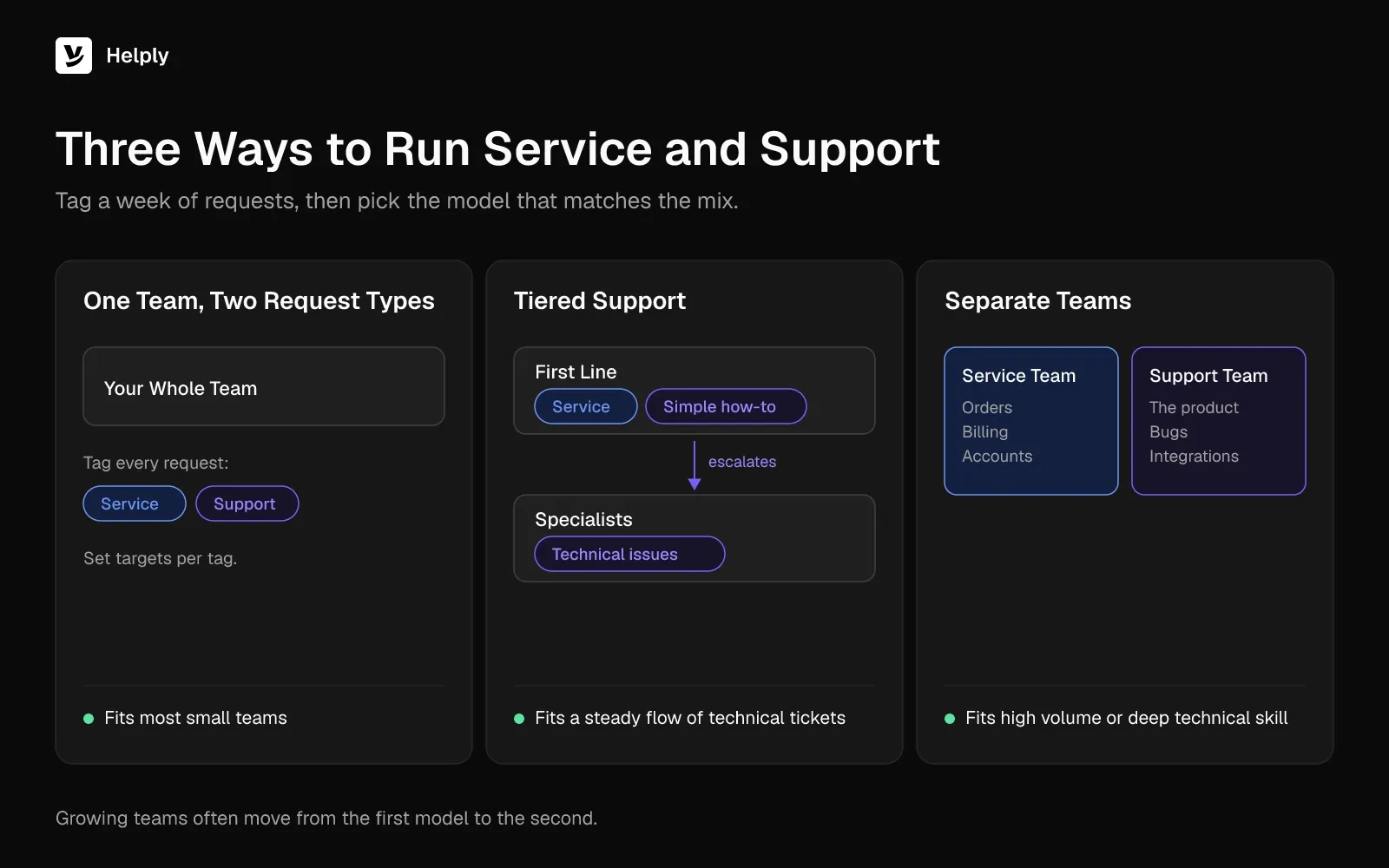
Pick the model from your request mix. Tag every request for a week, then count. A queue that's mostly orders and billing needs strong service basics, and a queue full of integrations and bugs needs a technical tier.
Our guides on scaling customer support and building a customer support team cover hiring and structure in more depth.
How Do You Measure Customer Service and Customer Support?
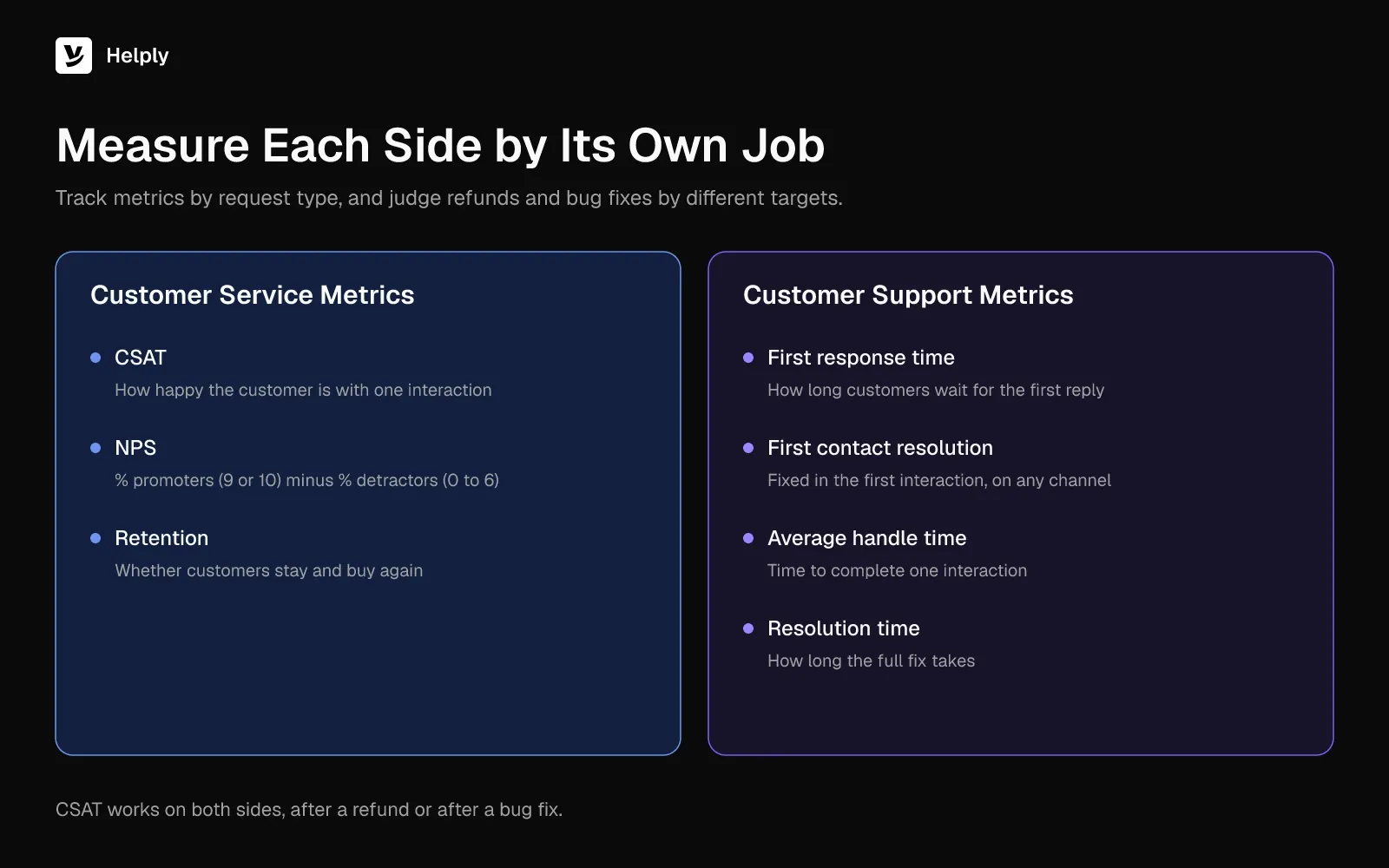
Measure customer service with CSAT, NPS and retention. Measure customer support with first response time, first contact resolution, handle time and resolution time.
A refund team held to handle time can rush customers. A technical team held to NPS can't see which bugs cost the most. Track customer support KPIs by request type, so you judge each side on its own work.
Customer Service Metrics
- CSAT: a short survey after an interaction that gauges how happy the customer is with it.
- NPS: the percentage of promoters minus the percentage of detractors. Customers answer "How likely are you to recommend us to a friend or colleague?" from 0 to 10. Promoters pick 9 or 10, and detractors pick 0 to 6.
- Retention and repeat purchase: whether customers stay and buy again.
Customer Support Metrics
- First response time: how long customers wait before anyone on your team replies.
- First contact resolution: the share of requests resolved in the first interaction, on any channel, with no follow-up.
- Average handle time: the average time to complete an interaction from start to finish.
- Resolution time and reopen rate: how long a fix takes and how often the problem comes back.
Track first contact resolution on both sides. Zendesk published its CX Trends 2026 report in November 2025. In it, 85% of CX leaders said customers will drop brands that can't resolve issues on first contact.
To lift satisfaction scores, see our guide to improving customer satisfaction.
How AI Agents Handle Both Service and Support Questions
AI agents can resolve routine service and support requests and pass the rest to people with context. In a mixed queue, routine service questions use up your team's time, so technical tickets that need a person wait longer. The same Zendesk report found that 74% of consumers expect 24/7 service because of AI.
Helply runs both from one place:
- Both request types in one inbox: every plan has a shared inbox for email and live chat. It also includes a knowledge base hosted on your domain, with AI answers built in.
- Routine requests resolved: the Support Agent investigates issues, answers questions and takes action on any connected channel. It can resolve requests start to finish, working from your knowledge base and connected tools.
- Technical tickets arrive ready: a request the Support Agent can't confidently close goes to a teammate. A failing import, for example, reaches a teammate with the investigation and the customer's details already in the thread.
- Your refund rules applied: Guidelines set how your AI agents act and decide. Put your refund and exception rules there.
- Faster human replies: the Assist Agent prepares draft answers for your people using the thread, the account and your Guidelines. A teammate can also have it take supported Actions.
Escalation rules, from the Team plan, let you set the situations, confidence levels or customer conditions that hand a conversation to a person. Team also adds Skills, which teach the agents recurring work such as a refund check, and memory of past conversations. WhatsApp, SMS and Slack Connect also come with Team, and Microsoft Teams arrives on Pro.
The Knowledge Agent, also from Team, spots gaps and stale content in your help articles and suggests fixes your team can review. For fewer repeat questions in the first place, see how to reduce incoming support tickets.
Service or Support First: Where to Start This Week
Start with the side your queue needs most. If most requests are orders, billing and policy, write down your policies, build saved replies and survey CSAT. If most are product problems, fill the gaps in your knowledge base, set an escalation path to engineering and track first contact resolution.
Helply fits software, ecommerce and marketplace teams that want both jobs in one inbox. Your team gets the investigation and customer context with each handoff, so customers repeat themselves less. Technical tickets wait less, because the Support Agent can take routine billing, plan and order questions before they reach a person.
LingQ, a language-learning platform with 11 to 50 people, kept the same support team while users grew 50% year over year. Support volume fell by about 50% over that period. Each Helply plan puts the Support Agent and Assist Agent to work for your team, with one pool of AI credits.
To start, connect one mailbox and tag a week of requests as service or support. Use the split to see which requests an AI agent can take first and which ones your people should keep.
Frequently asked questions
No, customer support is one part of customer service. The difference between customer service and customer support is scope: service covers billing, orders and refunds around a purchase. Support solves product problems, such as a failed import or a login loop.
Common alternatives are technical support, product support, help desk, customer care and customer help. Many companies also use "customer service" and "customer support" for the same team.
Customer service examples include a plan question, a refund status and an address change. Customer support examples include a login loop, a failed CSV import and connecting an integration.
Yes, sales works to win a purchase, while customer service helps people before, during and after one. Service teams answer pre-sales questions, but they usually don't carry a quota.
Many companies use the two terms for the same work. Companies that separate them use customer care for the ongoing relationship and how customers feel. Customer service is the day-to-day work of answering requests.
Customer relations is the long-term work of building loyalty through account check-ins, loyalty programs and feedback loops. Customer service handles individual requests as they come in.
Customer support reacts when something breaks. Customer success works ahead of problems with each account, so customers reach their goals and renew.
Customer experience is every interaction a person has with your brand, from ads to the product. Customer service is one part of that experience.
Yes, on small teams one person often handles both. Tag each request as service or support so the metrics stay separate, and set one escalation path for technical issues.
Yes, AI agents can answer routine questions and take supported actions on both sides. Helply's Support Agent can resolve a request start to finish and escalates with its investigation and customer context when it can't.
About the author

Konrad Janczyk
Staff Software Developer


