 Jared Scheel ··13 min read

How AI Chatbot Pricing Works: Five Billing Models
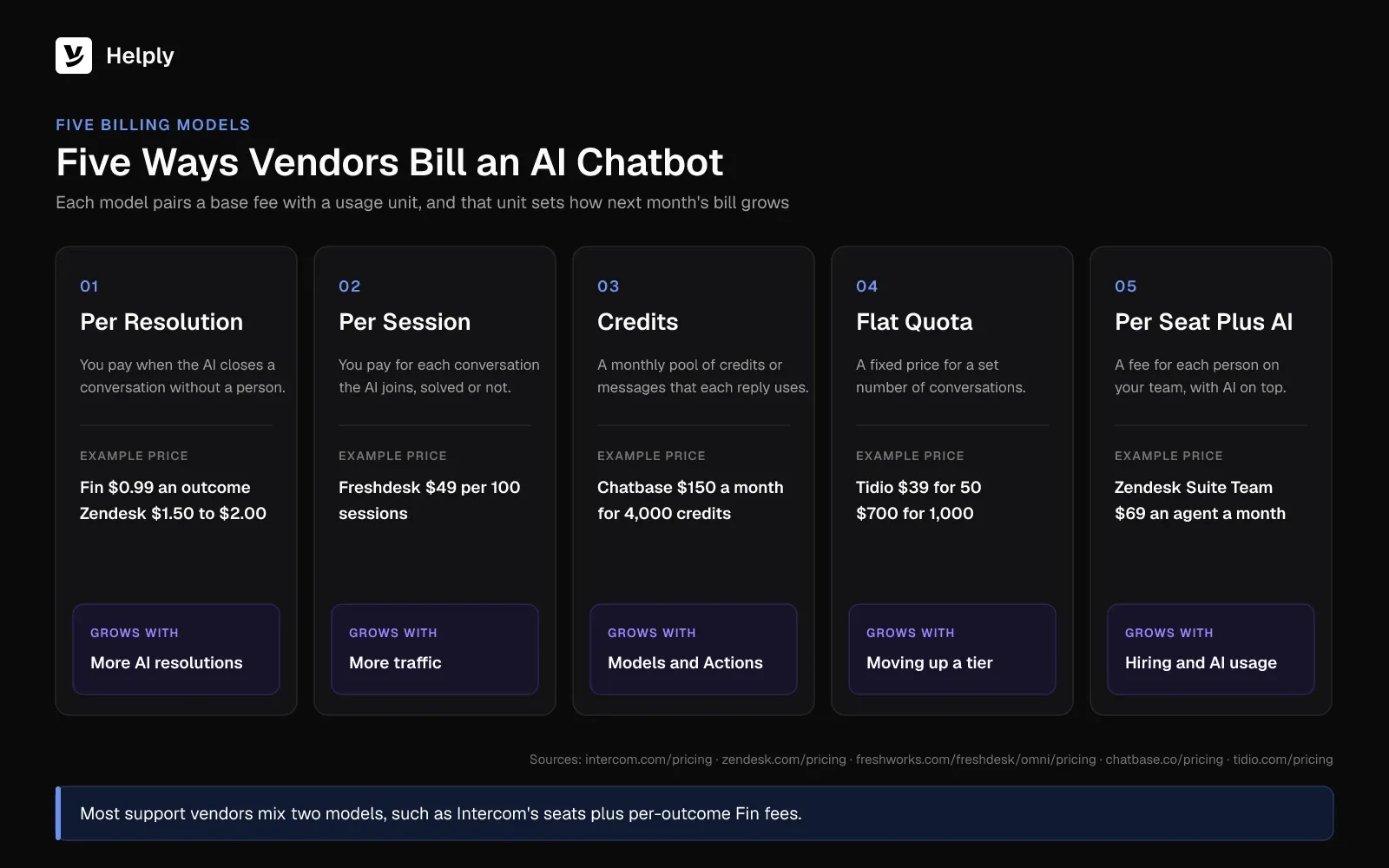
Most AI chatbot plans add a usage charge to a base fee. Vendors bill that charge by resolution, session, credit or quota conversation, and some also charge per seat.
You have three quotes open: $0.99 per outcome, $2.00 per resolution and $49 per 100 sessions. Each vendor counts a different unit, so you can't read next month's invoice off any of them. One bill climbs as the bot improves, some bots go quiet at their limit, and wrong answers can cost more than fees.
Price one queue in each vendor's unit, and you can compare the three quotes as monthly bills.
Per resolution or outcome: you pay each time the AI closes a conversation alone, so the bill rises as the bot gets better. Intercom bills $0.99 per Fin outcome, at most once per conversation. Zendesk includes 5 resolutions per agent, then bills $1.50 each on a commitment and $2.00 each without one.
Per session: you pay for each conversation the AI joins, solved or not. Freshdesk gives 500 free Freddy AI Agent sessions once per account, then charges $49 per 100.
Credits or messages: you buy a monthly pool, and each AI action draws from it. Chatbase's Basic plan includes 4,000 message credits for $150 a month ($120 billed annually). Each reply draws 1 to 5 credits, depending on which recommended model answers, and replies that run Actions make extra model calls.
Flat plan with a quota: you pay a fixed price for a set number of conversations or resolutions. Tidio's With Lyro AI plans start at $39 a month ($33 billed annually) for 50 conversations. Growth reaches $700 for 1,000, and Plus starts from $300 a month plus usage.
Per seat plus AI: a help desk charges for each person on your team, and the AI fee sits on top. Zendesk charges $69 per agent each month for Suite Team ($55 billed annually), before any resolution fee. Hiring raises this bill even when the AI does the same work.
AI Chatbot Billing Models Compared: Unit, Price and Bill Driver
| Billing model | What you pay for | Example list price | What grows the bill |
|---|---|---|---|
| Per resolution or outcome | Each conversation the AI closes alone | Intercom Fin $0.99 per outcome; Zendesk $1.50 to $2.00 per resolution; HubSpot $0.50 per resolution (50 credits) | More AI resolutions |
| Per session | Each conversation the AI joins | Freshdesk $49 per 100 sessions | More traffic, solved or not |
| Credits or messages | Each AI reply or action from a monthly pool | Chatbase $150 a month ($120) for 4,000 message credits | Pricier models and replies that run Actions |
| Flat plan with a quota | A set number of conversations | Tidio $39 a month ($33) for 50 conversations; Growth $700 for 1,000 | Moving up a tier |
| Per seat plus AI | Each person on the team, plus an AI fee | Zendesk Suite Team $69 an agent a month ($55) | Hiring and AI usage |
Most support vendors mix two models. Intercom adds per-outcome Fin fees to per-seat help desk pricing, and Gorgias adds per-interaction AI fees to plans priced by ticket volume.
What Counts as a Resolution, Session or Credit
Two vendors with the same headline price can send different invoices. Each vendor defines its billing unit in its own fine print, and that definition sets what you pay for.
- Intercom Fin: Fin earns an outcome when the customer says the answer worked, or exits without asking for anything more. A Procedure handoff also counts as an outcome. A customer's request for a person or a default escalation doesn't.
- Zendesk: the bill covers only resolutions that pass Zendesk's conversation review. A language model reviews each conversation after it ends.
- HubSpot: a resolution counts when no handoff to a human happens within 72 hours. Each one uses 50 HubSpot Credits, or $0.50.
- Gorgias: an interaction counts as automated when no human agent steps in for 72 hours. Each one also counts as a helpdesk ticket.
- Freshdesk: a chat session covers everything within 24 hours, and an email session covers a 72-hour window. Previewing an AI agent uses sessions too.
- Tidio: any conversation with at least one message from your team or Lyro uses one unit of a shared quota. A handoff still counts once.
- Chatbase: each reply draws 1 to 5 message credits on recommended models, and replies that run Actions make extra model calls. Unused credits don't carry over.
- ChatBot.com: a resolution counts when "the AI directly solved a customer question," and several questions in one chat count once.
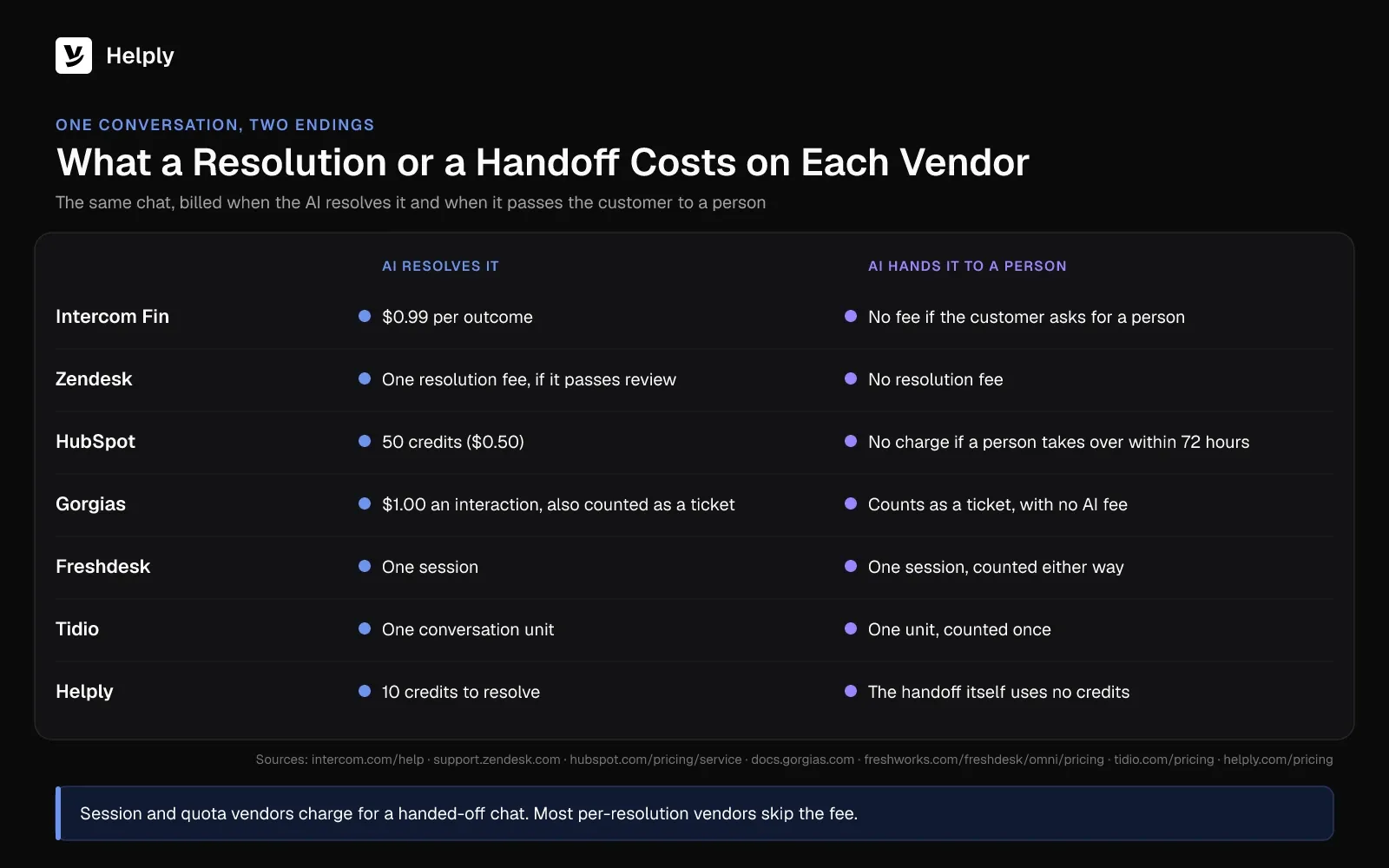
Handoffs are the line item to check first. Most per-resolution vendors skip the fee when a customer asks for a person, though Intercom bills a Procedure handoff as an outcome. Session and quota vendors charge for that conversation anyway.
AI Chatbot Prices by Vendor
Entry plans for an AI chat agent run from $19 a month on Botsonic to $150 on Chatbase, before onboarding and AI fees. Each row shows monthly list prices first, with annual billing in parentheses.
Support Chatbot Prices by Vendor: Base Plan, AI Fee and Billing Unit
| Vendor | Base plan for an AI chat agent | AI fee | Billing unit |
|---|---|---|---|
| Intercom | Essential $39 a seat ($29) | $0.99 per Fin outcome | Outcome, at most one per conversation |
| Zendesk | Suite Team, $69 per agent ($55), with 5 resolutions per agent each month | $1.50 (committed) to $2.00 (pay-as-you-go) | AI resolution that passes review |
| Freshdesk | Omni Growth $35 an agent ($29) | $49 per 100 sessions after 500 free, once per account | Session (24 hours on chat) |
| HubSpot | Service Hub Professional $100 a seat billed monthly on an annual commitment ($90 paid annually), plus $1,500 onboarding | 50 credits ($0.50) per resolution after 3,000 included credits | Resolved conversation |
| Gorgias | Basic $60 ($50) for 300 tickets; Starter $10, monthly only | $1.00 an automated interaction ($0.90); overage $1.50 | Automated interaction, plus a ticket |
| Tidio | With Lyro AI Starter $39 ($33) for 50 conversations | Included in the plan | Conversation, shared by AI and team |
| Chatbase | Basic $150 ($120), 4,000 message credits | Included; $40 per 1,000 extra credits | Message credit |
| ChatBot.com | Essential $25 a user ($19), 10 AI resolutions a month | $0.99 per extra resolution or $49.50 per 50 | Resolution |
| Botsonic | Starter $19 ($16), 1,000 messages | $25 per 2,000 extra messages | Message |
Per-resolution AI fees run from $0.50 at HubSpot to $2.00 on Zendesk pay-as-you-go, with Intercom's Fin at $0.99 an outcome.
A few plan rules change who can use these prices:
- Intercom bills the Fin fee on top of seat prices. See how Helply compares with Intercom.
- Fin also runs on other help desks, such as Zendesk, Salesforce or HubSpot, at $0.99 an outcome with no seat fees. Plans carry a 50-outcome monthly minimum.
- An AI agent on Zendesk web chat needs a Suite plan. See how Helply compares with Zendesk.
- Gorgias's AI Agent needs a connected Shopify store.
- Freshdesk counts AI sessions, solved or not. See how Helply compares with Freshdesk.
- Tidio bills With Lyro AI plans by a conversation quota that Lyro and your team share.
Gorgias fits Shopify stores that price support by ticket volume. HubSpot's Customer Agent makes sense for teams on Service Hub Professional.
Tidio's With Lyro AI plans work for small queues, since one quota covers Lyro and your team. Zendesk and Freshdesk add AI to a help desk billed per agent, so they fit teams planning to stay on either one.
What a Support Chatbot Costs at 1,000 and 3,000 Conversations a Month
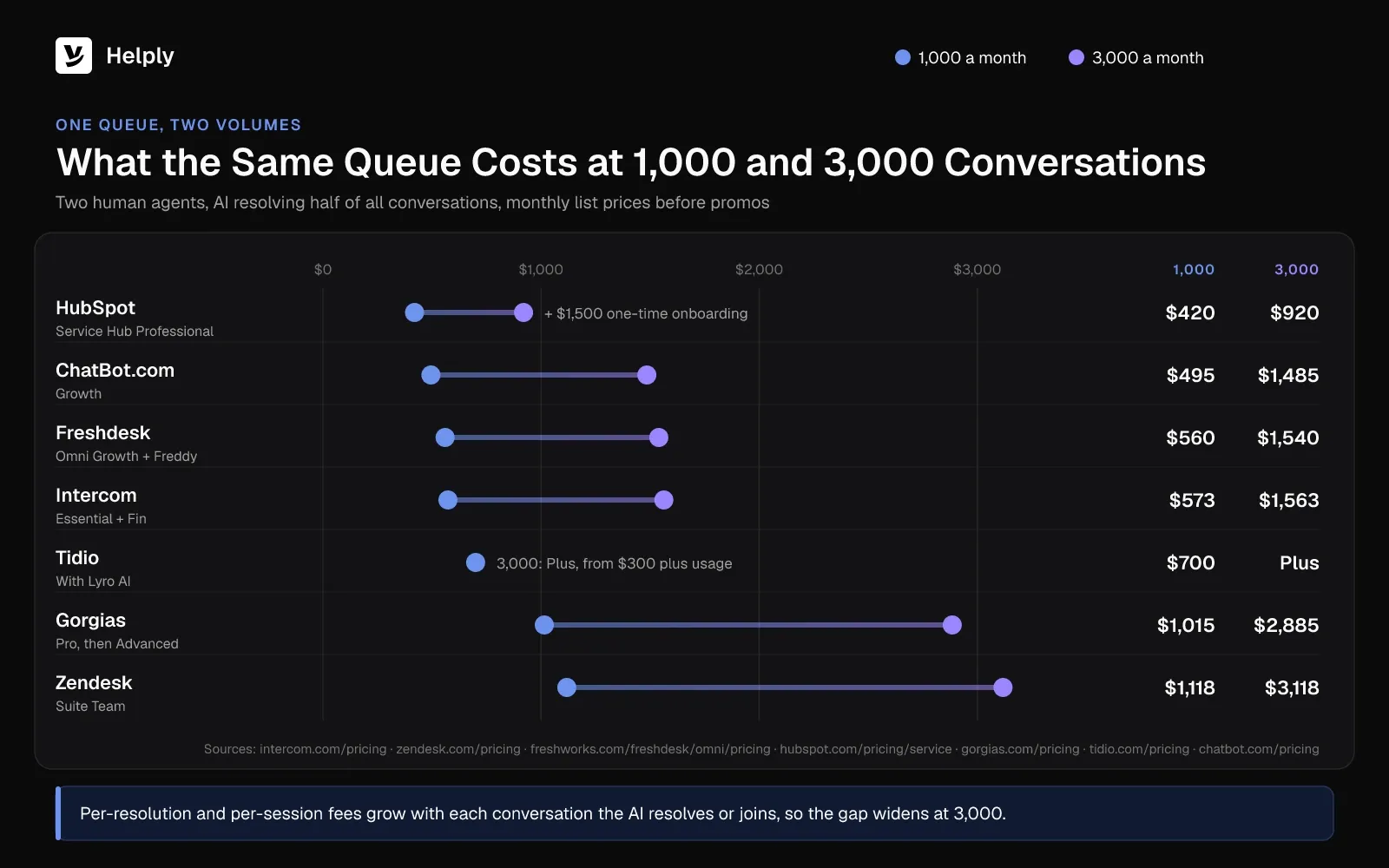
At 1,000 conversations a month, list prices run from $420 on HubSpot Service Hub Professional to $1,118 on Zendesk Suite Team. At 3,000, HubSpot stays lowest at $920 among vendors with a complete price, and Zendesk reaches $3,118. Both ranges assume two human agents, AI resolving half of all conversations, list prices and no promos.
Figures in parentheses use annual billing, and for Zendesk they also use the $1.50 committed rate. The Freshdesk row assumes the AI opens every conversation, after the one-time 500 free sessions. HubSpot's $1,500 onboarding fee sits outside the monthly total.
Monthly AI Support Cost for Two Agents at 1,000 and 3,000 Conversations
| Vendor and plan | 1,000 conversations (500 AI resolutions) | 3,000 conversations (1,500 AI resolutions) |
|---|---|---|
| HubSpot Service Hub Professional | $420 ($400) plus $1,500 one-time onboarding | $920 ($900) plus $1,500 one-time onboarding |
| ChatBot.com Growth | $495 ($455) | $1,485 ($1,445) |
| Freshdesk Omni Growth | $560 ($548) | $1,540 ($1,528) |
| Intercom Essential with Fin | $573 ($553) | $1,563 ($1,543) |
| Tidio With Lyro AI | Growth: $700 | Plus: from $300 plus usage |
| Gorgias with AI Agent | Pro: $1,015 ($936) | Advanced: $2,885 ($2,682) |
| Zendesk Suite Team | $1,118 ($845) | $3,118 ($2,345) |
The maths behind each row:
- HubSpot: two Professional seats at $100 ($90), and each resolution uses 50 credits. After the 3,000 included, 22,000 extra credits cost $220 at 1,000 conversations. At 3,000 conversations, 72,000 extra credits cost $720.
- ChatBot.com: two Growth users at $99 ($79) include 200 resolutions. The other 300 cost $49.50 per 50, or 1,300 more at 3,000 conversations.
- Freshdesk: two Omni Growth agents at $35 ($29), plus 10 packs of 100 sessions at $49, or 30 packs at 3,000 conversations.
- Intercom: two Essential seats at $39 ($29), plus 500 outcomes at $0.99, or 1,500 outcomes at 3,000 conversations.
- Tidio: 1,000 shared conversations is the top Growth tier. At 3,000 you move to Plus, priced from $300 plus usage.
- Gorgias: Gorgias prices by tickets, so the two agents add nothing. The Pro bundle at $550 ($471) includes 190 AI interactions, with 310 more at $1.50 apiece. At 3,000, the Advanced bundle at $1,430 ($1,227) includes 530, with 970 more at $1.50.
- Zendesk: two Suite Team agents at $69 ($55) include 10 resolutions. The rest cost $2.00 pay-as-you-go, and the figure in parentheses uses the $1.50 committed rate.
Per-resolution and per-session fees grow with each conversation the AI resolves or joins. Seat fees stay flat for the same two agents, so the gap between vendors widens as volume grows.
Chatbase and Botsonic bill by message, so you'd need a message count per conversation to price them on this queue.
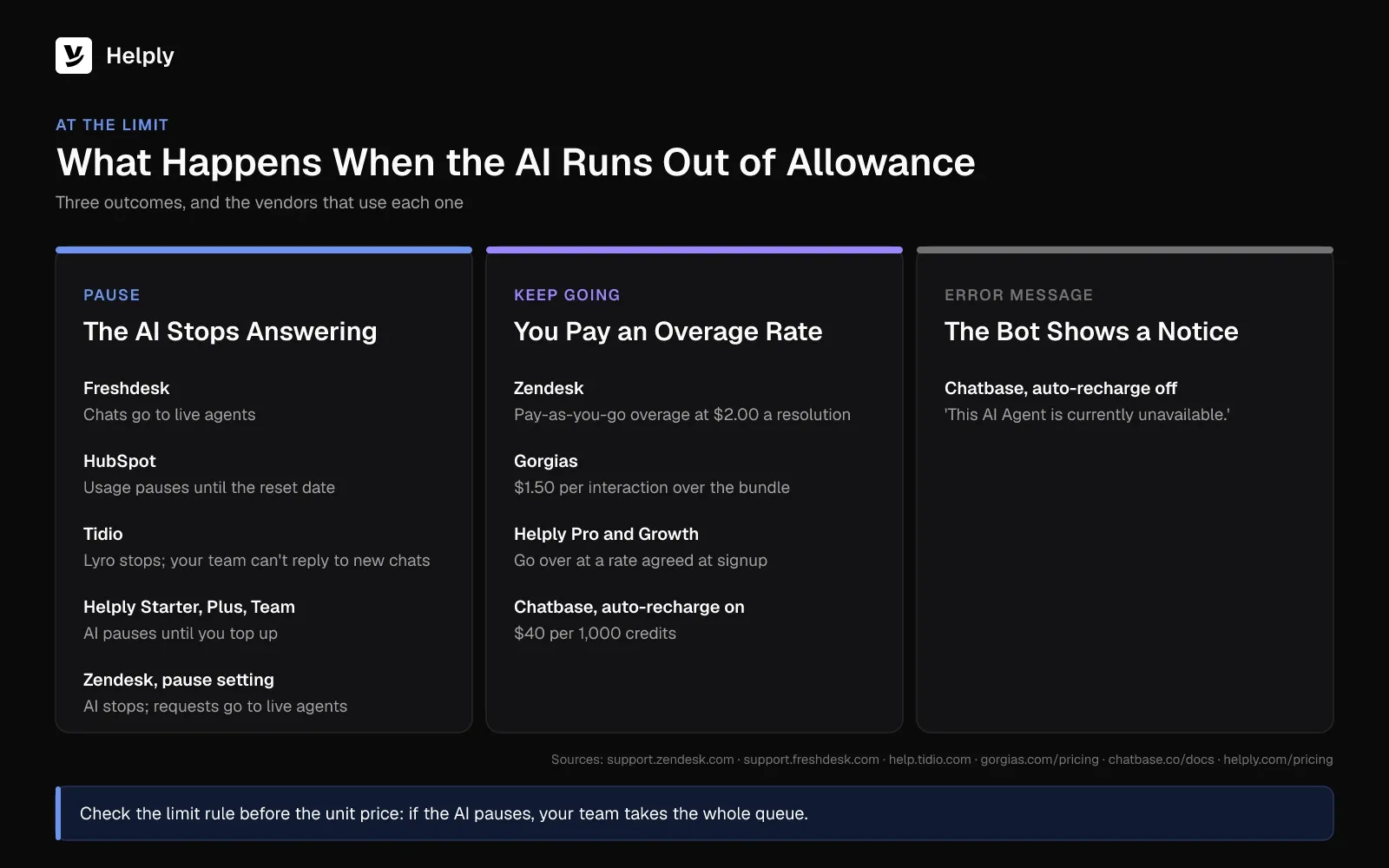
What Happens When the Bot Hits Its Limit
At the limit, most support bots either stop answering until the quota renews or keep going at an overage rate. Check which one your plan does.
- Zendesk: you choose overage at the pay-as-you-go rate, or a pause where AI agents stop and requests route to live agents.
- Freshdesk: once sessions run out, the AI agent stops responding and chats go to live agents.
- HubSpot: usage pauses until your reset date unless you buy more credits.
- Tidio: at the limit, Lyro stops answering and your team can't reply to new conversations. Both resume once the quota renews or you raise it, and an optional automatic upgrade kicks in at 95%.
- Chatbase: with auto-recharge off, the bot displays "This AI Agent is currently unavailable." Auto-recharge costs $40 per 1,000 credits.
- Helply: usage alerts warn you well before the limit. On Starter, Plus and Team, AI pauses there until you buy a credit top-up or switch to a bigger plan. Pro and Growth teams can pick a hard cap, or continue past the limit at a rate agreed at signup.
If the AI pauses during a sale or an outage, your team takes the whole queue at once. Check the limit rule before you check the unit price.
Hidden Costs That Change the Bill
The plan and the AI fee leave out several costs. Some sit in footnotes, and others in help articles or your own queue.
- Onboarding fees. HubSpot adds a one-time onboarding fee of $1,500, which Service Hub Professional requires.
- Per-agent fees. Seat-priced help desks charge for each agent who replies, on top of AI fees. Helply plans cover bands of 2 to 50 human agents, with AI credits inside the plan price.
- Testing. Freshdesk counts AI agent previews against your sessions, published or not.
- Channel gating. Some channels start on higher plans. On Helply, WhatsApp, SMS and Slack Connect start on Team.
- Wrong answers. In February 2024, a British Columbia tribunal made Air Canada pay C$812.02 after its chatbot misstated the bereavement fare policy. The tribunal held the airline responsible for all information on its website, chatbot included.
One bad bot conversation also costs you the customer's next try. Gartner surveyed 3,566 customers across February and March 2026. After one bad experience, only 27% would give a chatbot another try.
The same Gartner release found 87% of customers say access to a human agent is essential when companies use GenAI in service. Budget for the handoff path along with the bot.
Consumer AI Chatbot Prices: ChatGPT, Claude and Gemini
In the US, consumer AI chatbots cost $0 on free plans and $4.99 to $20 a month on entry paid plans. ChatGPT Pro reaches $500.
Each subscription covers one person's drafting and research. A customer-facing support channel needs a business tool.
ChatGPT vs. Claude vs. Gemini Pricing: Free, Entry, Top and Team Plans
| Assistant | Free | Entry paid plan | Top plans | Team plan |
|---|---|---|---|---|
| ChatGPT | $0 | Go $8; Plus $20 a month | Pro from $100 (tiers at $100, $200 and $500) | Business $25 a user ($20 annually) |
| Claude | $0 | Pro $20 a month ($17 annually) | Max $100; Ultra $200 | Team $25 a user ($20 annually) |
| Google Gemini | $0 | Google AI Plus $4.99; AI Pro $19.99 | AI Ultra from $99.99 | Gemini with Google Workspace from $14 a user |
Google AI Plus at $4.99 a month is the cheapest paid plan of the three. To answer customers from your help content, you need a knowledge base chatbot or a custom build.
What It Costs to Build Your Own Chatbot
A custom chatbot on a model API costs little per conversation in tokens. The engineering, hosting and upkeep cost more than the tokens.
On OpenAI's API, gpt-6.2-sol costs $2.00 for each million input tokens and $10.00 for each million output tokens. gpt-6-luna costs $0.10 and $0.50. A conversation with 3,000 input and 500 output tokens costs about $0.011 on gpt-6.2-sol, and under a tenth of a cent on gpt-6-luna.
Next to Intercom's $0.99 for a single Fin outcome, tokens make up a small share of a support bot's cost. A support bot also needs search over your help content, handoff to your team, an inbox, analytics and someone to maintain it.
Building fits a team that ships software and wants the bot inside its product. If support owns the queue, buy a platform.
How Helply Prices AI Agents for Support
Helply is an AI-native customer support platform. Plans scale by bands of human agents, the people who reply to customers, and include a monthly pool of AI credits.
Helply's entry plan is Starter: $116 a month ($99 billed yearly), with 2,500 AI credits and room for 2 human agents. Yearly billing saves 15%.
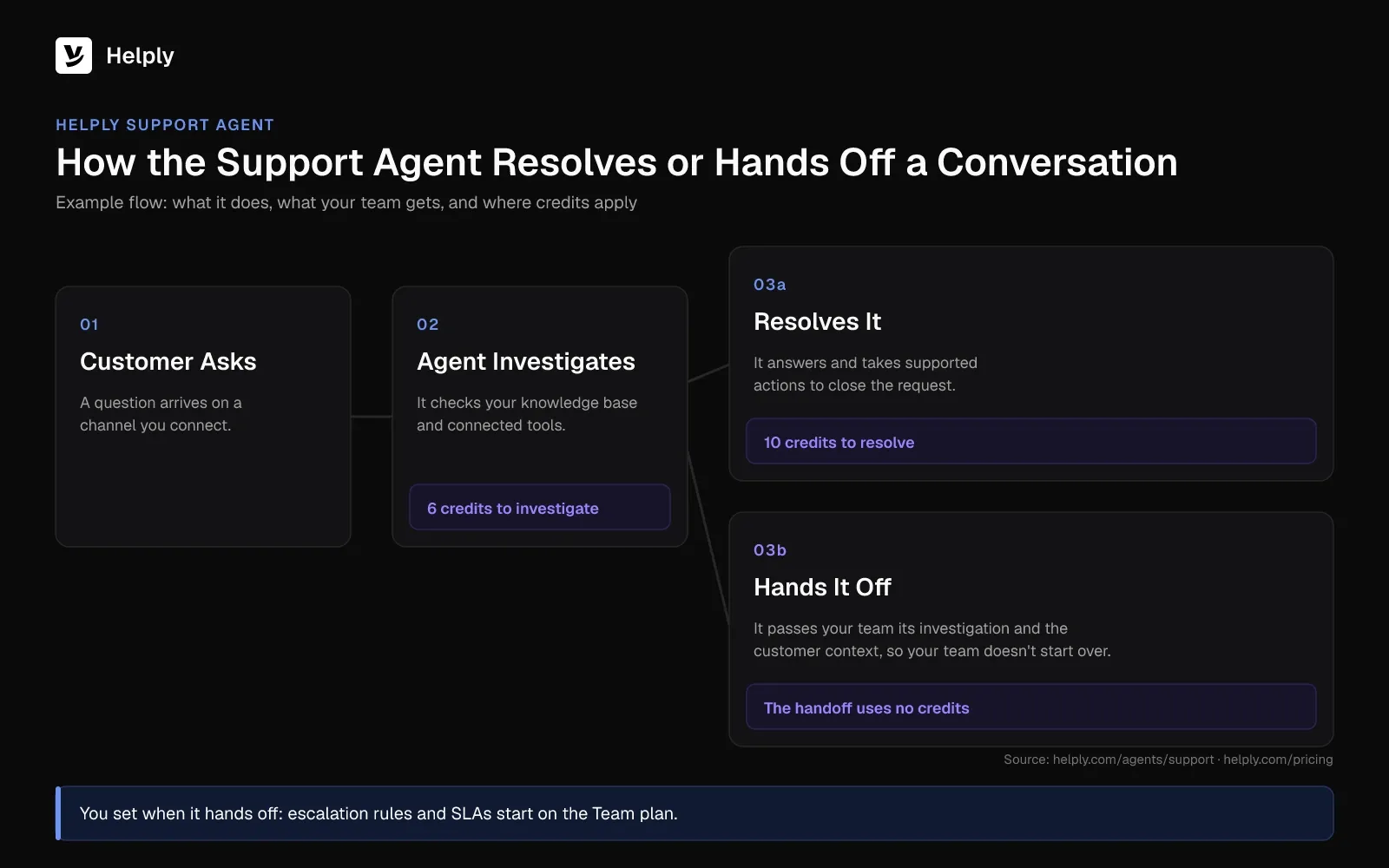
Both AI agents ship with every plan, along with a shared inbox, email, live chat and a help center that answers with AI. The Support Agent works with customers and can investigate, answer, take an action and resolve a request end to end.
The Assist Agent works beside your team inside each conversation. It finds answers and drafts replies, and your team can direct it to run supported actions.
Helply prices credits by the work the AI does, and the credits page lists every rate:
- 1 credit: triage, summary, translation or a QA score.
- 2 credits: a drafted reply, an answer to a teammate in Slack, an action or a backtest.
- 3 credits: a customer answer drawn from the knowledge base.
- 5 credits: a new knowledge base article.
- 6 credits: an investigation across tools such as Stripe, HubSpot or your logs.
- 10 credits: a conversation resolved end to end.
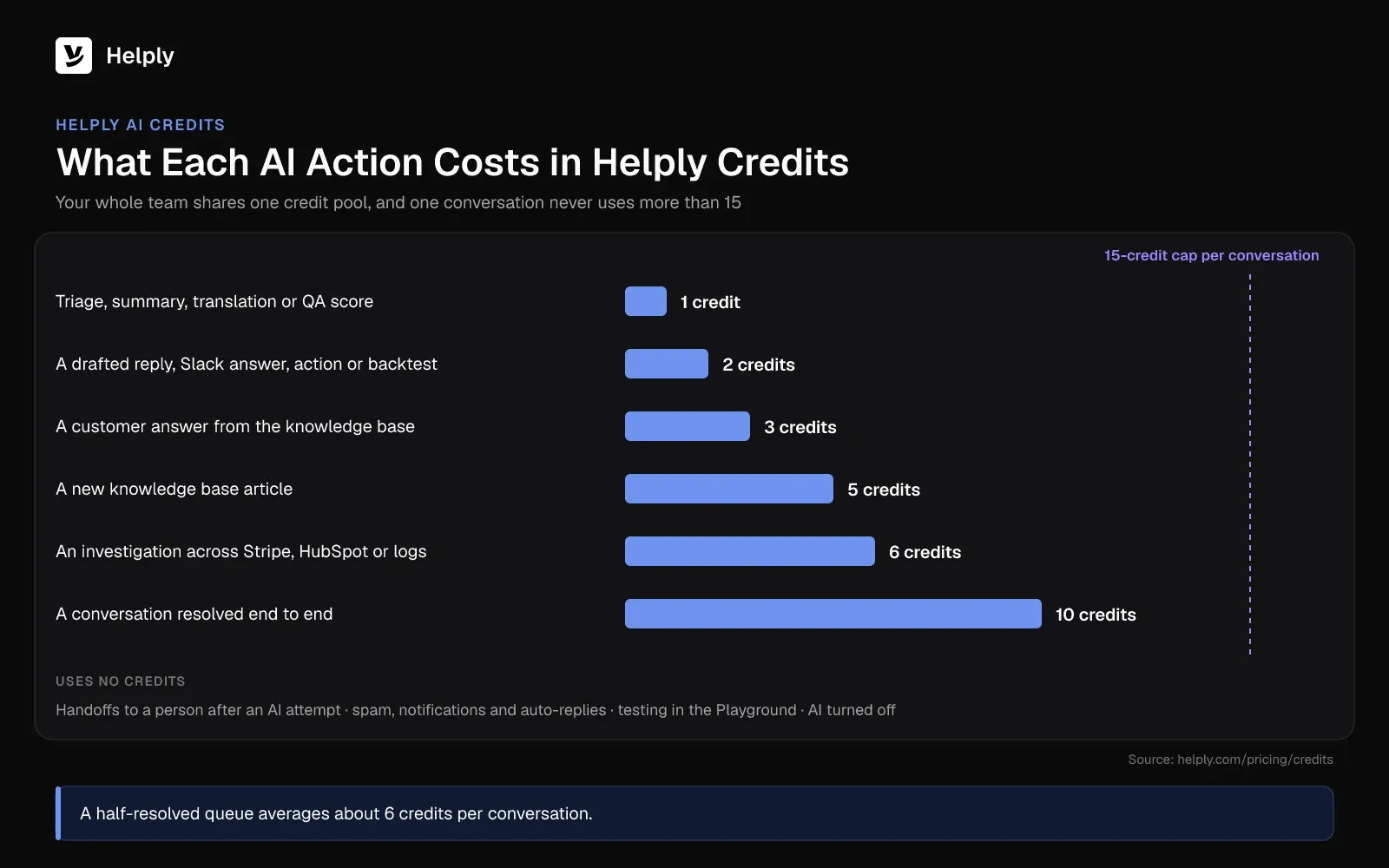
No single conversation can use over 15 credits. Credits pool across the whole team, with usage alerts well ahead of the limit. Spam, auto-replies and Playground tests use none.
Each time the Support Agent lacks the confidence to resolve a case, it passes your team its investigation and the customer's context. Your team picks up without starting over, and the handoff itself uses no credits.
Pay per Resolution or Buy a Pool of Credits?
Put the three quotes on one queue, and you can compare them. With two agents, 3,000 conversations and half resolved by AI, Intercom's comes to $1,563, Zendesk's to $3,118 and Freshdesk's to $1,540 a month. Freshdesk lands lowest, a little under Intercom, and Zendesk costs about twice either one.
Pay per resolution when volume is low or the bot sits on a help desk you plan to keep. A small site with a few FAQs fits a flat plan with a quota.
Choose Helply for the help desk and both AI agents under a single plan price, with a published credit rate for every action. Credit use rises as the AI resolves more, since a resolution uses 10 credits and the handoff step itself uses none. Unlike a per-resolution fee, those credits come from a pool inside the plan price, and no conversation uses over 15.
On Starter, Plus and Team, top-ups cost $40 per 1,000 credits. At that rate, a resolved conversation's 10 to 15 credits cost $0.40 to $0.60. Intercom's Fin fee is $0.99 an outcome, and Zendesk's runs $1.50 to $2.00 a resolution.
On Helply, that 3,000-conversation queue lands near 18,000 credits: the Team plan plus a top-up. Usage alerts warn you well before the pool runs out, and on Starter, Plus and Team a top-up restarts a paused AI. Check the containment rate you expect before you size any plan.
A wrong answer can cost more than its fee. Air Canada's chatbot error ended in a C$812.02 tribunal order.
Start with one inbox and a week of real conversations, then size the plan from your own numbers.
Frequently asked questions
A business AI chatbot costs about $19 to over $3,000 a month, depending on the billing unit and your volume. With two agents, 1,000 conversations and AI resolving half, list prices run $420 to $1,118 a month. The low end excludes HubSpot's one-time $1,500 onboarding fee.
A small business can start at $19 a month on Botsonic Starter ($16 annually) or $150 on Chatbase Basic ($120). Helply's plans include a full help desk and AI agents. A 1,000-conversation month with half resolved by AI uses about 6,000 credits.
Price one month of your own queue in each vendor's unit, then add the seat fees. At 1,000 conversations with AI resolving half, Fin fees come to $495 and Freshdesk sessions to $490. Zendesk's resolution fees reach $980 after the 10 included.
Yes, for personal use: ChatGPT, Claude and Gemini all list $0 free plans. For support, free tiers are small. Tidio's Free plan includes 50 human conversations a month, and Lyro's 50 free AI conversations are a one-time allowance.
At $4.99 a month, Google AI Plus costs less than ChatGPT Go at $8 or ChatGPT Plus at $20. Claude Pro costs $20 a month, or $17 a month billed annually.
Yes, you can subscribe to a chatbot platform or build your own on a model API. Tokens cost about $0.011 on OpenAI's gpt-6.2-sol for a conversation with 3,000 input and 500 output tokens. Engineering, hosting and upkeep outweigh the token bill.
Under per-resolution pricing, you pay a fee each time the AI resolves a conversation without a person. Intercom's Fin costs $0.99 an outcome, and a Procedure handoff counts as one too. HubSpot charges $0.50 per resolved conversation, and Zendesk $1.50 to $2.00 per reviewed resolution.
On fees per contact, yes. A 2019 Gartner poll of service leaders put live channels such as phone, chat and email at an average of $8.01 per contact. AI fees run about $0.50 to $2.00 per resolution, before platform and seat costs.
For personal work, ChatGPT Plus and Claude Pro both cost $20 a month. For customer support, match the billing unit to your queue, then compare monthly bills.
Most per-resolution vendors don't, while session and quota vendors count the conversation anyway. Intercom skips the outcome fee when the customer asks for a human, but bills a Procedure handoff as an outcome. On Helply, the handoff after an AI attempt uses no credits, though the AI's work before it does.
About the author

Jared Scheel
Co-founder & CTO
Keep reading

Best Customer Service Software for Small Business in 2026
Bildad Oyugi · 22 min read
Support Operations: What It Covers and When You Need a Support Ops Role
Konrad Janczyk · 14 min read