
 Bildad Oyugi ··15 min read

A reply lands in your queue. "This is the third time I've explained this."
Scroll up and you find two handoffs, an AI answer no teammate checked and a refund promise your policy doesn't allow.
The customer has reason to be angry. In Zendesk's CX Trends 2026 survey, run in June 2025, 74% of consumers found it frustrating to repeat information.
Air Canada lost a tribunal case over an AI answer, and Dave Carroll turned United's lost claim into a viral song. Each pattern below ends with fixes your team can start this week.
What Is Bad Customer Service?
Bad customer service is support that makes a customer's problem harder to solve. It hands the company's work back to the customer.
Customers end up repeating themselves, chasing updates, arguing with policy or solving the problem alone.
Most poor customer service examples share a short list of traits:
- Answers that sound sure but are wrong.
- Agents who lose context at each handoff.
- No owner to follow up.
- Silence when something big breaks.
- Exits hidden behind pages, transfers and fees.
- Blame aimed at the customer.
- Careless handling of the customer's data.
CEB studied more than 75,000 customers for a 2010 Harvard Business Review article. Customers were four times as likely to come out of a service interaction disloyal as loyal.
CEB also found that 81% of customers who struggled to get help planned to bad-mouth the company.
Qualtrics XM Institute puts nearly $3 trillion of global sales at risk from bad experiences in 2026. Its estimate rests on a survey of 20,001 consumers in 14 countries, run in the third quarter of 2025.
12 Bad Customer Service Examples, Paired by Failure
Each pattern pairs two bad customer service stories, one consumer and one software company, then lists steps a support team can run.
1. An AI Agent Invents a Policy: Air Canada and Cursor
An AI agent states a rule your company never made, and the customer acts on it.
In November 2022, Jake Moffatt asked Air Canada's website chatbot about bereavement fares on the day his grandmother died.
The chatbot said he could claim the bereavement rate after his trip if he applied within 90 days of his ticket's issue date. Air Canada staff later told him the airline accepted no such claims after travel.
The airline offered him a $200 coupon, and he turned it down.
The case reached British Columbia's Civil Resolution Tribunal. Its February 2024 ruling said Air Canada was in effect arguing that its chatbot was a separate legal entity. The tribunal called that "a remarkable submission" and rejected it.
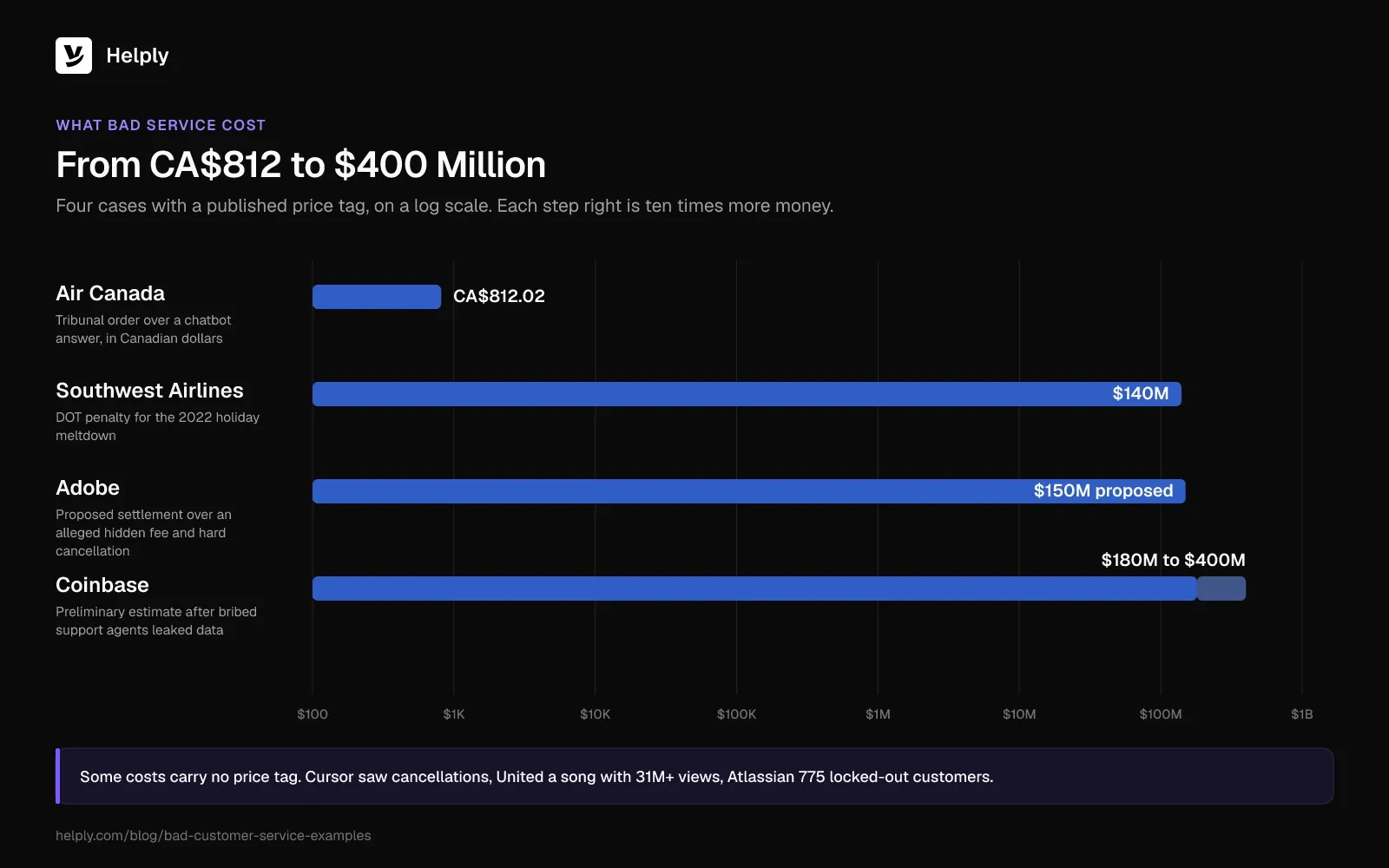
The order came to CA$812.02, of which CA$650.88 was damages. The tribunal wrote: "It should be obvious to Air Canada that it is responsible for all the information on its website."
Cursor, the AI-powered code editor, hit the same failure in April 2025, Ars Technica reported. Users kept getting logged out when they switched machines.
One user asked support and got a reply from "Sam," which said Cursor was "designed to work with one device per subscription as a core security feature."
No such policy existed, and Sam was an AI support bot. Users posted on Reddit that they had canceled.
A reply from co-founder Michael Truell's account followed: "Hey! We have no such policy."
Two days later, Truell apologized on Hacker News and said Cursor had refunded the user. He added: "Any AI responses used for email support are now clearly labeled as such."
Customers already doubt AI support. In Gartner's survey of 5,728 customers, run in December 2023, 64% preferred that companies not use AI for customer service.
To prevent it:
- Ground every AI answer in your docs, policies and past resolutions.
- Block AI answers on refunds, pricing or account rules it can't source.
- Write down what the AI may promise alone and where a person takes over.
- Set the AI to hand off when unsure, with its findings attached.
- Label AI replies so customers know who they're talking to.
- Treat every AI answer as a company answer, because a tribunal already has.
2. The Issue Gets Lost Between People: United Airlines and Okta
A customer explains the problem, then explains it again to each new person who picks it up.
On 31 March 2008, Dave Carroll flew United from Halifax to Omaha through Chicago. His $3,500 Taylor guitar arrived broken.
On later calls, United staff struggled to find his claim number. United sent him from Halifax to its Chicago baggage office, then to Central Baggage in New York.
A New York contact said she'd never received his fax, then found it when he asked her to look. Later, he had to start over with the same 1-800 number.
Nine months in, the claim had narrowed to a string of emails with one United employee.
In July 2009, Carroll posted the song "United Breaks Guitars" on YouTube. The video has more than 31 million views.
The lost issue can also be a security report. BeyondTrust, an Okta customer, raised a suspected breach of Okta's support system on 2 October 2023.
It held Zoom calls with Okta on 11 and 13 October to explain its evidence. By its own account, it kept escalating without acknowledgment until 19 October.
In its November 2023 root-cause report, Okta wrote: "For a period of 14 days, while actively investigating, Okta did not identify suspicious downloads in our logs."
In Zendesk's CX Trends 2026, 81% of consumers wanted agents to carry a conversation forward without backtracking. In CEB's 2010 study of more than 75,000 customers, 56% had re-explained an issue and 59% reported transfers.
To prevent it:
- Give every issue one owner until it's solved, even when other teams do the work.
- Write handoff notes that carry the full story: what the customer asked, what you tried and what you promised.
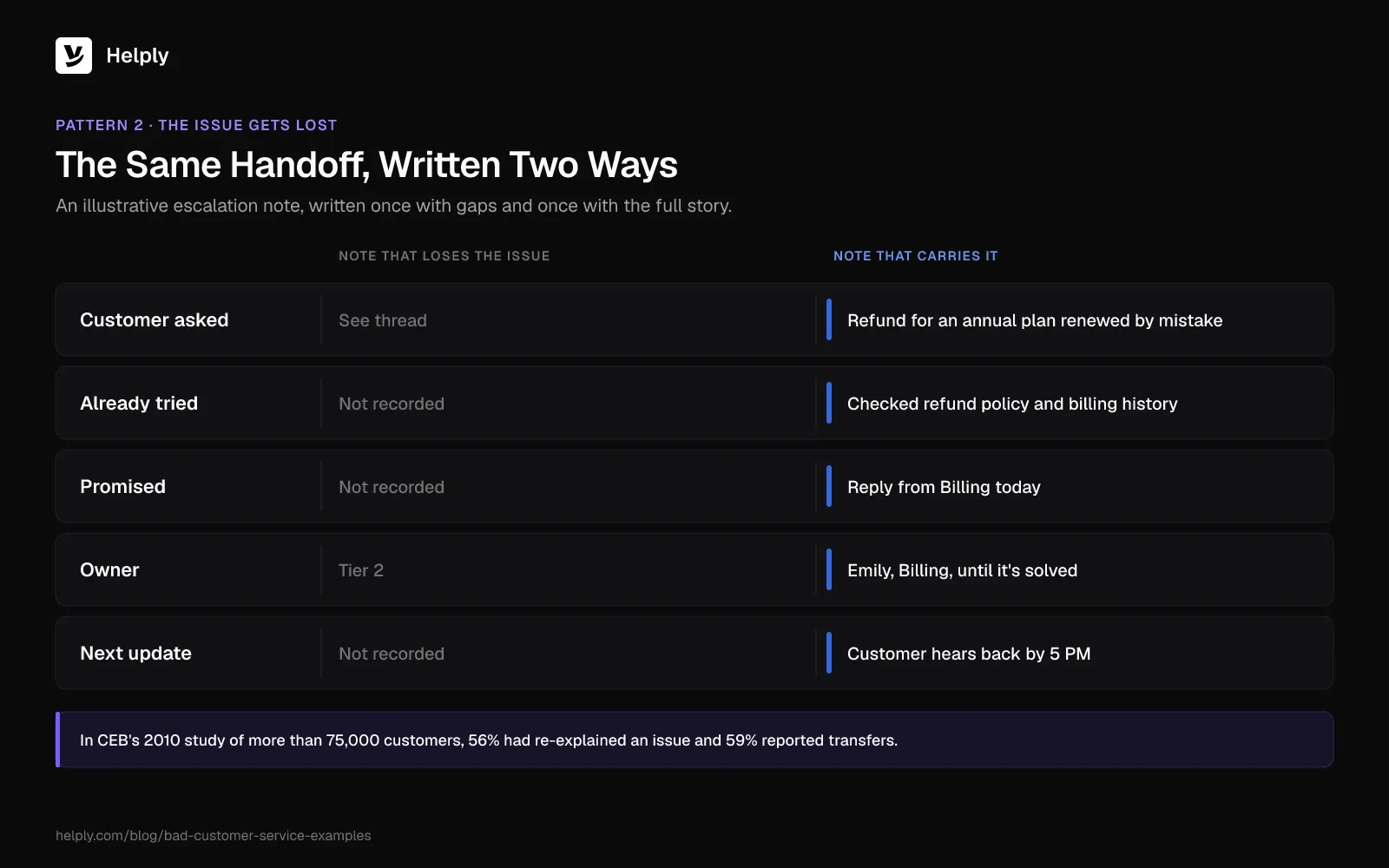
- Keep the customer's history and account details next to the thread, so your agents don't ask the customer twice.
- Define a path from support to security and engineering, with a deadline for the first reply.
3. Support Goes Silent During an Outage: Southwest Airlines and Atlassian
Something big breaks, and customers can't reach anyone who knows what's going on.
During its December 2022 holiday meltdown, Southwest canceled 16,900 flights and stranded more than two million passengers.
Callers "were often met with busy signals, hours-long queues to connect with agents, or dropped calls," said the US Department of Transportation.
In December 2023, the DOT fined Southwest $140 million. The penalty includes $35 million in cash. The DOT credited $72 million for a compensation system and $33 million for Rapid Rewards points Southwest had already issued.
Atlassian's outage started on 5 April 2022. A script meant to remove a legacy app deleted whole customer sites. In all, 775 customers lost access to their Atlassian products, some for up to 14 days.
The script also wiped some customer contact details. Customers couldn't file support tickets the usual way, and Atlassian couldn't reach many of them.
Atlassian's first broad public message was a tweet on 7 April. The last sites came back by 18 April.
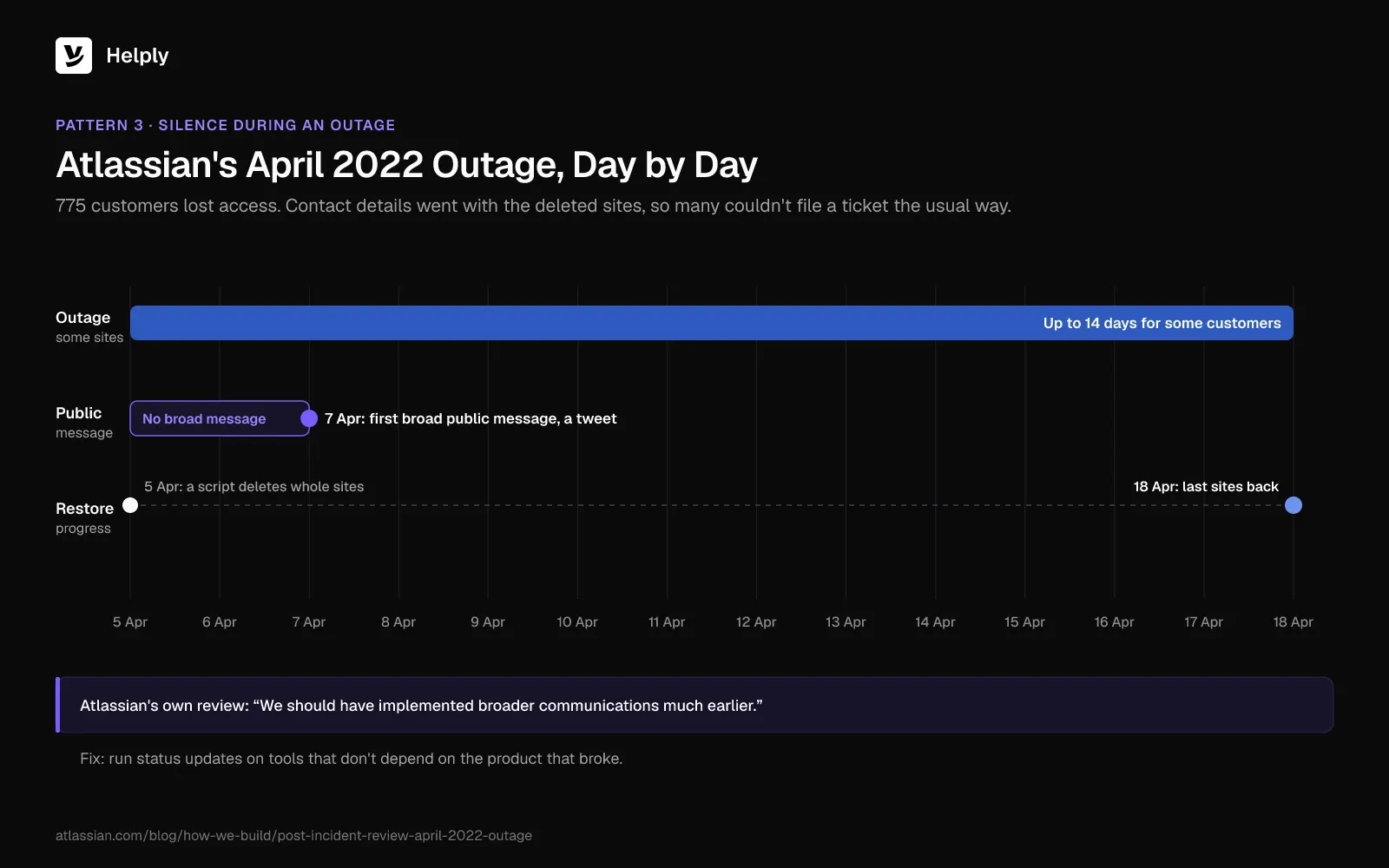
Atlassian's own review says it "should have implemented broader communications much earlier." It also names a second cause: "Disparate tools and processes across our customer-facing teams slowed our response."
To keep it from happening:
- Plan extra staff, callbacks and self-serve status answers for the day a major outage hits.
- Run your status page and incident updates on tools that don't depend on the product that broke.
- Keep a copy of customer contact details outside the product.
- Post a first public update fast, even if it only says what you know and when you'll update next.
- Give each affected account one named owner and one update schedule.
4. Leaving Takes a Fight: Comcast and Adobe
A customer tries to cancel, and the company makes each step harder than signing up.
In July 2014, Ryan Block called Comcast to cancel his service. He started recording about 10 minutes in.
His recording captures about eight minutes of a representative refusing to process the cancellation.
Comcast told NPR: "We are very embarrassed by the way our employee spoke with Mr. Block and are contacting him to personally apologize."
In June 2024, the US Department of Justice sued Adobe on a referral from the FTC.
The complaint says Adobe hid an early termination fee on its "annual paid monthly" plan. The fee was half of the remaining monthly payments for customers who canceled in their first year.
The complaint describes customers forced to "navigate numerous pages in order to cancel." They also faced "dropped calls and chats, and multiple transfers."
In March 2026, Adobe agreed to a proposed $150 million settlement, subject to court approval. The proposed order splits it into $75 million in civil penalties and $75 million in free services.
To prevent it:
- Let customers cancel in the same channel they used to sign up.
- Make one retention offer, then process the cancellation.
- Show every fee before purchase and again at cancellation.
- Track cancel requests that take more than one contact, and fix each cause.
5. The Customer Gets the Blame: 23andMe and CrowdStrike
The company answers a failure on its side by pointing at the customer.
In December 2023, 23andMe said attackers got into about 14,000 accounts. From there they reached profile data for about 6.9 million people through the DNA Relatives and Family Tree features.
Customers sued. In January 2024, TechCrunch reported that 23andMe's lawyers blamed users who had "negligently recycled and failed to update their passwords."
In July 2024, a faulty CrowdStrike update affected an estimated 8.5 million Windows devices. Delta Air Lines threatened CrowdStrike with litigation over the outage.
CrowdStrike's lawyers replied in August 2024 that Delta's threats had "contributed to a misleading narrative." In their words, that narrative held CrowdStrike "responsible for Delta's IT decisions and response to the outage."
The letter repeated CrowdStrike's apology. It also asked why Delta's competitors "all restored operations much faster."
The fix:
- Own the vendor-side cause before any talk of the customer's setup.
- Separate the fix from the fault, and help the customer recover either way.
- Keep legal arguments out of support replies.
- Review every customer-facing statement after an incident for blame.
6. Support Access Exposes Customer Data: Coinbase and Okta
Attackers reach customer data through your own support agents or support tools.
In May 2025, Coinbase disclosed that criminals had bribed overseas support agents to steal customer data. The theft affected under 1% of its monthly transacting users.
Coinbase refused a $20 million ransom demand. In an SEC filing, it gave a preliminary estimate of $180 million to $400 million for remediation and voluntary customer reimbursements.
In October 2023, Okta disclosed the support-system breach BeyondTrust had flagged. An attacker had used a stolen credential to view files customers uploaded with their cases.
Okta's root-cause report says the attacker reached files tied to 134 customers, under 1% of its customer base. Some were HAR files, browser logs that held session tokens.
In late November 2023, Okta said the attacker had also downloaded a report. It listed the names and email addresses of all Okta's support system users.
To prevent it:
- Give support agents and contractors access to the customer fields their work needs, and nothing more.
- Ask customers to strip tokens and passwords from logs before upload, and delete uploads once a case closes.
- Log who opens which customer record, and review unusual access.
- Never ask customers to send passwords or session tokens in a ticket.
Bad Customer Service Examples Compared: Failure, Cost and Fix
All 12 bad customer service examples appear below with the failure, what it cost and the fix. The Air Canada ruling, the DOT penalty notice, Adobe's proposed settlement and Coinbase's SEC filing set out the dollar costs.
| Case | Failure | What it cost | Fix |
|---|---|---|---|
| Air Canada (2022) | Chatbot invented a refund rule | CA$812.02 tribunal order | Ground AI answers in policy |
| Cursor (2025) | AI support agent invented a device limit | Cancellations and a public apology | Label AI replies and hand off when unsure |
| United Airlines (2008) | Claim bounced between offices | A nine-month claim and a song with more than 31 million views | One owner and full handoff notes |
| Okta, BeyondTrust report (2023) | Breach report escalated from 2 to 19 October | 14 days without spotting the attacker's downloads | A support-to-security path with a deadline |
| Southwest Airlines (2022) | Callers hit busy signals during a meltdown | $140 million DOT penalty | Support capacity planned for incidents |
| Atlassian (2022) | Silence after a script deleted sites | 775 customers out for up to 14 days | Status updates outside the product |
| Comcast (2014) | Agent refused a cancellation | A viral recording and a public apology | One retention offer, then cancel |
| Adobe (2024 complaint) | Alleged hidden fee and hard cancellation | Proposed $150 million settlement | Fees shown up front and one-channel cancel |
| 23andMe (2024) | Blamed users' passwords | Lawsuits over data on about 6.9 million people | Own the vendor-side cause first |
| CrowdStrike (2024) | Pointed at a customer's IT decisions | A public dispute with Delta | Legal arguments kept out of support |
| Coinbase (2025) | Bribed agents leaked data | $180 million to $400 million preliminary estimate | Support access limited to needed fields |
| Okta, support files (2023) | Support uploads held session tokens | Files tied to 134 customers reached | Secrets stripped and uploads deleted |
How to Spot Bad Customer Service in Your Own Queue
Bad customer service often shows up in your ticket data before it reaches social media. Check these seven signs each week:
- Customers write "as I said" or "third time" in replies.
- Tickets reopen after your team marks them solved.
- A single ticket passes through three or more people.
- AI answers cite no doc, policy or past resolution.
- Cancellation requests take more than one reply.
- Outage tickets wait hours for a first response.
- Attachments with logs, passwords or tokens sit in closed tickets.
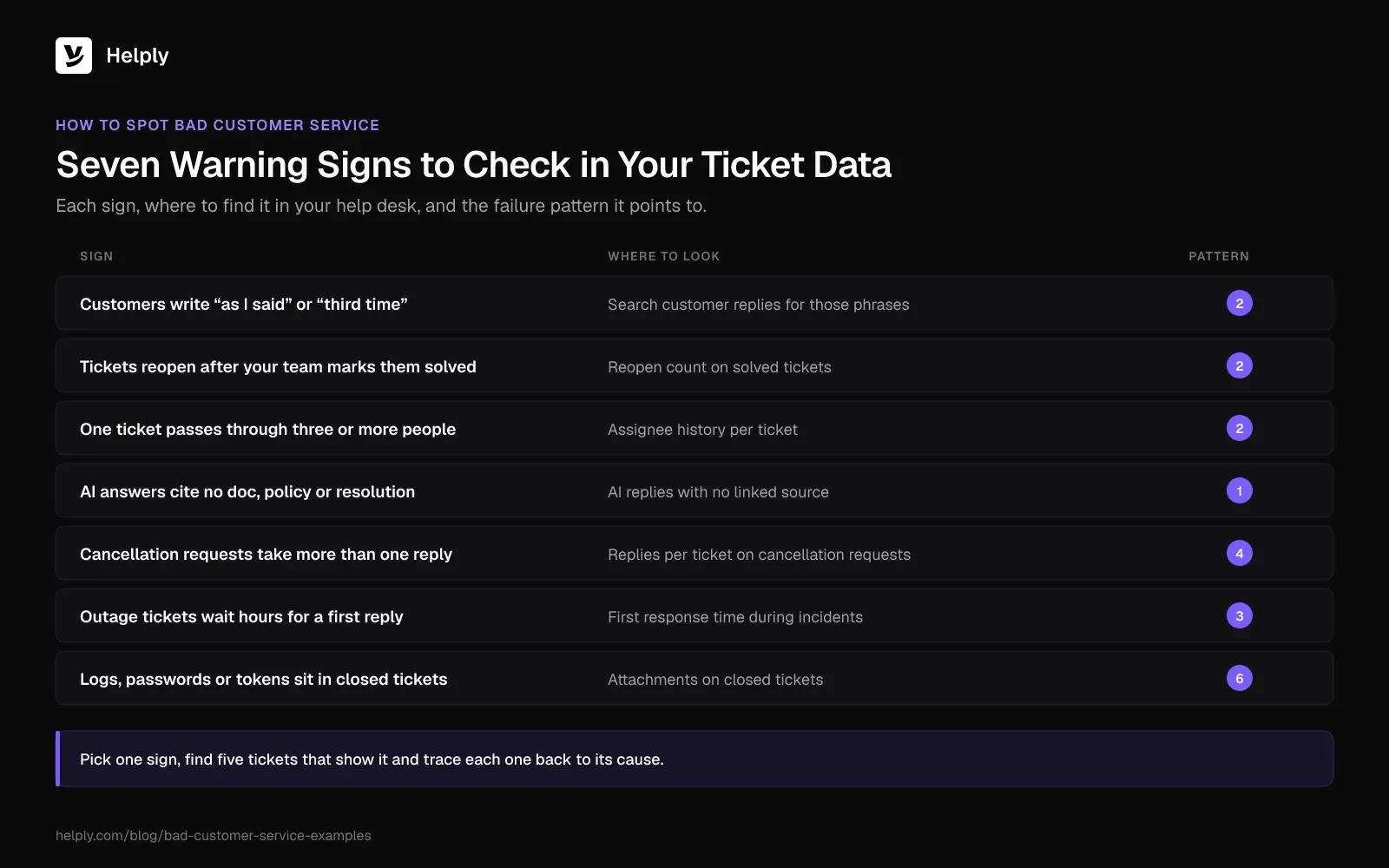
Pick one sign, find five tickets that show it and trace each one back to its cause. Send a CSAT surveyafter each solved conversation to see whether the fix worked.
What to Do After Bad Customer Service
After your team gets it wrong, work through four steps in order:
- Own it. Say what went wrong in one plain sentence, without "unfortunately" or "per our policy."
- Fix the case. Solve the customer's problem first, then talk about compensation.
- Fix the cause. Change the doc, rule, handoff or access setting that let it happen.
- Tell the customer what changed. Cursor's co-founder did this when he said AI email replies now carry a label.
Comcast took the first step. It called the way its representative communicated with Block "unacceptable" and promised him a personal apology.
Keeping Answers Accurate and Handoffs Whole with Helply
Helply lets your team limit what AI agents promise, get handoffs with full context and see customer history beside each thread.
Your "third time" customer got an unchecked AI answer, told the story three times and heard a promise your policy doesn't allow. Your team can set up Helply to guard against each one.
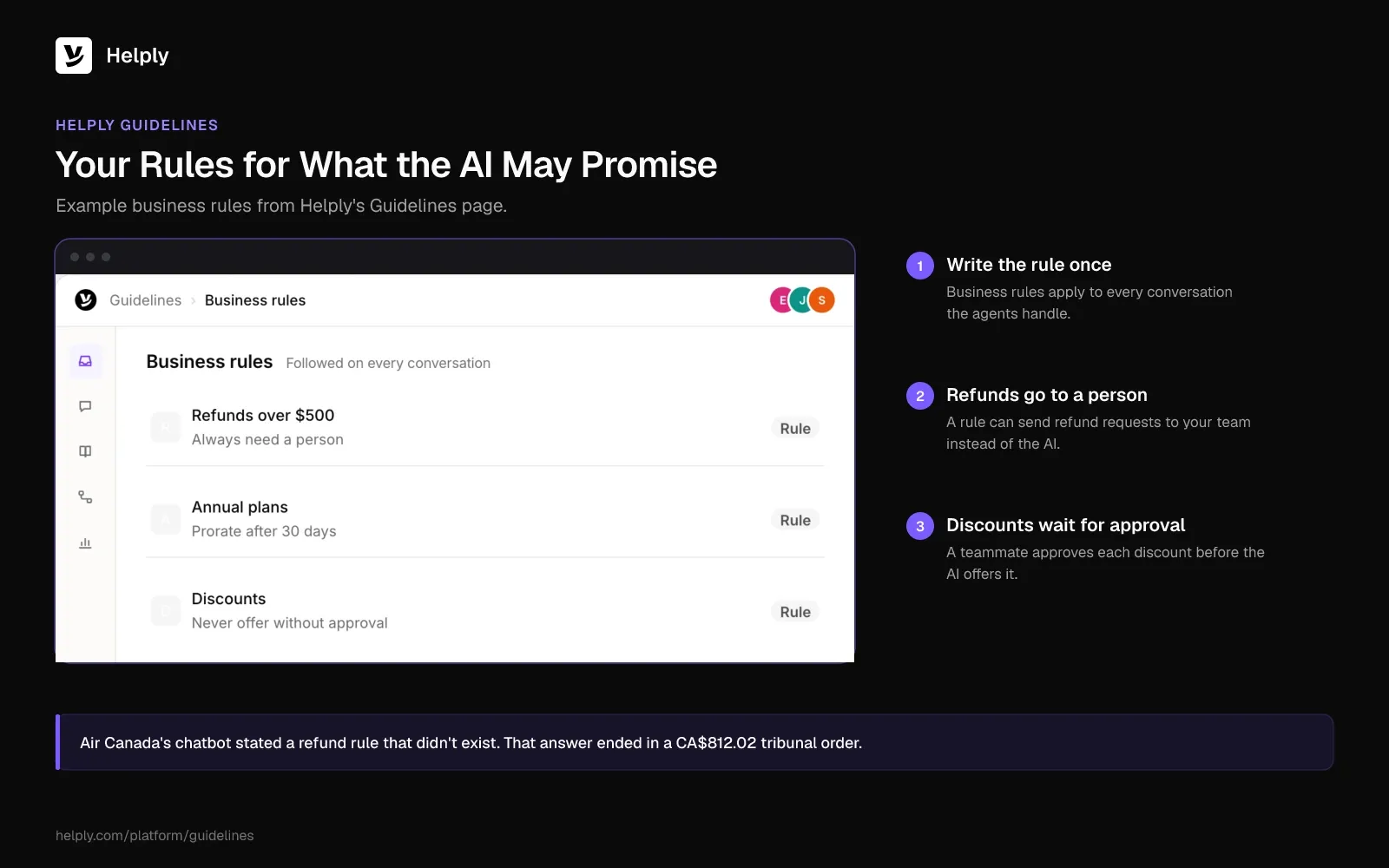
Guidelines set what Helply's agents may handle alone and when a teammate takes over. You can write a Guideline that leaves refunds to a person, so agents hand those requests to your team.
The Support Agent can resolve a conversation end to end. Before it replies, it searches your knowledge base and connected tools and reads the customer's history. If it isn't sure, it hands the thread to a teammate with what it checked and the customer's context attached.
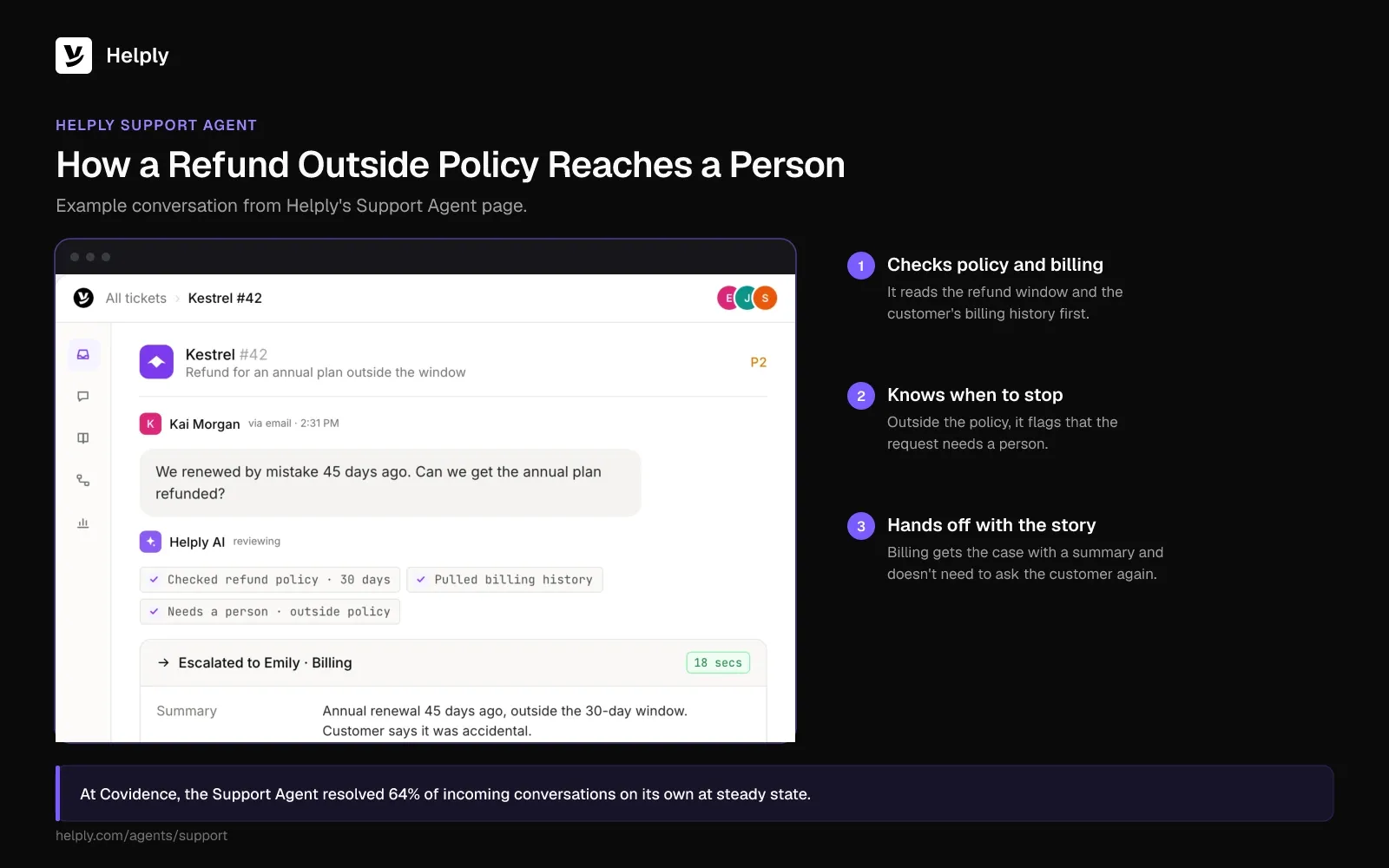
Your team sees each customer's details, past conversations and account information next to the thread. A teammate can take over without asking the customer to explain a third time. The Assist Agent drafts replies in the ticket from the conversation so far, the customer's record and the Guidelines you've set.
Guidelines can also cover cancellations and incident replies. One can tell the agents to make a single retention offer, then pass the cancellation to your team. Another can have them own a company-side cause before they raise the customer's setup.
Escalation rules route an issue to the right person based on the problem, the customer, the account or the urgency. SLAs keep each issue on a clock.
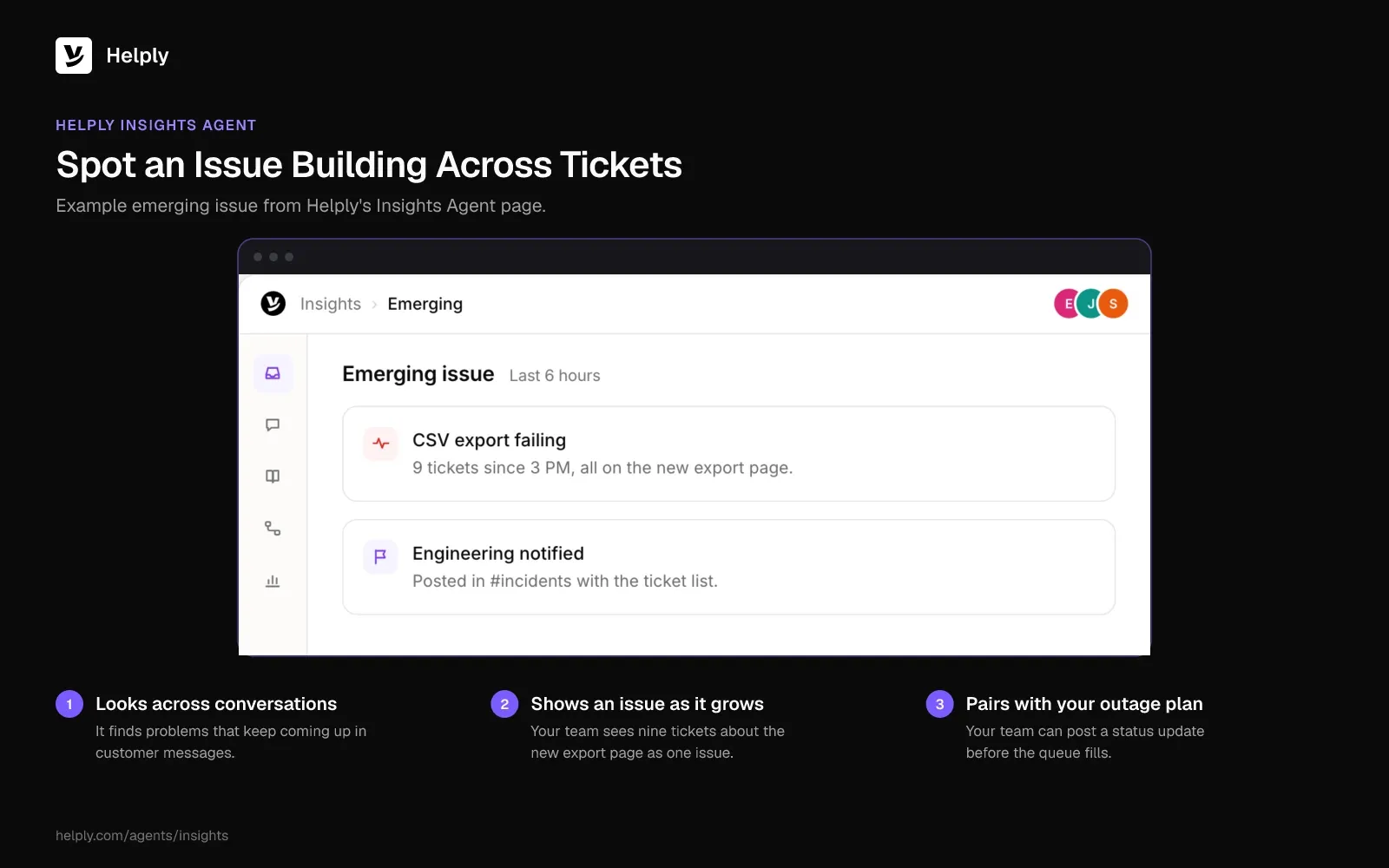
During an outage, the Support Agent can field the same question again and again from the update you add to your knowledge base. The Insights Agent looks across conversations for recurring problems, so your team can see an issue building across tickets.
If a customer stops replying, the Support Agent can send a nudge after a wait your team chooses. It can then close the conversation if the customer stays quiet.
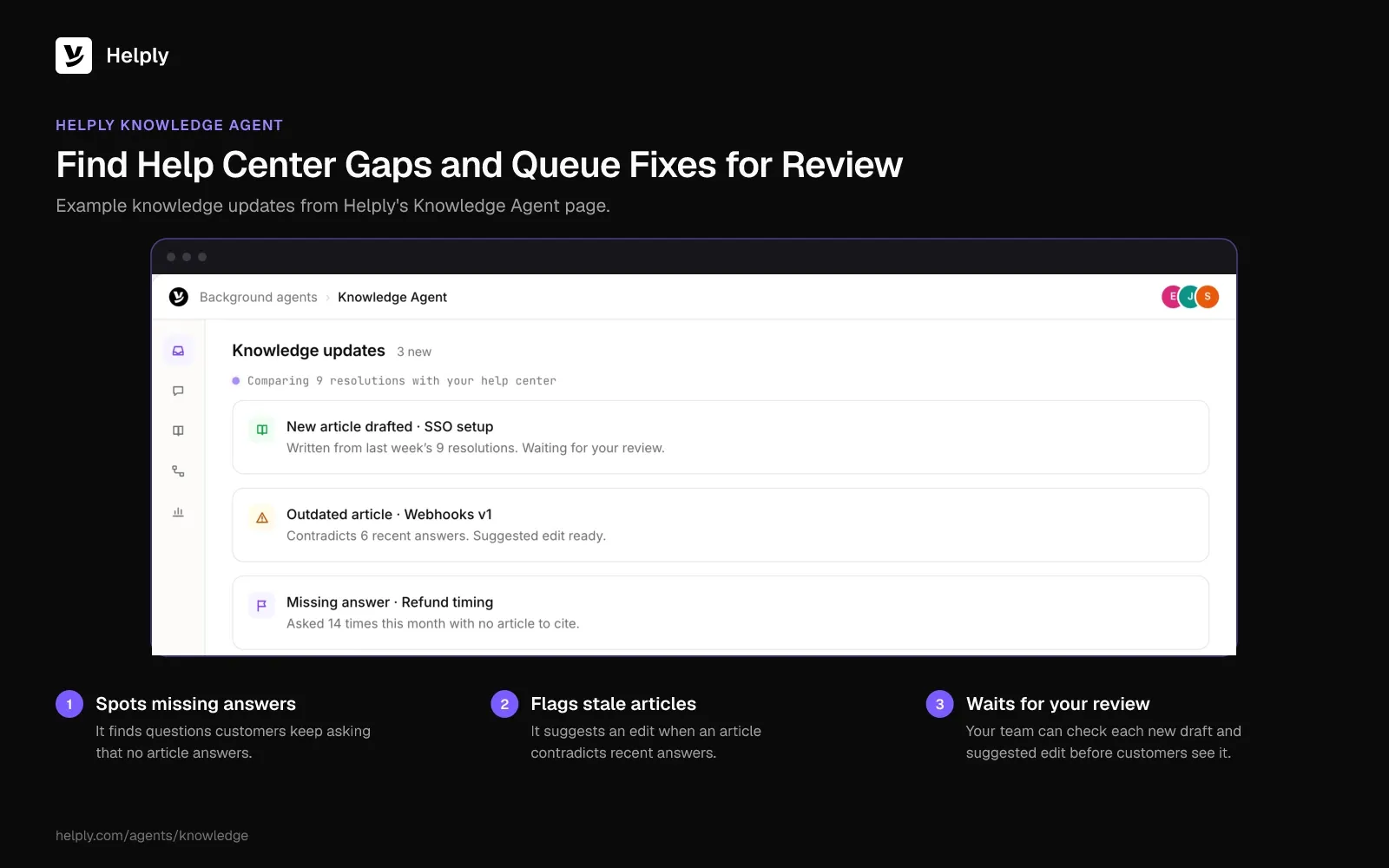
The Knowledge Agent spots questions your help center can't answer and articles that have gone stale. Your team can review each suggested change before customers see it.
Attackers reached Coinbase and Okta customer data through support access. Helply carries a SOC 2 Type II report and doesn't train AI models on customer data. It's built to support GDPR with a DPA on request, and you can read the compliance details on the Trust and Security page.
Fix the Process Yourself or Put AI Agents on the Queue
A small team with low volume may need only the fix lists above. One owner per issue, full handoff notes and a one-channel cancel path cost nothing but discipline. Every Helply plan includes a shared inbox with internal notes and collision detection, so your team can run those habits in one place.
If your queue has repeat questions or overnight waits, or an AI already answers for you, add AI agents with guardrails. Helply fits teams that want AI answers from their docs, customer history and tools, with a person on every case AI can't settle.
Covidence's Support Agent handed off whenever its confidence dropped. In peak review seasons, the agent resolved 72% of inbound conversations without a person, up from 64% at steady state. It passed low-confidence questions to a teammate, and Covidence still saw no measurable rise in wrong answers over its human-only baseline.
The Support Agent and Assist Agent are part of every Helply plan. AI credits sit in one pool for the whole team. A handoff to a teammate after the AI has tried uses none of those credits.
Plans from Team up add escalation rules, SLAs and the Knowledge and Insights Agents. Helply pricing lists what each plan includes.
Start with one inbox. Write Guidelines for what the AI may promise alone, connect your help docs and read every handoff for a week.
Frequently asked questions
Poor customer service traits include confident wrong answers, lost context and no clear owner. Others are silence during problems, hidden exits, blame and careless data handling.
United Airlines, Comcast and Air Canada each faced public fallout over a service failure. United bounced a broken-guitar claim between offices in 2008, and a Comcast agent refused a cancellation on a recorded call in 2014. Air Canada's chatbot invented a refund rule in 2022.
Cursor's AI support agent invented a one-device limit in April 2025, and users posted that they had canceled. BeyondTrust says it chased Okta about a suspected breach from 2 to 19 October 2023. Atlassian couldn't reach many of the 775 customers whose sites a script deleted in 2022.
Five examples of bad customer service are an AI that invents a policy, repeated explanations, outage silence, a blocked cancellation and customer blame. Air Canada, United, Atlassian, Comcast and 23andMe each show one of them.
Own the failure in one plain sentence, fix the customer's problem, then fix the cause. Tell the customer what changed, as Cursor did in April 2025 when it began labeling AI support replies. If you're the customer, ask for one owner, keep ticket numbers and escalate in writing.
Let the customer finish, restate the problem and say what happens next and when. Keep one owner on the issue until it's solved.
In Zendesk's CX Trends 2025 survey, run in mid-2024, 63% of consumers said one bad experience would send them to a competitor. Single incidents can reach nine figures. Southwest's DOT penalty was $140 million, and Coinbase gave a preliminary estimate of $180 million to $400 million.
Not by itself. AI support goes wrong when it answers without limits, as Air Canada's chatbot and Cursor's support bot did. At Covidence, Helply's Support Agent escalated when unsure, with no measurable rise in wrong answers over the human-only baseline.
Good customer service solves the problem with context and one owner. Bad customer service makes the customer repeat themselves, chase updates or argue with policy.
About the author

Bildad Oyugi
Head of Content
Bildad is a digital marketing expert with over 5 years of experience in copywriting, content marketing, and editing. Outside of work, he enjoys videography and spending time with his family.
Keep reading

10 Best Free and Open-Source Ticketing Systems for Small Support Teams
Alex Turnbull · 24 min read
Support Tiers Explained: Tier 0 to Tier 3, Escalation Rules and a Routing Table
Bildad Oyugi · 14 min read