
 Konrad Janczyk ··9 min read

What Does 24/7 Customer Support Mean?
A card fails at 02:14. The customer writes in, gets an auto-reply promising contact "within one business day", and spends the night wondering whether their account still works. A 24/7 setup gets that customer an answer before morning.
24/7 customer support, often called 24/7 customer service, means help 24 hours a day, 7 days a week, weekends and holidays included. Teams use the term for three things: a person answers, someone takes a message, or someone solves the problem.
Customers mean the third. Service leaders told HubSpot for its 2024 State of Service report that 82% of customers want their issues solved immediately.
In that report, more than half of CRM leaders put their customers' expected wait for a fix at three hours or less. An answering service that logs the 02:14 message for a 9am reply misses both marks.
Three Ways to Cover the Night, and What Each One Costs
You can cover nights with one of three models, or a mix. Each buys something different, so compare what each gets done for a single overnight conversation.
A second shift. You hire or rotate people onto nights and weekends, and they can solve anything your day team solves. The cost is a second payroll for every overnight hour, busy or quiet, plus hiring, training and retention.
An outsourced answering service. A call centre or chat service answers on your behalf, follows a script and takes messages. Anything complex goes back to your team in the morning, so the customer often waits for a real answer anyway.
An AI agent. An agent connected to your docs, customer history and tools answers at any hour. It resolves what it has context and confidence for and hands the rest to a person with the investigation done. It needs no overnight rota, and your day team picks up only what it escalates.
Night Coverage Models Compared: Cost Driver, Resolution and Handoff
| Model | What drives the cost | Can it resolve the issue? | What the morning team inherits |
|---|---|---|---|
| Second shift | Salaries for every overnight hour | Yes, anything the day team can | Notes from colleagues |
| Answering service | Contract per call, minute or message | Rarely; it takes messages | A pile of messages to start from scratch |
| AI agent | A software plan, with no overnight payroll | Yes, for issues it has context and permission for | Resolved tickets plus escalations with findings attached |
| Follow-the-sun hubs | Salaries across two or three regional teams | Yes, during each hub's working day | A queue passed between regions at each shift change |
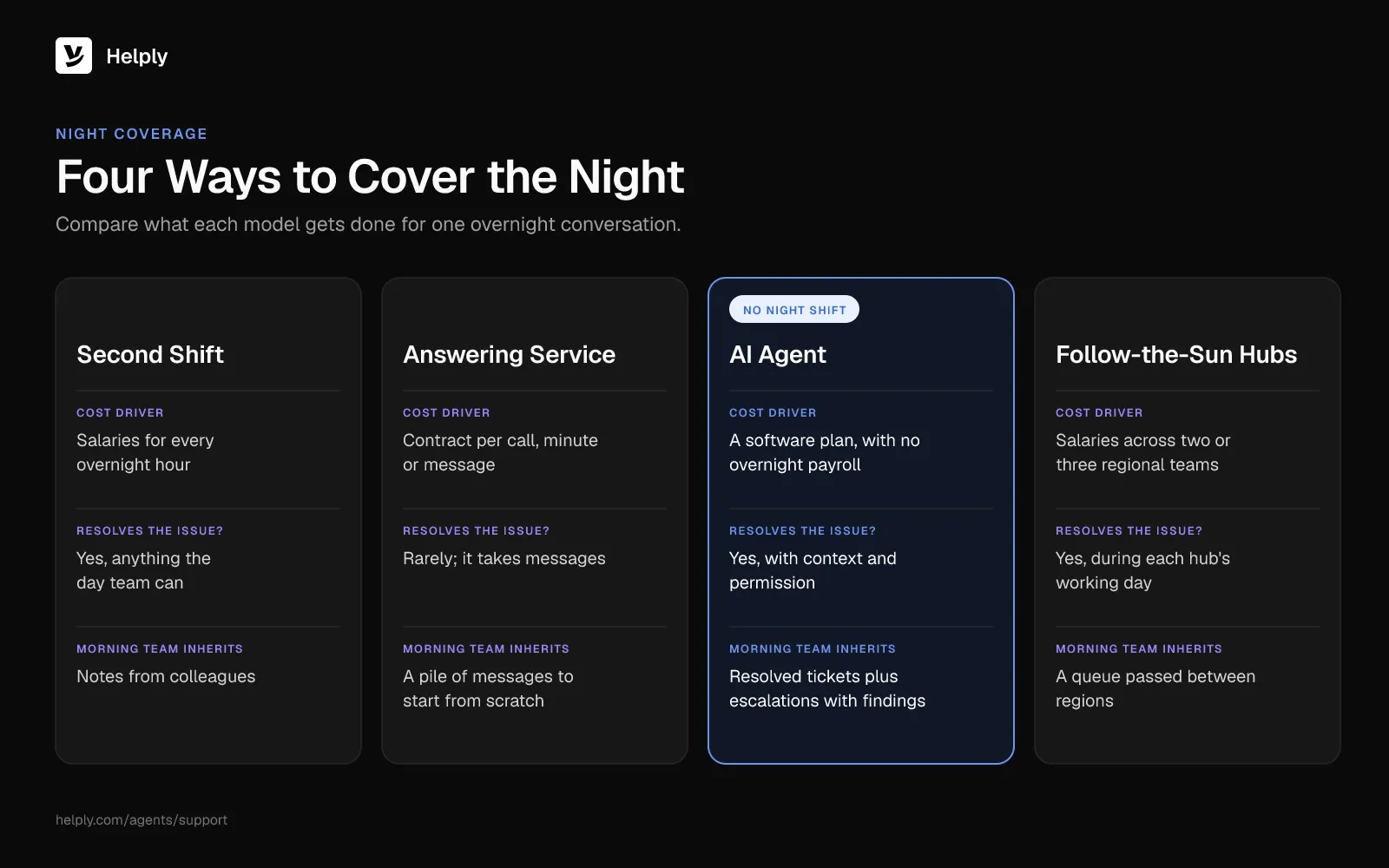
Follow-the-sun suits larger teams with regional hubs, and it adds headcount to cover the clock. For most overnight queues, you get coverage by routing work to an agent and a short escalation list.
The 02:14 Billing Failure: What an Agent Can Finish Before Morning
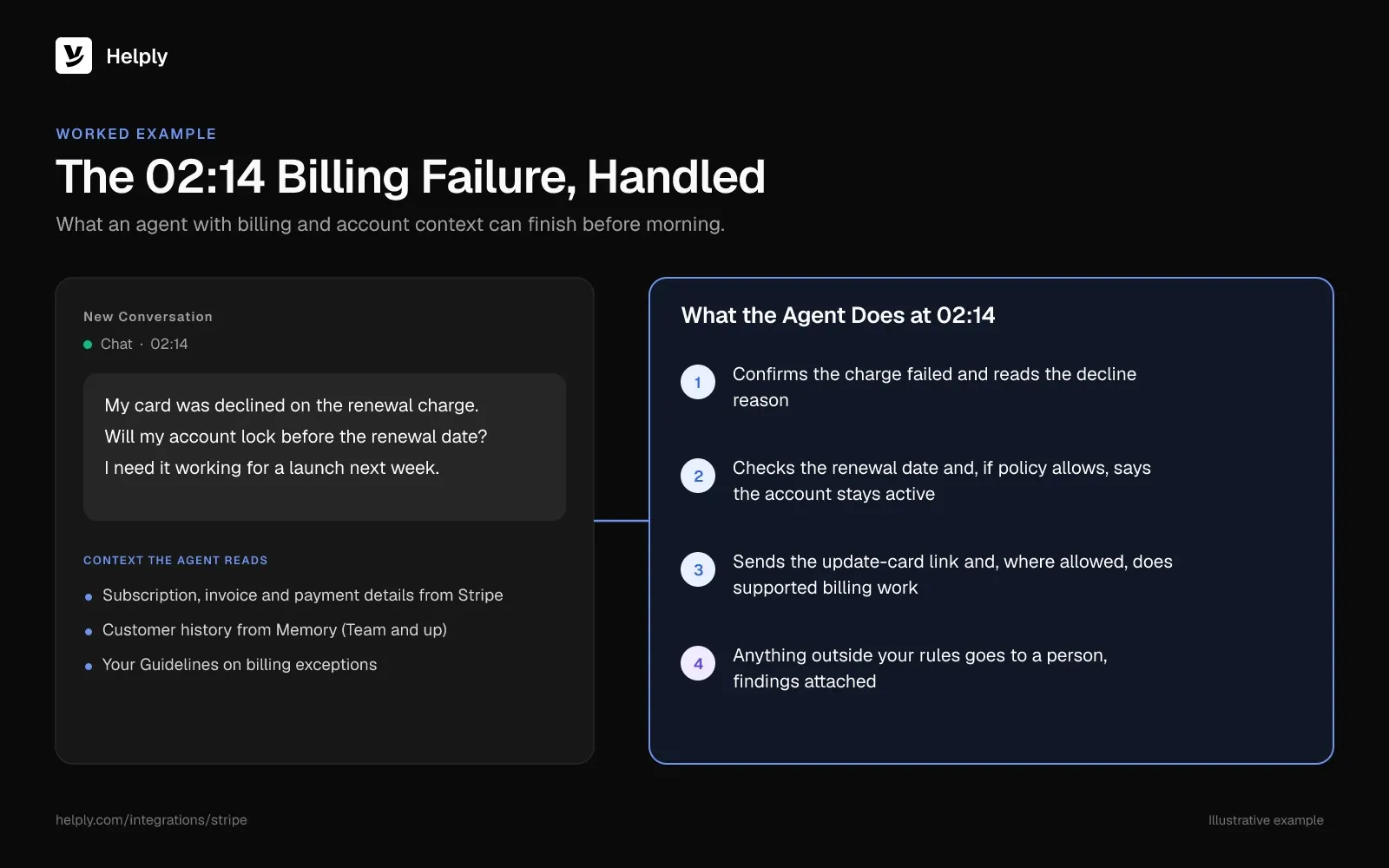
Back to the failed card. The customer's renewal is three weeks out, and they want to know whether the account will lock. A chatbot without account access can only say a person will reply at nine.
An agent with billing and account context can do the job. Helply's Support Agent can "investigate what's happening, use connected Tools, and take Actions."
With Stripe connected, it can see subscription, invoice and payment information beside the conversation.
At 02:14 the agent can:
- confirm the charge failed and read the decline reason;
- check the renewal date and, if your policy keeps the account active, tell the customer so;
- send the update-card link and, where you've allowed it, perform supported billing work;
- pass the case to a person, findings attached, if anything falls outside your rules.
On the Team plan and up, Memory lets agents see "relevant customer history so they can understand what's already happened."
The agent treats a customer who disputed a charge last month differently from one who never has. The agent uses that history to decide whether to answer or hand the case to a person.
The 2am Order Question: Resolve It or Escalate It
A shopper writes at 2am: where is my order, and can I still change the delivery address? This question needs a complete answer or a clean handoff.
If the order hasn't shipped and your rules allow address changes, the agent checks the order, updates the address and confirms it. The customer goes back to sleep with the answer.
If the parcel is already with the carrier, the agent says so and explains the options. It escalates the change request with the order details attached.
A 2am "we've received your request" is a half-answer. It leaves a person to look up the same order at 9am. The customer loses a night, and your team repeats the investigation.
Where to Draw the Resolve-or-Escalate Line
An AI agent should resolve an after-hours ticket alone only when it has the context, the permission and the confidence to act. Anything else goes to a person, paged now or queued for 9am with the investigation attached.
Draw the line before launch, in writing, and review it every week for the first month. An agent should resolve on its own when three things hold:
- It has the context: the docs, the customer's history and the account data the answer depends on.
- It has the permission: your rules allow the action, such as an address change or a refund under a set amount.
- It has the confidence: the question matches cases it has handled before, and no policy exception applies.
An agent should wake a person, or queue for the morning with everything prepared, when any of these appear:
- money outside policy, such as a refund past the window or a discount request;
- a security or access issue, such as a suspected account takeover;
- an outage signal: the same error from several customers in an hour;
- legal, medical or safety topics;
- an angry customer on a high-value account.
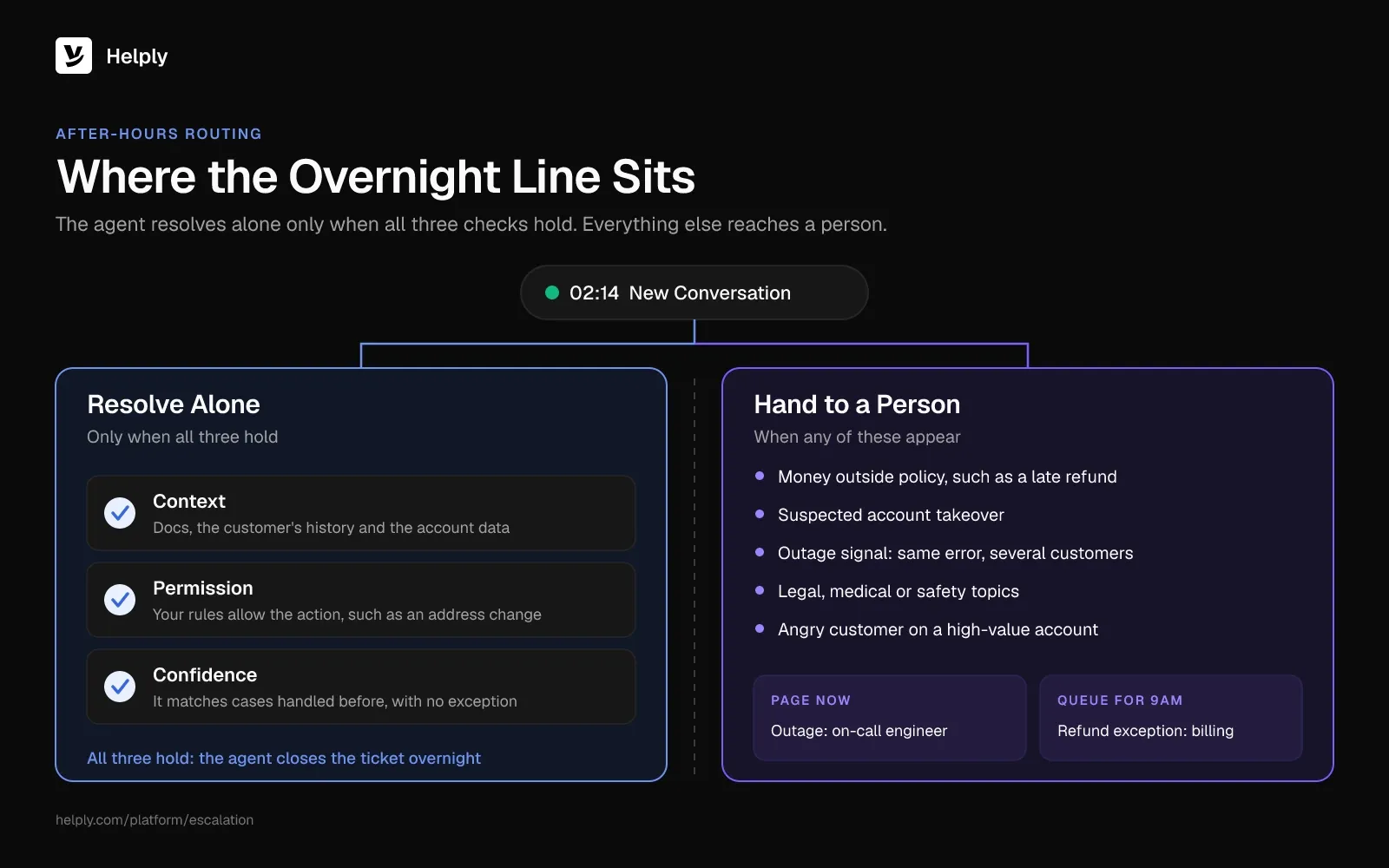
Helply's Support Agent hands over anything it can't resolve with confidence, and attaches what it found plus the customer's context.
On the Team plan and up, Helply's escalation rules let you "define when AI can proceed independently and when human judgment is required."
They route each case by "the issue, customer, account, urgency, or other context." Guidelines come with every plan and set the policy side: refunds, cancellations, account changes and exceptions.
Decide which escalations page someone now and which wait for 9am. An outage pages the on-call engineer. A refund exception waits for billing in the morning, with the case already written up.
The 9am Handoff: What the Team Reads in the Morning
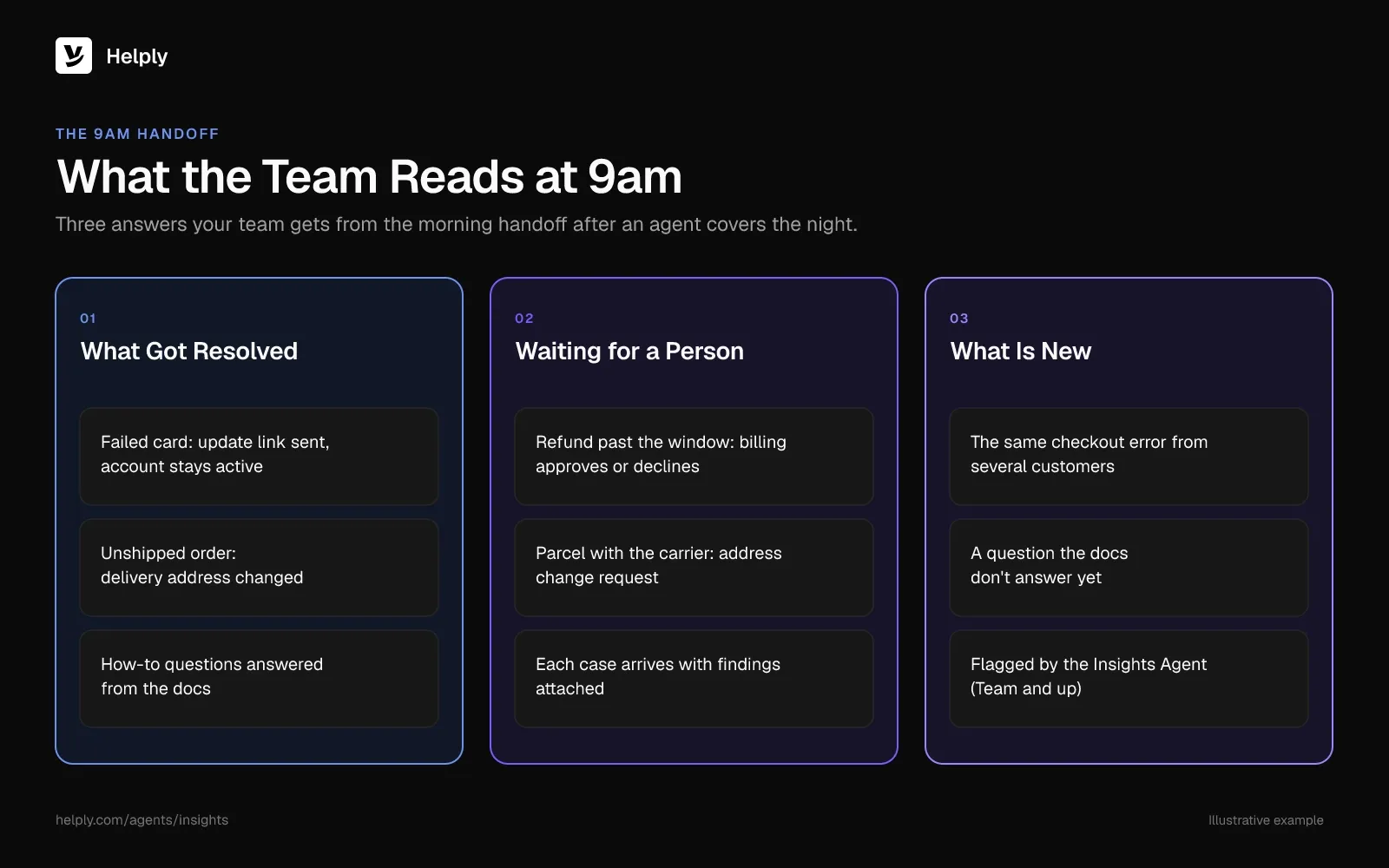
The overnight resolution count matters less than what the team learns from the night. A good morning handoff gives the team three answers fast: what got resolved, what is waiting for a person, and what is new.
The agent should hand over each escalation ready to act on. Helply passes along "the investigation, customer context, and relevant information instead of making the human start over."
The billing specialist reads the case, approves or declines the exception, and moves on.
The third question is the one teams skip. On Team and up, the Insights Agent "continuously analyzes customer conversations" to surface trends, recurring problems and emerging themes.
At StaffTraveler, it sends a daily briefing on what users are asking. Laurens, Co-founder & Head of Support, said: "And a daily briefing on what a million users are asking is something we could never have produced ourselves."
When Follow-the-Sun Support Still Makes Sense
Follow-the-sun support passes the queue between regional teams as each one's workday ends. Two or three hubs cover 24 hours without anyone working nights.
It still wins in a few cases:
- phone-heavy support, where callers expect a live voice;
- complex technical or regulated work that needs a specialist on every ticket;
- enterprise accounts with contracts that promise a named human response.
Follow-the-sun loses context each time one hub passes the queue to the next. An agent closes the repeatable work in every region and leaves each hub a clean queue of what needs a person.
That often means one or two hubs plus an agent, where three hubs ran before. For the staffing side, see how to scale customer support.
What to Measure After Hours
Track the night separately from the day, so daytime volume doesn't mask overnight results. Three metrics tell you whether coverage works:
- Overnight resolution rate. The share of after-hours conversations closed without a person. Pair it with reopen rate to catch false resolutions.
- Escalation rate and reason. The share handed to a person, grouped by cause. A rising "missing context" count points to a gap in your docs.
- Time to human on escalations. The wait between an escalation and a person's reply. Pages should take minutes, and morning-queue items should clear in the first hour.
Add CSAT on overnight conversations as a fourth check, compared against the daytime score. For the agent itself, read KPIs for AI support and what chatbot containment rate leaves out.
Hire a Night Shift or Let an Agent Run 24/7 Support?
Hire people for nights if most after-hours volume needs a person's judgment, or if customers pay for a live voice. Choose an AI agent if most of the night is repeatable work: billing questions, order changes, how-to answers and account lookups.
Helply is an AI-native customer support platform. Software, ecommerce and marketplace teams run it as their help desk, with agents that resolve overnight and an escalation line the team controls.
With billing work allowed, the agent can resolve the 02:14 failure before morning and answer or hand off the 2am order question. Your team starts the day with a short list of cases that need a person.
StaffTraveler's handful of people "could stop being on call around the clock" once the agent took the first line.
The Support Agent, Guidelines and handoffs to your team come with every Helply plan. Escalation rules, Skills, Memory and the Insights Agent come with Team and up; see pricing.
Start with one channel overnight, read the handoffs each morning for two weeks, then widen what the agent may resolve.
Frequently asked questions
24/7 customer support means help at any hour, nights, weekends and holidays included. A second shift or follow-the-sun hubs keep a person online, while an AI agent covers the night without one.
A small team can put an AI agent on the first line and keep people for escalations. StaffTraveler, with 1 to 10 people, covers more than a million users at any hour this way.
It is worth it when your customers write outside your working hours. A chat vendor's August 2025 analysis of more than 25,000 chats across its customers found only 42.5% arrived during 9-to-5 hours.
24/7 support describes the outcome: help at any hour. Follow-the-sun support is one way to get there, by passing the queue between teams in different time zones.
Yes, where the agent has the context, permission and confidence to act. Anything outside policy, security-related or sensitive should escalate to a person with the investigation attached.
Send a person anything outside policy, suspected account takeovers, outage signals, legal, medical or safety topics, and angry customers on high-value accounts. Write these rules down before launch.
Track overnight resolution and reopen rates, escalation rate by reason, time to human, and overnight CSAT. Report them separately from daytime numbers.
About the author

Konrad Janczyk
Staff Software Developer
Keep reading

AI Customer Experience: Where It Helps and Where It Hurts
Alex Turnbull · 9 min read
AI Chatbots for Customer Service: How to Pick One That Resolves Tickets
Bildad Oyugi · 9 min read