
 Bildad Oyugi ·14 min read
Key Takeaways
- Generative AI produces content on request, while agentic AI works toward an outcome with tools and actions inside permissions you set.
- The agentic AI vs. generative AI split comes after the draft: the account lookup, the refund, the record update and the close.
- Generative AI still helps. In a 2025 Quarterly Journal of Economics study of 5,172 human support reps, it lifted issues resolved per hour by 15% on average.
- In March 2025, Gartner forecast that by 2029 agentic AI would resolve 80% of common customer service issues with no person involved. In June 2025, it predicted companies would scrap more than 40% of agentic AI projects before 2028.
- On Helply, a drafted reply uses 2 credits and a full resolution uses 10. One conversation tops out at 15 credits.
One Support Ticket, Handled Two Ways
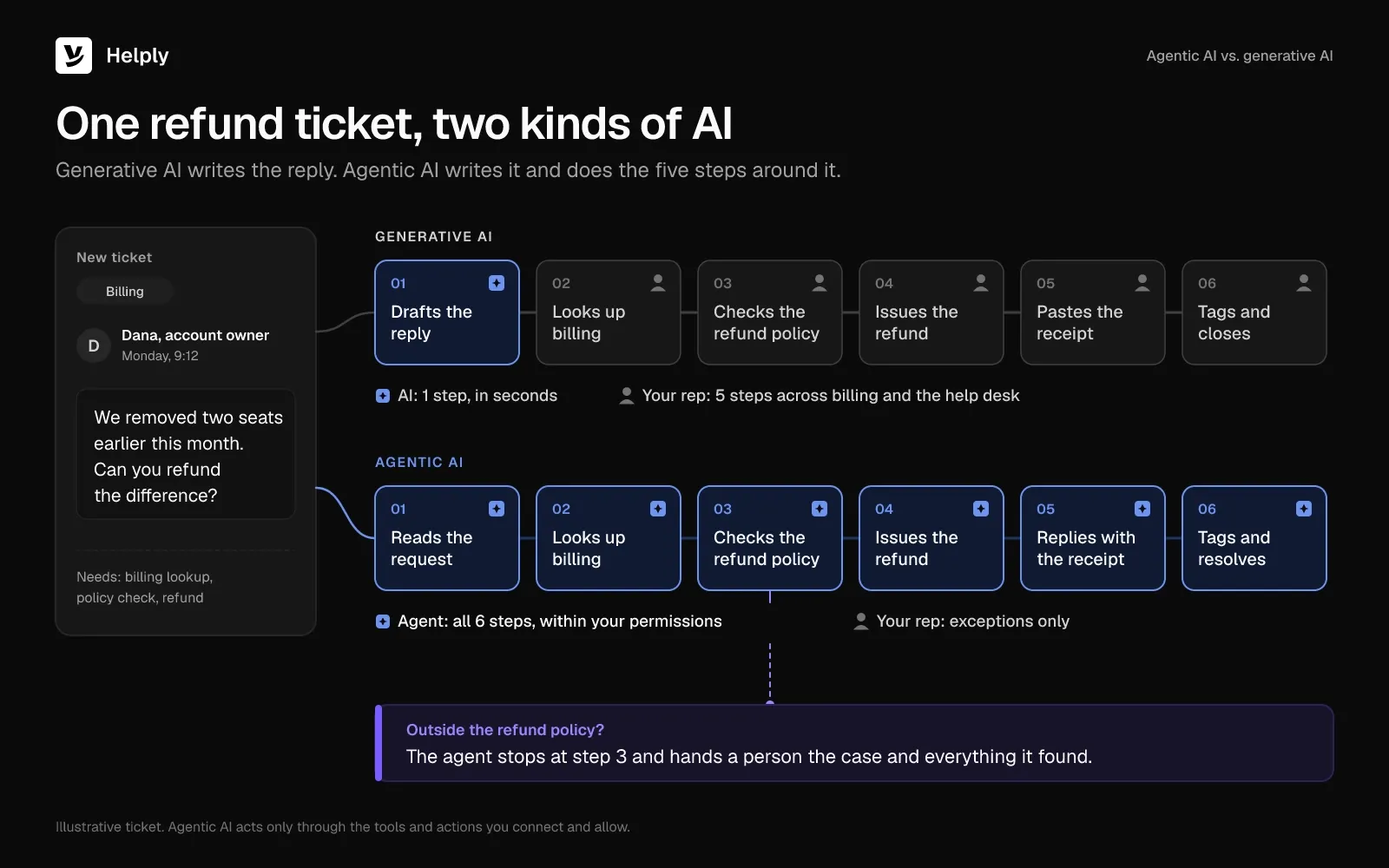
A customer writes in on Monday morning. They removed two seats from their plan earlier in the month and want the difference back. Your help desk AI drafts a polite answer in seconds.
The rest of the job stays manual. A rep opens the billing system, finds the change and checks the refund policy. They issue the refund, paste the receipt into the reply, then tag and close the ticket.
The AI sped up the writing and left every other step to the rep. That gap is the practical difference between agentic AI and generative AI in support. An agentic system would check billing, issue the refund, reply with the receipt and close the ticket on its own.
With Generative AI: A Faster Draft, the Same Manual Steps
Generative AI shortens the writing. A rep clicks a button, gets a reply based on the conversation, edits it and sends it.
A harder ticket means more work up front. Before your rep writes a word, they have to understand the request, find the account and read its history. They search past conversations and the knowledge base, check account and product data, bring in engineering when needed and decide on the fix.
Helply's own support team counted seven steps of investigation before the reply on a complicated ticket. A drafting tool speeds up the eighth.
With Agentic AI: The Agent Does the Steps, People Take the Exceptions
An agentic system reads the same message and starts working. It looks up the customer in billing and confirms when the seats came off. It checks the refund policy, issues the refund and replies with the receipt.
Then it tags the ticket and closes it. If the request falls outside the policy, it stops and hands the case to a person with everything it found.
You see the same split on an ecommerce or marketplace "where's my order?" ticket. Generative AI writes a friendly holding reply. Agentic AI checks the order and carrier records and answers with the real status.
At AirGigs, a bootstrapped music marketplace, Helply's Support Agent did the account, order and payment lookups itself. AirGigs' team no longer hopped between screens to answer "where's my order?"
What Is Generative AI in Customer Support?
Generative AI is software that produces new text, images or code from a prompt. Large language models are the familiar kind: they predict a likely response to whatever you give them. On its own, generative AI stops at the words and can't open the billing system or issue the refund.
In a support queue, generative AI handles the writing jobs:
- Drafting a reply for a rep to review and send.
- Summarizing a long thread before a handoff.
- Translating a message in either direction.
- Writing a help article from a resolved ticket.
- Scoring a conversation against your guidelines.
Brynjolfsson, Li and Raymond studied 5,172 support agents at a Fortune 500 software company (The Quarterly Journal of Economics, 2025). A generative AI assistant lifted the number of issues those reps resolved per hour by 15% on average. Less skilled and less experienced reps gained 30%.
In the same study, the most experienced reps gained a little speed and lost a little quality. The tool offered real-time suggestions that reps could use, edit or ignore.
What Is Agentic AI?
Agentic AI is AI that can pursue a goal on its own, within limits a person sets. It decides the steps, uses tools to carry them out, checks the result and adjusts. The word comes from agency, the capacity to act.
An agentic support system needs six parts:
- A goal. The agent works toward a resolved ticket that stays inside your policy.
- Context. It reads the customer's account, history and past conversations.
- Tools. It has access to billing, orders, product data and your help desk.
- Actions. It can take specific steps, such as a refund, an order change or a bug report.
- Memory. It carries what happened on earlier tickets into the next one.
- Rules for when to stop. It knows which cases belong to a person.
Gartner draws a similar line: generative AI tools assist people with information, while agentic AI will resolve requests on the customer's behalf. In March 2025, it predicted that by 2029 agentic AI would close 80% of common customer service issues without a person. Gartner expects that shift to cut operational costs by 30%.
Agentic AI vs. Generative AI: Key Differences
The main difference between agentic AI and generative AI is who finishes the job. Generative AI finishes the writing, and a person finishes everything else. Agentic AI finishes the ticket, or hands it over with its findings.
Generative AI vs. Agentic AI in Support: Output, Systems and Oversight
| Criterion | Generative AI | Agentic AI |
|---|---|---|
| Starts when | A person prompts it or clicks a button | A ticket arrives, or a rule or event triggers it |
| Produces | A draft, summary, translation or article | A resolved ticket, or a handoff with findings |
| Reads | The text in the prompt or thread | Account, billing, order and product records |
| Changes in other systems | Nothing | Refunds, order updates and bug reports, within the permissions you set |
| Who finishes the job | A person | The agent, or a person when the case falls outside its rules |
| Who finishes the job | The current conversation | Past conversations and account history |
| When it can't finish | Leaves the gap for a person to spot | Stops and hands off with what it found |
| What to measure | Time saved per reply, edit rate | Resolution rate, action accuracy, handoff quality |
| Seat refund example | Drafts the reply, then a rep checks billing, refunds and closes | Checks billing and policy, refunds, replies with the receipt and closes |
| Best for | Tickets where wording matters and the facts sit in the thread | Repeatable tickets that need lookups and changes in other systems |
Inside an agent, a generative model reads the customer's message and writes the reply, and tools handle the rest.
A support team can run both: agents on the repeatable tickets and generative drafts on the tickets a person should answer.
Why an Agentic Resolution Costs More Than a Draft
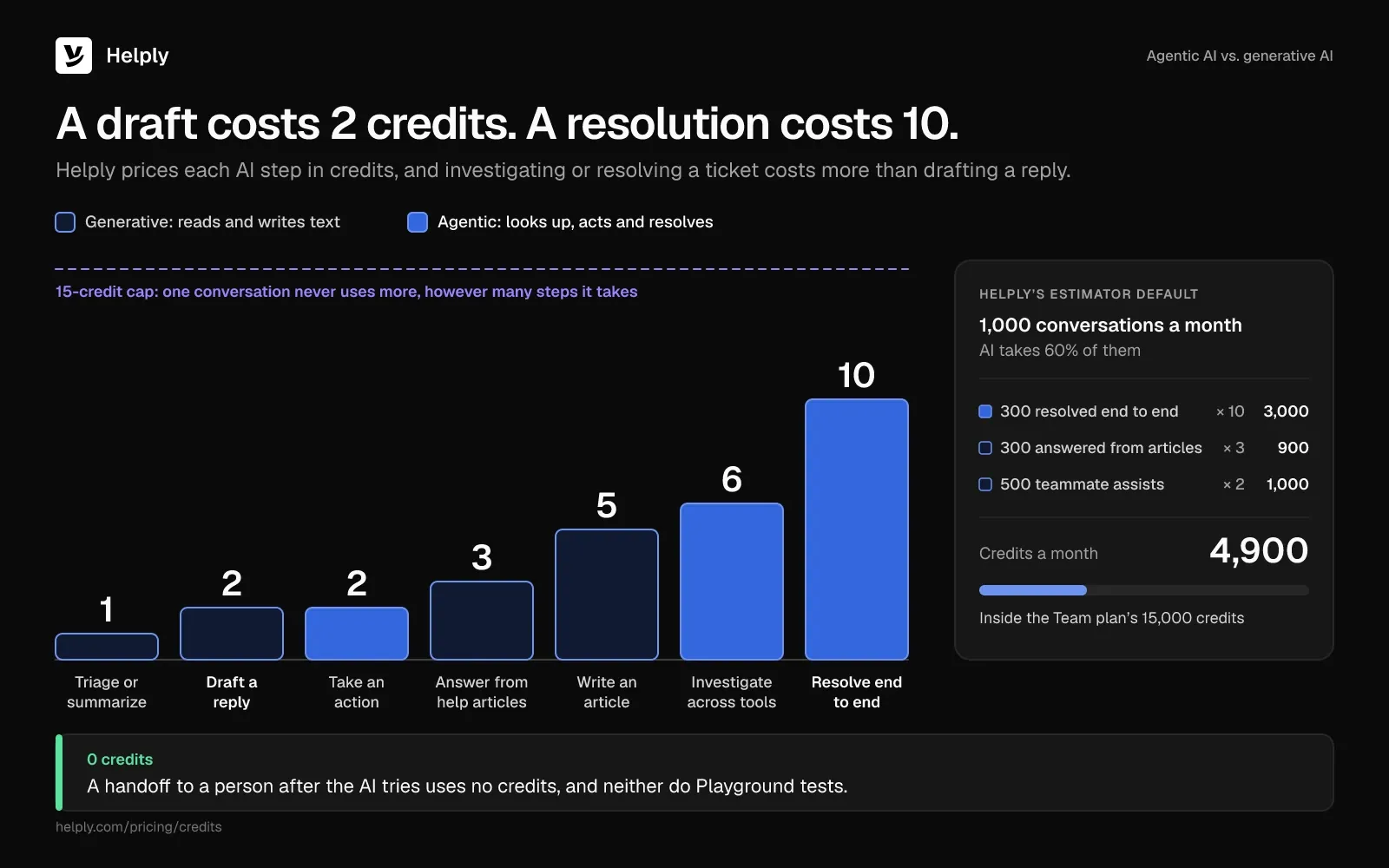
An agentic resolution runs more steps than a draft, so it costs more per conversation. On Helply, each step has its own credit cost:
- Triage, summarize, translate or score a conversation: 1 credit.
- Draft a reply that a teammate reviews and sends: 2 credits.
- Take an action, such as a refund or an order update: 2 credits.
- Reply to a customer from your help articles: 3 credits.
- Write a knowledge base article: 5 credits.
- Investigate in Stripe, HubSpot, logs or other tools: 6 credits.
- Resolve a conversation end to end: 10 credits.
The total for one conversation stops at 15 credits. If the AI tries and then passes the ticket to a person, the handoff itself uses no credits. Usage alerts warn the team before credits run low.
At the limit, the AI on Starter and Team pauses until you add credits in the app or move to a larger plan. Pro and Growth let you choose a hard cap or keep going at an overage rate you agree on at signup.
Helply's estimator starts with 1,000 conversations a month, and AI takes 60% of them. It resolves 300 end to end at 10 credits each and answers the other 300 at 3. Add 500 teammate assists at 2 credits, and you need 4,900 credits a month, inside the Team plan's 15,000.
Which Is Better for Customer Support, Generative or Agentic AI?
Neither generative nor agentic AI wins on every ticket. Match the AI to what each ticket needs: careful words, actions in other systems or a judgment call.
Generative drafting fits tickets where wording matters most and the facts already sit in the thread. A complaint that needs a careful apology belongs here, and so does a tricky sales question. A person checks the draft, fixes the tone and sends it.
Agentic AI fits repeatable tickets that need lookups and changes: refunds inside policy, order status, password resets, plan changes, invoice copies. Each one follows the same steps, and an agent can take those steps in billing, order and account systems.
Three Routes a Ticket Can Take
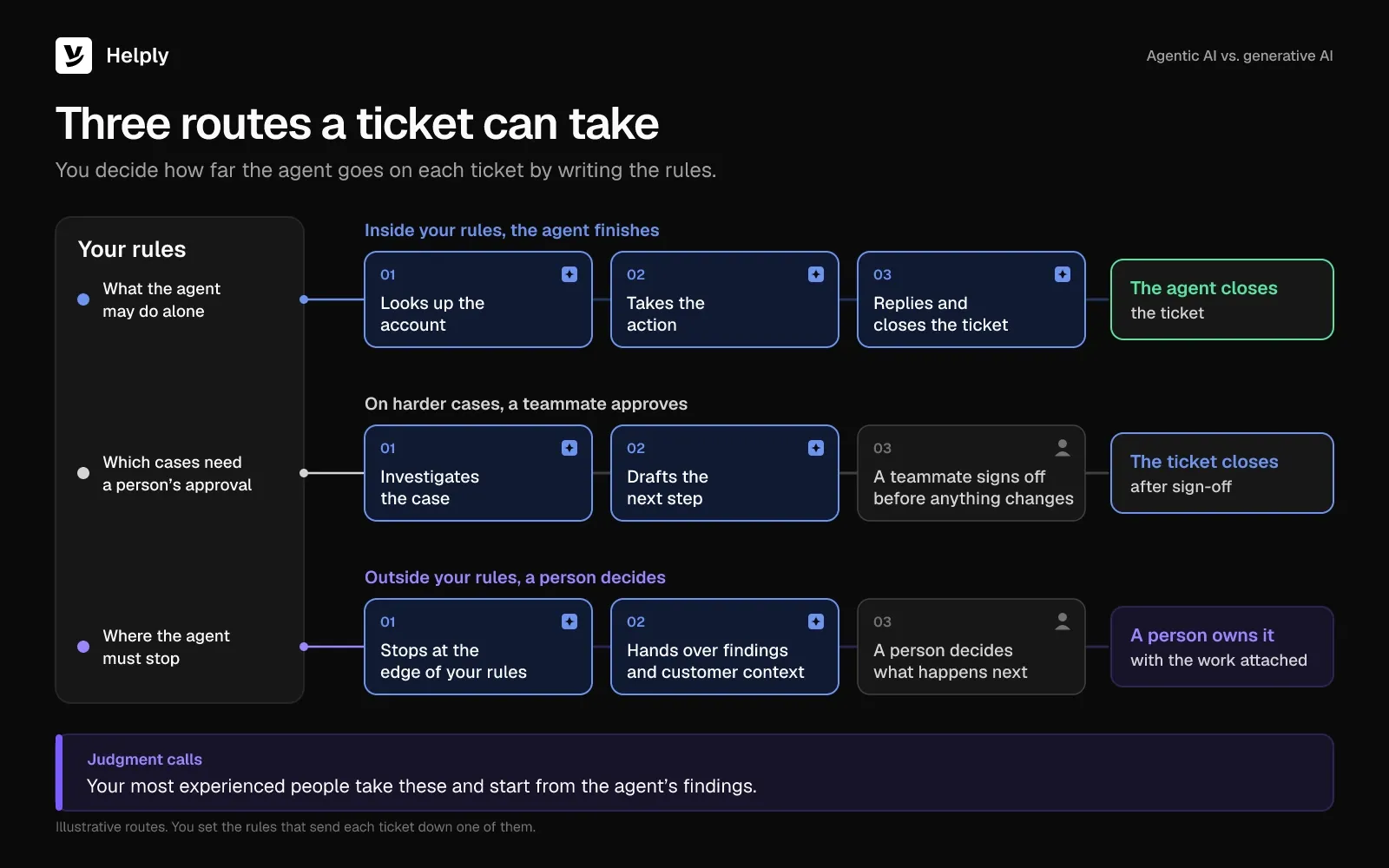
Between those sit the tickets that need both. In a team that runs agents, the rules you write send a ticket down one of three routes:
- Inside your rules, the agent finishes. It looks up the account, takes the action, replies and closes the ticket.
- On harder cases, a teammate approves. The agent investigates and drafts the next step, and a person signs off before anything changes.
- Outside your rules, a person decides. The agent stops and hands over its findings and the customer context.
In the 2025 study, AI suggestions helped the most experienced reps least, with small speed gains and small quality declines. Put your own most experienced people on the judgment calls, with the agent's findings in hand.
Is Agentic AI the Same as AI Agents?
Agentic AI and AI agents overlap. An AI agent is the software, and agentic describes how much of the work it can plan and carry out by itself. Some agents only answer questions, while others look up records, take actions and close tickets.
Some vendors call a help-center chatbot an agent, though it can't check an order or issue a refund. Gartner calls this agent washing: rebranding chatbots, AI assistants and robotic process automation (RPA) tools as agents without real agentic capability. By its estimate, about 130 vendors are real out of the thousands selling agentic AI (Gartner, June 2025).
Judge an agent by the actions it can take on your tickets.
How to Tell If a Support Tool Is Agentic
A support tool is agentic when it reads live records, takes actions in other systems and hands off cases outside your rules. Ask the vendor to work tickets from your own queue, then score the tool on these seven checks:
- It reads live data. It pulls the customer's plan, billing and order records during the conversation.
- It takes actions in other systems. It can issue a refund, update an order or file a bug, and you choose which.
- It follows your policies. It decides the next step from rules you wrote, such as a refund window.
- It checks its own result. It confirms the refund went through before it tells the customer.
- It writes back. It logs what it did on the ticket and in the customer's account.
- It knows when to stop. It hands off with the investigation attached when a case falls outside its rules.
- It shows its work. You can see each step it took, what it looked at and why.
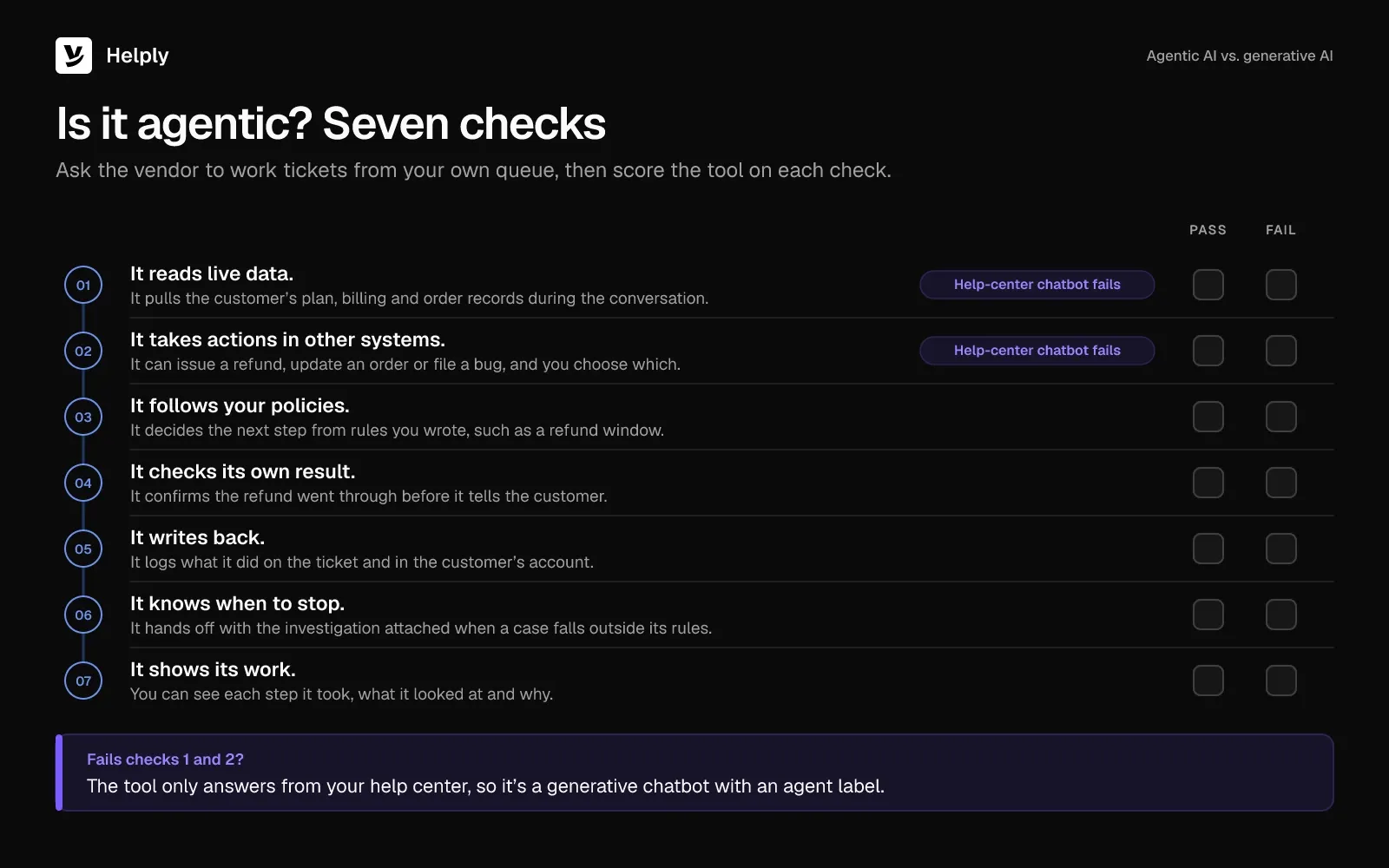
A tool that only answers from your help center fails the first two checks. That makes it a generative chatbot with an agent label.
In June 2025, Gartner said companies would cancel over 40% of agentic AI projects before 2028. It pointed to rising costs, unclear business value or weak risk controls. Run the seven checks on your own tickets to see whether the agent can do the work inside your controls before you sign.
How to Keep Agentic AI Under Your Control
A wrong refund costs money and a customer's trust, so set the limits before the agent acts. Use five controls to decide how far it can go:
- It stops where you say. Write down what the agent may handle alone and where it must stop and bring in a person. Helply calls these rules Guidelines.
- It touches only the systems you choose. Decide which systems the agent can read and which actions it can take. On Helply, you connect those systems through Tools.
- Hard cases reach a person with the work done. Set the cases that go to a person, and make the agent pass along what it found. With Helply's escalation rules, included from the Team plan up, the agent hands over the investigation and customer context so nobody starts over.
- You test it before customers see it. Run test conversations in Helply's Playground first. Playground tests use no credits.
- You widen its scope on evidence. Read the agent's steps on a sample of tickets each week, and add ticket types only where it gets them right.
In a product demo of Helply's Support Agent, a customer asks to refund an annual plan 45 days after renewal. The agent checks the 30-day refund window, pulls the billing history and hands the case to billing in 18 seconds. It suggests a prorated credit or an exception, and a person on the billing team makes the call.
Every Helply plan comes with SOC 2 Type II and GDPR, and you can request a DPA. The audited SOC 2 report covers Helply's security and operational controls. AI providers that receive customer data from Helply do not use it to train their models.
How Helply's Support Team Moved From Drafts to Agents
Helply's support team first added AI drafting and summaries to the help desk it already had. The tools helped, but a person still orchestrated the work on each ticket.
As the Model Context Protocol (MCP) became more useful, the team connected Claude to the systems its people searched by hand. Helply estimated these Claude workflows lifted each support person's efficiency by about 22%. That came to about eight hours per person each week.
The team was on pace to spend about $48,000 a year on Claude. A complex investigation could run as long as 25 minutes and cost up to $8.
Then the team put Helply to work on its own queue. Helply's account of the move reports substantive AI-agent work in 64% of conversations and 40% fewer escalations to Product & Engineering.
Support, Assist and Background Agents
On every Helply plan, you get the Support Agent, the Assist Agent and a shared pool of AI credits. The Support Agent works with customers on email, chat and the other channels you connect, and can do the steps after the draft.
Through connected tools, the agent can investigate, act and resolve requests end to end, or hand a person its findings.
The Assist Agent works beside your reps on the tickets they answer. It investigates and drafts replies grounded in the thread, the account and your Guidelines. It takes supported Actions in connected tools when your team asks.
Background Agents monitor conversations, customers and support signals, then act on what they find with no one asking. Team comes with 2, and Pro and up include the full set.
Skills show an agent how to work one kind of customer request. Memory gives each agent the customer's history, so no conversation starts from zero. Skills, Memory, SLAs and escalations come with the Team plan and up.
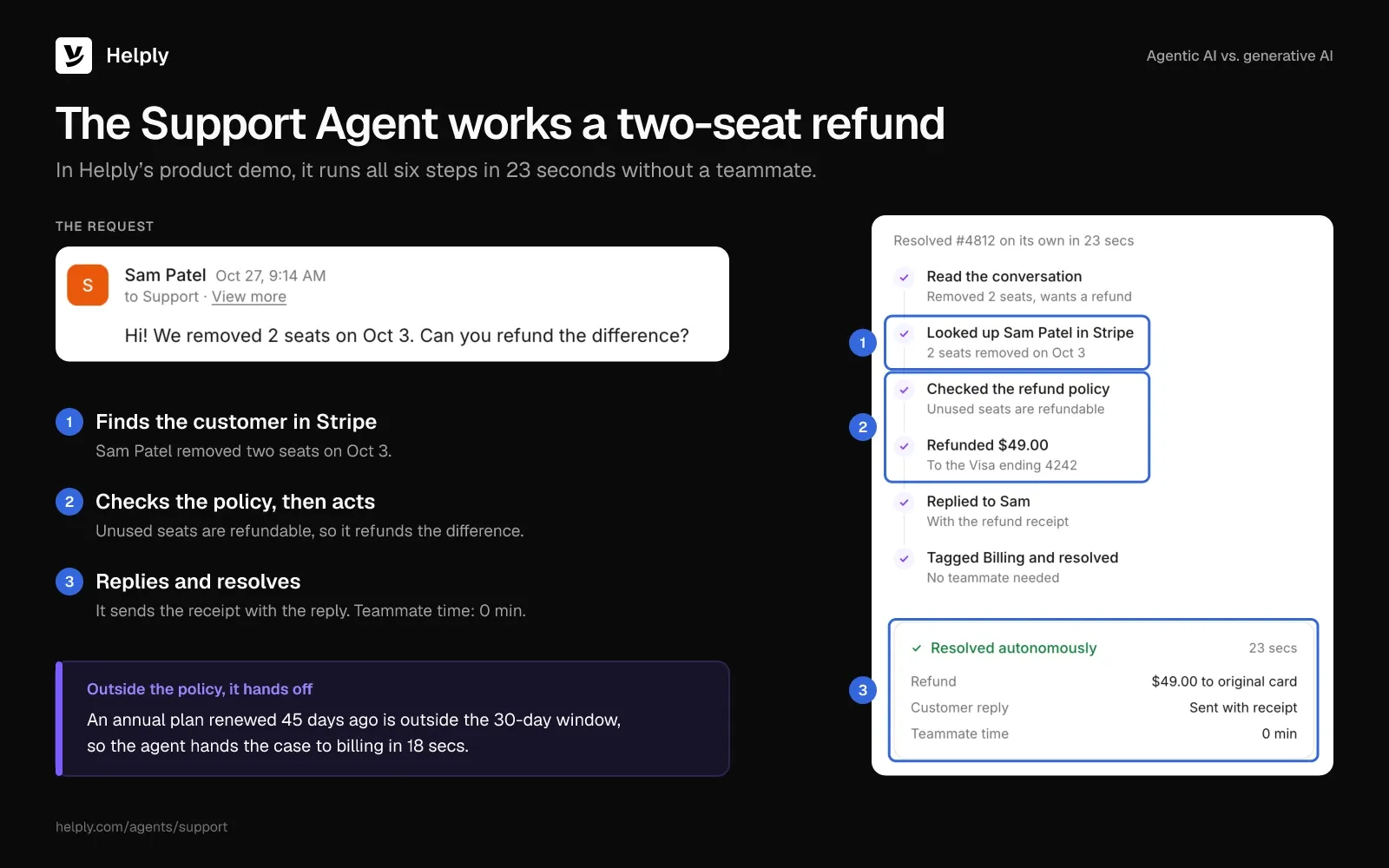
In another product demo, the Support Agent resolves the same kind of two-seat refund in 23 seconds. It finds the customer in Stripe, checks the refund policy and refunds the difference. Then it replies with the receipt and closes the ticket, with no teammate involved.
Keep AI Drafting, or Let AI Close Tickets?
To weigh agentic AI vs. generative AI for your queue, sort a sample of last month's tickets by what each needed. If most needed careful wording and little lookup, the drafting AI in your current help desk may be enough. If most needed lookups and account changes, agentic AI on one queue is the better fit.
Helply is a complete help desk with both kinds of AI built in. The Assist Agent drafts and investigates beside your reps, and the Support Agent can close the repeatable tickets on its own. At AirGigs, the Support Agent closed 68% of conversations from first message to resolution, lookups included.
Put an agent on repeatable tickets, and it takes the billing lookup, the refund and the close off your rep's desk. You decide which cases it may touch through the limits you write and the handoffs you set. Before you trust a vendor's agent label, have the tool work your own tickets and score it on the seven checks.
Starter costs $79 a seat a month, holds up to 3 seats and gives each seat 500 AI credits. Team is $499 a month for 5 seats and a pool of 15,000 credits, with extra seats at $99 a month each. It adds SLAs and escalations, and its pool covers the 4,900-credit estimator example about three times over.
Start with one ticket type, such as refunds or order status. Write its limits and the cases that go to a person. Then read the agent's steps for a week before you widen its scope.
Frequently asked questions
Agentic describes AI that can act toward a goal by itself, within limits you set. The term comes from agency, the ability to act. An agentic system plans steps, uses tools and takes actions, while generative AI produces content on request.
Generative AI is better for writing tasks, and agentic AI is better for tasks that need actions in other systems. A support team can use both, and most AI agents run on a generative model.
ChatGPT is generative AI that runs on large language models and writes responses to prompts. It acts as an agent when it has tools, a goal and permission to take steps. Without tools, it can draft a refund reply, but it can't issue the refund.
Most agentic systems do. A generative model reads the request, works out the steps and writes the reply. The agent layer adds tools, actions, memory and stop rules.
An agent can refund unused seats after a billing and policy check, or answer "where's my order?" from live order data. It can also file a bug report with the logs attached. At AirGigs, Helply's Support Agent handled the account, order and payment lookups and resolved 68% of conversations end to end.
Not on current evidence. Gartner surveyed 321 customer service leaders in October 2025 and found only 20% had cut agent staffing because of AI. Another 55% held staffing steady while handling more volume (published December 2025).
Yes, when the agent acts only inside limits you write and hands everything else to a person. Set the refund rules, choose which actions it may take and read its steps on a sample of tickets each week.
"AI agent" names the software, and "agentic" describes how far it can plan and act without a person. A help-center chatbot can carry the agent label and still lack the access to refund a charge.
A chatbot answers questions and robotic process automation (RPA) repeats a fixed script, while agentic AI picks the next step from context. Gartner calls it agent washing when vendors rebrand chatbots and RPA as agents.
On Helply, a full resolution costs 10 credits and a drafted reply costs 2, with a cap of 15 per conversation. The Team plan, at $499 a month, includes 5 seats and 15,000 credits. In Helply's estimator, AI resolves 300 of 1,000 monthly conversations and answers 300 more, and 500 teammate assists make it 4,900 credits.
About the author

Bildad Oyugi
Head of Content
Bildad is a digital marketing expert with over 5 years of experience in copywriting, content marketing, and editing. Outside of work, he enjoys videography and spending time with his family.