
 Jared Scheel ··9 min read

What Is an AI Agent?
An AI agent is a program that works toward a goal with some independence. You tell it the outcome you want. It chooses the steps, calls the tools it needs and decides when the job is done.
The big cloud vendors use close variations of that idea:
- IBM: "a system that autonomously performs tasks by designing workflows with available tools." (IBM)
- AWS: a program that can "interact with its environment, collect data," and use it for "self-directed tasks that meet predetermined goals." (AWS)
- Google Cloud: agents "show reasoning, planning, and memory and have a level of autonomy to make decisions, learn, and adapt." (Google Cloud)
Four traits recur across these definitions:
- A goal. The agent works toward an outcome, such as "refund this order," and stops when it gets there.
- Tools. It can look up records and change data in other systems, such as billing or orders.
- Memory. It keeps track of what it has tried and what it learned along the way.
- Judgment within limits. It picks its own next step, inside rules a person set.
Back in the queue, the customer writes, "I was charged twice, can you fix it?" A chatbot replies with a link to the refund policy. An AI agent opens the billing record, finds the duplicate charge, issues the refund and confirms it in the same thread.
How Do AI Agents Work?
An AI agent works in a loop. A large language model does the reasoning, and tools let it act on the world outside the chat window.
OpenAI's practical guide to building agents splits an agent into three core components:
- Model: the language model that reasons and decides.
- Tools: the functions and APIs the agent calls to read data or take action.
- Instructions: the guidelines and guardrails that shape its behavior.
Each turn of the loop follows the same four steps:
- Understand. The agent reads the request plus the context it can reach: account data, past conversations, help articles.
- Plan. It decides what it needs to know and which tool gets it there.
- Act. It calls the tool, such as a billing lookup, an order status check or a draft reply.
- Observe. It reads the result and decides whether to keep going, finish or pass the case to a person.
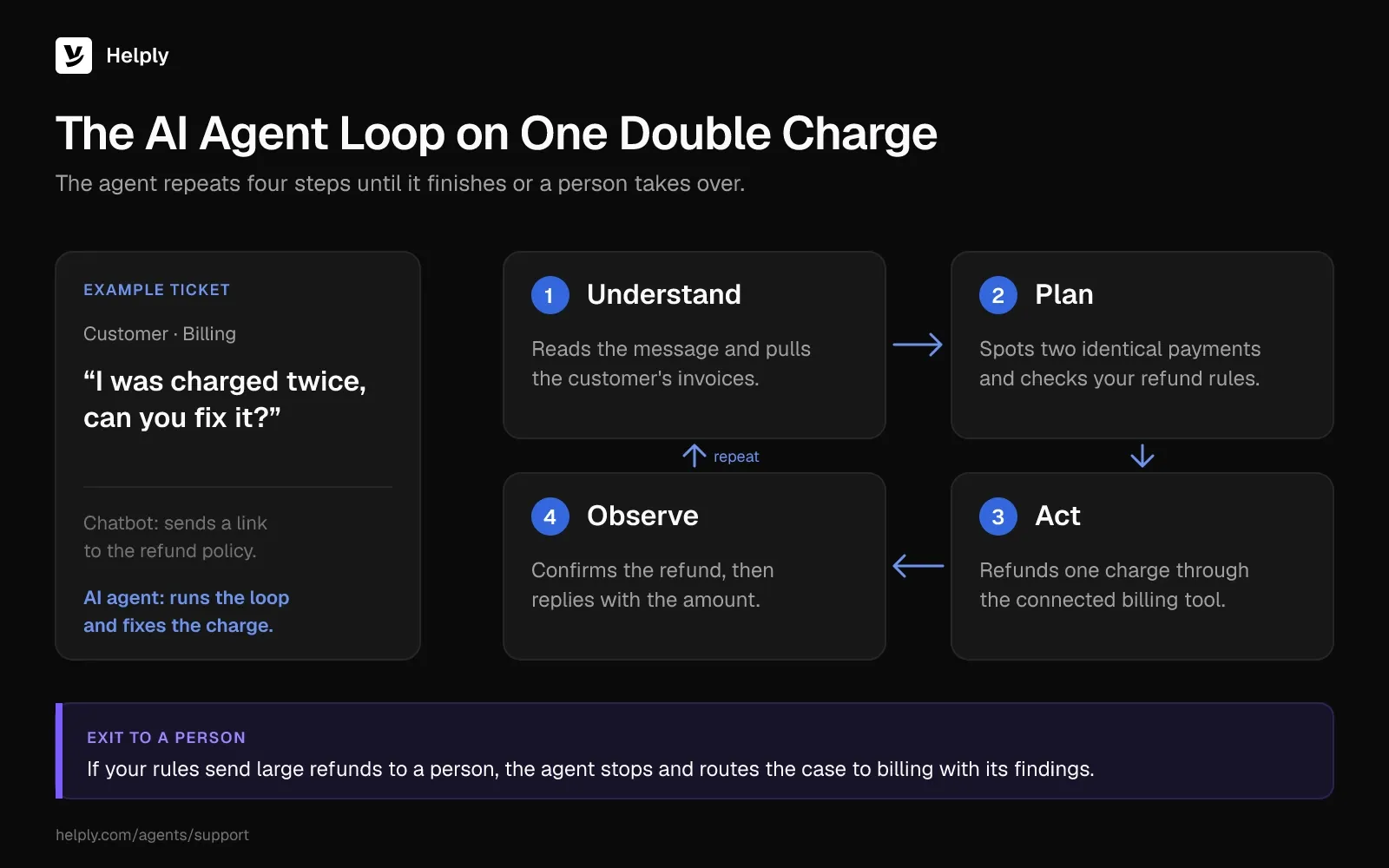
Take the double charge again. The agent pulls the customer's invoices and spots two identical payments a minute apart. It checks your refund rules, refunds one charge and replies with the amount.
Suppose your rules send large refunds to a person. The agent would then stop, route the case to billing and attach what it found.
A safe agent stops at the limits you set and passes its findings to your team.
AI Agent vs. Chatbot vs. Workflow
Chatbots, workflows and agents all automate parts of a conversation. They differ in who decides the next step.
Anthropic draws the line in its December 2024 guide, Building Effective Agents. It calls workflows "systems where LLMs and tools are orchestrated through predefined code paths." Agents "dynamically direct their own processes and tool usage."
Rule-Based Chatbot vs. Workflow vs. AI Agent: Who Decides the Next Step
| Question | Rule-based chatbot | Workflow | AI agent |
|---|---|---|---|
| Who picks the next step | A script | Code a developer wrote | The agent, within its rules |
| Handles an unplanned question | Falls back to "I didn't get that" | Only if a path exists | Plans a new route with its tools |
| Takes action in other systems | Rarely | Yes, on fixed paths | Yes, chosen per case |
| Best for | FAQs and menu choices | Repeatable processes with few branches | Varied requests that need lookups and decisions |
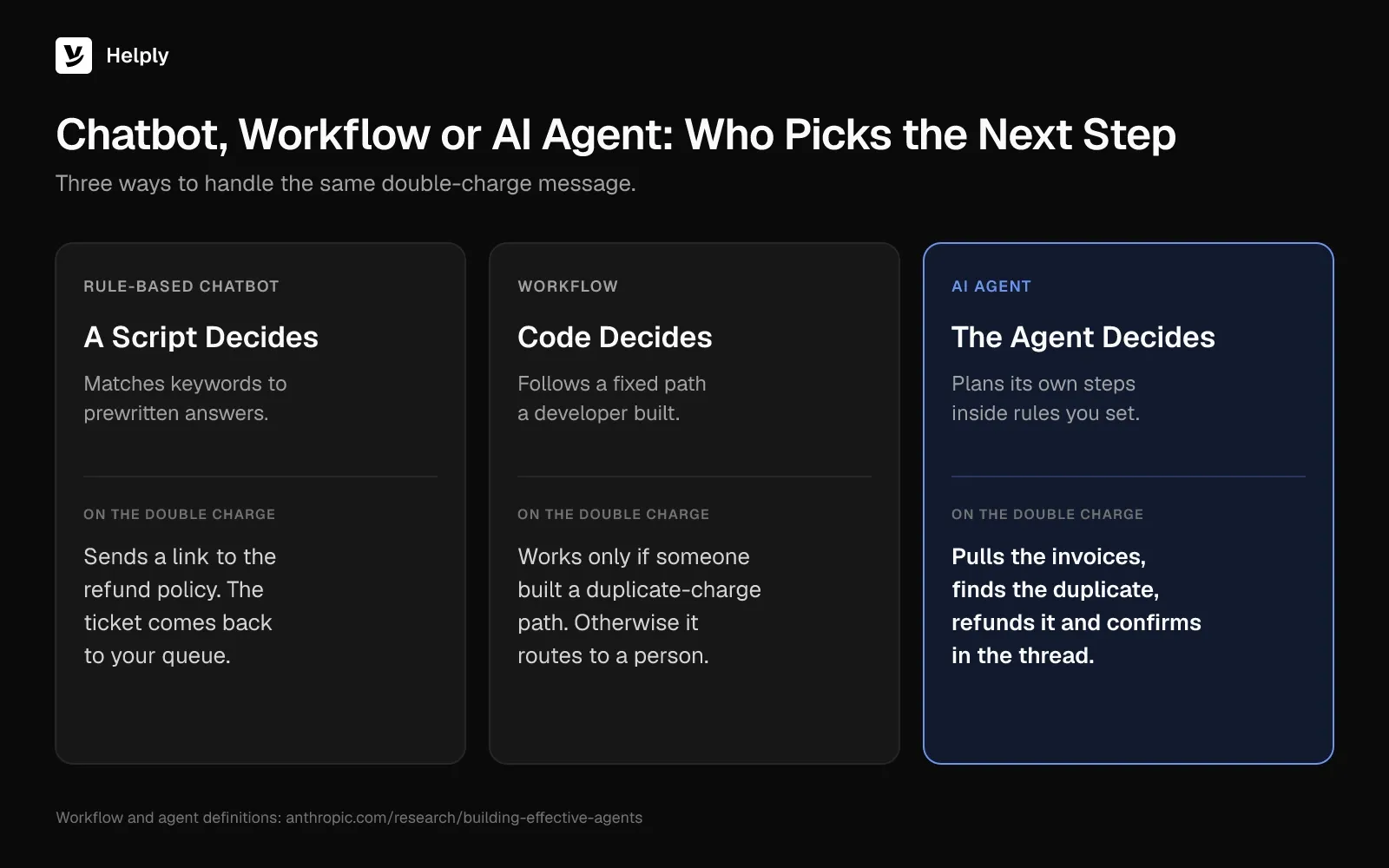
A workflow fits a job with the same steps every time, like tagging every invoice email. An agent earns its keep when each request needs a different mix of lookups and decisions.
The Five Types of AI Agents
IBM groups agents by how they decide and lists five classic types:
- Simple reflex agents follow condition-action rules. If the message contains "password," send the reset link.
- Model-based reflex agents keep an internal model of the world, so they still work when they can't see everything.
- Goal-based agents plan steps toward an objective, like "get this customer a working login."
- Utility-based agents weigh options and pick the one with the best overall result.
- Learning agents improve from new experiences and data.
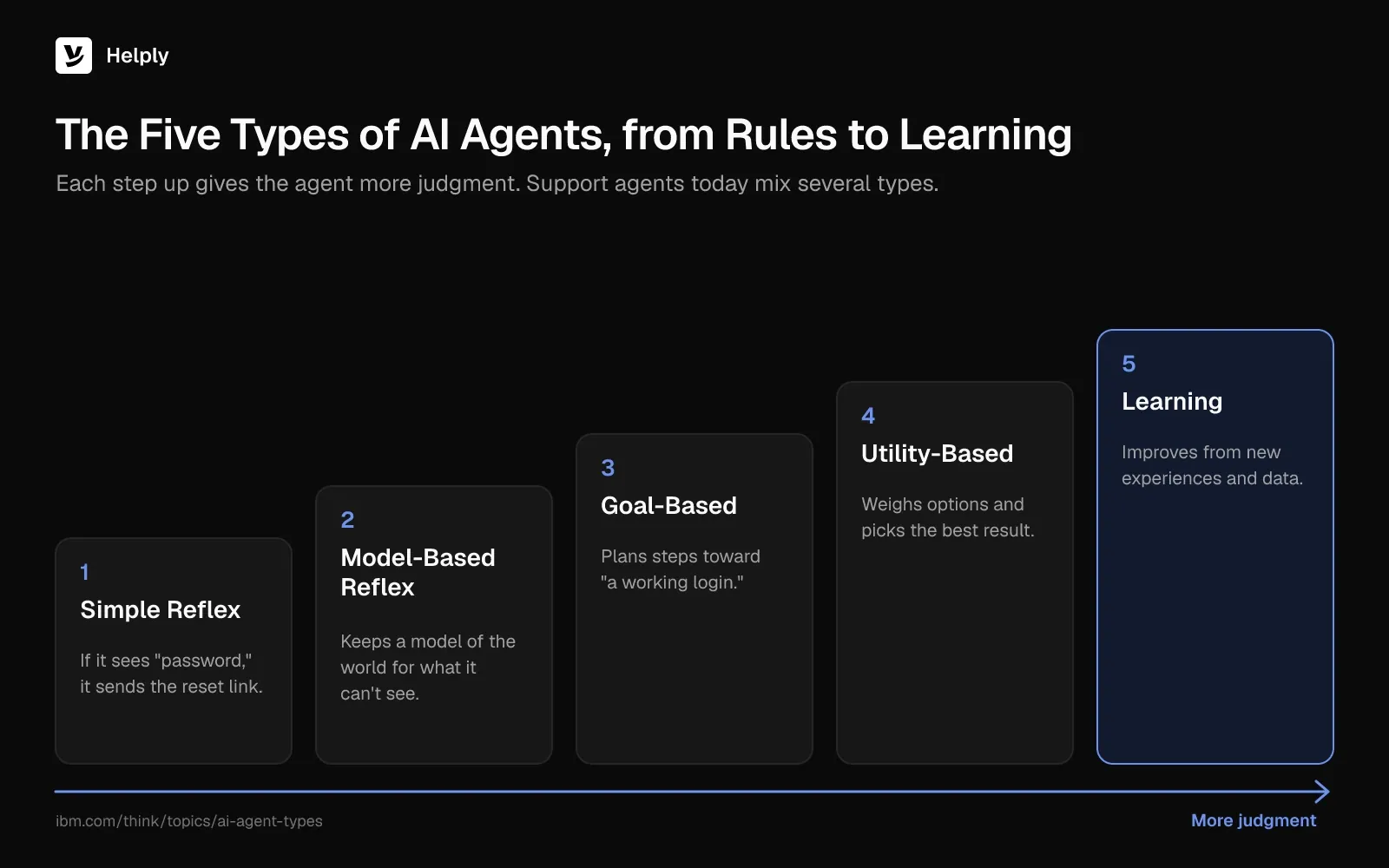
Modern AI agents built on language models mix several of these. A support agent plans toward a goal, follows rules you set and improves as your knowledge base grows.
AI Agent Examples in Customer Support
Support work fits AI agents because requests vary, answers live across several systems, and most cases end with a clear action.
Helply is an AI-native customer support platform. Three agent types there each cover a different part of the queue, and all plans ship with the Support and Assist Agents:
- Support Agent: it talks with customers on every channel, investigates and takes action, and can resolve requests end to end. Cases it can't close go to your team with its research included.
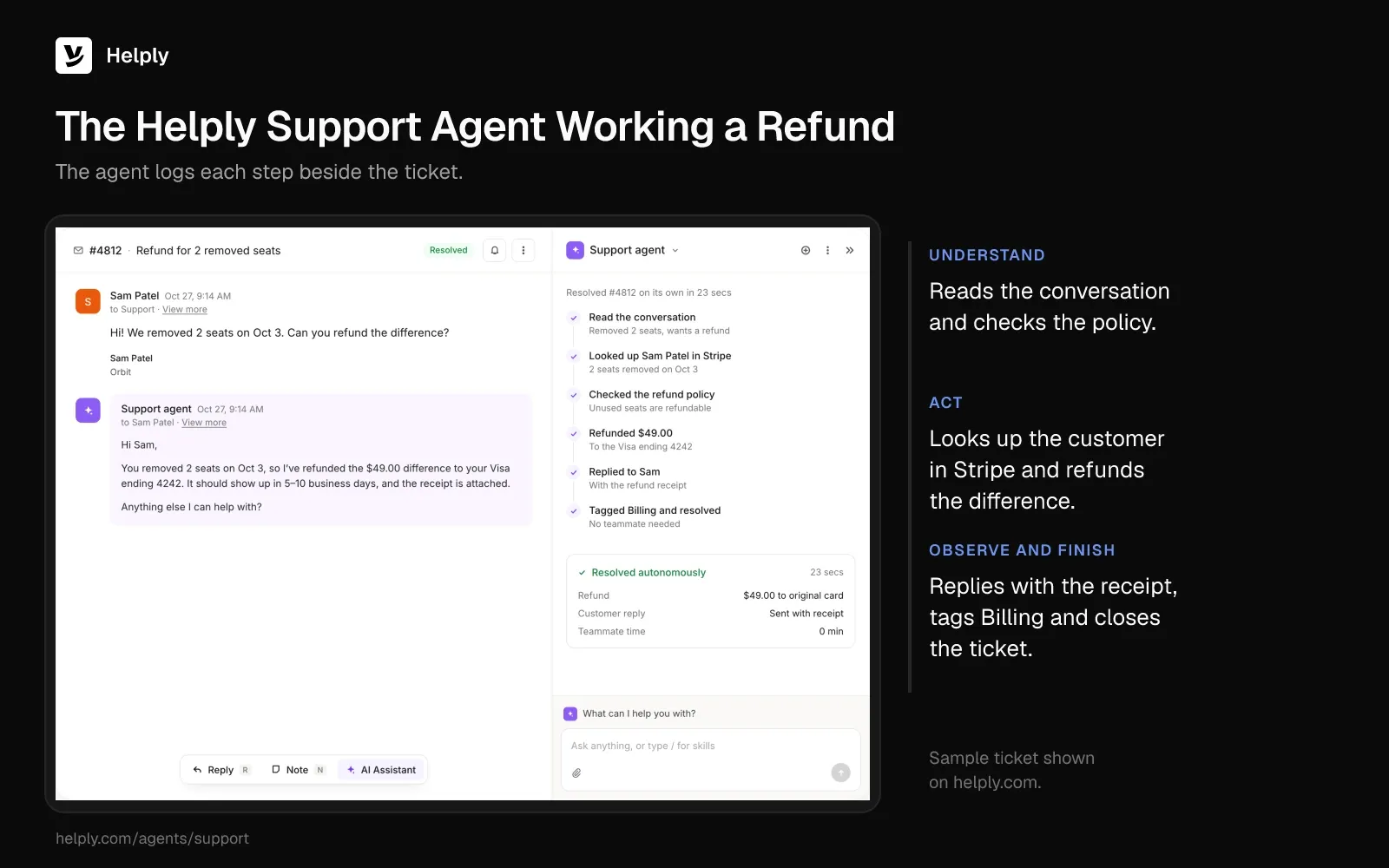
- Assist Agent: it works next to your human team inside each ticket, investigating and drafting replies. When your team directs it, it can take supported actions too.
- Background Agents: from the Team plan, they "continuously monitor conversations, customers, and support signals to find what matters and take action automatically."
The Knowledge Agent, one of the Background Agents, learns from customer conversations. It finds missing answers and flags outdated articles for your team to review.
Every Helply agent shares the same building blocks: Skills, Guidelines, Training, Escalation rules, Workflows, Memory and Tools. Skills teach an agent how to handle a specific type of customer work. Guidelinesset how it talks, how it decides and when it stops to involve a person.
On the double charge, the Support Agent can pull the invoice from a connected billing tool and follow your refund Guidelines.
When an AI Agent Is Worth It and When It Isn't
An agent costs more effort than a script, so match it to the work. Anthropic advises "finding the simplest solution possible, and only increasing complexity when needed."
An AI agent makes sense when:
- requests vary and need lookups in more than one system;
- the right answer depends on the customer's account, plan or history;
- the job ends with an action, such as a refund, a plan change or an update;
- your volume grows faster than your team.
A simpler tool fits when every request follows the same few steps, or when the agent has no systems to connect to.
A March 2025 Gartner forecast has agentic AI settling 80% of common service issues by 2029, without people stepping in.
Gartner also predicted, in a June 2025 forecast, that over 40% of agentic AI projects would face cancellation before 2028. It cites escalating costs, unclear value and inadequate risk controls.
Start with one queue and measure resolution and handoff rates before you expand.
How to Evaluate an AI Agent
Vendors demo the happy path. Ask these five questions to see how an agent handles the rest:
- What can it do, not only say? List the tools and actions it can reach, such as billing, orders or your CRM.
- Who sets the rules? Look for written guidelines on tone, policy and boundaries that your team controls.
- How does it hand off? A good handoff passes the investigation and customer context, so your team doesn't have to start over.
- Where does your data go? Ask whether the vendor's AI providers train on your customer data.
- How do you measure it? Track resolution rate, handoff rate and customer satisfaction from day one.
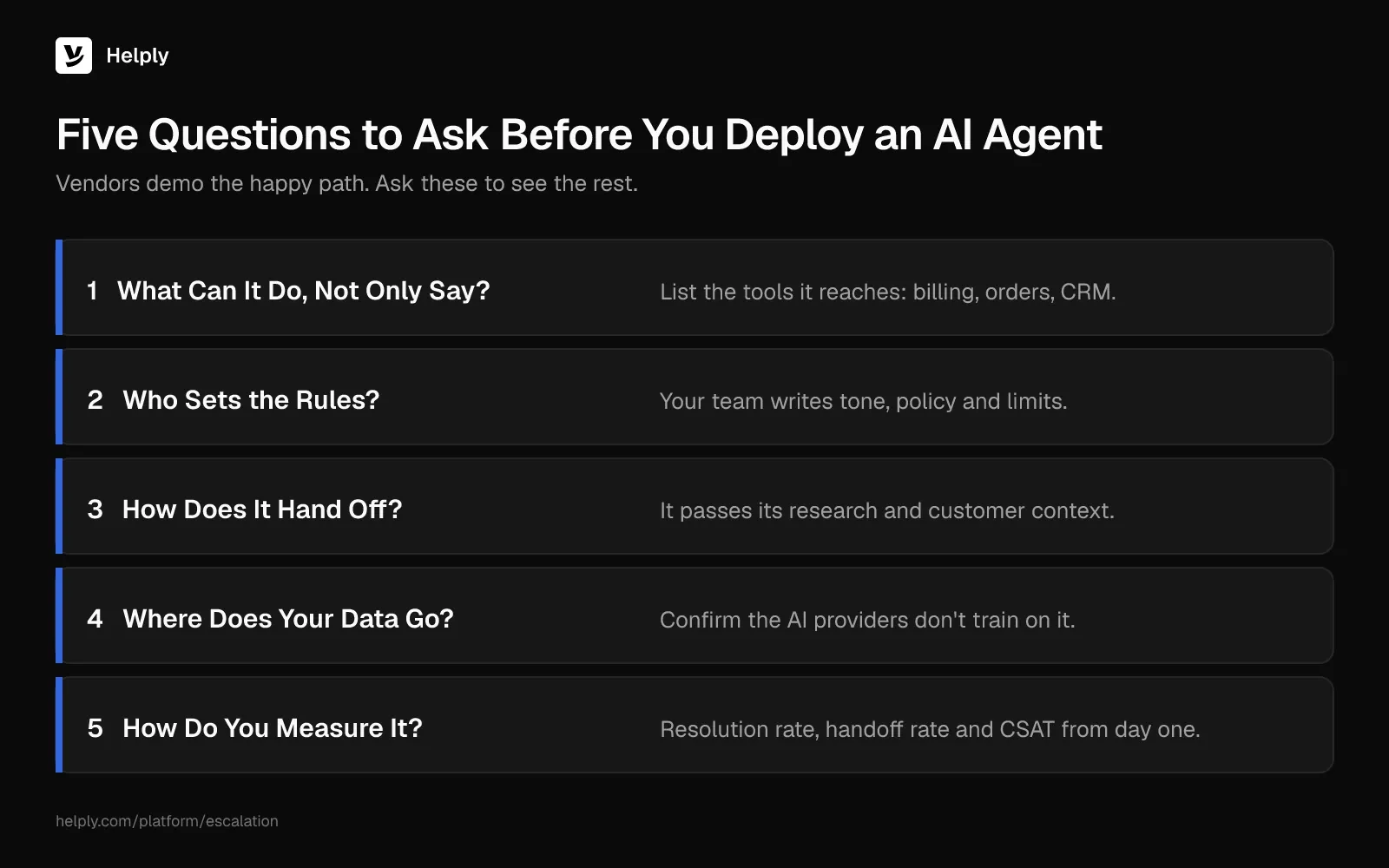
On Helply, Guidelines set tone, policy and when the agent stops. Escalation rules from the Team plan pass the agent's research and customer context to your team. Helply states that customer data sent to AI providers "is never used to train their models."
Planning a rollout? Start with adding an agent to your site, then read the common reasons AI support rollouts stall.
Is ChatGPT an AI Agent?
ChatGPT is an AI agent in agent mode and a chat assistant in plain chat mode. OpenAI launched ChatGPT agentin July 2025. Its launch post says ChatGPT "now thinks and acts," completing tasks "using its own computer."
The plain chat mode answers questions. The agent mode works through tasks that take several steps.
AI Agent vs. Agentic AI
An AI agent is one system with one job, such as resolving billing tickets. Agentic AI is the broader approach of building software that plans and acts on its own.
Gartner warns about "agent washing," the rebranding of chatbots, RPA and AI assistants as agents without real agentic abilities. In its June 2025 forecast, Gartner estimated that only about 130 of the thousands of agentic AI vendors are real. Ask any vendor what their agent can do without a script.
Start with One Queue or Keep Your Current Setup?
If your requests rarely change and your team keeps up, a chatbot or a set of automated workflows may cover you. If your queue keeps growing and each answer needs a lookup, an AI agent fits better. Helply fits teams who want agents that investigate, act and hand off inside one AI-native help desk.
At LingQ, users grew 50% a year while the support team stayed the same size. Helply's agents reached an 88% resolution rate, and support volume dropped by about half.
You decide where the agent stops. Pick one queue, write your Guidelines, connect the tools the agent needs and watch the handoffs for a week.
Frequently asked questions
A simple AI agent follows condition-action rules, which IBM calls a simple reflex agent. A password-reset bot that sends a link whenever a message mentions "password" fits this type.
No, because a rule-based chatbot follows a script and answers a message. An AI agent picks its own next step and uses tools such as a billing lookup. If it gets stuck, it passes the case to a person.
ChatGPT agent completes multi-step tasks for users on its own computer. In support, Helply's Support Agent can resolve customer requests end to end, and from the Team plan Helply's Knowledge Agent flags outdated articles.
Not so far. AI agents take over repeatable cases and hand the rest to people. At LingQ, a Helply customer, support volume fell about 50% while users grew 50% a year, with the same-sized team.
Safety depends on the vendor's data policy and the limits you set. On Helply, customer data sent to AI providers "is never used to train their models," and Guidelines set where the agent stops.
Setup time depends on your docs, tools and rules. LingQ captured its onboarding flows as Skills and went live with Helply in under 20 days.
A support agent reads the request, checks the customer's account and history, and takes an action such as a refund. Cases it can't resolve go to a person with its findings.
About the author

Jared Scheel
Co-founder & CTO


