
 Alex Turnbull ··14 min read

Two Ways to Add Support Capacity
An outsourcing provider adds its agents to your queue, and AI agents answer customers themselves.
Your queue grew faster than your team. Replies that went out by lunch now wait until tomorrow, and weekend messages sit until Monday. Hiring more people to keep up made each reply cost more.
Then two offers arrive. An outsourced customer service provider quotes a price per agent, with more for voice and other languages. An AI vendor quotes a price per outcome or conversation and promises support at every hour of the week.
Each offer also carries a risk. Provider agents need time to learn your product, and you lose some of that knowledge each time one leaves. An AI agent can give a confident wrong answer.
Both offers can be the right buy, depending on the work in your queue. Compare them on cost per resolved conversation first, then on quality, coverage and control.
Customer Service Outsourcing vs. AI Agents: Cost, Coverage and Control
You buy different things in each model: time from trained people, or the conversations and actions an AI agent handles.
| Factor | Customer service outsourcing | AI agents |
|---|---|---|
| How you pay | Per agent hour, per agent month, or per chat or ticket | Per outcome, per resolution, per conversation or per action |
| Published starting prices | $9 an hour per agent (Hugo); $1,400 a month per dedicated Level 1 digital agent in APAC (Influx); $185 a month for 50 chats, or $3.70 a chat (HelpSquad) | $0.99 per Fin outcome (Intercom); $1.50 per automated resolution with a volume commitment, $2.00 without (Zendesk); $2 per Agentforce conversation (Salesforce) |
| What grows the bill | Hours staffed, languages, voice, nights and weekends | Billed outcomes, resolutions, conversations or actions |
| Nights and weekends | Extra shifts and people, or a shared 24/7 pool; one always-on seat needs 168 agent hours a week | Replies at night and on weekends, with no extra shifts |
| Peaks | Extra agents, who need notice and training; Hugo lets customers scale with 24 hours' notice | Absorbs spikes without hiring, and the bill rises with usage |
| Languages | Hugo lists 60+ languages; Influx charges 10% or 20% more for Spanish or Portuguese | Varies by vendor; test each language on real conversations before moving it |
| Quality risk | Varies with the provider's hiring, training and turnover | A confident wrong answer when the AI guesses |
| Who holds the know-how | The provider's agents | Your docs, past conversations and written rules |
| Customer data | Outside staff read customer records | The AI vendor processes records under its data terms |
| Contract shape | Month to month at Hugo and Influx; under a year to over five years at Concentrix, in most cases with 30 to 90 days' notice to end early | Usage billing, sometimes with a committed volume or monthly minimum |
| Best fit | Phone-led, emotional, regulated or multilingual voice work | Repeat questions on chat and email that your docs and systems can answer |
How Much Does Customer Service Outsourcing Cost Compared with AI Agents?
Contact Center USA's 2026 pricing guide puts outsourced agents at $9 to $45 an hour, from offshore to US-based. AI vendors list $0.99 to $2.00 per billed outcome, resolution or conversation (Intercom Fin, Zendesk, Salesforce Agentforce).
Providers quote the cost of outsourcing customer service by the hour, month or chat, so the two prices don't line up. Convert both into cost per resolved conversation and add the costs neither quote shows. For hourly agents, ask the provider how many conversations each agent resolves in an hour.
How Outsourcing Providers Charge
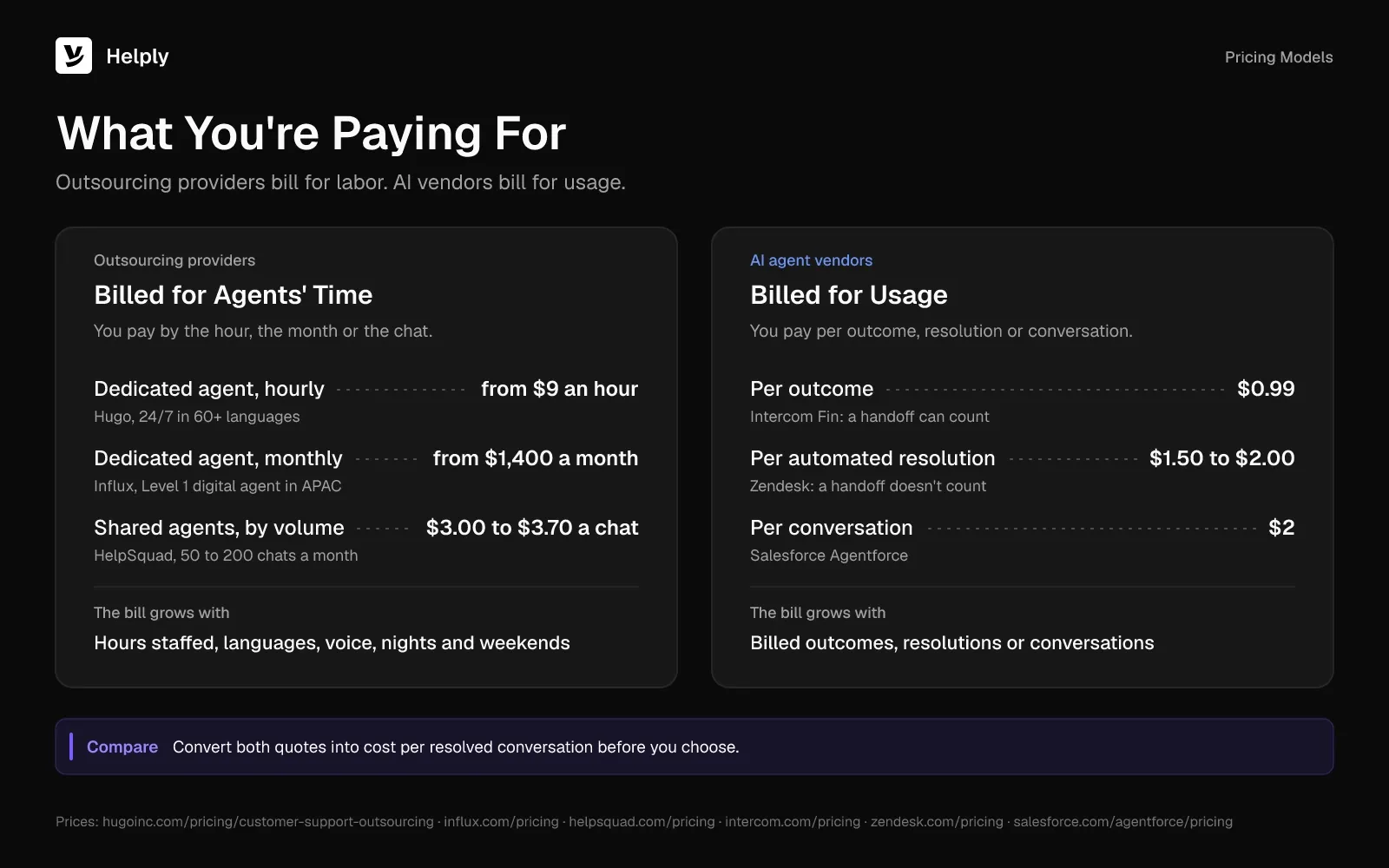
Most customer support outsourcing firms, or BPOs (business process outsourcing providers), sell agent time. Hugo lists dedicated teams from $9 an hour per agent, with 24/7 cover in 60+ languages. Influx prices by the month: Level 1 digital agents start at $1,400 a month in APAC and $1,700 in the Americas.
Teams with smaller queues can buy shared agents by volume. HelpSquad sells 24/7 live-chat cover at $185 a month for 50 chats, $350 for 100 and $600 for 200. That works out to $3.70, $3.50 and $3.00 a chat.
Large providers use the same two units, hours and volume. Concentrix's 2026 SEC filing says it books about 99% of its revenue on staffing hours or the number of customer transactions it handles.
By region, Contact Center USA's guide lists $9 to $18 an hour offshore and $14 to $28 nearshore. The same guide, from a US outsourcing provider, puts US-based agents at $29 to $45 an hour. For in-house pay, the Bureau of Labor Statistics lists the median US rep at $21.53 an hour in May 2025, before benefits.
How AI Agent Vendors Charge
Intercom sells its Fin agent at $0.99 per outcome. Fin's billable outcome covers three cases: the customer confirms it worked, stops asking, or Fin completes a workflow, handoffs included.
Zendesk charges $1.50 per automated resolution when you commit to a volume, or $2.00 a resolution without that commitment. It bills only requests its AI resolved with no escalation to a person. Salesforce charges $2 per customer-facing Agentforce conversation, and Flex Credits cost $500 per 100,000, or $0.10 for an action's 20 credits.
Read the billable event before you compare prices: a Fin outcome can end in a handoff, and a Zendesk resolution can't. Intercom charges for one outcome per conversation at most and refunds it if the conversation reopens.
Helply prices its plans by the human agents on your team. All plans come with the Support and Assist Agents, plus AI credits the whole team draws from. The AI uses credits for the work it does on a conversation, and handing it to a person adds none.
The credit table shows what each action and a full resolution use, so you can work out Helply's cost per resolved conversation. Usage alerts and limits keep that spend predictable.
The Cost of Around-the-Clock Cover
Around-the-clock dedicated cover multiplies the hours you pay for. A week has 168 hours, so one dedicated seat staffed all week needs about 728 agent hours a month. At 40-hour weeks, that's 4.2 full-time agents before breaks, leave and training.
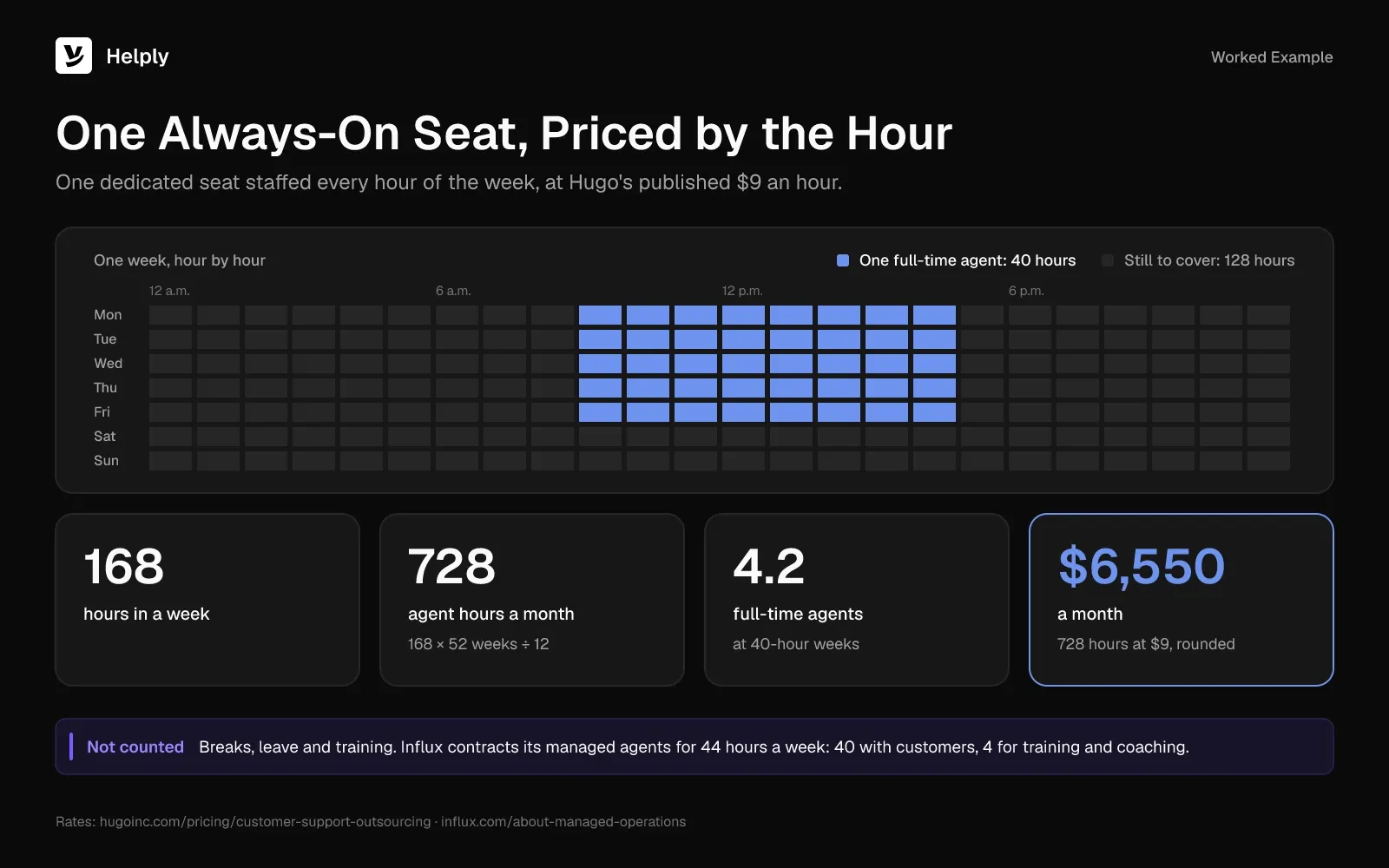
At Hugo's $9 an hour, one always-on seat comes to about $6,550 a month. Paid hours also exceed customer-facing hours. Influx contracts its managed agents for 44 hours a week: 40 with customers and 4 for training and coaching.
An AI agent keeps no office hours, so covering all 168 hours adds no shifts to the bill. It answers overnight questions and leaves anything that needs judgment for a person in the morning.
Outsourcing vs. AI Agent Cost at 1,000 Chats a Month
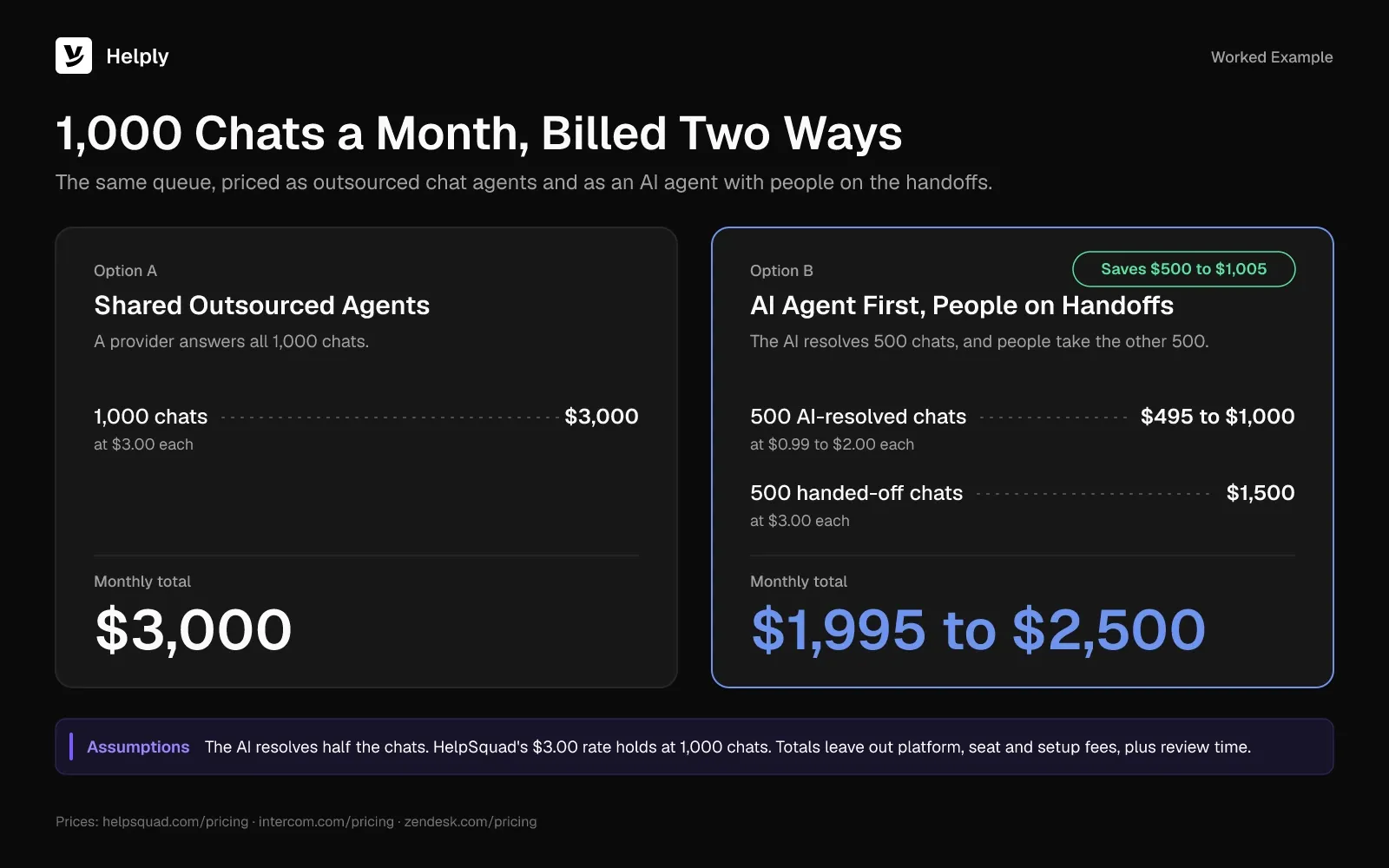
Take a queue of 1,000 chats a month, most of them order status, password resets and billing changes. Assume the AI resolves half and people take the other half. Both rows also assume HelpSquad's best published rate, $3.00 a chat, holds at 1,000 chats.
| Setup | What you pay for | Estimated monthly cost |
|---|---|---|
| All outsourced, shared chat agents | 1,000 chats at $3.00 | $3,000 |
| AI agent first, outsourced people on the rest | 500 AI-resolved chats at $0.99 (Fin) to $2.00 (Zendesk) each, plus 500 chats at $3.00 | $1,995 to $2,500 |
On those assumptions, putting the AI first cuts the monthly bill from $3,000 to between $1,995 and $2,500.
Both totals leave out platform or seat fees, setup fees and review time. The low end holds only if none of the 500 handed-off chats counts as a Fin outcome. Each extra 100 chats the AI resolves saves $100 to $201, so the resolution share, or chatbot containment rate, matters most.
Agentforce bills $2 per conversation instead, so check which conversations it counts before you run that price through this example.
Hidden Costs of Outsourcing and AI Agents
Outsourcing starting rates can leave out:
- Language and channel premiums: Influx charges more for voice, and Spanish or Portuguese adds 10% or 20%, depending on the service.
- Management layers, such as Influx's managed operations, which start at $2,000 a month per agent in APAC or EMEA.
- Ramp-up time while new agents learn your product, which starts over each time an agent leaves.
AI usage prices can leave out:
- Monthly minimums or committed volumes, such as the $49 monthly minimum for Fin on another help desk, which covers 50 outcomes.
- Knowledge upkeep, since the AI answers only as well as your docs and past conversations.
- Review time while your team checks answers in the first weeks.
- Repeat contacts when the AI gets an answer wrong and the customer writes back.
AI costs can rise too. In January 2026, Gartner predicted that generative AI's cost per resolution in customer service will exceed $3 by 2030. That would be higher than what many B2C offshore human agents cost.
Re-check the AI's resolution share and usage prices before each renewal, as you would a provider's rates.
Which Gives Customers Better Service: Outsourced Agents or AI Agents?
For angry customers, edge cases and calls that need a calm voice, outsourced agents give better service. Quality still depends on the provider's hiring, training and turnover, and your product knowledge sits with people you don't employ.
For repeat questions, an AI customer service agent gives the same answer at 3 a.m. and at noon, drawn from your docs. Its failure mode is a confident wrong answer. You limit that risk with rules for when the AI stops and hands the conversation to a person.
Of the 5,728 customers in a December 2023 Gartner survey, 64% would rather companies didn't use AI for customer service. Their top worry, named by 60% of respondents to that question, was that AI would make reaching a person harder.
Klarna's February 2024 announcement said its AI assistant did work equal to 700 full-time agents. At the time, ITPro reported that most of Klarna's 3,000 or so service agents worked for outsourcing partners.
In May 2025, Bloomberg reported that Klarna's CEO said cost had counted for too much and quality had slipped. He said customers should know a human is always available, and Klarna began piloting a new pool of human agents. Plan a route to a person from day one, whichever model takes the first reply.
Nights, Peaks and Languages: Outsourced Teams vs. AI Agents
AI agents reply through the night and absorb a spike from a launch, a sale or an outage with no new hires. The extra conversations show up on your usage bill.
Providers cover nights with shifts and peaks with extra agents, who need notice and training. Hugo, for example, lets customers scale up or down with 24 hours' notice.
Providers still lead on languages, above all on the phone. Test an AI agent on real conversations in each language before you move that queue, and route misses to a fluent person.
Who Keeps Control of Knowledge, Data and Contracts?
With an outsourced team, your product knowledge lives in the provider's training notes and its agents' heads. AI agents answer from your docs, past conversations and written rules, which your team keeps and edits.
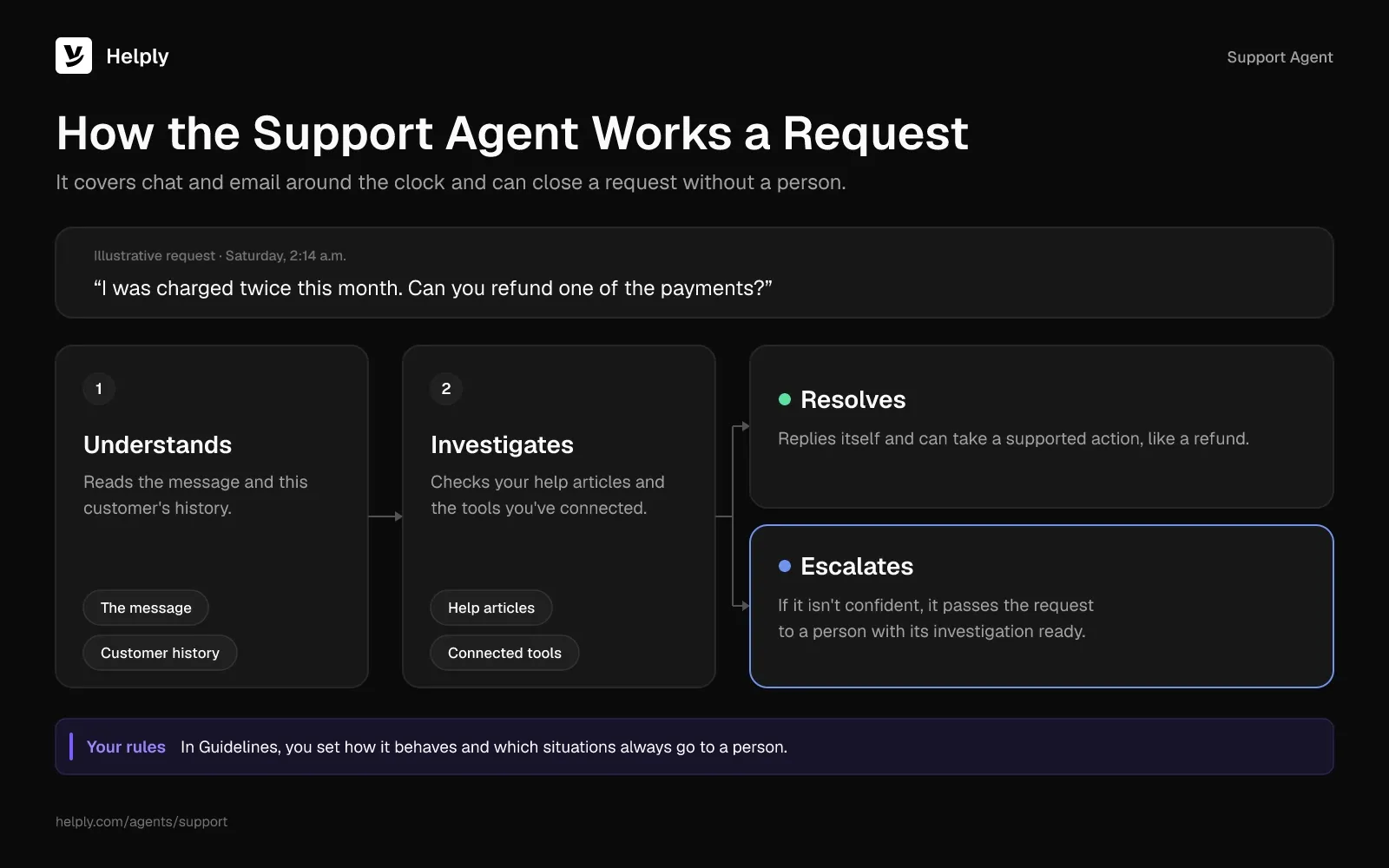
In Helply's Guidelines, you tell its agents how to behave and decide, and name situations that always need a person. Each action the agents take stays within the permissions you grant, and Helply logs every one.
Outside staff at a provider read your customer records, often in another country. An AI vendor processes the same records under its data terms.
Ask any AI vendor for its SOC 2 report and whether anyone trains models on your data. Helply backs its security and operational controls with a SOC 2 Type II report. Its AI providers never use the customer data it sends for model training, and you can ask for a DPA.
Concentrix's contracts run from under a year to over five years. In most cases, its clients can end them early with 30 to 90 days' notice, while Influx and Hugo sell month to month. AI pricing has its own commitments: Zendesk's $1.50 rate needs a committed volume, and Fin on another help desk has a monthly minimum.
When Should You Outsource Customer Service Instead of Using AI Agents?
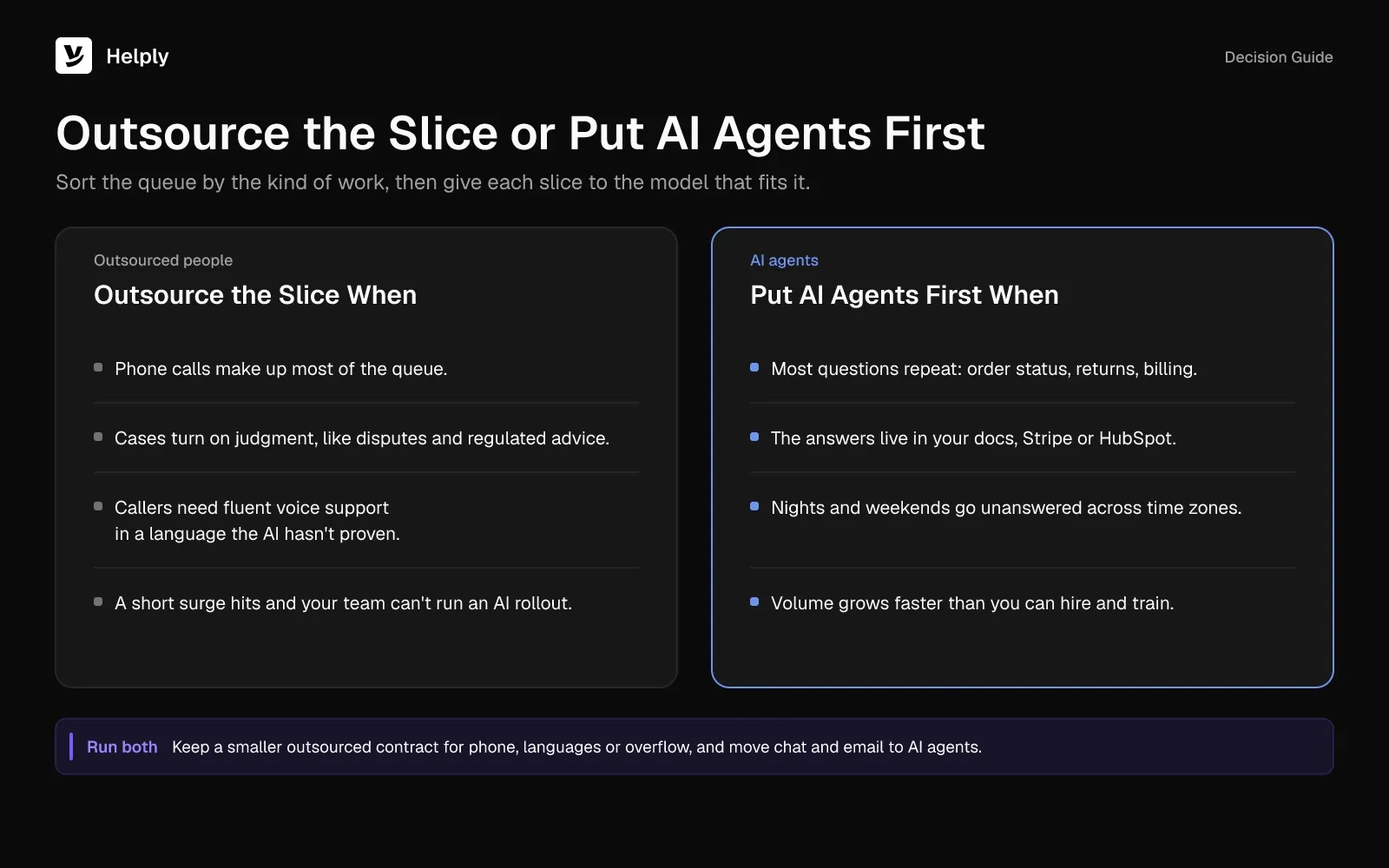
Before you outsource customer support, sort the queue by the kind of work, then give each slice to the model that fits it.
Outsource the slice when:
- Phone calls make up most of the queue and callers expect a person.
- Cases turn on judgment, such as disputes, complaints, regulated advice or high-value accounts.
- Customers need fluent voice support in a language your AI agent hasn't proven it handles.
- A seasonal surge needs people for a few weeks and no one on your team can run an AI rollout.
Put AI agents first when:
- Most conversations repeat: order status, returns, password resets, billing changes and how-to questions.
- The answers live in your docs, your help center and systems such as Stripe or HubSpot.
- Nights and weekends go unanswered and customers sit in different time zones.
- Volume grows faster than you can hire and train people.
The Hybrid Model: AI Agents First, People on Handoffs
In a hybrid setup, the AI agent replies first in chat and email, then resolves what it can. People take the rest, with the full history attached.
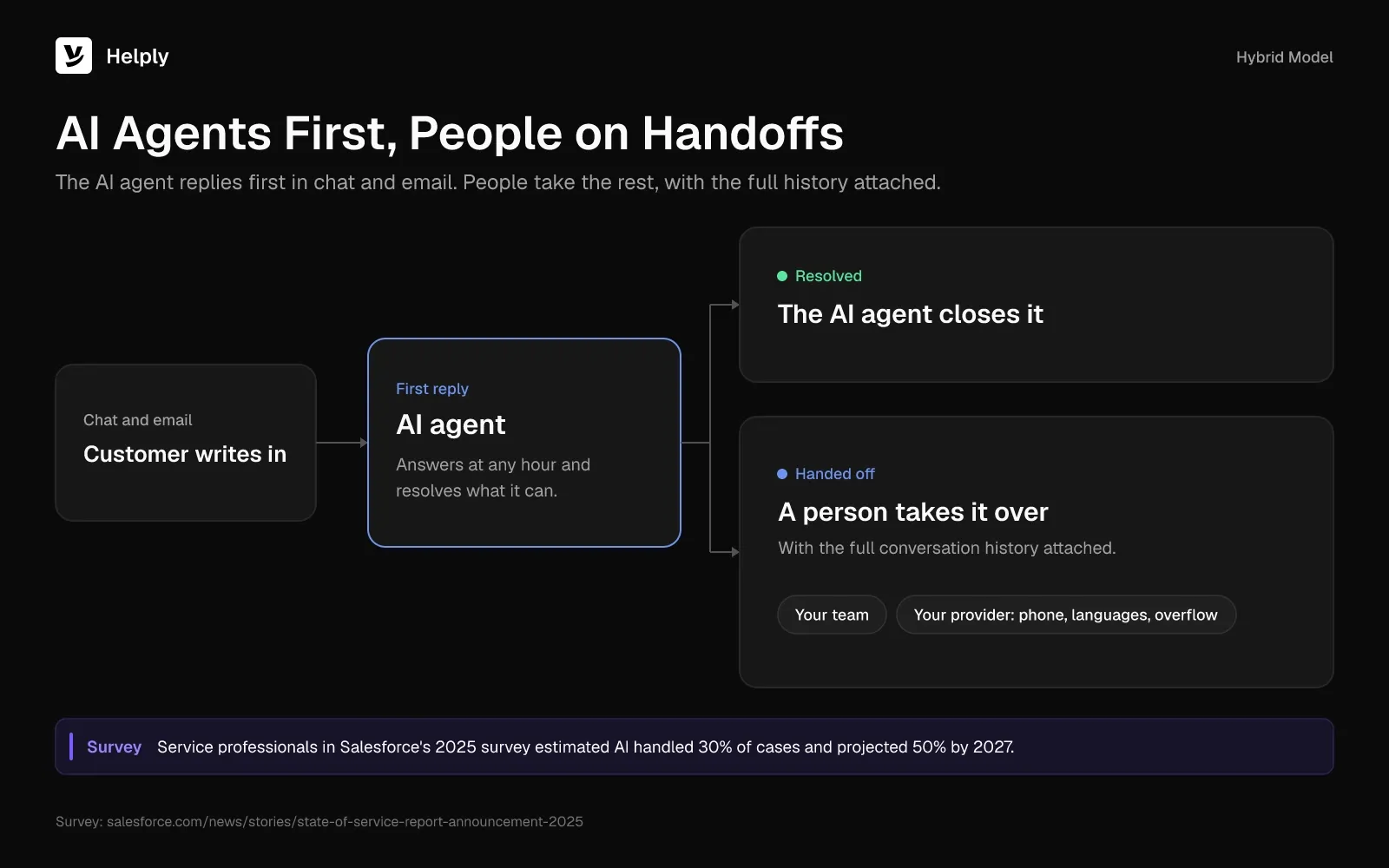
Salesforce ran its State of Service survey of 6,500 service professionals between April and June 2025. They estimated AI handled 30% of cases and projected 50% by 2027. Gartner's survey of 275 service leaders, run in July and August 2026, found only 21% had cut agent headcount because of AI.
Both surveys point to AI taking a growing share of cases while most teams keep their people. Those people can sit on your team or at a provider. You can keep a smaller outsourced contract for phone, extra languages or overflow, and move chat and email to AI agents.
Read whether AI will replace human support teams for the jobs question, and how to scale support without hiring for staffing.
How Helply Takes the Queue You'd Otherwise Outsource
Helply is an AI-native customer support platform. First replies can go to its AI agents, and your people take the rest in the same help desk.
In chat and email, the Support Agent does a provider's first-tier work and can resolve requests from start to finish. It replies to customers itself, using your help articles, that customer's history and the tools you've connected. It can also carry out supported actions, like issuing a refund or changing a plan.
It handles common questions around the clock, so fewer weekend messages wait until Monday. If it can't settle a request with confidence, it escalates to a person with its investigation and the customer's details ready.
The Assist Agent helps whoever takes the handoff in Helply, on your team or at a provider. It writes drafts grounded in the thread, what you know about the customer and your Guidelines. At your team's direction, it takes supported actions too, so you can handle more conversations without hiring at the same rate.
The Knowledge Agent, from the Team plan up, learns from your conversations to flag missing answers and outdated help content. You can review each suggestion before it enters the docs you own. The Insights Agent, also from Team, turns conversations into trends and recurring problems worth your team's attention.
From the Team plan up, you can also write escalation rules for when the AI keeps going, asks a teammate or hands off.
How to Move Work from an Outsourcing Contract to AI Agents
Switch queue by queue, with the provider still on duty, so customers keep getting answers through the change.
- Map the queue. Export three to six months of conversations and tag the top contact reasons by volume.
- Read the contract. Note the notice period, any minimum hours or seats, and what the provider must hand back, such as macros and training notes.
- Load your knowledge. Add your help articles and past conversations so the AI can answer like your team from the first day.
- Test before customers see it. Try Helply's agents in the Playground, which uses no credits, and from Team up, backtest them on past conversations.
- Start with drafts. Run Helply beside your current setup, approve each AI reply, then let the Support Agent resolve one topic at a time.
- Shrink the contract by queue. Move topics the AI now resolves off the provider's scope, and keep the provider on phone, languages or escalations that still need people.
- Measure both sides the same way. Track cost per resolved conversation for AI and people over the same weeks, then add these AI support KPIs, such as escalation rate.
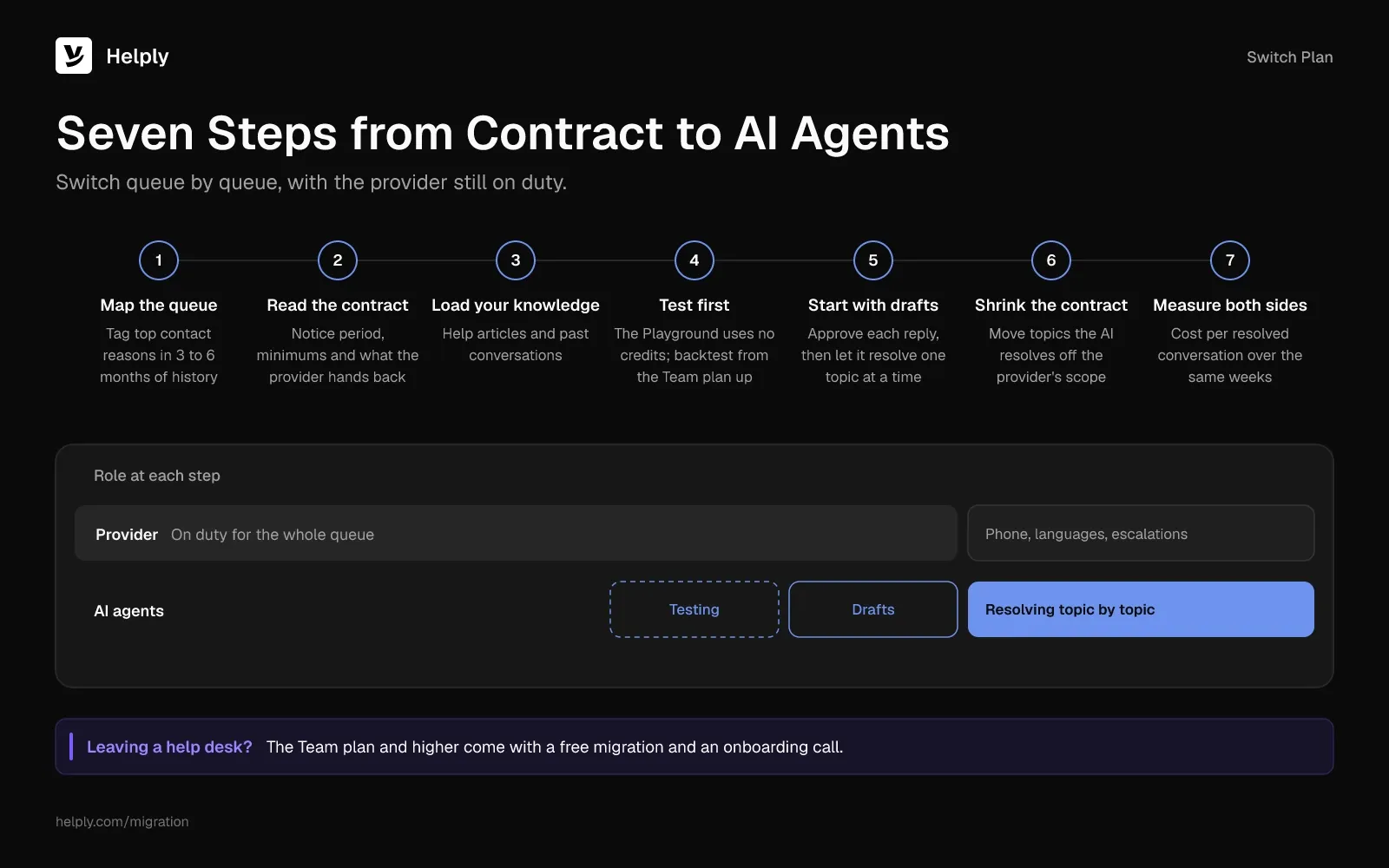
If you're also leaving a help desk, the Team plan and higher come with a free migration and an onboarding call. The migration brings your conversations and help center across from Help Scout, Front, Zendesk, Intercom or Freshdesk.
Outsource the Queue or Hand It to AI Agents?
Outsource the work that needs a person on the phone, a fluent speaker or a judgment call, and keep that contract small. Put AI agents on repeat chat and email questions, where they reply overnight and, at list prices, can cost less per resolved conversation. Helply fits that second job, with its AI agents and your people in one help desk.
A provider's bill rises with each hour and language you add, so set both quotes against cost per resolved conversation. Helply prices plans by the human agents who reply, with AI credits pooled across the team. The credit table shows what a resolution uses, and usage alerts and limits stop a surprise bill.
The Support Agent answers overnight and weekend questions and passes judgment calls to your team with its investigation attached. You set where the AI stops, with Guidelines on every plan and escalation rules from Team. Your team writes and edits the docs the AI answers from.
Once routine questions went to the Support Agent, support capacity stopped limiting AirGigs' growth.
Start with one support inbox. Connect it, run Helply next to your current provider or help desk, and approve each AI reply before it goes out. Compare both sides over the trial, ahead of your next renewal.
Frequently asked questions
Customer service outsourcing means paying an outside firm, a business process outsourcing (BPO) provider, to answer your customers by phone, chat or email. The provider bills by the agent hour, the agent month or the chat. AI agents handle part of that work instead, and you pay their vendors per outcome, resolution, conversation or action.
For repeat chat and email questions, AI agents can cost less per resolved conversation than per-chat outsourcing at list prices. Intercom's Fin and Zendesk list $0.99 to $2.00 per billed outcome or resolution. HelpSquad's shared chat agents work out to $3.00 to $3.70 a chat, and outsourcing still suits phone-heavy and judgment-heavy work.
Not in full: of 275 service leaders Gartner surveyed in July and August 2026, only 21% had cut agents because of AI. Gartner also predicted in June 2025 that by 2027, half the organizations planning big AI-driven cuts to service staff will drop those plans. A smaller outsourced contract can still cover phone, languages and complex cases.
Contact Center USA's 2026 pricing guide puts outsourced agents at $9 to $18 an hour offshore and $29 to $45 in the US. Influx lists a Level 1 digital agent in APAC from $1,400 a month, and HelpSquad sells 50 shared chats for $185 a month. At Hugo's $9 rate, one seat staffed around the clock costs about $6,550 a month.
AI agents answer customers end to end, draft replies for human agents and spot trends and knowledge gaps in conversations. In Helply, the Support Agent answers and the Assist Agent drafts, on every plan. From the Team plan up, the Knowledge and Insights Agents spot the trends and gaps.
Some can, including Intercom's Fin Voice, which its sales team sells for $1.99 per voice outcome. Trained people still suit upset or complex callers. For calls, Helply can tie transcripts and supported call information to the customer's history.
Many customers do. In Gartner's December 2023 survey of 5,728 customers, 64% would rather companies didn't use AI for customer service. Gartner's later survey of 3,566 customers, from February and March 2026, found 87% want companies using GenAI to offer a human option.
The move takes about as long as your provider's notice period, since AI agents can run beside the provider from day one. In most cases, Concentrix's clients can end contracts early with 30 to 90 days' notice, and Hugo and Influx sell month to month. Give notice once the AI holds a steady resolution rate on the queues you plan to move.
Track cost per resolved conversation, first-contact resolution, repeat contacts, CSAT (customer satisfaction), escalation rate and time to resolution for each model. Measure both over the same weeks, and count a conversation as resolved only when the customer doesn't come back about the same issue.
About the author

Alex Turnbull
CEO & Founder, Helply
Alex is the CEO & Founder of Groove. He loves to help other entrepreneurs build startups by sharing his own experiences from the trenches.
Keep reading

Best AI Chatbots for Business: 9 Picks Compared by Cost and Fit
Konrad Janczyk · 26 min read
What Is an AI Chatbot? Rule-Based vs. AI Chatbots Explained
Bildad Oyugi · 11 min read