
 Alex Turnbull ··12 min read

Two messages land in your support chat on a Monday morning. A shopper writes, "can i get the medium instead? order 51744, hasnt shipped yet right".
An IT admin at a software customer writes, "SSO stopped working for our whole team after we switched Okta apps this morning. Also, do our licenses stay active through renewal next week?"
The chatbot fails both customers. The shopper gets the size-swap policy, but order 51744 stays unchanged.
The admin gets a stock fallback reply: "I didn't get that. Can you say it again?"
The shopper writes to support a second time. The admin opens an email ticket and explains the whole problem to a person.
The same NLP chatbot sent both replies, and it worked as its team designed it. On each message, it breaks down at a different one of its five steps.
What Is an NLP Chatbot?
An NLP chatbot is software that reads a typed or spoken message. It works out the intent behind it and writes a reply a person can read. "Swap to a medium" and "can i get the medium instead" reach the same answer.
IBM puts the line here: "Not all chatbots use artificial intelligence (AI). Traditional chatbots follow predefined rules, decision trees and scripted conversation flows." A rule-based bot waits for a button press or an exact keyword. An NLP chatbot reads the sentence.
For the history of chatbots and the basics of chatbots versus agents, start with the guide to what an AI chatbot is.
NLP vs. NLU vs. NLG
Natural language processing (NLP) is the umbrella. IBM describes it as a subfield of computer science and AI. It uses machine learning so computers can understand and communicate with people through text and speech.
Natural language understanding (NLU) does the reading. It uses syntax and meaning to work out what a sentence says. Natural language generation (NLG) does the writing: IBM defines it as producing a human-language text response from some data input.
| Term | Job in a Chatbot | Where It Shows Up in the Shopper's Message |
|---|---|---|
| NLP | The whole field of reading and writing human language | Every step, from cleaning the text to sending the reply |
| NLU | Reads the message: finds the intent and the entities | change_order_item, order 51744, size medium |
| NLG | Writes the reply from data | "Order 51744 can switch to a medium. Confirm your email to finish." |
How an NLP Chatbot Works: One Order Change, Step by Step
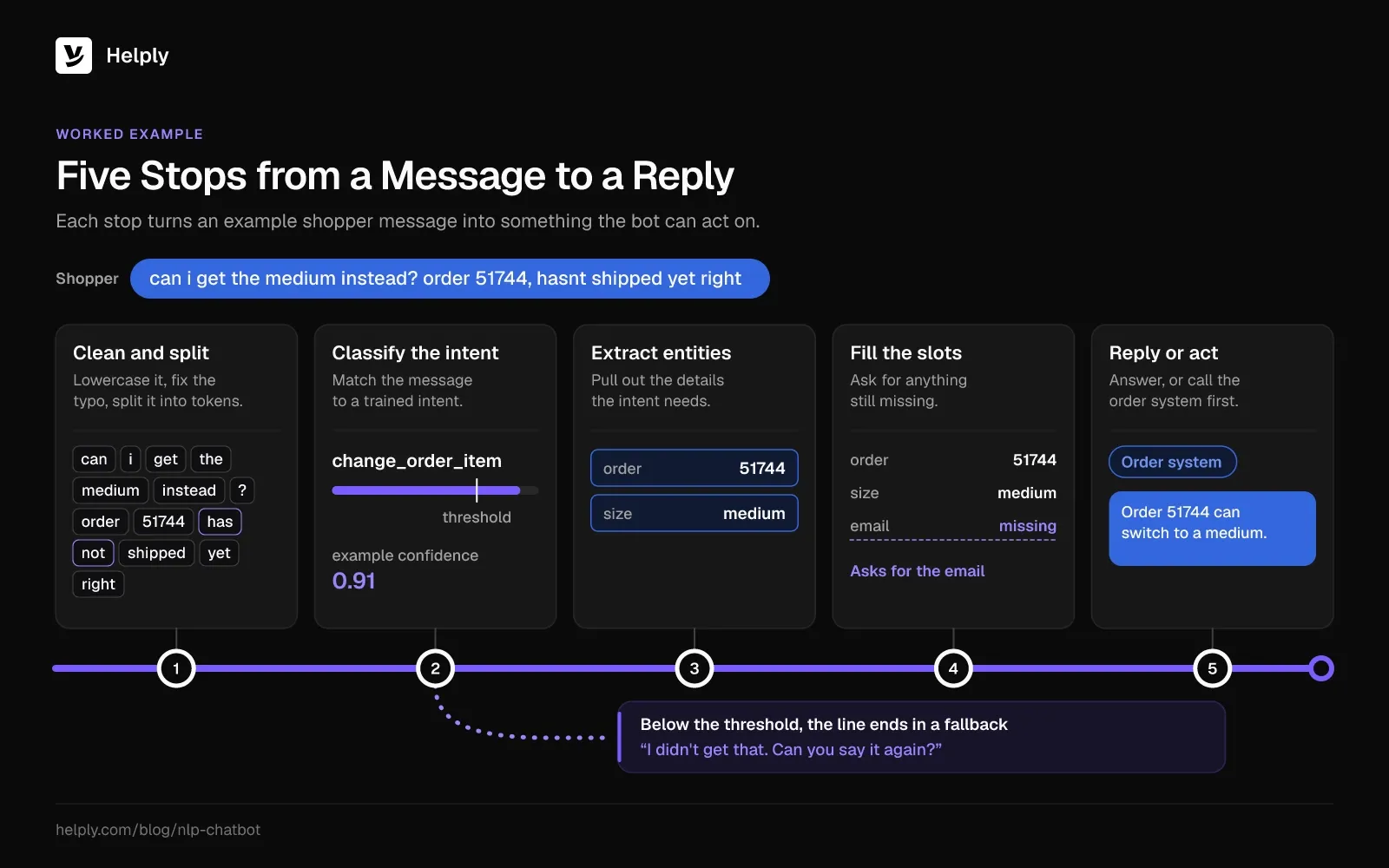
An NLP chatbot runs the shopper's message through five steps. The outputs below are example values, in the style intent tools such as Google Dialogflow and Rasa produce.
Step 1: Clean and split the text. The bot lowercases the message, sorts out "hasnt" and breaks the sentence into tokens. The bot has no grasp of meaning at this stage.
Step 2: Classify the intent. Dialogflow's docs say, "An intent categorizes an end-user's intention for one conversation turn." Teams build each intent from training phrases, example phrases for what users might say. The classifier compares the message with those examples and returns change_order_item at an example confidence of 0.91.
Step 3: Extract entities. Entity extraction pulls structured details out of the text. Each detail has an entity type that, in Dialogflow's words, "dictates exactly how the data is extracted." The bot finds order number 51744 and size medium.
Step 4: Track the conversation and fill slots. The change_order_item intent needs the order, the new size and the shopper's email. Dialogflow calls the next part slot filling: the bot keeps asking for the email until every required detail is in.
Step 5: Reply or act. A matched intent gets a static response by default. With fulfillment turned on, Dialogflow calls a service you define, such as the order system, then NLG writes the sentence.
Intent matching depends on a threshold. Dialogflow uses a classification threshold, and if no intent clears it, the bot falls back. Its default fallback replies include the line the admin got on Monday.
The Same Steps on a B2B Login Problem
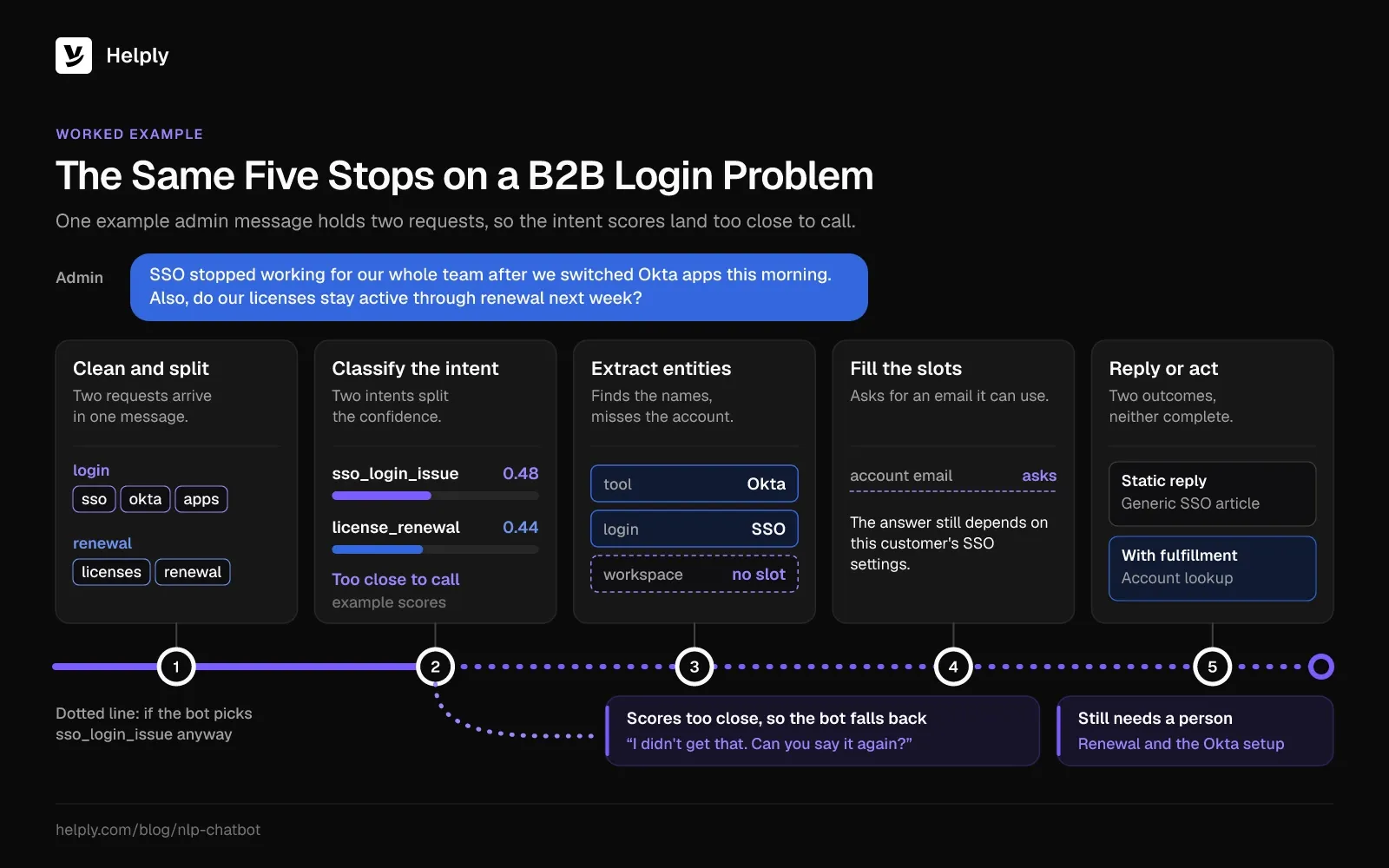
An intent bot reads the admin's SSO and renewal message as two competing intents.
In this example, Step 2's classifier splits its confidence between two intents: sso_login_issue at 0.48 and license_renewal at 0.44. Rasa's legacy docs describe an ambiguity threshold for this case. If the top two intents score too close together, the bot predicts a fallback instead of guessing.
Suppose the bot settles on the login intent anyway. Step 3 finds "Okta" and "SSO" but has no slot for the team or workspace.
The bot's team never wrote training phrases for an identity-provider change. Step 4 can ask for an account email, yet the answer still depends on the customer's SSO settings.
Step 5 has two outcomes. With only a static response, the admin gets a link to a generic SSO article that doesn't mention Okta app changes. With fulfillment, the bot can look up the account, but the renewal question still needs a person.
The bot fails the admin for three reasons: the message holds two intents, needs account data and depends on this customer's Okta setup.
Where Intent-Based NLP Chatbots Break
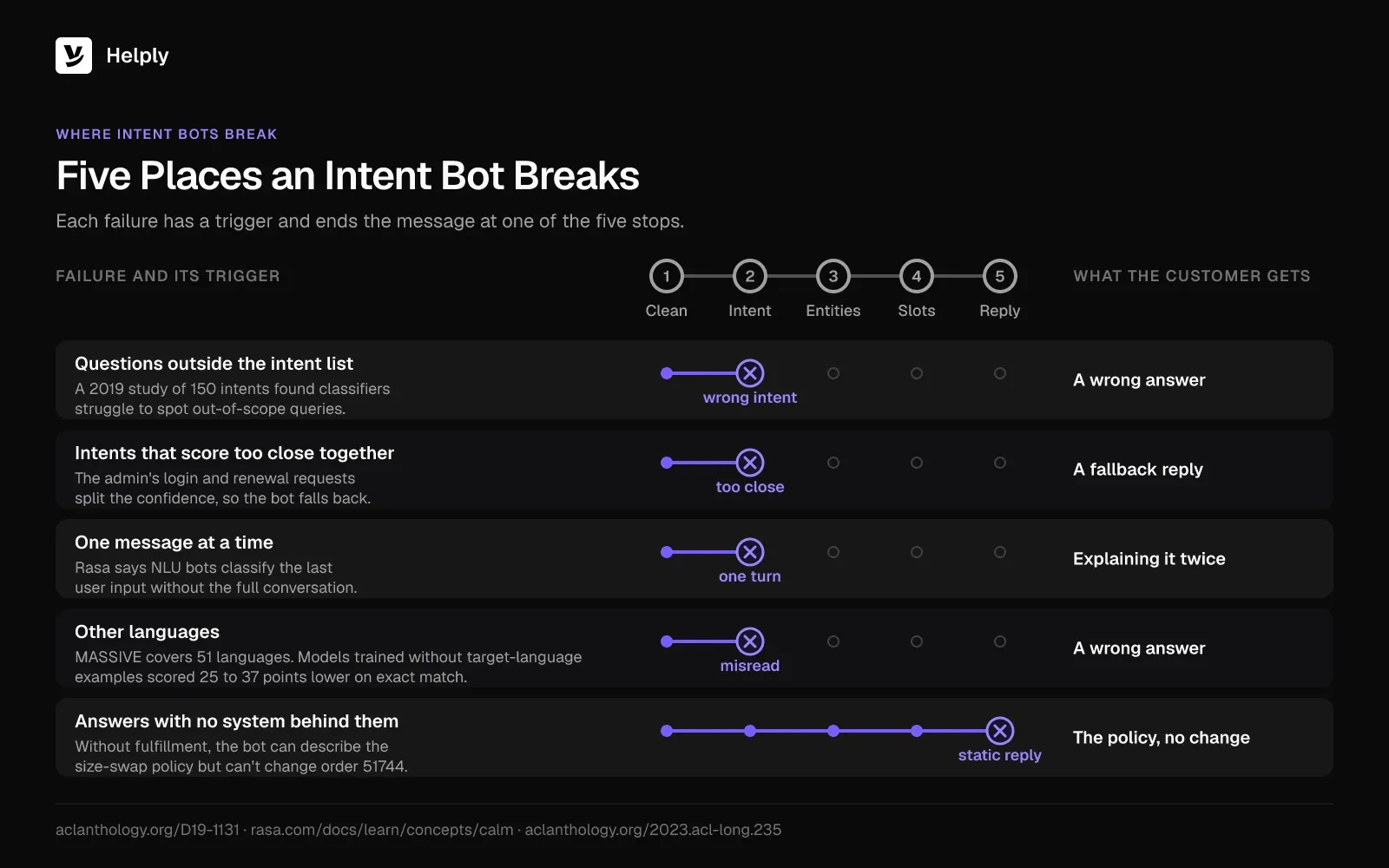
Intent-based NLP chatbots break in five predictable places, and the bot that answered both Monday messages fails at most of them.
- Questions outside the intent list. A 2019 study presented at EMNLP-IJCNLP built a dataset of 150 intents across 10 domains to test this. Its authors found classifiers did well on known intents yet "struggle to identify out-of-scope queries." An unplanned question such as the admin's Okta change can land on the wrong intent.
- Intents that score too close together. The admin's login and renewal requests split the confidence. Rasa handles this with an ambiguity threshold and a fallback intent, so the admin gets a fallback reply instead of an answer.
- One message at a time. Rasa's documentation says NLU bots classify "the last user input, without the context of the full conversation." Rasa adds that topic overlap hurts accuracy as the intent list grows.
- Other languages. Amazon's MASSIVE dataset, published at ACL 2023, covers 51 languages, 60 intents and 55 slot types. Models trained without target-language examples scored 25 to 37 points lower on exact match than models trained on the full dataset.
- Answers with no system behind them. A matched intent without fulfillment returns a static response. The bot can describe the size-swap policy but can't change order 51744.
Each failure ends in a fallback reply, a wrong answer or a customer who explains the problem twice.
NLP vs. LLM Chatbots: What Changes?
NLP chatbots and LLM chatbots both use natural language processing. An intent-based NLP chatbot sorts each new message into one intent from a list a team labeled, then sends that intent's reply. An LLM chatbot reads the whole conversation and writes each reply itself.
Rasa's documentation says LLMs outperform NLU classifiers on key dialogue-understanding tasks. They also need more computing resources, which raises cost and adds latency. Rasa's own LLM approach still turns each message into structured commands, which Rasa says "resemble intents and entities."
LLMs bring a different failure. OpenAI defines hallucinations as "plausible but false statements generated by language models." An LLM bot can state a wrong answer in a confident tone, where an intent bot would fall back.
In April 2025, the support bot at AI coding assistant Cursor told users a new login policy caused their logouts. No such policy existed. Co-founder Michael Truell later apologized, describing an "incorrect response from a front-line AI support bot."
ChatGPT is an LLM chatbot and, in the broad sense, an NLP chatbot too. OpenAI introduced it in November 2022 as a model "which interacts in a conversational way."
NLP vs. LLM Chatbots vs. AI Agents: Reading, Answers and Actions
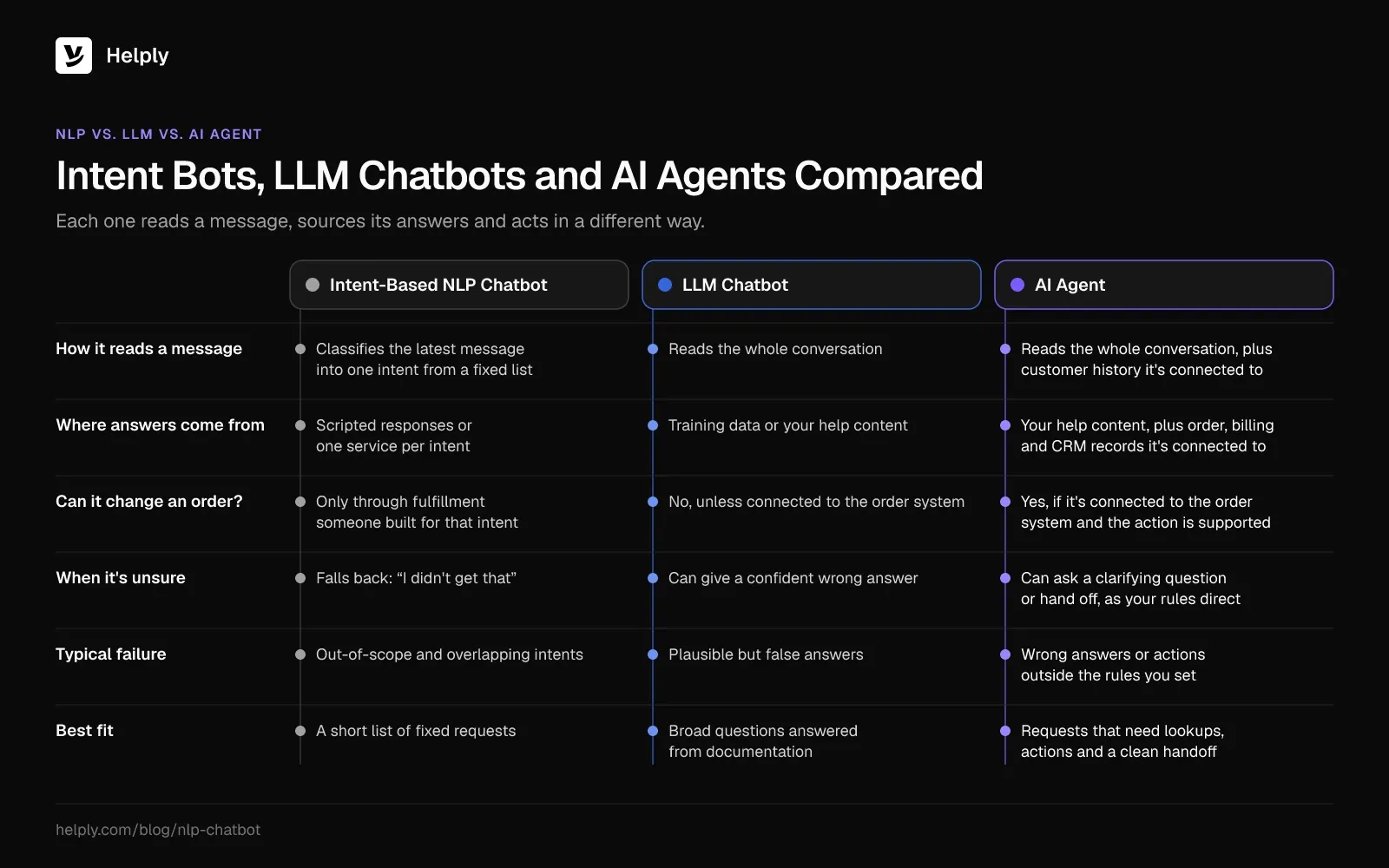
Intent bots, LLM chatbots and AI agents differ in how they read a message, where answers come from and whether they can act.
| Capability | Intent-Based NLP Chatbot | LLM Chatbot | AI Agent |
|---|---|---|---|
| How it reads a message | Classifies the latest message into one intent from a fixed list | Reads the whole conversation | Reads the whole conversation, plus customer history it's connected to |
| Where answers come from | Scripted responses or one service per intent | Training data or your help content | Your help content, plus order, billing and CRM records it's connected to |
| Can it change an order? | Only through fulfillment someone built for that intent | No, unless connected to the order system | Yes, if it's connected to the order system and the action is supported |
| When it's unsure | Falls back: "I didn't get that" | Can give a confident wrong answer | Can ask a clarifying question or hand off, as your rules direct |
| Typical failure | Out-of-scope and overlapping intents | Plausible but false answers | Wrong answers or actions outside the rules you set |
| Best fit | A short list of fixed requests | Broad questions answered from documentation | Requests that need lookups, actions and a clean handoff |
When Is an NLP Chatbot Enough for Support?
An intent bot pays off when requests are few and one reply settles each. Check your last month of chats against these points:
- Request types. A short list such as opening hours, password resets and return windows suits intents. A long tail of one-off questions doesn't.
- Account data. The size swap needs the order record. The SSO problem needs the customer's setup.
- Actions. Changing an order or checking a license goes beyond answering.
- Cost of a wrong answer. A wrong opening-hours reply annoys someone. A wrong login or billing answer creates a second ticket.
- Languages. Intent models trained in one language misread messages in others.
- A route to a person. Gartner surveyed 3,566 B2B and B2C customers in February and March 2026. In that survey, 87% said companies using GenAI must "provide an option to reach a human agent." Check that your bot offers one.
The handoff needs the history too. In the CX Trends 2026 report that Zendesk released in November 2025, 81% of consumers "want agents to continue the conversation without backtracking."
If most of your chats are a few fixed requests that need no lookups, tune the intent bot. If lookups, actions and multi-part messages dominate, AI agents fit better. For bots that answer from help-center articles, see the guide to the knowledge base chatbot.
How Helply's AI Agents Resolve or Escalate Both Messages
Helply's AI agents read the whole conversation, check the systems you connect and resolve what they can. Helply builds its support platform around those agents.
The Support Agent answers customers on each channel you connect. It draws on your knowledge base, the customer's past conversations and connected tools, and it can carry a request through to resolution.
For the shopper, the agent can check order 51744 in a connected order system. A supported action can then switch the size before it ships.
Tools give the agent that reach. Helply connects to 60+ tools, and MCP connectors plus custom API actions let you plug in your own order or account systems.
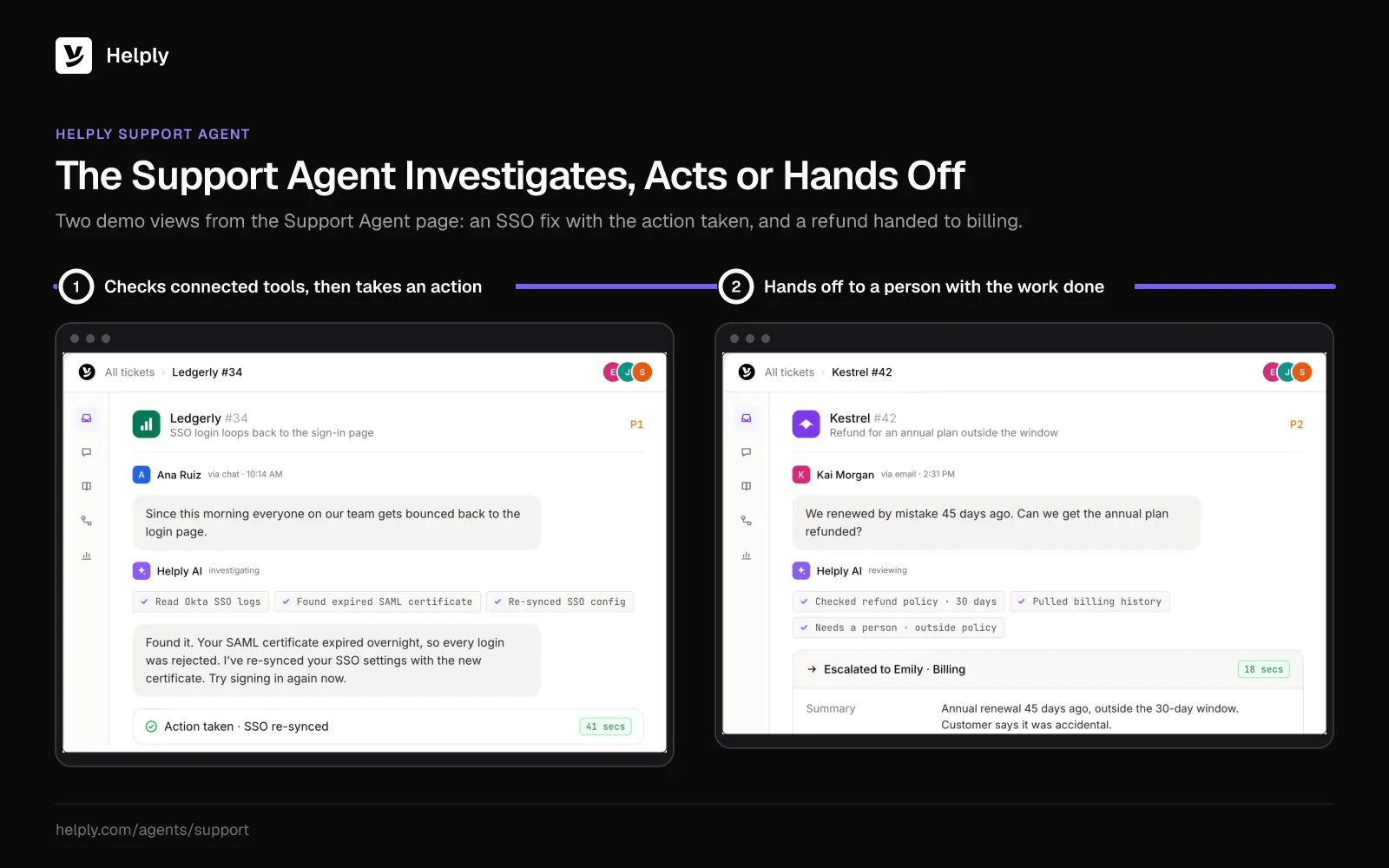
For the admin, the Support Agent reads both requests in the same conversation. It can answer the renewal question from your knowledge base or the account record in a connected tool. If it can't resolve the SSO problem with confidence, it escalates and attaches what it investigated plus the customer's details.
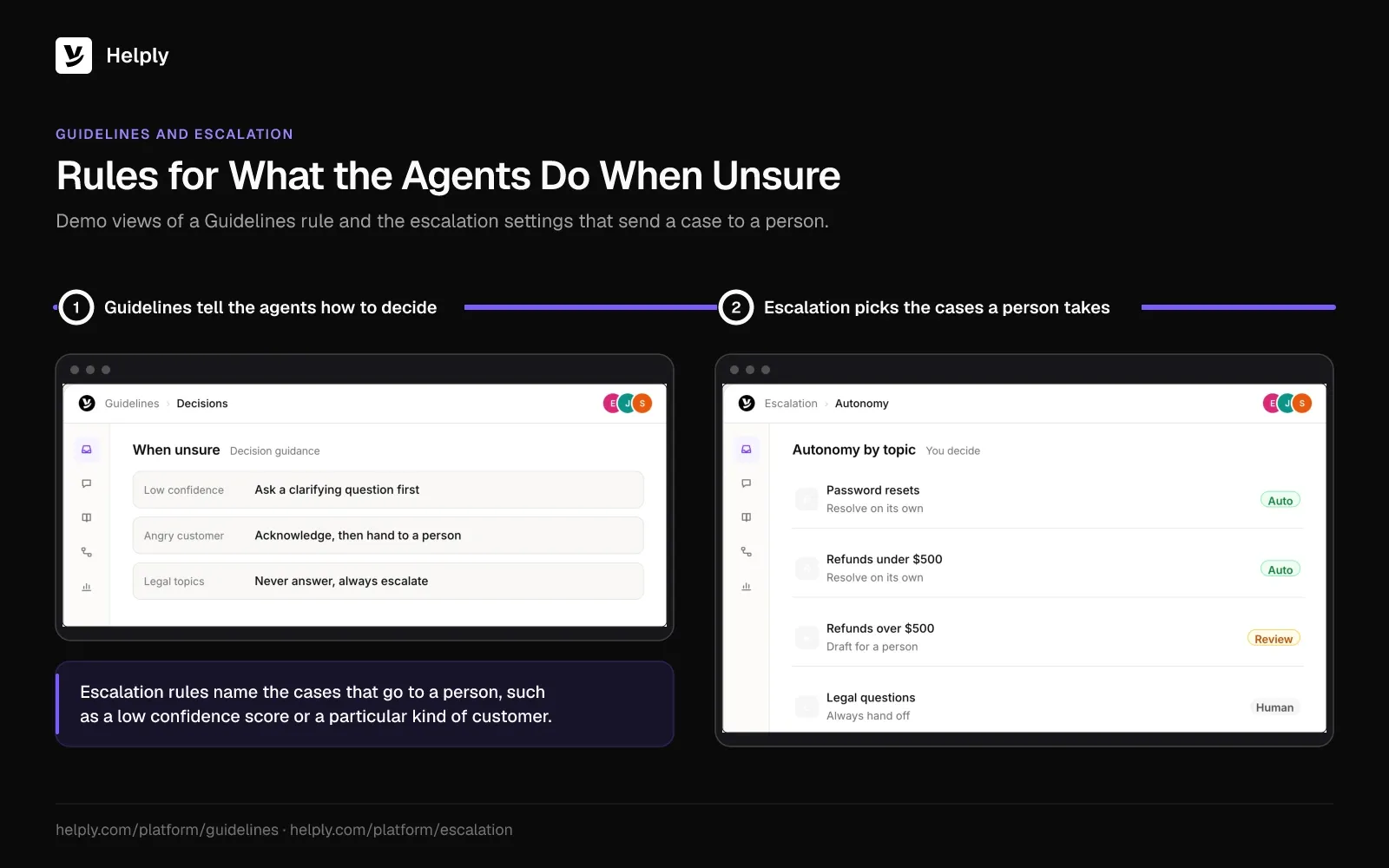
You decide what happens when the agents are unsure. Guidelines are your instructions for how the agents act and decide. One rule might say: when confidence is low, ask a clarifying question first.
Escalation rules name the cases that go to a person, such as a low confidence score or a particular kind of customer. For how cases move between levels of your team, see the guide to support tiers.
Once the SSO case reaches a teammate, the Assist Agent works beside them in that conversation. It drafts replies that follow your Guidelines and fit the customer's situation. The teammate can also tell it to run a supported action.
Intent bots fail first on questions outside their intent list. Helply hosts your knowledge base on your own domain, and AI helps write the articles and answer from them. The Knowledge Agent spots unanswered questions and stale articles in your conversations, and your team can review, edit and publish each draft.
Customers raise new request types before your team has a name for them. The Insights Agent watches conversations for trends and recurring problems and reports them to your team. Skills then teach the agents how to handle a recurring kind of work, such as an order change.
Customer data that Helply sends to AI providers never goes into training their models. Helply is SOC 2 Type II compliant. The Trust and Security page has the details.
Tune Your NLP Chatbot or Move to AI Agents?
Keep the intent bot for a short list of fixed requests. Tune its training phrases and confidence threshold, and track its chatbot containment rate. Write fallbacks that offer a person instead of asking the customer to repeat.
If lookups, account changes and two-part messages fill the queue, move those chats to AI agents. Helply's Support Agent can take that queue first.
Salesforce's State of Service research surveyed 3,075 service professionals and came out in May 2026. Salesforce found AI-agent adoption in service organizations climbed from 39% in 2025 to 66% a year later.
In the same Salesforce research, 70% of organizations using AI service agents say they saw measurable value within 60 days.
Gartner released a survey of 275 service and support leaders in November 2026. Only 4% of those leaders had reached the return they expected from AI. Start with one queue and measure what the agent resolves before you widen it.
Both Monday messages need an agent that checks the right system and hands off with what it found.
Every Helply plan includes the Support Agent, which talks to customers, and the Assist Agent, which works beside your team. Your teammates share one pool of AI credits. Every plan also hosts your knowledge base, with AI help for writing articles and answering from them.
Escalation rules, Skills, MCP connectors, custom API actions and the Knowledge and Insights Agents come with Team and every plan above it. See the full breakdown on Helply pricing.
Connect a chat channel and your help center. Then compare what the Support Agent resolves with what your intent bot sends to fallback today.
Frequently asked questions
Yes, in the broad sense. ChatGPT is a chatbot built on a large language model, and that model uses natural language processing to read and write text. OpenAI introduced it on 30 November 2022 as a model that "interacts in a conversational way."
An NLP chatbot cleans the text, classifies the intent and extracts details such as an order number. It then asks for missing details, which Dialogflow calls slot filling, and replies or calls a connected system.
An intent bot sorts each message into a team-defined intent; an LLM chatbot reads the whole conversation and writes its own reply. Rasa's documentation says LLMs understand dialogue better but cost more to run. LLMs can also state false answers with confidence.
Bots built with Google Dialogflow or Rasa are classic intent-based NLP chatbots. They match each message to a trained intent and fill slots such as an order number. ChatGPT counts too in the broad sense, as a chatbot built on a large language model.
Give each intent example training phrases, mark the entities to extract and set a confidence threshold for the fallback. Then review chats that hit the fallback and add phrases or intents for the gaps.
NLP lets software understand and produce human language. IBM describes it as a subfield of computer science and AI that relies on machine learning. In support, it powers intent detection, entity extraction, translation, summaries and the replies that chatbots and AI agents write.
If no intent clears the bot's confidence threshold, it matches a fallback intent. Dialogflow's default fallback sends replies such as "I didn't get that. Can you say it again?" A good fallback offers a person or a clarifying question instead of a loop.
Yes, and they work best with training data in each language. Amazon's MASSIVE study, published at ACL 2023, covered 51 languages. Models without target-language training scored 25 to 37 points lower on exact match than models trained on the full dataset.
An NLP chatbot answers within its intents; an AI agent also looks things up in connected tools and takes supported actions. Helply's Support Agent, for example, escalates what it can't resolve and attaches its investigation. For a full definition, read what an AI agent does.
No, Helply is a customer support platform built around AI agents. Its Support Agent answers from your help content, earlier conversations and the tools you connect. Requests it can't resolve with confidence go to your team with its findings attached.
About the author

Alex Turnbull
CEO & Founder, Helply
Alex is the CEO & Founder of Helply, (formerly Groove). He loves to help other entrepreneurs build startups by sharing his own experiences from the trenches.
Keep reading

Customer Service Statistics for 2026: Sourced Facts and Real Examples
Bildad Oyugi · 14 min read
What Is Customer Service? Meaning, Types & Examples
Jared Scheel · 12 min read