
 Jared Scheel ··12 min read

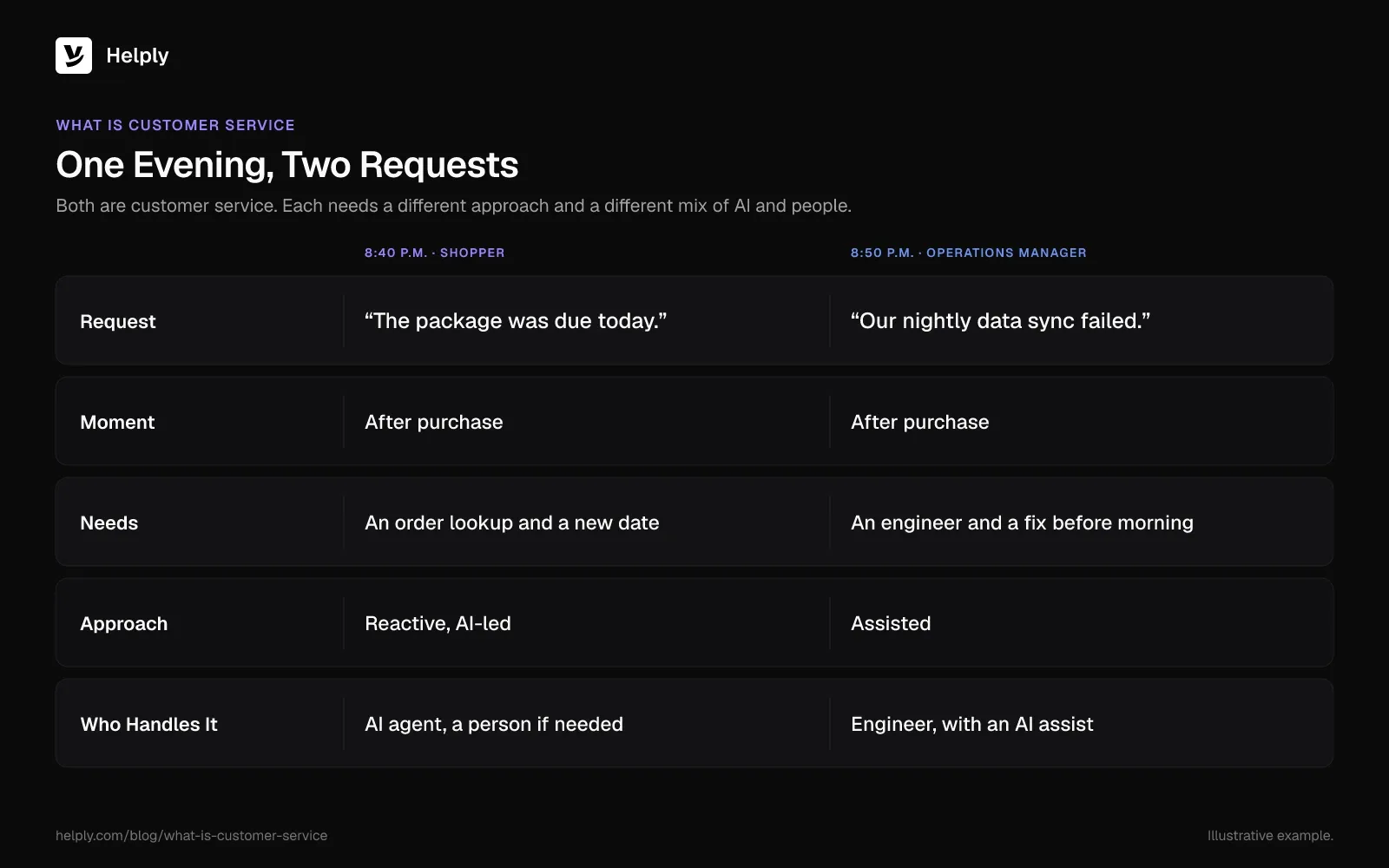
A shopper writes in at 8:40 p.m. The package was due today, and the tracking page hasn't moved since Tuesday.
Ten minutes later, an operations manager at a software company reports a failed nightly data sync. Their finance team can't send invoices until it runs.
Both messages are customer service, and both arrive after most of the team has logged off. One needs an order lookup and a new delivery date. The other needs an engineer who knows how the account's sync is set up, and a fix before morning.
Most types of customer service come in a consumer version and a business version, like these two.
What Is Customer Service?
Customer service means helping customers before, during and after a purchase. It includes answering questions, solving problems, handling requests such as returns or plan changes, and listening to feedback. Teams deliver it by phone, email, chat, messaging, social media, help centers and AI agents.
The Cambridge Dictionary defines customer service as "the way that an organization deals with customers before, during, and after a sale." Its other sense names the team that answers customers' questions and exchanges faulty goods.
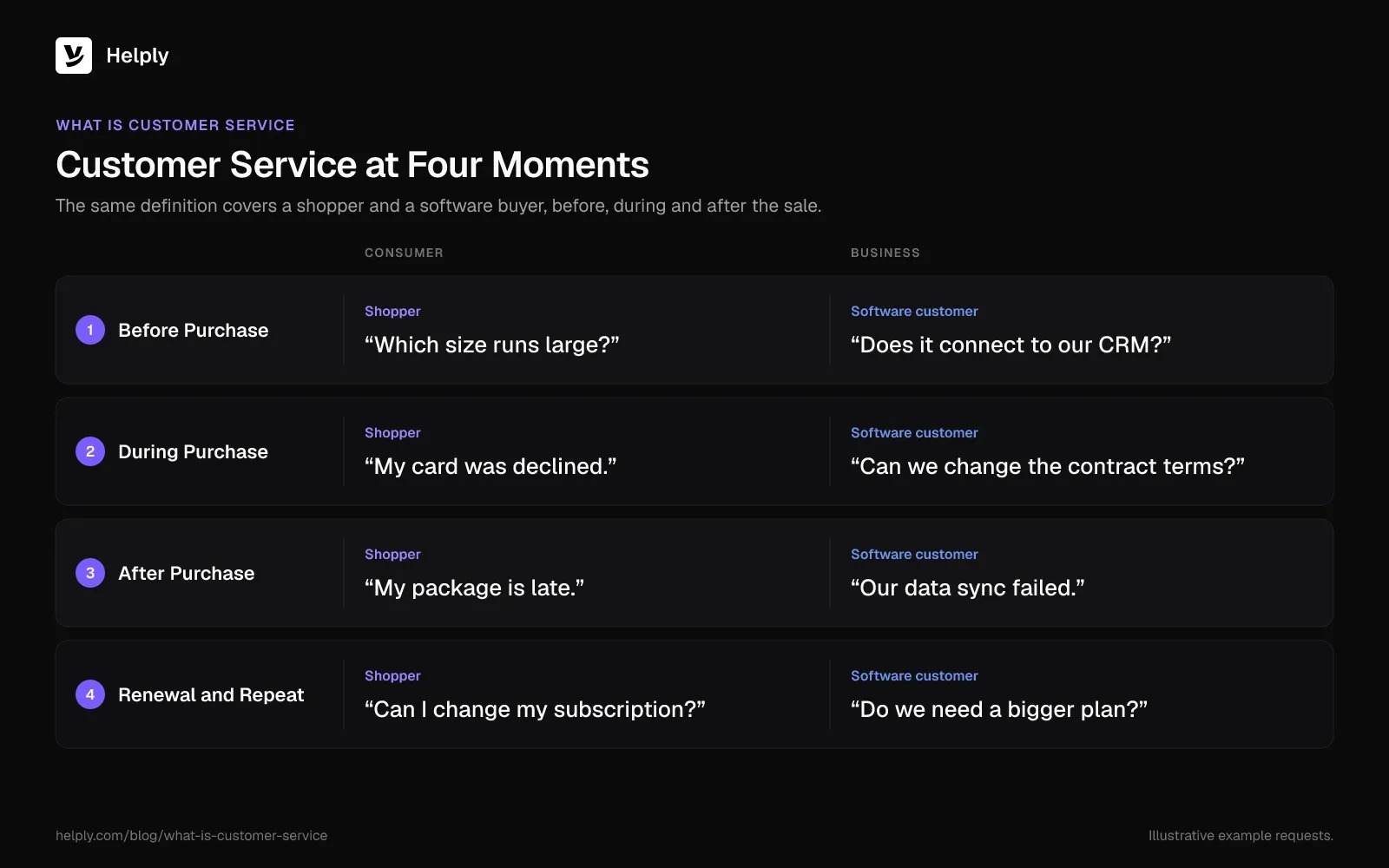
Customers need service at four moments:
- Before purchase: a shopper asks which size runs large, or a buyer asks whether the product connects to their CRM.
- During purchase: a declined card, a checkout error or a question about contract terms.
- After purchase: a late delivery, a bug, a refund or a password reset.
- Renewal and repeat purchase: a subscription change, an upgrade question or a reorder.
In everyday use, customer care and client service share the meaning of customer service. Customer support covers a narrower scope inside it. CS is the common short form.
Customer Service vs. Support vs. Experience: Scope, Owners and Metrics
Customer support is the problem-fixing part of customer service, and customer service is one part of customer experience.
| Term | What it covers | Who usually owns it | Typical measures |
|---|---|---|---|
| Customer service | All help before, during and after a purchase | The service or support team | CSAT (customer satisfaction score), first reply time |
| Customer support | Fixing specific product problems, often technical | Support team, with escalation to specialists and engineering | Resolution time, first-contact resolution |
| Customer experience (CX) | Every interaction with the brand, from ads to renewal | Leaders across marketing, product and service | NPS (Net Promoter Score), retention |
Support teams often split the harder work into support tiers, with specialists behind the front line.
Why Is Customer Service Important?
You can see the importance of customer service in retention, repeat purchases and trust. You can lose consumers and business buyers alike to poor service.
Salesforce's seventh State of the Connected Customer report surveyed 16,585 consumers and business buyers in July and August 2024. Poor customer service was the second most common reason they had stopped buying from a brand in the past year. Of those surveyed, 43% of consumers and 41% of business buyers named it.
In January 2026, two online surveys by Shep Hyken reached 2,226 US adults. Of them, 86% said great service raises their trust in a brand.
Types of Customer Service by Channel
Customer service runs on eight main channels: phone, email, live chat, messaging apps, social media, self-service, in person and AI agents. Most teams run several, and each suits a different kind of request.
- Phone: works best for urgent or emotional issues that need a real-time back-and-forth.
- Email: handles detailed requests, attachments and anything that needs a written record.
- Live chat: answers questions on the website or in the app while the customer is still there.
- Messaging apps: WhatsApp, SMS and Slack let customers write when it suits them and pick up later.
- Social media: covers public replies and private messages on platforms such as Instagram, Facebook and X.
- Self-service: a help center, FAQ or community forum lets customers find answers without contacting anyone. A knowledge base sits behind most of them.
- In person: stores, branches, service desks and on-site visits.
- AI agents: software that answers, investigates and resolves requests across the other channels, and hands off to a person when needed. See what an AI agent is.
A help desk pulls these channels into one queue, so requests don't get lost between them. For the digital channels on their own, read our guide to online customer service.
Types of Customer Service by Approach
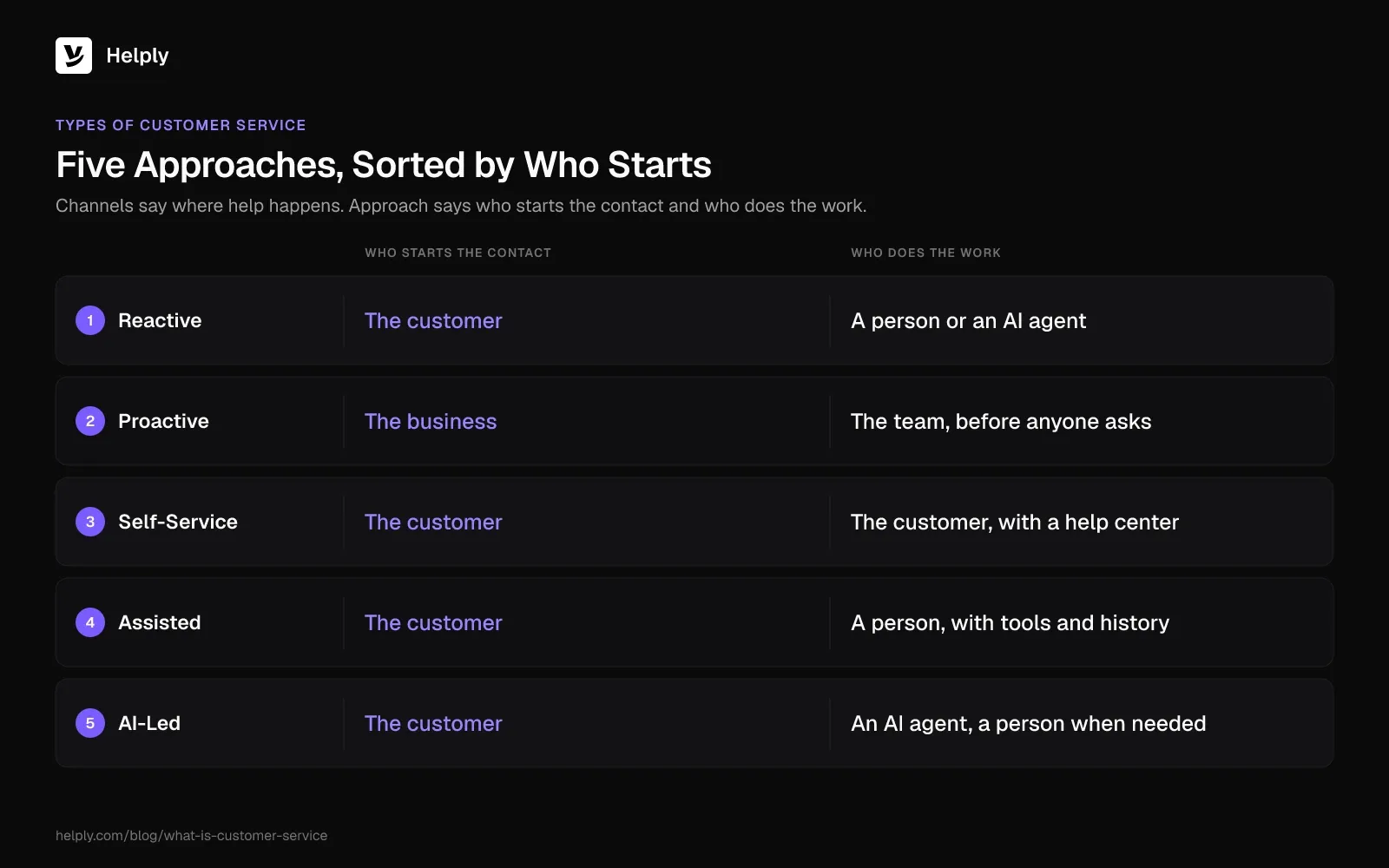
By approach, customer service is reactive, proactive, self-service, assisted or AI-led, depending on who starts the contact and who does the work.
- Reactive: the customer starts the contact, and the team answers.
- Proactive: the business reaches out before the customer notices a problem, with an outage notice or a delay alert.
- Self-service: the customer solves the problem alone. Gartner's December 2023 survey found only 14% of issues fully resolved this way, and only 36% of the simplest ones.
- Assisted: a person handles the request, with tools and history in front of them.
- AI-led: an AI agent handles the request and passes it to a person when needed.
Customers accept AI more when they can still reach a person. Gartner surveyed 3,566 business and consumer customers in February and March 2026. Of them, 87% told Gartner that a company using GenAI for service has to give them a route to a human.
Business buyers are more open to AI agents. In Salesforce's 2024 survey, 46% of them would work with one instead of a person for faster service, against 30% of consumers. With a clear path to a person, 56% of business buyers are likelier to use one, against 45% of consumers.
Customer Service Examples: Five B2C and B2B Pairs
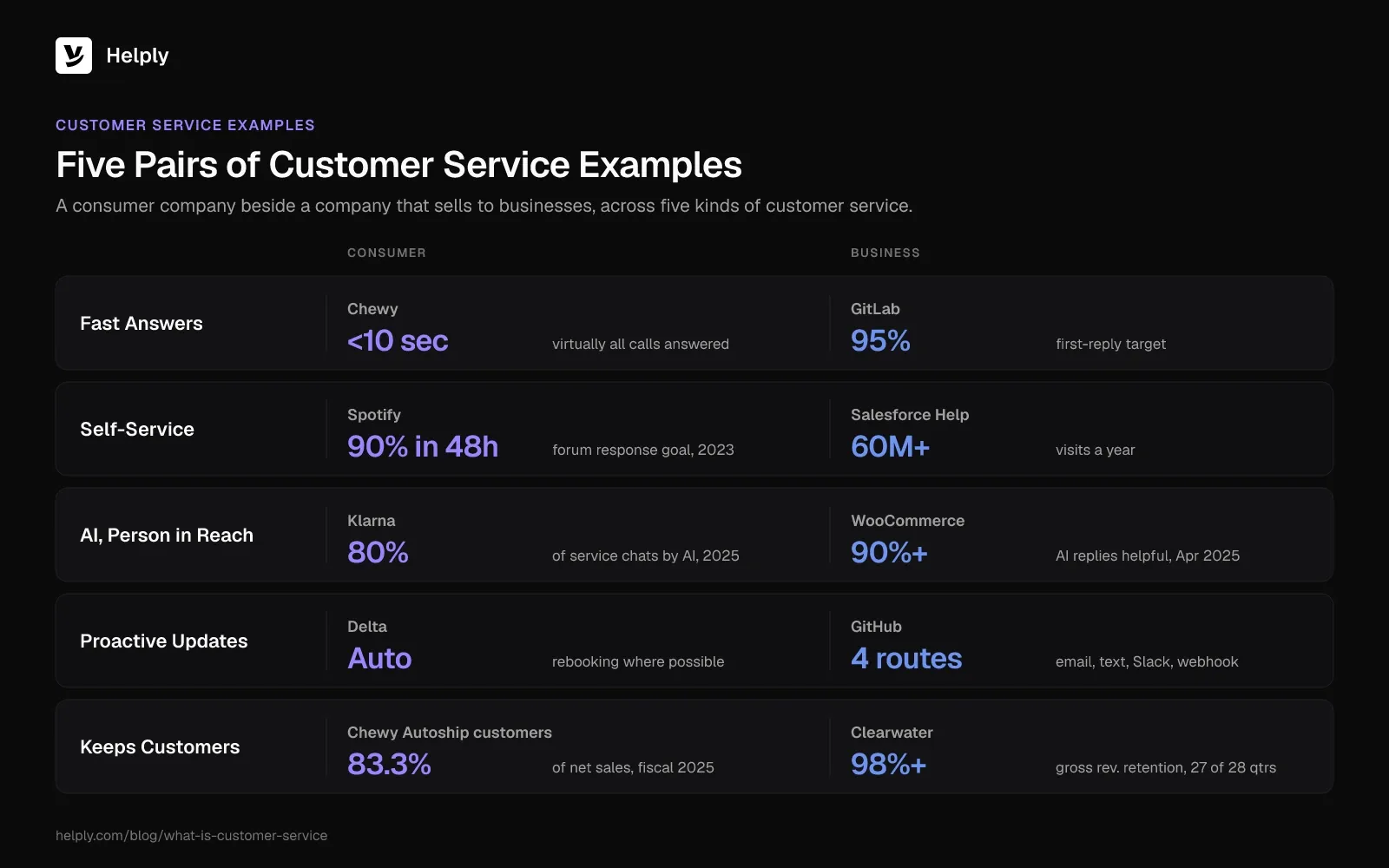
Each pair sets a consumer company beside one that sells to businesses. The pairs cover fast replies, self-service, AI with a human backup, proactive updates and retention.
Fast Answers by Phone and Ticket: Chewy and GitLab
Chewy, the online pet retailer, writes: "Our commitment to customer service is the core of our brand." Its annual report for fiscal 2025 says its team answers virtually all customer calls in under ten seconds.
GitLab sells developer software to businesses and publishes its support targets in a public handbook. It targets 95% of tickets meeting the first-reply time in each customer's support plan, and a 95% satisfaction score.
Both put a number on speed. Publish yours, as GitLab does, and customers know what reply time to expect before they write in.
Self-Service at Scale: Spotify and Salesforce Help
Spotify runs a community forum for listeners' help questions. Its 2023 goal was a response to 90% of new forum topics within 48 hours.
Salesforce Help, the support site for Salesforce's business customers, gets more than 60 million visits a year. Its support team still receives around two million support requests a year.
Even with a busy help center, keep people on hand for the requests customers can't solve on their own.
AI with a Person in Reach: Klarna and WooCommerce
Klarna, the payments company, says its AI assistant handled 80% of customer service chats in 2025. Its annual report adds that every customer can still choose a human. Klarna's CEO told Bloomberg in May 2025 that investing in "the quality of the human support is the way of the future for us."
WooCommerce, which sells ecommerce software and extensions to store owners, replaced its 24-hour acknowledgment email with an instant AI reply. By April 2025, WooCommerce rated its AI replies helpful more than 90% of the time, up from about 60% at the start. Customers who need more hit reply to reach a person.
Pair the AI reply with a clear route to a person, as both companies do.
Proactive Updates: Delta and GitHub
Delta aims to tell travelers about a cancellation or significant delay by email, text, phone call or the Fly Delta app. It also rebooks them automatically where possible, at no extra cost, and sends the new schedule.
GitHub, which software teams use to host their code, runs a public status page. Customers can subscribe to incident alerts by email, text, Slack or webhook, so they hear when GitHub opens and resolves an incident.
Both tell customers about a problem before they have to ask. One outage alert can head off a wave of "is it down?" tickets.
Service That Keeps Customers: Chewy Autoship and Clearwater Analytics
Chewy's Autoship customers get repeat deliveries on a schedule. Chewy's fiscal 2025 annual reportshows they accounted for 83.3% of net sales, up from 76.2% in fiscal 2023.
Clearwater Analytics sells investment accounting software to institutions. Its fiscal 2025 annual report puts gross revenue retention at 98% or higher in all but one of the past 28 quarters. The company attributes that partly to its focus on client service.
B2B vs. B2C Customer Service: Customers, Requests and Success Measures
The definition is the same in both markets, but the customers, requests and success measures differ.
| Dimension | B2B customer service | B2C customer service |
|---|---|---|
| Customer | A company, with several people contacting support | One person buying for themselves |
| Typical requests | Setup, integrations, permissions, contracts, outages | Orders, deliveries, returns, billing, log-ins |
| Volume and value | Fewer contacts, higher value per account | Many contacts, lower value each |
| Common channels | Email, chat, shared Slack channels, account managers | Phone, chat, messaging, social, self-service |
| What's at stake | A renewal and an expansion | A repeat purchase and a review |
| Success measures | Resolution quality, SLAs, retention | Speed, CSAT, first-contact resolution |
Marketplaces and many software companies serve both kinds of customer at once, sometimes through one support team.
What Does Good Customer Service Look Like?
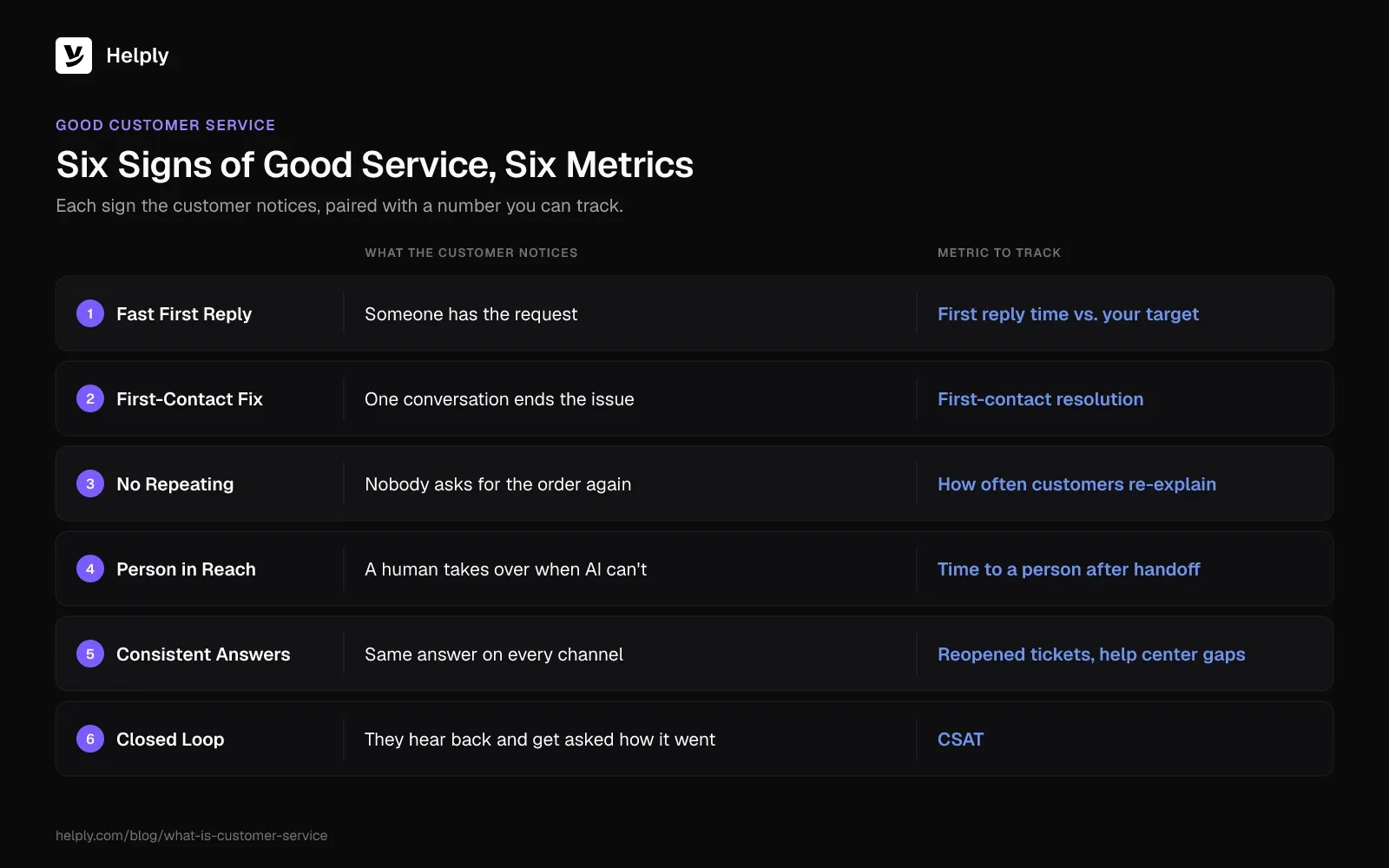
Good customer service ends the issue on the first try, without making the customer chase it. Watch for six signs, each with a metric to track:
- A fast first reply: The customer knows someone has the request. Track first reply time against a target you publish, as GitLab does.
- Resolution on the first contact: One conversation ends the issue. Track first-contact resolution.
- No repeating: The rep or AI agent who answers knows the order, the account and the last conversation. Track how often customers re-explain. In a June 2025 Zendesk survey, 74% of consumers reported frustration at repeating information.
- A person within reach: AI handles routine work, and a human takes over when it can't. Track time to a person after a handoff.
- Consistent answers: Customers get the same answer on each channel and from each agent, drawn from a current help center. Track reopened tickets and help center gaps.
- A closed loop: The customer hears back when a fix ships or a refund lands, and the team asks how it went. Track it with a CSAT survey.
Teams with customers across time zones add a seventh sign: coverage outside office hours. Our guide to 24/7 customer support covers the options.
Running All Five Approaches from One Help Desk
The late order and the failed sync arrived on the same evening. In Helply, both land in one help desk, and each customer's messages stay in one thread across channels. Channels include email, live chat, phone, Slack, Telegram, WhatsApp, SMS, Discord and Microsoft Teams.
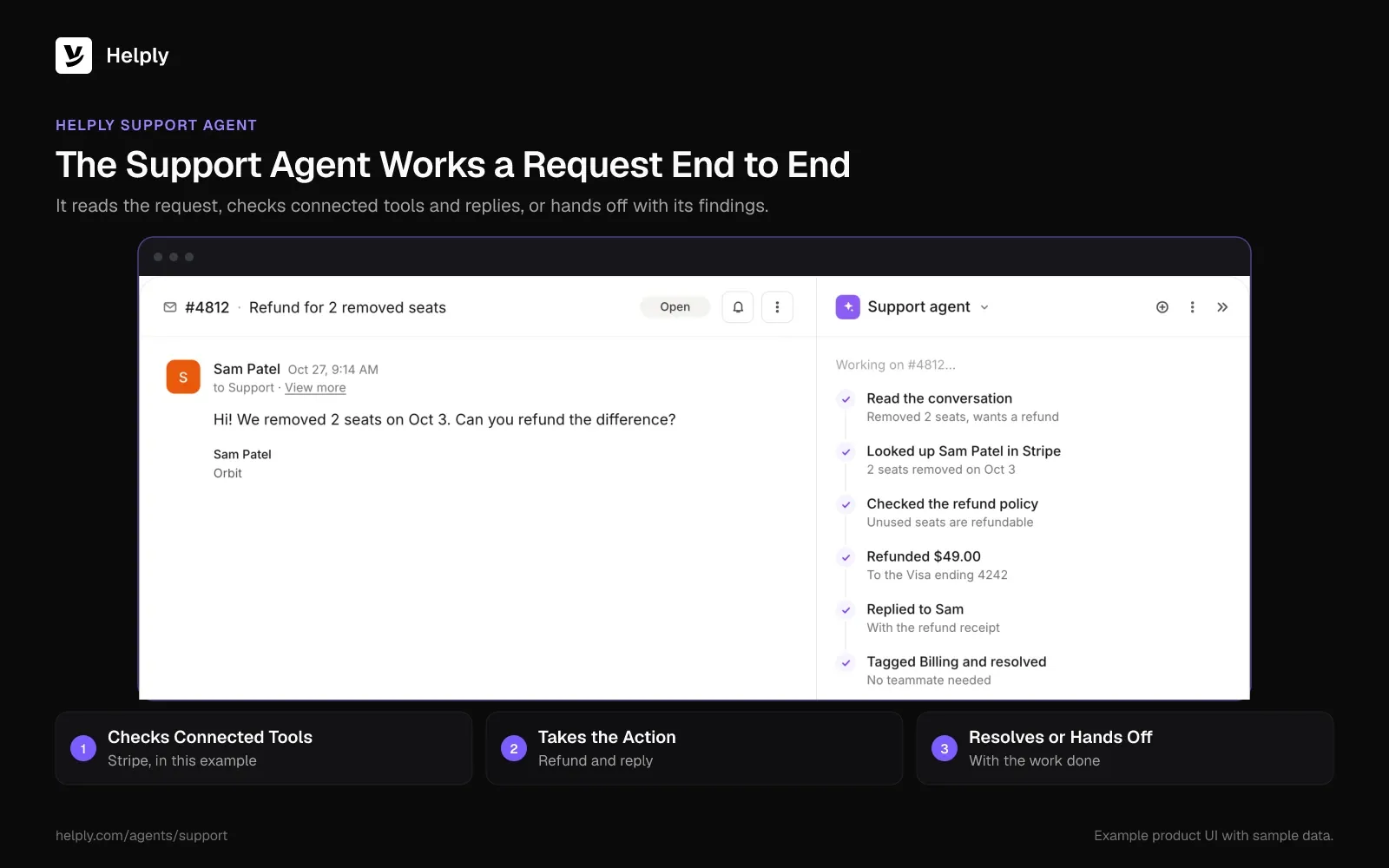
The Support Agent handles customer conversations on every channel. For the late order, it can check your connected order systems and reply with the new date. If it can't resolve the request, it hands the conversation, with its findings, to a person.
For the failed sync, your engineer gets help from the Assist Agent in the same thread. It looks into the account, writes a draft reply and runs the actions your engineer signs off on. The customer's full historysits on the same screen.
Your team sets escalation rules for when AI carries on and when a person steps in, so the failed sync reaches an engineer. The Support Agent answers from your help center, and your team reviews AI-drafted articles before they go live. With proactive messages, your team can reach customers before they write in.
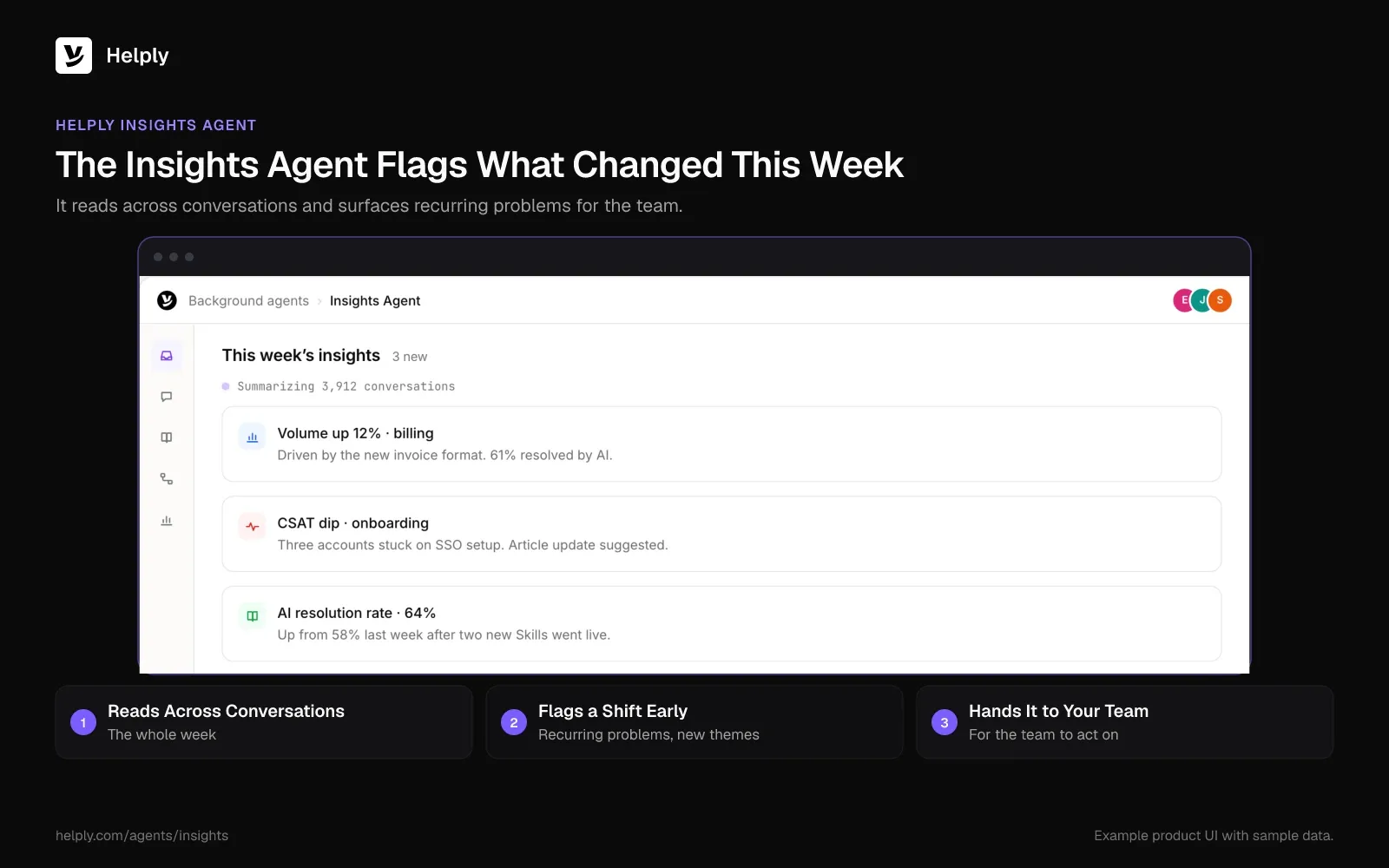
Two more agents work in the background across conversations. The Insights Agent spots recurring problems and new themes. The Knowledge Agent flags missing and outdated help center content for your team to review.
On security, Helply has an independent SOC 2 Type II report and is built to support GDPR. The AI providers behind Helply never train on your customers' data. You'll find the rest on the Trust and Security page.
AirGigs runs a music marketplace where artists hire session musicians, vocalists and audio engineers. Its queue filled with the same questions about log-ins, order status and payouts. Each one needed a person to dig through account records.
On Helply, the Support Agent became first contact. With access to AirGigs' account, order and payment records, it runs those lookups itself, around the clock for buyers and sellers. It resolves 68% of AirGigs' conversations end to end.
With the Assist Agent's help, one full-time rep moved from the queue to marketplace operations. The Insights Agent flags payout and delivery problems early.
Both front-line agents, Support and Assist, are part of every Helply plan. The Knowledge and Insights Agents, Slack Connect, WhatsApp, SMS, Discord, proactive messages, SLAs and escalation rules start on Team. Microsoft Teams needs Pro, and Helply pricing shows each plan in full.
Start with Your Busiest Channel or Your Most Repeated Question
If most requests repeat the same few questions, start with self-service and an AI agent on your busiest channel. If most need investigation across accounts and tools, start with a help desk, clear ownership and escalation rules. In Helply, the Support Agent takes the repeat questions, and the Assist Agent helps your people work through the investigations.
The shopper with the late order can get an answer that evening, with the new delivery date. The operations manager can hear from an engineer who has the account history and a drafted reply, in time to send the invoices.
Begin with one channel and your ten most common questions. Read the conversations the Support Agent resolves and the ones it hands off, then add the next channel.
Frequently asked questions
A rep tracking down a late order and confirming a new delivery date is customer service. So is GitHub's status page, which alerts business customers to outages before they ask. Chewy reports answering virtually all customer calls in under ten seconds.
No. Customer service covers the help customers get before, during and after a purchase, and it is one part of customer experience. Customer experience covers every interaction with the brand, including ads, the product, billing and service.
Excellent customer care means the team resolves the issue fast and on the first contact, and the customer doesn't have to repeat anything. The team also keeps a person available and follows up once the fix lands.
BPO customer service is support run by an outside company under contract. BPO stands for business process outsourcing, and the outsourcer's agents answer calls, emails and chats in your brand's name.
By channel, the common types of customer service are phone, email, chat, messaging apps, social media, self-service, in-person help and AI agents. By approach, customer service is reactive, proactive, self-service, assisted or AI-led.
CS is the common abbreviation for customer service. Teams also say customer care or client service, while customer support is a narrower term and CX means the broader customer experience.
A representative answers questions, solves problems and handles requests such as returns, refunds and account changes. Reps also log what customers report, so product and operations teams can fix the causes.
Partly: AI agents can resolve many routine requests, but customers expect a way to reach a person. Zendesk's CX Trends 2027 survey, run in July and August 2026, found 88% of consumers still want a human when needed. Helply's Support Agent handles the requests it can resolve and passes the rest, already investigated, to your team.
In an interview, a strong answer defines customer service as solving the customer's whole problem, on the first contact where possible. Back it with one short story of a time you did that for someone.
About the author

Jared Scheel
Co-founder & CTO
Keep reading

Customer Service Statistics for 2026: Sourced Facts and Real Examples
Bildad Oyugi · 14 min read
NLP Chatbots: How Natural Language Processing Works in a Support Chat
Alex Turnbull · 12 min read