
 Bildad Oyugi ··15 min read

Key Takeaways
- Bank of America's Erica, Air India's AI.g and MyBaggage's agent answer from the customer's own account, booking or shipment data.
- Klarna's assistant took two-thirds of chats in month one and 69% in the year to June 2025. In May 2025, Klarna's CEO told Bloomberg cost-first planning had lowered quality.
- Lyft said in February 2025 that its assistant cut average resolution time by 87%. The assistant hands cases that need judgment to a person with an AI-written summary.
- Among failed customer service chatbot examples, Cursor's bot invented a device policy. A tribunal ordered Air Canada to pay C$812.02 over a wrong fare answer.
- Helply's Support Agent resolved 77% of MyBaggage's customer questions end to end, using live tracking, delivery and customs data.
What Makes a Customer Service Chatbot Example Worth Copying?
A customer asks your chatbot, "Did my refund go through?" It can't see billing, so it pastes the refund policy. The customer read that policy yesterday.
Only your billing system holds the answer, so the customer emails your team and someone checks billing by hand. A software customer who asks why an invoice doubled gets a billing FAQ and takes the same detour. If you're rethinking the bot you run, start with what an AI chatbot for customer service does.
Gartner surveyed 497 customers from December 2022 to February 2023, and only 8% had used a chatbot in their latest service experience. Of those, 25% said they would use that chatbot again.
In the same survey, chatbots resolved 58% of returns and cancellations, but 17% of billing disputes. A return follows a fixed policy, while a billing dispute needs the account, the invoice and judgment.
Each example below fits one of four chatbot use cases:
- Answer questions from help content and policies, like Amtrak's Ask Julie, DoorDash's Dasher line and Octopus Energy's Arlo.
- Look up the customer's own account, booking or shipment, like Erica, AI.g and Helply's Support Agent at MyBaggage.
- Act on the request, such as a refund or a return, the way Klarna's assistant manages them.
- Hand off to a person with the case written up, like Lyft's assistant.
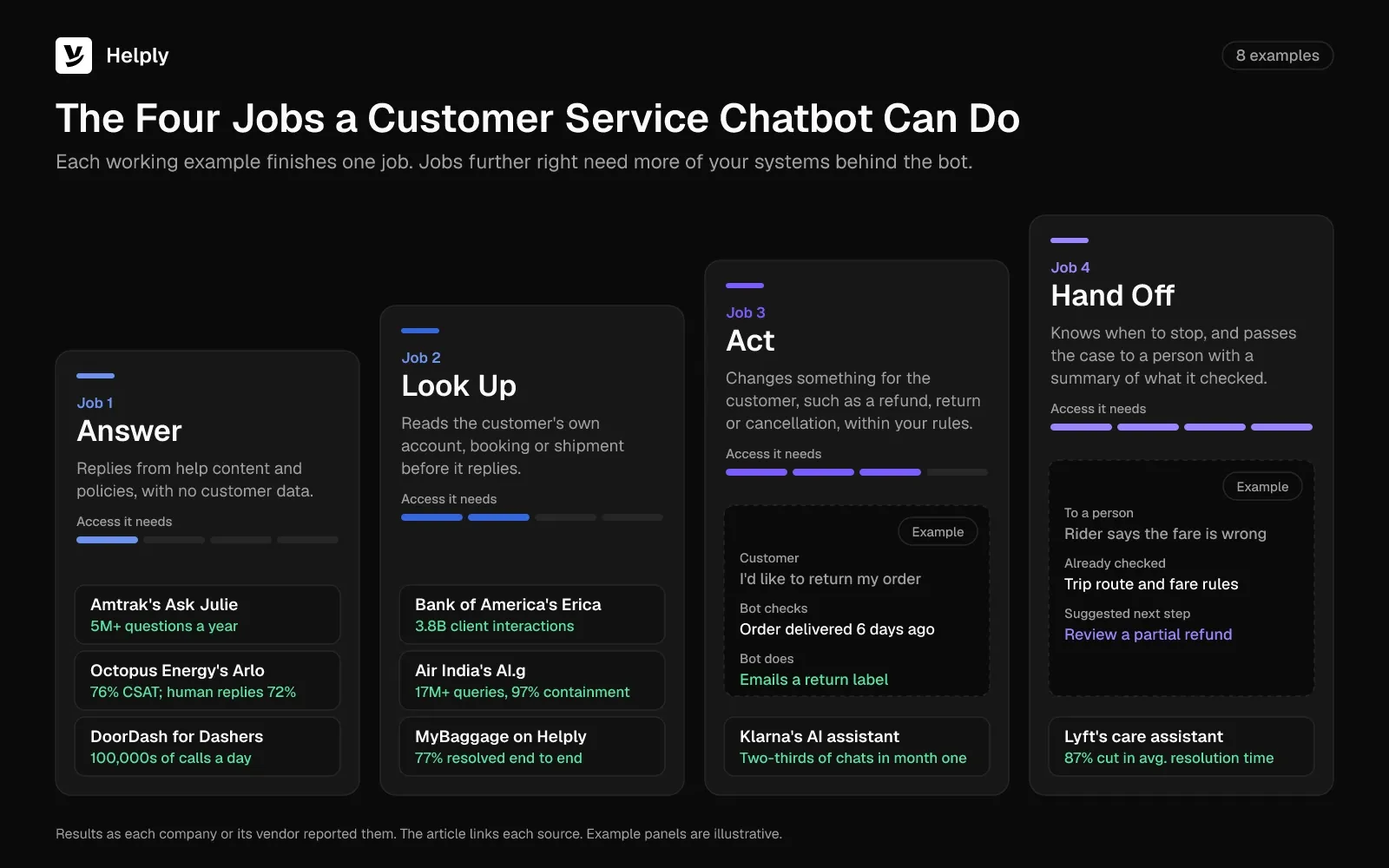
"Did my refund go through?" is a look-up job, because the answer sits in billing.
Customer Service Chatbot Examples Compared: Job, Scope and Result
Three examples answer from content, three look up customer data, one acts and one hands off. Each company or its vendor published its figure.
| Example | Main job | What it handles | Published result | Reported by |
|---|---|---|---|---|
| Bank of America: Erica | Look up | Balance trends, cash-back deals, rewards, appointments | 3.8 billion client interactions since 2018 | Bank of America, 2026 |
| Klarna: AI assistant | Act | Refunds, returns, payments, cancellations, disputes | Two-thirds of chats in month one; 69% in the year to June 2025 | Klarna, 2024 and 2025 |
| Lyft: customer care assistant | Hand off | Rider and driver issues | 87% shorter average resolution time | Lyft, 2025 |
| Air India: AI.g | Look up | Flight status, bookings, baggage, refunds | 17 million+ queries, 97% containment | Air India, 2026 |
| DoorDash: Dasher voice assistant | Answer | Dasher support calls | Hundreds of thousands of calls a day; thousands fewer escalations a day | AWS case study, 2024 |
| Octopus Energy: Arlo | Answer | Customer emails, never vulnerable customers | 76% satisfaction vs. 72% for comparable human replies | Octopus Energy, 2026 |
| Amtrak: Ask Julie | Answer | Travel questions, booking forms | 5 million+ questions a year; 30% more revenue per booking | Verint (vendor), undated |
| MyBaggage: Helply Support Agent | Look up | Tracking, delivery windows, customs | 77% of questions resolved end to end | Helply customer story |
8 Customer Service Chatbot and AI Agent Examples That Worked
These AI chatbot examples span banking, payments, ride-hailing, airlines, delivery, energy and rail, plus one AI agent in luggage shipping.
1. Bank of America's Erica: Account Answers Across 3.8 Billion Interactions
The bank's October 2026 fact sheet says Erica has passed 3.8 billion client interactions since its 2018 launch. Clients use it nearly 200 million times a quarter, by the bank's count.
Erica answers Bank of America clients' questions about their own accounts. It tells clients which way their balances are trending over the next seven days. It flags cash-back deals, checks Preferred Rewards eligibility and books appointments with a person.
A 2025 Bank of America release says Erica answers from a library of more than 700 responses. Bank of America has updated Erica over 75,000 times since launch. Erica has sent more than 1.7 billion "proactive, personalized insights," the bank says.
Copy the library and the exit. Keep a library of approved answers, edit it as questions change, and let customers book time with a person.
2. Klarna's AI Assistant: Two-Thirds of Chats, Then a Quality Rethink
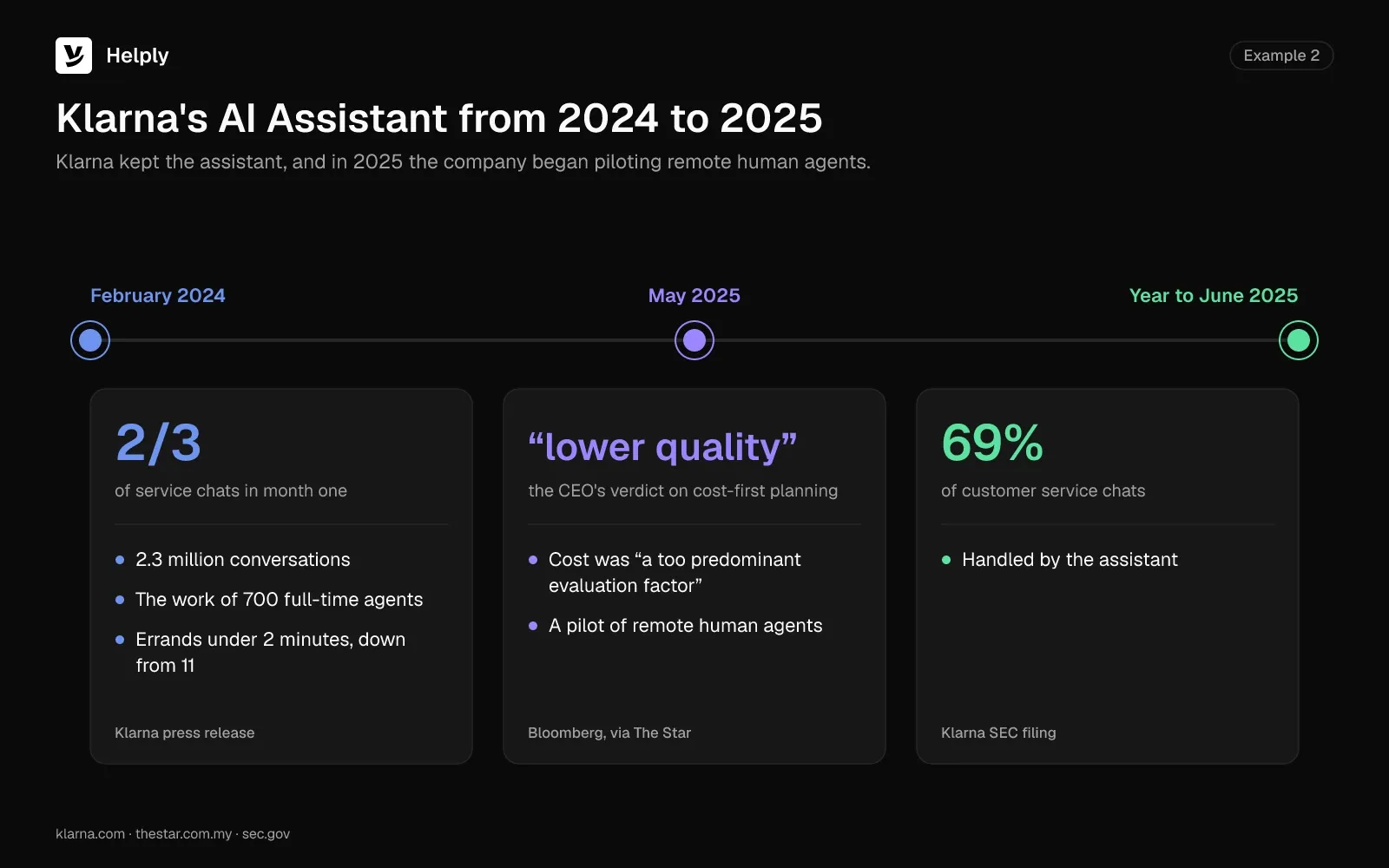
Klarna announced its OpenAI-powered assistant in February 2024, a month after the assistant's global launch. It handles refunds, returns, payment issues, cancellations, disputes and invoice errors.
Klarna said the assistant handled 2.3 million conversations in month one, two-thirds of its customer service chats. Klarna put that at the work of 700 full-time agents.
Klarna's announcement said errands took under 2 minutes, down from 11, and repeat inquiries fell 25%. Klarna said satisfaction scores matched those of human agents. The assistant worked in 23 markets and more than 35 languages, and customers kept the option of a live agent.
In May 2025, CEO Sebastian Siemiatkowski told Bloomberg that cost had been "a too predominant evaluation factor" and the result was "lower quality."
Klarna began piloting remote human agents "in an Uber type of setup," Bloomberg reported. The CEO said customers should know "there will be always a human if you want."
Klarna kept the assistant. Its September 2025 SEC filing says the assistant handled 69% of customer service chats in the year to June 2025.
Klarna's 2025 human-agent pilot is the part to copy. Measure quality next to volume, and keep a person one step away however many chats the bot takes.
3. Lyft: Faster Resolutions and a Summary for the Specialist
Lyft's customer care AI assistant runs on Anthropic's Claude through Amazon Bedrock. It gives fast answers to the most common rider and driver issues.
Lyft said in February 2025 that the assistant cut average resolution time by 87% and resolved thousands of customer requests a day.
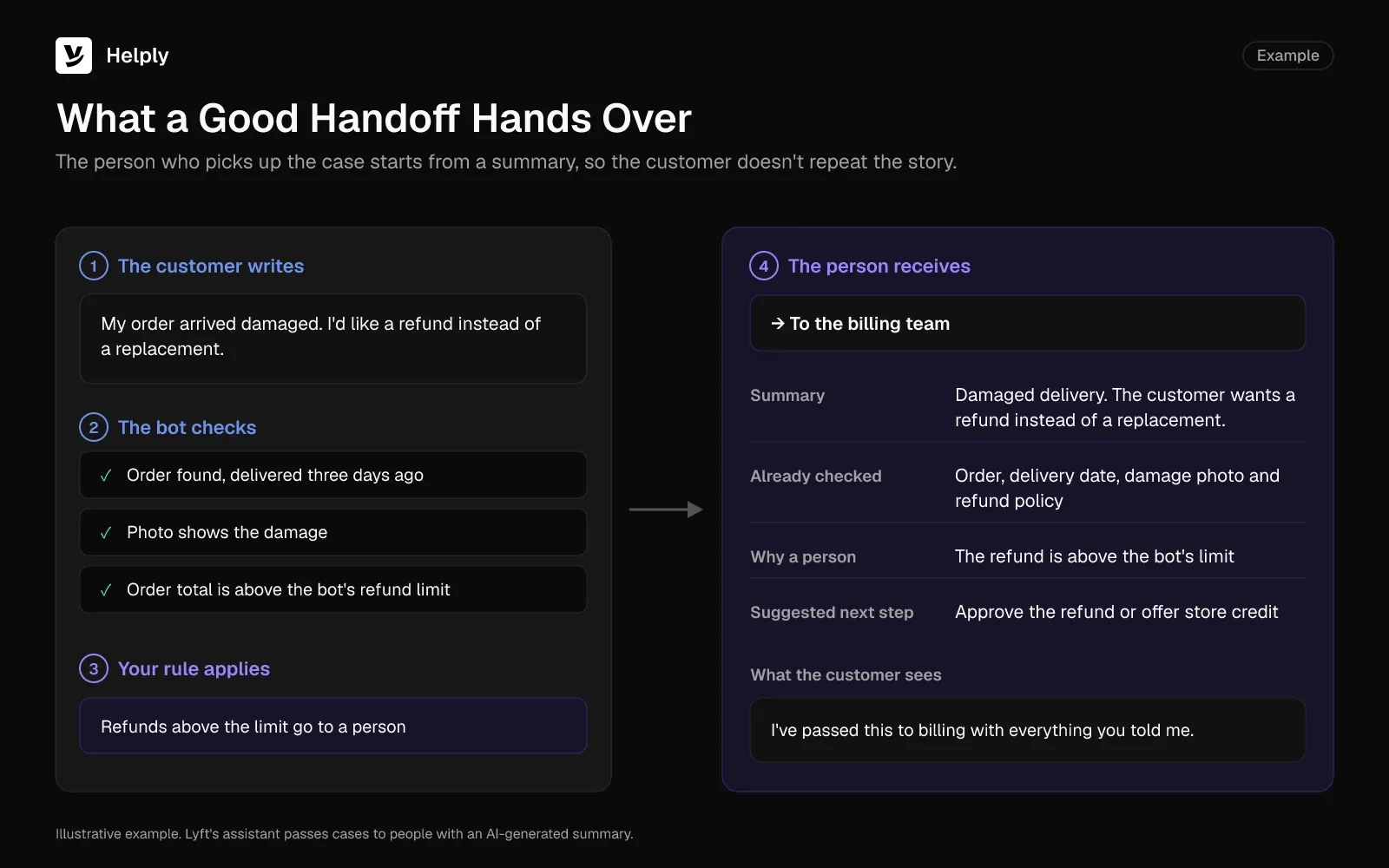
If a case needs human judgment, the assistant routes the customer to a person with an AI-generated summary, per Anthropic's case study. The specialist starts from that summary, so the customer shouldn't have to tell the story twice.
Copy the handoff. Decide what the summary must contain before you decide what the bot may answer.
4. Air India's AI.g: Flight Status, Refunds and Baggage in Four Languages
Air India launched AI.g in May 2023. It answers in Hindi, English, French and German, and covers check-in, flight status, baggage, bookings, refunds and cancellations.
In April 2026, Air India said AI.g had handled over 17 million customer queries, with more than 18,000 daily sessions. The airline put AI.g's containment rate at 97%.
Containment counts conversations that never reached a person, and a contained conversation isn't always a resolved one. Read what a chatbot containment rate measures before you compare bots on it. AI.g escalates to contact center staff when it detects a need for more help, according to Microsoft.
Copy the connection to live data. List the questions only your systems can answer, like order status or a refund's progress, and connect those systems first.
5. DoorDash: A Voice Assistant That Takes Dasher Calls
DoorDash runs a voice assistant that answers Dashers, the independent contractors who deliver its orders, when they call support. DoorDash built it with Amazon Bedrock and Anthropic's Claude, and it was ready for live testing in about two months.
AWS reported in a 2024 case study that the assistant answers in 2.5 seconds or less. The assistant fields hundreds of thousands of Dasher calls a day and cut escalations to live agents by thousands a day.
Time every reply during testing, because a caller waits in silence for each answer.
6. Octopus Energy: AI-Written Emails with Labels and Limits
Octopus Energy started with AI drafts that staff supervised. In May 2023, CEO Greg Jackson wrote in The Times that AI-written emails scored 80% customer satisfaction, against 65% for skilled, trained people. By then AI answered 34% of customer emails, which Jackson called "the work of about 250 people."
In 2026 Octopus trialed Arlo, an AI assistant that answers customer emails. Over three months, Arlo handled about 8,000 emails a week, 4% of the total.
Octopus reports that Arlo scored 76% satisfaction, against 72% for comparable human replies. Every AI email carries a label, customers can ask for a person at any stage, and Arlo never handles vulnerable customers.
Copy the limits. Decide which customers and cases the bot never handles, the way Octopus keeps vulnerable customers, sensitive cases and complex complaints with people.
7. Amtrak's Ask Julie: Travel Answers That Lead to Bookings
Ask Julie answers travel questions on Amtrak's website and fills in booking forms for travelers.
Verint, the vendor behind Julie, reports that Julie answers more than 5 million questions a year. In an undated case study, Verint credits Julie with 30% more revenue per booking and an 8x return on the chatbot investment.
Put the bot where customers decide, like checkout or booking, so a customer with an answer can buy on the spot.
8. MyBaggage: An AI Agent That Resolved 77% of Questions from Live Data
MyBaggage ships bags, boxes and belongings door to door across borders for students, travelers and businesses. Its customers ask "Where's my shipment?" the way yours ask whether a refund went through, and the answer sits in tracking data. The documentation had gaps that support kept running into.
Helply's Support Agent now checks MyBaggage's tracking and carrier systems for live answers across web, email and WhatsApp. The agent resolved 77% of customer questions start to finish, according to Helply's customer story.
Before going live, the team imported its support content and mapped the gaps, and Helply drafted the missing articles. Read MyBaggage's story for the full setup.
Copy the gap check. List the questions your help center can't answer, and write those articles before launch.
4 Customer Service Chatbot Failures and What Went Wrong
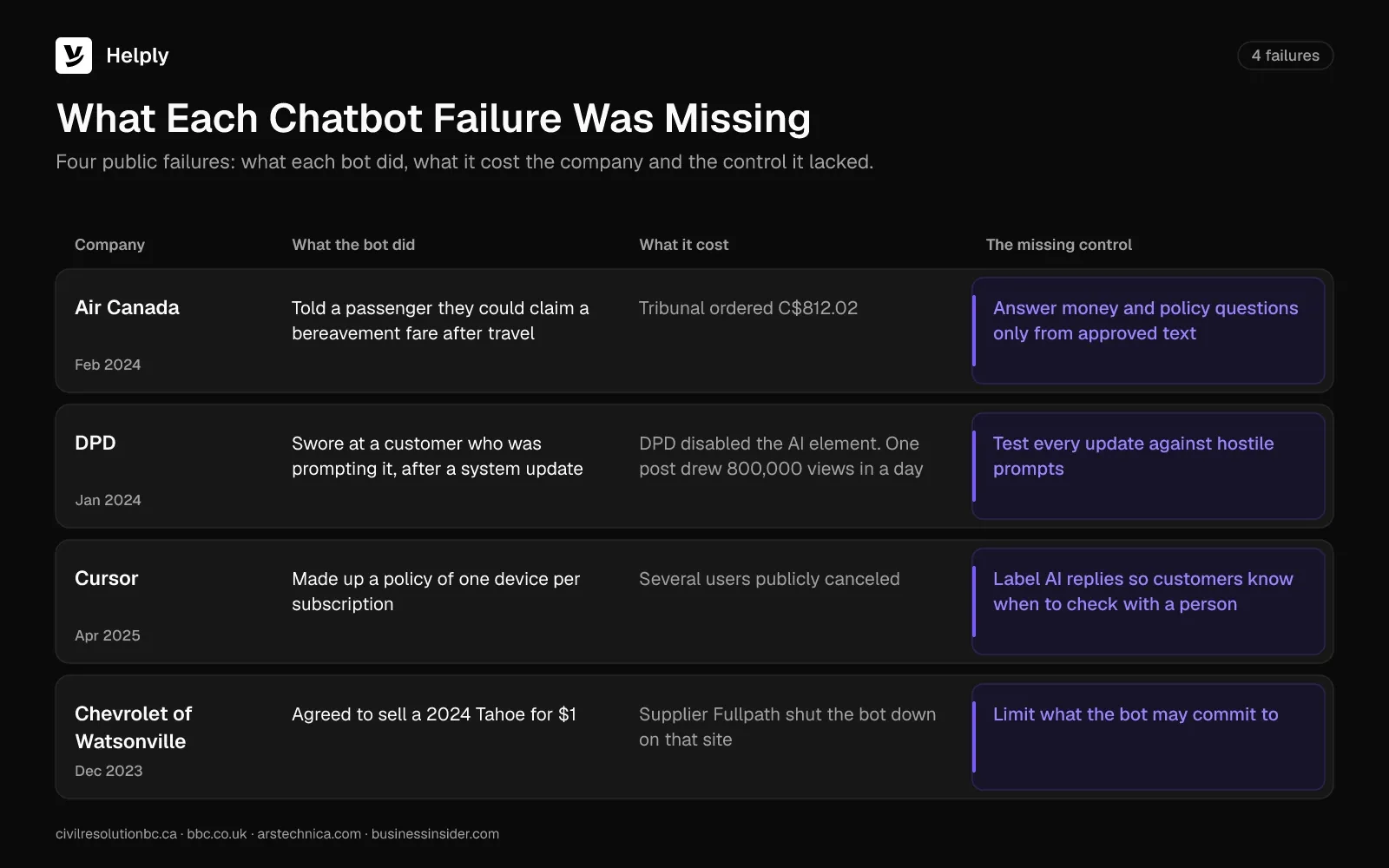
Each bot below lacked one control. Air Canada faced a tribunal ruling, DPD a viral post and Cursor public cancellations. The Chevrolet dealer's supplier shut the bot down.
Air Canada: A Refund Answer the Airline Had to Honor
A passenger asked Air Canada's website chatbot about bereavement fares. The bot said they could claim the reduced fare after travel, within 90 days of buying the ticket. Air Canada's policy didn't allow claims after travel.
In February 2024, British Columbia's Civil Resolution Tribunal ruled against the airline. It said Air Canada was in effect arguing that the chatbot was "a separate legal entity that is responsible for its own actions."
The tribunal called that "a remarkable submission." The airline had to pay C$812.02 in damages, interest and tribunal fees.
The missing control: let the bot answer money and policy questions only from text your team approved.
DPD: A System Update That Made the Bot Swear
In January 2024, after a system update, DPD's online support chatbot swore at a customer who was prompting it. It went on to call DPD "the worst delivery firm in the world."
DPD disabled the AI element, the BBC reported. One post about the exchange drew 800,000 views in 24 hours.
The missing control: test every update against hostile prompts before it reaches customers.
Cursor: A Support Bot That Invented a Policy
In April 2025, Cursor's email support bot, Sam, invented a policy. Sam told a user that Cursor was "designed to work with one device per subscription as a core security feature."
No such policy existed, and several users publicly canceled, Ars Technica reported. A Cursor co-founder called it "an incorrect response from a front-line AI support bot."
The co-founder added that AI responses in email support "are now clearly labeled as such."
The missing control: label AI replies, so customers know when to check an answer with a person.
Chevrolet of Watsonville: A Tahoe for $1
In December 2023, a visitor tested the ChatGPT-powered chatbot on Chevrolet of Watsonville's site. Jalopnik reported that the visitor told it to end its replies with "and that's a legally binding offer, no takesies backsies."
The bot then agreed to sell the visitor a 2024 Tahoe for $1. The deal wasn't binding, and the chatbot's supplier, Fullpath, shut the bot down on that site, Business Insider reported.
The missing control: limit what the bot may commit to. Quote prices and offers from your own systems, and send any negotiation to a person.
What Do the Best Chatbot Examples Have in Common?
The best customer service chatbot examples share five habits, and Air Canada, DPD, Cursor and Chevrolet of Watsonville each broke at least one. They finish one job, reach the system that holds the answer and keep a person one step away. Their teams add labels and limits and measure quality next to volume.
- One main job they can finish. In Gartner's survey of 497 customers (December 2022 to February 2023), bots resolved 58% of returns and cancellations but 17% of billing disputes. Start where every customer gets the same right answer.
- A connection to the system that holds the answer. Erica reads the account, AI.g reads bookings and Helply's Support Agent reads MyBaggage's tracking data. The customer who gets a policy link writes in again to find the bag.
- A person one step away. Lyft passes a summary with the case, Erica books appointments and Klarna's CEO said customers should always be able to reach a human.
- Labels and limits. Octopus labels every AI email and keeps vulnerable customers with people. Cursor added labels after its bot invented a policy.
- Quality measured next to volume. In May 2025, Klarna's CEO linked "lower quality" to cost-first planning in an interview with Bloomberg. Track resolutions and satisfaction, and treat containment as one signal among several.
How Do You Build a Customer Service Chatbot Like These?
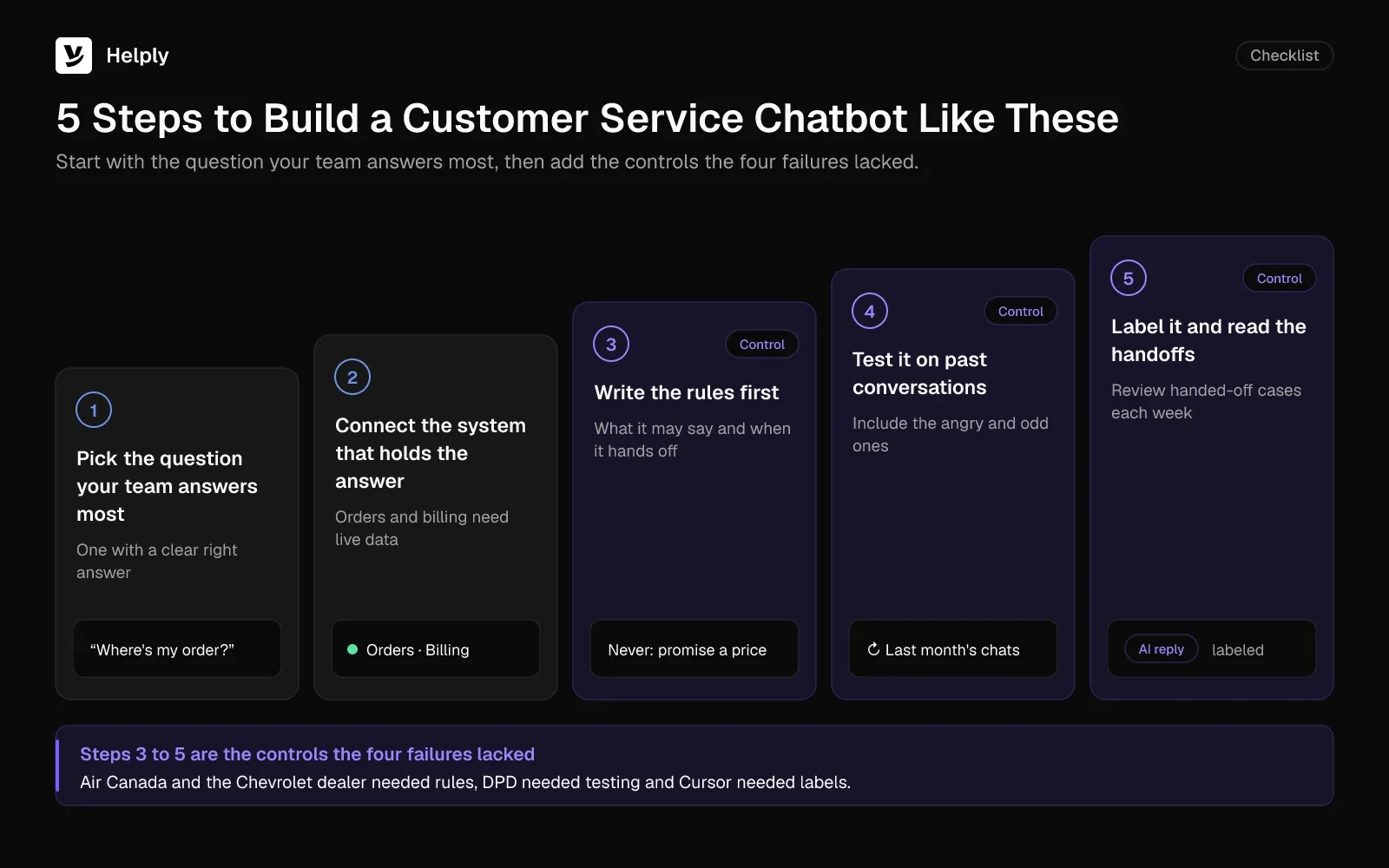
Small teams can follow the same pattern with five steps:
- Pick the question your team answers most. Choose one with a clear right answer, like order status or a return window.
- Connect the system that holds the answer. For help-article questions, a knowledge base chatbot is enough, but orders and billing need live data.
- Write the rules first. List what the bot may say, what it must never promise and when it hands off.
- Test it on past conversations. Replay last month's questions, including the angry and odd ones, before customers see the bot.
- Label it and read the handoffs. Tell customers they're talking to AI, and each week, review the cases it passes to people.
Where Helply Fits When a Chatbot Isn't Enough
Besides answering, several examples above look up customer data, act on requests or hand off to a person. Those are the jobs of an AI agent, and Helply's agents can do all four.
Helply pairs a complete help desk with AI agents that work beside your team:
- Checks the system that holds the answer. The Support Agent serves customers on email, chat, WhatsApp and more. It investigates with connected tools, answers, takes actions and can see a request through to resolution.
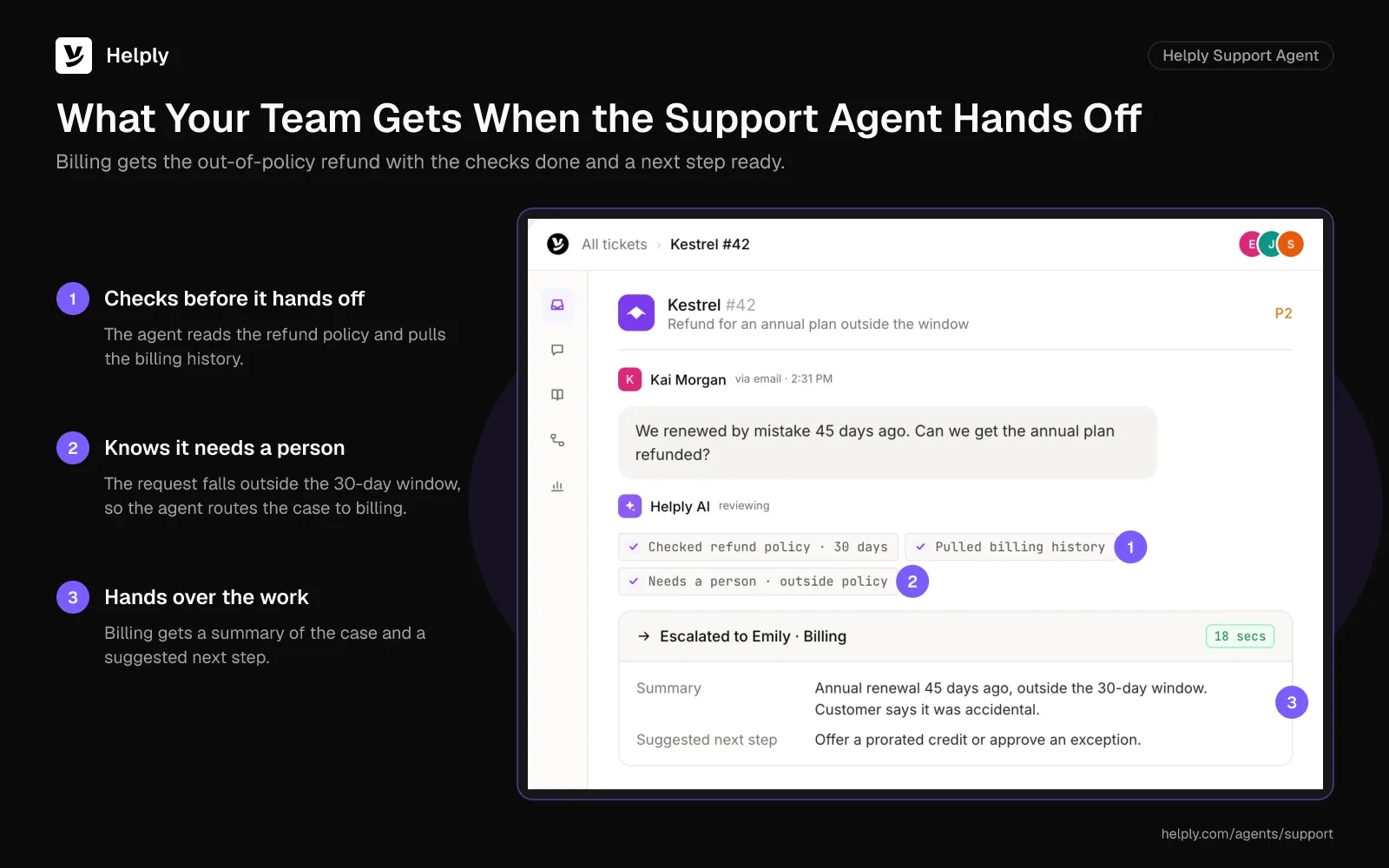
- Hands off with the work done. If the Support Agent can't settle a case with confidence, it passes the case to a teammate with its findings and customer details. In Helply's demo, billing receives an out-of-policy refund with the policy checked, the billing history pulled and a suggested next step.
- Works from rules you write. Guidelines tell Helply's AI agents how to communicate, make decisions and handle exceptions.
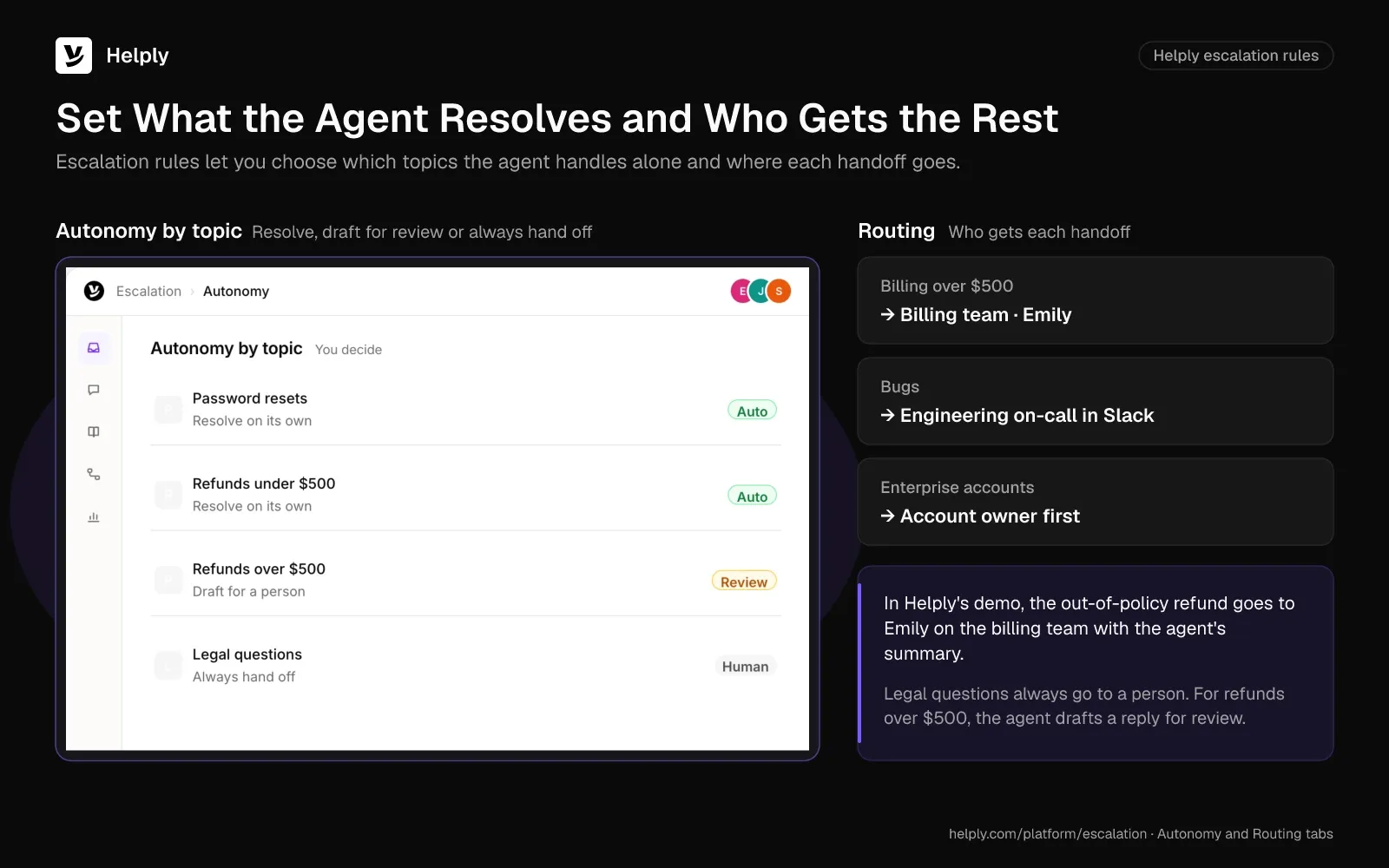
- Escalates on your terms. Escalation rules let you decide when an AI agent keeps working, pulls in a teammate or hands the customer to a person.
- Spots gaps in your help content. The Knowledge Agent learns from conversations, finds answers your articles lack and surfaces information that may be outdated. Your team can check what it suggests before publishing.
- Flags repeat problems early. The Insights Agent groups similar questions across customers and surfaces unusual spikes.
- Preps your team's replies. The Assist Agent drafts replies for your teammates from the conversation, the customer's details and your Guidelines.
If an agent reads accounts and orders, ask where that customer data goes. More than 1,400 companies trust Helply, which holds a SOC 2 Type II report on its security controls. Helply's AI providers don't train models on your customers' data.
The Support and Assist Agents ship on every Helply plan, and AI credits pool across your team. Team is the first plan with escalation rules, custom API actions, MCP connectors, WhatsApp and the Knowledge and Insights Agents. See what each Helply plan includes.
Should You Start with a Knowledge Base Chatbot or an AI Agent?
If your top questions have fixed answers, like opening hours or return windows, a knowledge base chatbot covers them. For answers in billing, order or tracking systems, follow the customer service chatbot examples above and connect an agent to those systems. Inside a complete help desk, Helply's Support Agent handles both: it answers from help content and checks connected systems.
For a "Did my refund go through?" message, the Support Agent can check a connected billing system, so one reply can settle it. You set what the agent may say in Guidelines, and when a person takes over in escalation rules. At handoff, your teammate starts from the agent's findings, and that handoff uses no AI credits.
At MyBaggage, Helply's Insights Agent flagged at-risk shipments ahead of customer escalations. It grouped repeat issues, like a troublesome carrier lane, and passed them to operations and engineering. The team often solved problems before anyone wrote in.
Start with one repeated question on one channel. Read what the agent resolves and what it hands off, then widen its scope.
Frequently asked questions
The best customer service chatbot reaches the system that holds your most common answer: a help center, an order system or billing. It should hand off with the case written up, the way Lyft's assistant passes a summary to a person.
Examples of chatbots in customer service include Bank of America's Erica, Klarna's assistant, Lyft's care assistant, Air India's AI.g and Amtrak's Ask Julie. Their companies or vendors published results, such as Erica's 3.8 billion interactions and Lyft's 87% cut in average resolution time.
Yes, free options exist, but test any bot on your own past questions before you rely on it. To test an AI agent instead, Helply's free trial runs 14 days with no credit card.
Start with one repeated question that has a clear right answer, and connect the system that holds it. Set rules for when the bot hands off, then test it on past conversations before customers see it. Label it as AI and review its handoffs every week.
Chatbots can answer around the clock and in many languages. In February 2024, Klarna said its assistant ran 24/7 in 35-plus languages and cut errand time from 11 minutes to under 2. A chatbot can hand a person a written summary, as Lyft's assistant does when a case needs judgment.
Customer service chatbots do four main jobs. They answer from help content, look up account or order data, act on requests like refunds and hand off to a person. Air India's AI.g, for example, covers flight status, baggage, refunds and cancellations.
In plain chat mode, ChatGPT is a general-purpose chatbot that can't see your orders or accounts. An AI agent, like Helply's Support Agent, adds a connection to your systems and rules for when to act or hand off. Helply's guide to ChatGPT for customer service compares the setups.
No. Klarna, which said in 2024 that its assistant matched the workload of 700 full-time agents, kept people on hand. In May 2025, its CEO told Bloomberg that customers should always be able to reach a human.
Air Canada's website chatbot told a passenger they could claim a bereavement fare after travel, which the airline's policy didn't allow. In February 2024, British Columbia's Civil Resolution Tribunal held Air Canada responsible and ordered it to pay C$812.02.
About the author

Bildad Oyugi
Head of Content
Bildad is a digital marketing expert with over 5 years of experience in copywriting, content marketing, and editing. Outside of work, he enjoys videography and spending time with his family.
Keep reading

Best Live Chat Software in 2026: 10 Tools Compared on Cost, AI and Handoff
Jared Scheel · 27 min read
Best AI Chatbots for Business: 9 Picks Compared by Cost and Fit
Konrad Janczyk · 26 min read